August 29, 2023

Top stories

■ Media companies like NYT and Hearst are pushing employees to return to office more regularly (Digiday) / NYT unions file cease-and-desist letters to management over return-to-office policies (Axios) / ICYMI: ‘In an internal note, the New York Times says most staff must come in 3 days a week. While managers won’t check attendance, “newsroom leaders will periodically also look at badge swipe data to review attendance trends” and “may flag individuals with particularly low attendance.” ’ (Max Tani) 


■ The Washington Post lays off staff from tech arm (Semafor) / The Texas Tribune’s first-ever layoffs worry the news industry (Nieman Journalism Lab)


■ COVID update at journalism conference: ‘#ONA23, COVID edition. Started feeling symptomatic Saturday and tested for three days before coming up positive for the first time since the pandemic began. … I hope journo conferences will improve their care standards going forward.’ (Simon Galperin) / ‘I'm nervously watching friends fall like flies with COVID acquired at #ONA23. So far, I'm still negative. … ’ (Jeff Jarvis) / ‘I'm another #ona23 COVID casualty … I know this is not easy, but I wonder what's stopping us from requiring daily testing, universal masking when logistically possible, and more indoor air cleaning.’ (Julie Westfall) / ‘… I do appreciate the journos who are sharing they got COVID publicly. It's a sign that you need to test if you were in session with them.’ (Julia Métraux)


■ Disney, The New York Times and CNN are among a dozen major media companies blocking access to ChatGPT as they wage a cold war on A.I. (CNN) / Columbus Dispatch pauses use of an AI sports writing tool after facing criticism on social media (Axios) 


■ AI images are getting harder to spot. Google thinks it has a solution. (Washington Post) / Google debuts a new way to watermark AI-generated images (Axios)  


■ Jamila Robinson, an Inquirer assistant managing editor, will become Bon Appétit's new editor-in-chief (Philadelphia Inquirer)


■ BuzzFeed News’ zombie-like homepage revival rankles ex-staffers (Daily Beast) 


■ Pentagon protested Fox News report about fallen Marine that was based on false claims by a U.S. congressman. Fox issued apology to family and removed the story but didn’t publish a correction or explain its removal. (Washington Post)


■ Meta faces backlash over Canada news block as wildfires rage (Agence France-Presse via VOA) 


■ TV news crew robbed in Chicago's Wicker Park while reporting on spike in armed robberies (Block Club Chicago) 


■ The Daily Wire to debut new docuseries on X (Axios) / Elon Musk, X face 2,200 arbitration cases over changes since Twitter takeover (Axios) / X/Twitter will accept political ads again, reversing pre-Musk ban (Variety) 


■ Media #MeToo men mount pathetic comebacks (Daily Beast) 


■ MSNBC is having its Super Bowl with Donald Trump’s indictments (Vanity Fair)


■ Columbia Journalism School Dean Jelani Cobb on J-school sticker shock, education wars, and the Trump coverage conundrum (Vanity Fair) 


Press freedom


■ Censorship has never been worse at Guantánamo Bay (The Intercept) 


■ Exiled Russian journalist describes 'poisoning' ordeal on German train (Reuters) 


■ Gabon authorities suspend 3 French broadcasters, block internet during elections (Committee to Protect Journalists) 


■ Taliban leader considers new Afghan media law (VOA)

CRAFT
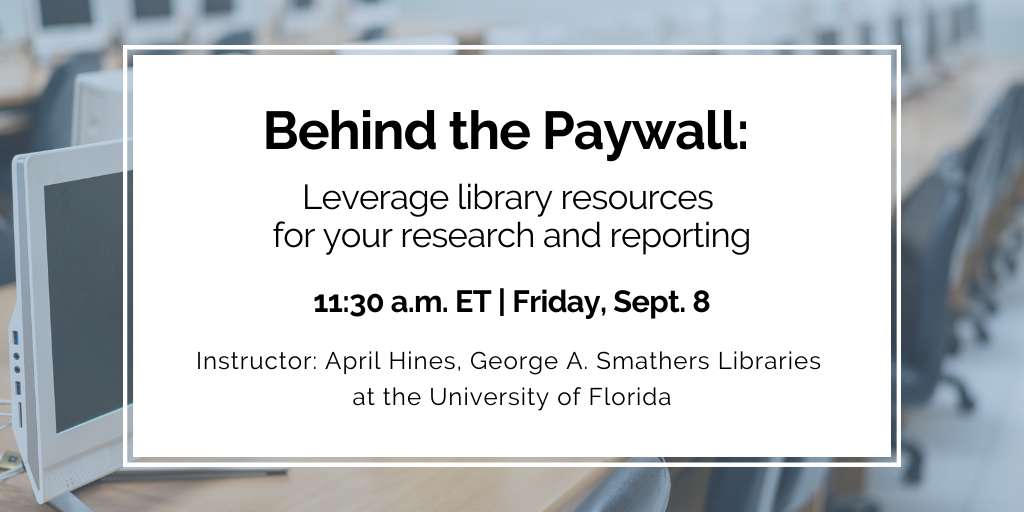
Behind the Paywall: Leverage library resources for your research and reporting. Virtual program with April Hines, librarian for the George A. Smathers Libraries at the University of Florida. Join us Sept. 8 at 11:30 a.m. ET.

Learn how journalists can tap public and academic libraries to find and use government documents, academic research, archives, and other resources that are free via libraries, but not easily accessible on the open web. Whether it’s uncovering a new information source or helping to fact-check your work, librarians and libraries are a goldmine for accessing information – and much faster than you may think. 


Join us to learn from April Hines, journalism and mass communications librarian for the George A. Smathers Libraries at the University of Florida. Her research areas include information literacy instruction for journalists, library marketing and outreach, and social media engagement. 


Registration is open for this free virtual program, which will take place on Friday, Sept. 8, at 11:30 a.m. ET over Zoom.

REGISTER NOW

Participants will learn: 


  • The types of information resources available in public libraries
  • How to tap into the expertise of subject matter experts in academic libraries
  • How to request help from librarians, especially when you’re on a deadline 
  • The wealth of story ideas that can originate from library resources

AP style tip: Generative AI


"Humans can interact with generative AI models in a seemingly natural way but the models aren’t reliably capable of distinguishing between facts and falsehoods or fantasy. Generative AI systems are often powered by large language models. They sometimes generate inaccurate or fabricated responses to queries, an effect AI scientists call hallucination. If using the term hallucination, describe it as an issue associated with the technology that produces falsehoods or inaccurate or illogical information. Some in the field prefer the term confabulation or simpler terms to describe the inaccuracies that don’t draw comparisons with human mental illness."


-- AP Stylebook, artificial intelligence chapter

CAREER


To improve productivity, try rearranging your meeting schedule


“What impacts knowledge workers’ energy is not the sheer amount of time they spend in meetings, but the relative proportion of meeting time compared to what they spend on individual tasks. We found that, on a given day, the more time knowledge workers dedicate to meetings relative to their own individual tasks, the less they engage in small break activities (e.g., a short walk, casual conversations, brief fun reading) to restore their energy during that day. The absence of such break activities, which are crucial for periodic replenishment, harms their workday energy. The impaired energy in turn has a negative impact on the knowledge workers’ task performance, creativity, and job satisfaction at work.”


-- Harvard Business Review, “Arrange your meeting schedule to boost your energy”


COMMUNITY

National Press Club news

Resources

This newsletter is written & edited by the National Press Club Journalism Institute staff: Beth Francesco and Holly Butcher Grant. Send us your questions and suggestions for topics to cover.


Get this from a friend? Subscribe, and view the archives.

Facebook  Twitter  Linkedin  Youtube  

The National Press Club Journalism Institute promotes an engaged global citizenry through an independent and free press, and equips journalists with skills and standards to inform the public in ways that inspire a more representative democracy. As the non-profit affiliate of the National Press Club, the Institute powers journalism in the public interest.