Sixty percent of Americans say they have little to no trust in the media to report the news fully, accurately, and fairly, according to Gallup.
Republicans are far less trusting of news than Democrats, and marginalized communities have long mistrusted the media because they didn’t see their experiences represented on the front page or on the evening news.
So what can we do to rebuild trust, especially among communities who never felt that journalism covered them accurately?
New research from the Media Insight Project demonstrates a different way to look at this challenge, and offers new solutions for journalists.
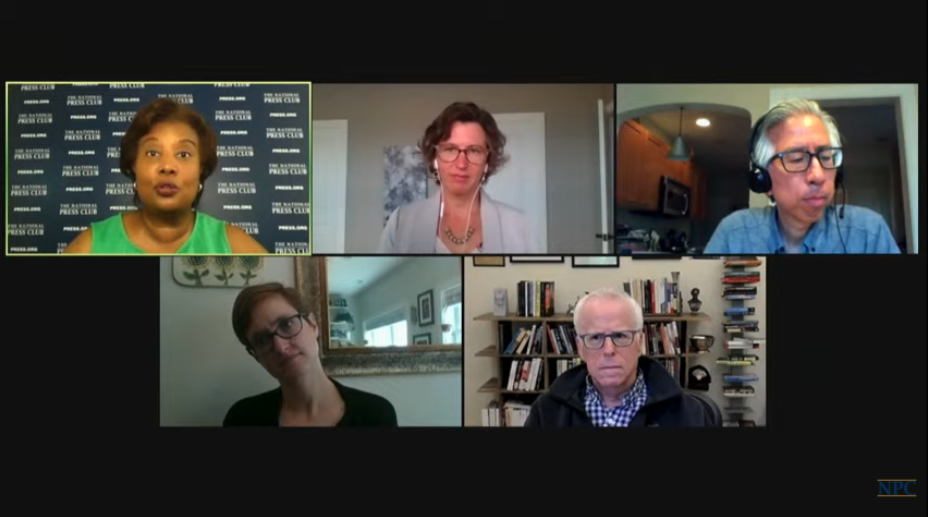
Representatives from the project — a collaboration among the American Press Institute, the Associated Press, and NORC — joined a National Press Club and Journalism Institute event to discuss their research and lessons learned:
-
Jennifer Benz, vice president, NORC at the University of Chicago
-
Tom Huang, assistant managing editor for journalism initiatives, The Dallas Morning News
-
Tom Rosenstiel, executive director, American Press Institute
-
Emily Swanson, director of public opinion research, The Associated Press
Lisa Matthews, assignment manager of U.S. video for the Associated Press and the 114th president of the National Press Club, moderated the program.
Understanding (and measuring) journalism core values
Many journalists assume that the public supports and understands the journalistic mission.
“Journalists are a different breed,” Huang said. “We really hold the watchdog role and accountability as our top value.”
But the public is not on the same page, as the Media Insight Project discovered.
“We tried to figure out how many people support what journalists see as their fundamental mission,” Rosenstiel said. “Maybe the suspicion over journalism values — over what it is we think we should be doing as journalists — is a key component of the trust problem.”
With help from a panel of academics and journalists, the Media Insight Project measured support for these five journalism values:
-
Oversight: A journalist’s job is to act as a watchdog
-
Transparency: Society is better if things are out in the open
-
Factualism: The more facts people have, the closer they will get to the truth
-
Giving voice to the less powerful: Amplify the voices of people who aren’t ordinarily heard
-
Social criticism: Spotlighting problems helps society solve them
While journalists may consider these five journalism values universal, non-journalists do not.
“Only 11% of the public supported all five of these core journalism values without any reservation,” Benz said.
Moral values appeared to be a more important driver than politics were.
“It's not a tale of complete support or opposition to each value based on somebody's political identification or ideology, there's a lot more nuance with moral values and they go beyond what we can learn from some simple measures of partisanship,” Benz continued.
“One of the key findings of this study is just how strongly people's moral values are connected to their support of the journalism values, and this connection between people's moral values and views of journalism principles exists even when we control for a person's age, their race and ethnicity, education, gender, and political affiliation or ideology.”
Takeaways for journalists
“We believe that this work opens up a new window into understanding the trust crisis that threatens the future of journalism,” Rosenstiel said. “Journalism exists to create a common set of facts and a public square. And if half of America is not in that square, that's a threat to democracy.”
“Community engagement is another huge component of this,” Huang said. “It's not just thinking of stories as, we do it, and we're done. Create a conversation around it. Hold virtual and in person events when it's safe to do that around some of these topics. Hold listening sessions in diverse communities.”
“Many people — not just conservatives — do not see themselves in the news,” Rosenstiel said. “And that's because, in many ways, the press is a tribe: We work together. We are friends together. We think alike. We reinforce each other's values. … You cannot begin to understand and think and empathize with the community that you serve, unless you've got people who are from diverse communities.”
“I think that is also really important for us to be aware that no matter what stories we're telling, we are keying on values,” Swanson said. “There's no world in which journalism is, you know, just purely a list of facts that isn't trying to key on values. So, knowing what values the full community holds is really important and really important to understanding the audiences that we speak to.”
Other suggestions for journalists to try now:
-
Consider the different “stakeholders” in a story and expand the kinds of experts to talk to
- Pre-edit a story before the reporting to determine who is affected and what questions need to be asked
- Implement reader advisory panels, or people who are not journalists in your newsroom to give feedback about stories