Editor's note: The Latest will return to your inbox Monday, July 20.


July 9, 2026

Top stories

■ Reporting the Graham Platner allegations (Columbia Journalism Review) / Reporter who broke the story on new Graham Platner sexual assault accusation speaks out (MS NOW) / ‘Drop Site News is now apologizing for their tweets about Ryan Grim's Breaking Points segment about the Graham Platner rape story…’ (Justin Baragona)


■ ‘Three months after gunfire upended Washington's biggest media event, the White House Correspondents’ Association is bringing it back in a dramatically different form.’ (Status)


■ The Washington Post joins Trump’s growing list of media lawsuit losses (Poynter)


■ Appeals court tosses challenge to FCC's approval of Nexstar-TEGNA deal (The Desk) / Nexstar decries $6.2B Tegna merger injunction, calls out DirecTV, state AGs (Deadline) 


■ State AGs finalizing antitrust lawsuit over Paramount–Warner Bros. Discovery merger (CNN) / The $80 billion debt cloud hanging over David Ellison’s Warner Deal (Wall Street Journal) / CNN CEO Mark Thompson thinks ‘messing’ with network would be a mistake (TheWrap)


■ CNN airs ‘disturbing video’ of Houston man after he’s fatally shot by ICE: ‘I want to warn our viewers’ (Mediaite)


■ Bari Weiss sidelines veteran CBS News correspondent on '60 Minutes' Nigel Farage story: report (New York Post)


■ The New York Times expands local coverage with Twin Cities newsletter launch (TheWrap)


■ New York Times-led group asks court to sanction OpenAI in US copyright dispute (Reuters) / ‘New York Times and its co-plaintiffs are accusing OpenAI of lying in their big copyright lawsuit, over whether OpenAI was able to search their systems for NYT copyrighted material, even though they had actually already done so. They say this came out in a deposition of an OpenAI engineer.’ (Hadas Gold)


■ ‘Marie Claire actually left a prompt from an AI in one of their recent articles…’ (Emma Grae)


■ Kristen Spalding named WERU GM (Current) / Inyoung Kang and Emily McGarvey join breaking news hub at The New York Times (New York Times) / The New York Times announces new hires in Newsroom Operations (New York Times) / Washington Post's Lerman to cover consumer economics (Talking Biz News) / Politico hires Bloomberg Law's Ruoff (Talking Biz News) / John Lasker, a top ESPN streaming executive, to exit in September (Variety) 


■ Once unimaginable, publishers are preparing to opt out of Google search (Adweek)


■ Still in a Dream: A fun and messy account of music journalism in the ’80s and ’90s (Financial Times)

Pamela Tobey Award for Excellence in Visual Storytelling 1000 dollar prize Apply now

Applications are open for the 2026 Pamela Tobey Award for Excellence in Visual Storytelling, a $1,000 prize and national recognition from the National Press Club Journalism Institute. This annual design award recognizes visual journalism that pushes the boundaries of storytelling beyond text and rewards creative uses of data visualization, interactivity, photography, videography, audio, illustration, and emerging tools. 

CAREER

What we can learn from the 2026 Local Journalist Index


By Jennifer Nehrer, NPCJI Intern


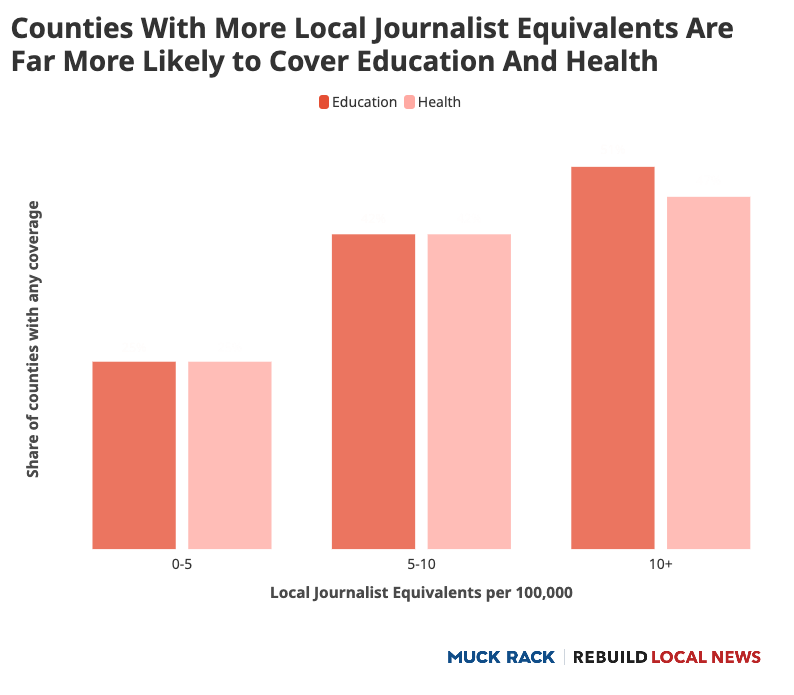
An updated report on the state of local journalism in the U.S. has reached an alarming conclusion: Counties with fewer local journalists have far lower rates of stories covering health, education and other civic matters. 


The Local Journalist Index, now in its second year, is a collaboration between Rebuild Local News and Muck Rack that tracks the ratio of Local Journalist Equivalents (or LJEs) per 100,000 residents in U.S. counties to gauge the health of the local reporting ecosystem. Researchers defined LJEs by filtering journalists in the Muck Rack database by factors such as where their content was primarily published.


This year, the two organizations added to the report by updating how the LJEs are calculated as well as finding new data on what the lack of local reporters can mean for a county. 


The Findings


Broadly, the researchers found that there are approximately 7.8 LJEs per 100,000 residents in the U.S. — which is a decrease of 81% from 2002. It is also a decrease of 0.4 from last year’s ratio, though due to the changes in methodology, this is not a statistic the authors say they focused on. 


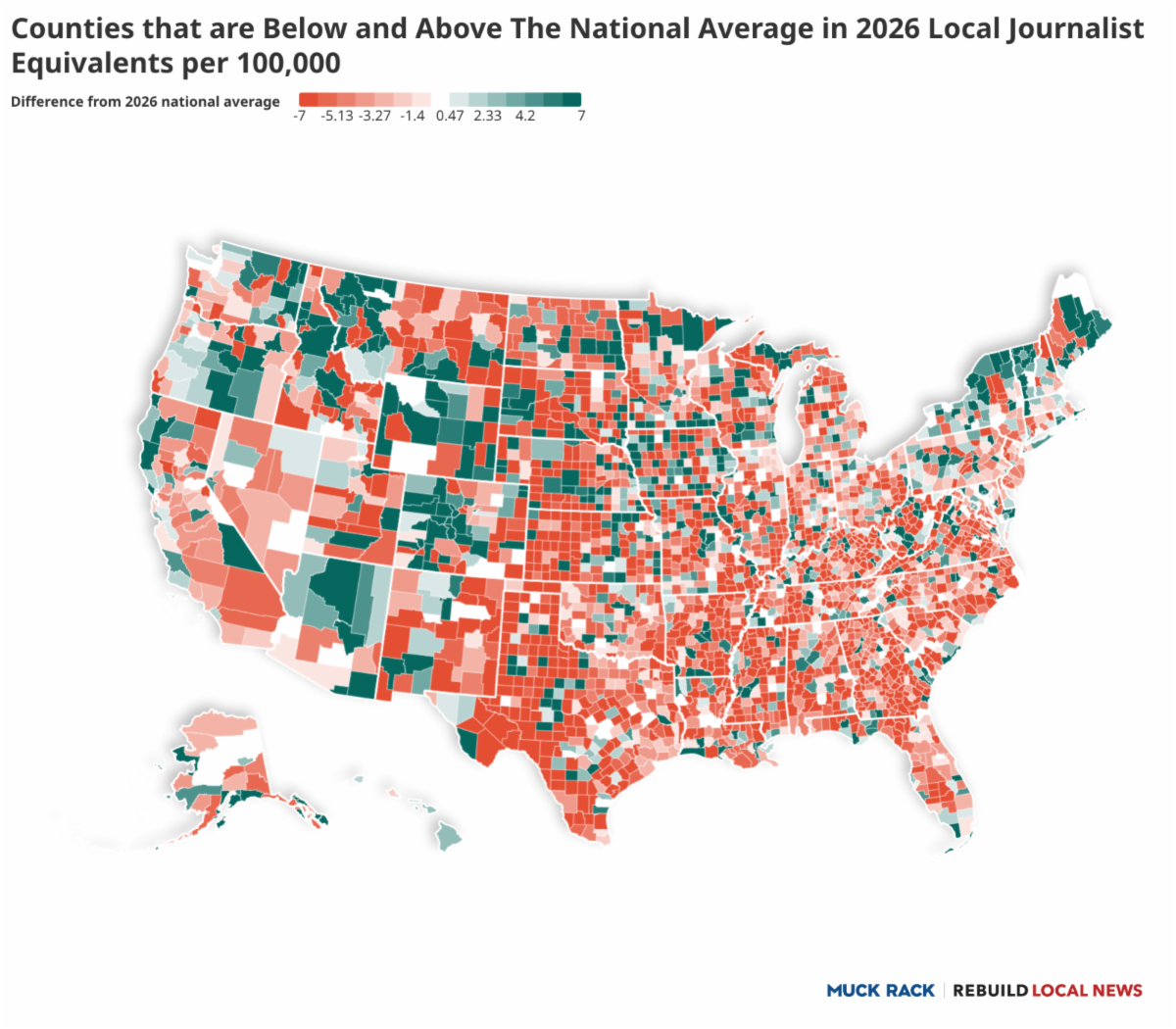
Seventy percent of U.S. counties featured in the study are below the national average in terms of LJEs per 100,000 residents. Eighteen counties have less than one LJE per 100,000 residents, and only 33 have more than the 2002 national average of 40. 

The report also included a list of the 10 best and worst performing states in the nation when it came to LJE ratios. Among the best were states such as Vermont, the Dakotas, and New York, while California, Florida, and Texas made the 10 worst.


In speaking with the researchers, they said this is more evidence to the fact that economic health is not the only factor in whether a state has robust amounts of LJEs. It is, however, indicative of which states are choosing to prioritize local journalism.


“That should all give us pause to think about what we need to do — beyond what we’re already doing — in order to ameliorate that effect,” said Matt Baker, one of the Index’s co-authors and the Director of Research at Rebuild Local News. “Because as we show this year, the decline is — if not continuing — stable; but the effects are real and they’re being experienced every year, regardless of if we don’t do anything.”


In addition to the ratio of local journalists themselves, this year, Muck Rack and RLN also expanded their research beyond counting journalists and began counting their coverage — or lack thereof — of civic topics in their localities. What the researchers found was a concerning set of disparities between counties with large and small ratios of LJEs when it came to articles about education, health, labor, and more. 


The research done for the 2026 index is based on 4.2 million articles published across every county in the U.S. between January and March of 2026. The researchers then filtered by articles that mention the name of a locality and then analyzed those remaining articles for topics. 


Of the 3,144 counties studied, the researchers found that roughly 2,500 had no articles mentioning the name of a town or city within them that covered one or more of the following topics: health, education, the environment, or transportation.


In counties with fewer than five LJEs per 100,000 residents, 90% had zero stories about local education. Instead, many of these counties had much higher concentrations of crime stories. 

“It’s staggering that there is this dearth of coverage on topics that people care about,” Baker said, “whether you’re working a couple of jobs in some place and trying to pay for health insurance, or whether you have kids in school and you are interested in tracking what’s going on with the local county board of education.” 


The Banner


The report, thankfully, was not all bad news. The authors highlighted multiple areas where local journalism was doing well, including a nod to The Baltimore Banner, a young newsroom in Maryland that has already had a profound impact. 


A recent Pew Research study found that under a quarter of U.S. adult respondents had ever spoken with or been interviewed by a local journalist. Though this number has risen since the survey was last done in 2024, it is down by 3% overall since 2016. 


This is where Audrey Cooper, editor-in-chief of The Banner, attributes some of the newspaper’s massive success since its founding in 2022. Cooper, who was hired in late 2025 to replace the Banner’s founding editor, said the staff hosts regular listening sessions at libraries to allow regional residents to give their input on local coverage. 


“It’s really encouraging,” Cooper said. “[Readers] are so happy that somebody’s asking them what they think and what they want.”


The Banner was listed as a bright spot in the 2026 Index because of its recent successful expansions into Montgomery and Prince Georges Counties as well as its thorough coverage of the civic topics often left behind in low-LJE areas. The report also cited its 2025 Pulitzer-winning coverage of the opioid crisis in Baltimore and 2026 Pulitzer finalist coverage of regional transit woes. 


The Montgomery and Prince Georges Counties’ expansions, Cooper said, have already proven very lucrative for the success of The Banner and civic information in Maryland. On June 23, The Banner’s website saw the most traffic it had ever gotten as readers searched for primary election guides and results in Montgomery County. During their first week covering Prince George’s County, The Banner released two investigations that led to two public officials losing or being put on leave from their jobs. 


“I think Montgomery County and Prince George’s County have been starved for high-quality local news,” Cooper said. “[The investigations] show what happens when you have a news desert and nobody is covering it.” 


The Takeaways


Baker and his co-author, Matt Albasi, said that methods to help local news thrive will differ state by state when it comes to policy and economic aid, but that individual readers also have an important part to play. Albasi, a senior data journalist at Muck Rack, said it is important for individuals to invest in local news themselves by reading, subscribing, and sometimes even building an outlet of their own — something he once did himself. 


“The same business model that works in Philadelphia might not work in Boise,” Albasi said. “But so much of the dead spots that we see in here can be buttressed, can be held up, can be built out just by one or two people deciding, ‘Hey, I’m not going to wait for the philanthropic dollars to come in. I’m not going to wait for the state sponsorship to come in. I’m going to start now and do what I can and build it over time.’”


Cooper said that similarly, she believes in the power of starting a newsroom for a community in need, though she also said that it must be done with care and intention. She noted that part of The Banner’s success in local reporting is due to its size: the newsroom has roughly 100 journalists.


“Politicians nowadays are hard to shame,” she said, “and I strongly think it’s because we are not building newsrooms at scale anymore, and the ones that are at scale are shrinking, shrinking, shrinking. So, unless we go out and we say we’re covering this for real and on purpose, it’s not going to work.”


The price tag on that staffing, Cooper acknowledges, is high. The Banner does require a subscription for most of its content, but with that requirement of money for news comes a responsibility for the journalists providing it to step up. Cooper said she doesn’t want to ask readers to pay for subpar coverage. 


“We wanted to make people there feel like they were getting their money’s worth,” she said. “We’re asking them to pay us for a subscription, so they deserve more than one or two stories a day. They deserve a real bureau.”


Cooper said she feels flattered and empowered by the attention that The Banner has gotten for its success in local coverage, and that she hopes other stakeholders are inspired to implement change for local news across the country on a large scale. 


“I don’t think local news is going to be saved by just little bitty things at a time,” she said. “It needs audacious, brave investment that is intensely community focused. And so what we’re trying to do is, yes, provide Maryland with the best local news it could possibly have, but also in doing so, show the world how to save local journalism. And I think when we do that, we save the American experiment too.”

CRAFT
 
 
Workshop: Creating vertical video to reach new audiences with creator-journalist Rahim Jessani. July 23, 2 p.m. ET. Get tickets.

Workshop: Creating vertical video to reach new audiences


Learn how to make short-form vertical videos that grab attention and grow your audience on social media.


In this hands-on workshop with creator-journalist Rahim Jessani (The Creator Translator), you'll learn how to script videos, master the basics of shooting content on your phone, and pick up exclusive tips and tricks for making concise, digestible videos for social media.


🗓️ Thursday, July 23 | ⏰ 2 - 5 p.m. ET | 📍National Press Club | 🎟️ On sale now


By the end of the session, you'll be ready to create your own short-form videos that engage and grow new audiences.

Space is limited to 40 seats, so be sure to register soon while tickets last. Email Institute@press.org with any questions.


COMMUNITY

Resources

This newsletter is written and edited by the National Press Club Journalism Institute staff. Send us your questions and suggestions for topics to cover.


Get this from a friend? Subscribe and view the archives.

Bluesky  Facebook  Linkedin  X  Youtube

DONATE TO THE INSTITUTE


The National Press Club Journalism Institute promotes First Amendment values by equipping journalists in Washington, D.C., and nationwide with the skills, knowledge, standards, resources and networks to empower and inform the public. As the non-profit affiliate of the National Press Club, the Institute powers journalism in the public interest. The Institute's tax ID number is 52-1750908.