Nov. 3, 2026

Top stories

■ How US news organizations will make midterm race calls (Reuters) / ‘The content creator election’: Digital streamers and TV networks face off for midterms coverage (The Guardian) / How broadcast, cable and late-night shows plan to cover the midterm elections (New York Times) 


■ We can’t predict what will happen on Election Day. But we’ll be here to cover it. (ProPublica) / How a reporter interviews people about the midterms, even those who ‘don’t talk politics’ (New York Times) / For Iowa journalist Laura Belin, covering politics is a constant battle (New York Times) / The real-life diet of John King, who hides mini protein bars behind the Magic Wall on election night (GQ) / Student journalists are getting a crash course in election coverage (Poynter) 


■ Mike Lawler campaign bans Bloomberg reporters from election night event (TheWrap)


■ Six in seven journalist murders go unpunished, UNESCO reports (UN News)


■ ‘With Fox News ratings plunging and Donald Trump’s political fortunes fading, the Murdochs are being confronted with a thorny predicament that could spell the beginning of the end for the network’s MAGA era.’ (Status) / Fox-Roku deal poised to clear Justice Department scrutiny under consent decree (Semafor)


■ What Kalshi gets from sponsoring news orgs (Puck) 


■ New York Times, Chicago Tribune sue tech company Brave over AI copyright claims (TheWrap) / Hollywood backs NYT in AI copyright battle versus OpenAI, Microsoft (Axios) 


■ Disney plans several thousand layoffs, asks some managers to cut costs by up to 20% (CNBC)


■ 12 Skydance org charts reveal the execs who gained power in streaming, tech, and more after the Paramount-WBD merger (Business Insider)


■ Union accuses new Post-Gazette owners of discriminating against striking workers in hiring (TribLIVE)


■ Trevor Brown named Houston Chronicle AI newsroom developer (Houston Chronicle) / Johnson named Americas editor at The Economist (Talking Biz News) / Palm Beach Post expands real estate coverage (Talking Biz News) / Express Desk adds reporter in Western Canada (New York Times) / Updates on Times Opinion’s guest essay team (New York Times) / ESPN hires The Athletic editorial director Sergio Gonzalez (Front Office Sports) 


■ How Barron’s decides what to cover, and why it won’t use AI (Talking Biz News) 


■ Americans’ trust in information from news organizations has risen in the past year (Pew Research Center) 


■ Press Forward gave $20 million to 205 local newsrooms over two years. Here’s how some of them spent it. (Nieman Journalism Lab)

 
CRAFT

'Whatever restrictions they put in place, we continue to report': Journalists speak to navigating access bans


By Le Nguyen, NPCJI Press Freedom Fellow


When journalists from Politico, CNN, and MS NOW were suddenly denied access to report from the White House on Sept. 18, 2026, journalists were faced with the question: how could they continue reporting on the country’s most powerful institution when they didn’t have access to the building itself?


Today, access denials aren’t just affecting national reporters — they’re impacting reporters at the local and state levels, too. A week after the White House ban, for instance, two Milwaukee Journal-Sentinel reporters were denied access to a gubernatorial campaign event in Wisconsin.


Reporters still have resources at their disposal that they can tap into to continue reporting, even as they push back against bans through legal measures, journalists told the National Press Club Journalism Institute. Here’s their advice:


Continue to report


Loss of access can lead to a severe roadblock affecting reporters’ ability to cover politicians and government officials in real time.


“We absolutely push for as much press access as we can get, but ultimately it’s up to the government to decide how much access they’re going to allow,” a Washington, D.C.-based correspondent who has covered the White House said on condition of anonymity because he is not allowed to comment on his work publicly. 


But he stressed that doesn’t mean the end of reporting: “Whatever their decision is, whatever restrictions they put in place, we continue to report.”

Michael Stowe, editor-in-chief of Asheville Watchdog, experienced this personally when the Treasury Department denied his newsroom access to cover the G20 finance ministerial summit in Asheville, North Carolina, in August 2026.


Not having access “doesn’t mean you can’t write stories,” he said. “We were ultimately deciding what stories we’re going to write and what stories we’re not going to write [given the access denial],” he added. For instance, Asheville Watchdog chose to pursue bigger-picture investigative stories, like how having the summit in the local community affected federal support for Hurricane Helene recovery.

“The location of the live shot for a television report does not really matter. The question is the content of the information,” the reporter said. “[Bob] Woodward and [Carl] Bernstein were never in the White House covering [President] Nixon, and they had the most explosive stories on the Nixon administration.”


Lean on sourcing


A loss of physical access to the people reporters cover isn’t negligible, said the Washington correspondent, but in response, journalists should turn to what they do best: sourcing.

“We can reach sources any time of day and night, anywhere they are,” the Washington correspondent explained, noting that news outlets banned from the White House have still been able to cover consequential stories about the Trump administration.


“Institutions are made up of people. You got to find the people who have the information and get them to give it to you,” he said. “Your telephone is the best resource you’ve got. Just keep making calls.”


He pointed out that press briefings are not the setting where original reporting often occurs. “You can get the administration’s statements on something, their comments, their reactions to world events, but you’re not going to do any exclusive reporting anyways,” he said.


“They [access bans] throw some sand in the gears of that process [of reporting], but they are not going to stop that process from happening,” he stressed.


Use the coverage out there


Not being present at the summit affected Asheville Watchdog’s reporting by preventing them from gathering information or hearing reactions to their concerns from officials, Stowe said.

“All we could do is to read the coverage that was coming out from other media. We had to find alternative sources, look for documents, go to livestreams,” he said.


Stowe pointed to a separate instance in which Asheville Watchdog covered a closed-door meeting of an out-of-town company that runs the local hospital system. News outlets weren’t invited and the outlet just “found out about the meeting after the fact,” he said.


“But they livestreamed the meeting, so we went back and watched the livestream. We called up the people who were there,” he said. “Even though we reported on it a week later, it was the first time our readers were hearing about it.”


Don’t be afraid to reach out to other media outlets. During the G20 finance summit, Stowe’s team contacted other reporters who were in the room to identify the number of media representatives permitted access as part of their reporting on the outlet’s own access denial.


That said, journalists shouldn’t rely on other outlets to report their own stories, Stowe noted. 


The Washington correspondent also cautioned against relying on other outlets to get the interviews they need or raise the questions reporters want asked. “It’s a very competitive industry, and I think everybody needs to do their best on their own,” he said.


Write about it


Writing the story about the access denial is important, Stowe stressed, as audiences often falsely believe that denials and bans affect only national, rather than local, media.


“When we got denied [from the G20] … we heard that other larger national organizations were denied, so suddenly we were like we just needed to get this out there and write about it,” he said.


“We’ve got a very positive response from the community,” he added. “Our readers believe in what we’re doing, so when they see us not getting access, it causes them to ask questions and show support.”


Stowe recommended that other outlets “start asking earlier” about press credentials so that they don’t get the news that their access was denied at the last minute. He also encouraged journalists to get the denial documented and come up with alternative reporting plans.


“The best practice is figuring out who gets access and whether the rules are applied consistently,” he added.


Newsrooms should also prepare a quick communication strategy and a plan for how to respond to an access denial, he pointed out. “Come up with a plan for how you’re going to react, how you might report it, what questions you need to ask,” he said.


Don’t compromise on values


Stowe said that his outlet “is holding up strong journalistic principles” despite the backlash it’s experienced from government agencies. 


He cited an in-depth piece that Asheville Watchdog had published ahead of the G20 summit, which outlined the upcoming meetings, discussed recovery efforts from Hurricane Helene in North Carolina, and raised hard questions about the level of federal funding and support the region was receiving. 


“I cannot draw a straight line [between the piece and the denial], but it seems as if the administration was picking media outlets that it thought were going to result in favorable coverage,” he said.


He stressed that affected outlets should continue to fight for all forms of access until it is granted. In one instance, Asheville Watchdog kept pursuing a lawsuit over a public record denial even long after the story was over and they didn’t need the records anymore.


“We think we’re going to get the records very soon, and we’ll write a story saying that the court granted us these records and that they were held back from us illegally,” Stowe said.


“We’re going to ask hard questions and hold people accountable. We’re not going to stop doing that. We’re not going to apologize for writing stories,” he said.

CAREER
 

Quick tip to break into newsroom leadership


“If you might want to get into management in the near future, consider volunteering for newsroom committees, such as serving as a leader on an inclusion or style committee, or joining a mentoring program. Check in with colleagues who seem eager for more support and guidance. They will often spread the gospel about your coaching to people who have the power to promote you. Show you’re a team player by contributing to major newsroom projects. Make sure your editor supports your involvement and gives you time to take on these additional responsibilities. Even if you ultimately decide against going into management, you will have strengthened your relationships with your colleagues and learned more about how your newsroom works.”


-- Cristina Silva, managing editor for operations and standards at The Boston Globe, excerpt from "Want to become a newsroom editor? Here's how to get your first management job." (Poynter)


COMMUNITY
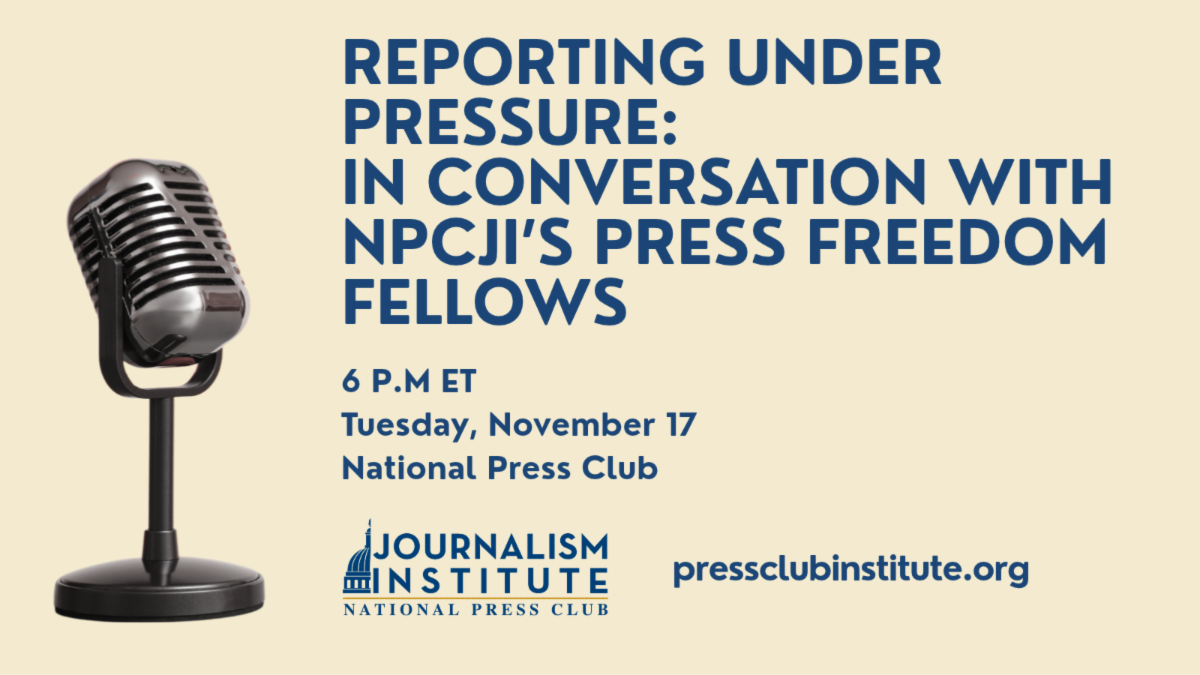
Reporting under pressure: In conversation with NPCJI's press freedom fellows. Nov. 17, 6 p.m., at the National Press Club.

Reporting Under Pressure: Conversation with NPCJI’s Press Freedom Fellows


From navigating access restrictions to knowing your rights while covering immigration, the Institute’s Press Freedom Fellows have spent the past six months reporting on today’s most urgent press freedom challenges. Now they’re sharing what they’ve learned, and they want to meet you.


Join us for a panel and reception with our five fellows, experienced journalists from around the world who have faced serious obstacles to their own reporting and persevered. Through their coverage and the reporting resources they’ve created at the Institute, they’re helping journalists understand their First Amendment rights and stay safe in the field.


🗓️ Tuesday, Nov. 17 | ⏱️ 6 p.m. ET | 📍National Press Club | 🎟️ Free


Their work comes at a pivotal moment. Journalists in the United States face growing threats to their safety and civil liberties, along with mounting legal and financial pressures that make holding power to account harder than ever. In this conversation, the fellows will share practical tools and techniques for navigating press freedom barriers, explain how to recognize the threats that matter most, and discuss how to protect your ability to report freely.

After the panel, stay for the reception to connect with the fellows one-on-one, ask questions, and meet fellow journalists and advocates who share your commitment. Whether you’re a reporter, editor, student, or supporter of a free press, you’ll leave with new skills, new connections, and a stronger network for defending press freedom together.

Resources


This newsletter is written and edited by the National Press Club Journalism Institute staff. Send us your questions and suggestions for topics to cover.


Get this from a friend? Subscribe and view the archives.

Bluesky  Instagram  Facebook  Linkedin  X  Youtube

DONATE TO THE INSTITUTE


The National Press Club Journalism Institute promotes First Amendment values by equipping journalists in Washington, D.C., and nationwide with the skills, knowledge, standards, resources and networks to empower and inform the public. As the non-profit affiliate of the National Press Club, the Institute powers journalism in the public interest. The Institute's tax ID number is 52-1750908.