July 13, 2022

Top stories

■ Reporter investigated again for impersonating a cop (The Paper.)  


■ Texas news outlets defend decision to publish shooting video from Uvalde (CNN) / 'Once we had the video in our possession, frankly we felt a journalistic responsibility... to bring that information to the public as quickly, but carefully, as we could' (Brian Stelter) / 'We have to bear witness to history': Why the Austin American-Statesman chose to publish video from inside Robb Elementary (Austin American-Statesman) / ‘Some parents and other family members of children killed in the Uvalde school massacre are taking to social media to express their outrage over the leaked surveillance video. Anger is aimed at both the law enforcement response depicted in the surveillance footage and at the Austin-American Statesman for publishing the video.’ (CNN) / 'Uvalde city meeting getting heated right now. Mayor calls reporters at the Statesman & KVUE “chicken” and “unprofessional” for releasing new video footage before the families were able to see it first. A resident shot back, asking him if he thinks the cops are chickens.' (Antonia Hylton) / 'Whatever one thinks about the leak, it’s important to keep in mind how little state, county and city officials have disclosed — despite numerous requests by Texas news organizations.' (Sewell Chan) / ‘The View': Whoopi Goldberg spits – literally – on ‘appalling’ Austin newspaper that leaked Uvalde shooting videos (The Wrap) 


■ ‘Show the bodies’: Mass shootings spark media debate on gory photos (Washington Post) 


■ A Detroit news outlet got hit with a ‘frivolous’ lawsuit and won. Now it’s on the hook for $10,000. (Poynter)


■ 'Recent headlines have focused on the strategic maneuvering of the biggest chains – Gannett, Lee Enterprises and Alden Global Capital, which own most of the newspapers in the country’s largest markets. At the same time, however, privately owned regional chains have snapped up dozens of newspapers shed by the mega-chains, as well as smaller family-owned operations.' (Medill Local News Initiative) / North Carolina's local news scene is changing (Axios) 


■ U.S. journalists differ from the public in their views of ‘bothsidesism’ in journalism (Pew Research Center) 


■ 'Inbox: New York Times tells employees the "expected return" to the office will start on Sept 12' (Katie Robertson)


■ 'PBS NewsHour's staff have unionized ... WETA management tells me they plan to voluntarily recognize the union' (Andrew Beaujon) 


■ NBC reporter's new book revisits past interviews she couldn't shake (New Jersey Monthly) 


■ A Tribune reporter's great-grandfather was poisoned in Chicago in 1935. She set out to learn if it was an accident — or murder. (Chicago Tribune)


■ Photojournalist Donna Ferrato's camera is a weapon for women (New York Times) / What I learned from 20 years photographing lightning in D.C. (Washington Post)


Press freedom 


■ ‘I was shackled and blindfolded but never beaten or tortured — things that could not also be said for the scores of local journalists and demonstrators dropped off in the prison after me, some with fresh scars, others stumbling about catatonically.’ (Nieman Reports) 


■ The 'shadow of two slain journalists' haunts Biden’s Middle East trip (Washington Post) 


■ US invites slain Al Jazeera journalist's family to Washington (Agence France-Presse via Arab News)

Political protests and civil unrest are expected across America this summer and fall. The combination of the Supreme Court’s decision to overturn Roe vs. Wade, ongoing right-wing conspiracies about the validity of U.S. elections, and the prospect of domestic terrorist attacks have produced a climate that forebodes tense confrontations between protesters, counter-protesters, and the police.


Journalists are already in the mix covering these clashes, sometimes being mistreated, physically harmed, or even targeted in the process. In the days following the Roe v. Wade ruling, journalists already have been shoved and clubbed in Los Angeles while covering protests. 


Are you familiar with your rights as a journalist to cover political protests and police responses to them? Do you have a plan on what to do if those rights are challenged — or ignored — by police or protesters? What steps are you taking to keep yourself and your equipment safe and secure, physically and legally?


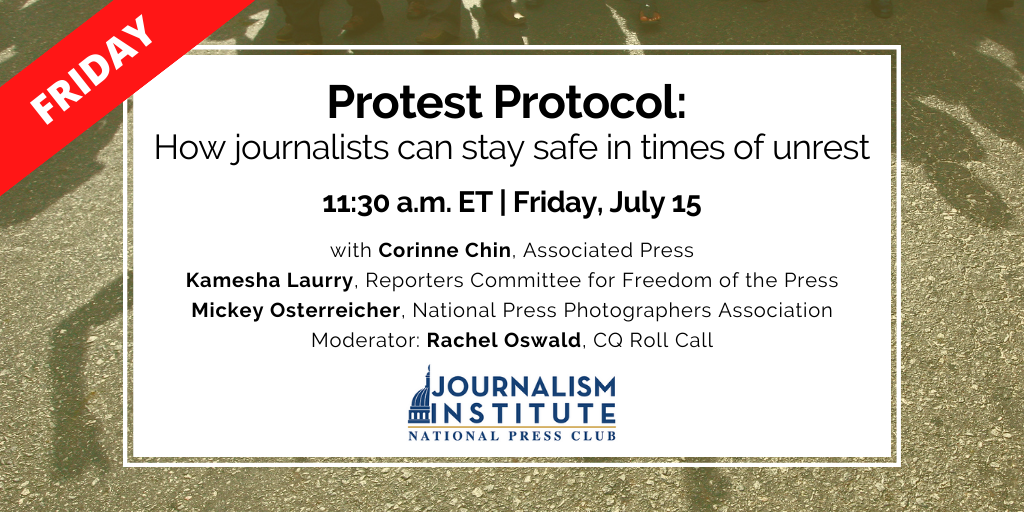
Registration is open for a National Press Club Journalism Institute virtual safety training at 11:30 a.m. ET on Friday, July 15, on how to cover political protests and civil unrest while limiting your legal exposure and physical safety risks.


Speakers include:


  • Corinne Chin, Emmy-award winning video journalist, and Associated Press director of news talent
  • Kamesha Laurry, Borealis Racial Equity in Journalism Fund Legal Fellow for the Reporters Committee for Freedom of the Press
  • Mickey Osterreicher, general counsel for the National Press Photographers Association


The conversation will be moderated by Rachel Oswald, National Press Club press freedom team lead and a foreign policy reporter for CQ Roll Call.

Manager's Minute: What should I tell myself when I’m feeling imposter syndrome?

Jill Geisler, Bill Plante Chair in Leadership & Media Integrity at Loyola University Chicago and Freedom Forum Fellow in Women’s Leadership, on how to overcome "imposter syndrome."

Manager's Minute: What should I tell myself when I’m feeling imposter syndrome?

Read next: 7 ways to outsmart ‘Imposter Syndrome’


Get more career advice: Read Jill's columns | Watch Manager's Minute videos

Resources

This newsletter is written & edited by the National Press Club Journalism Institute staff: Beth Francesco, Holly Butcher Grant, and Julie Moos. Send us your questions and suggestions for topics to cover.

Get this from a friend? Subscribe, and view the archives.

If you value this newsletter, consider supporting The Latest with a tax-deductible, recurring gift to the Institute: Even $5 a month will help fund the technology and time it takes to provide this important service.  
Facebook  Twitter  Linkedin  Youtube  

The National Press Club Journalism Institute promotes an engaged global citizenry through an independent and free press, and equips journalists with skills and standards to inform the public in ways that inspire a more representative democracy. As the non-profit affiliate of the National Press Club, the Institute powers journalism in the public interest.