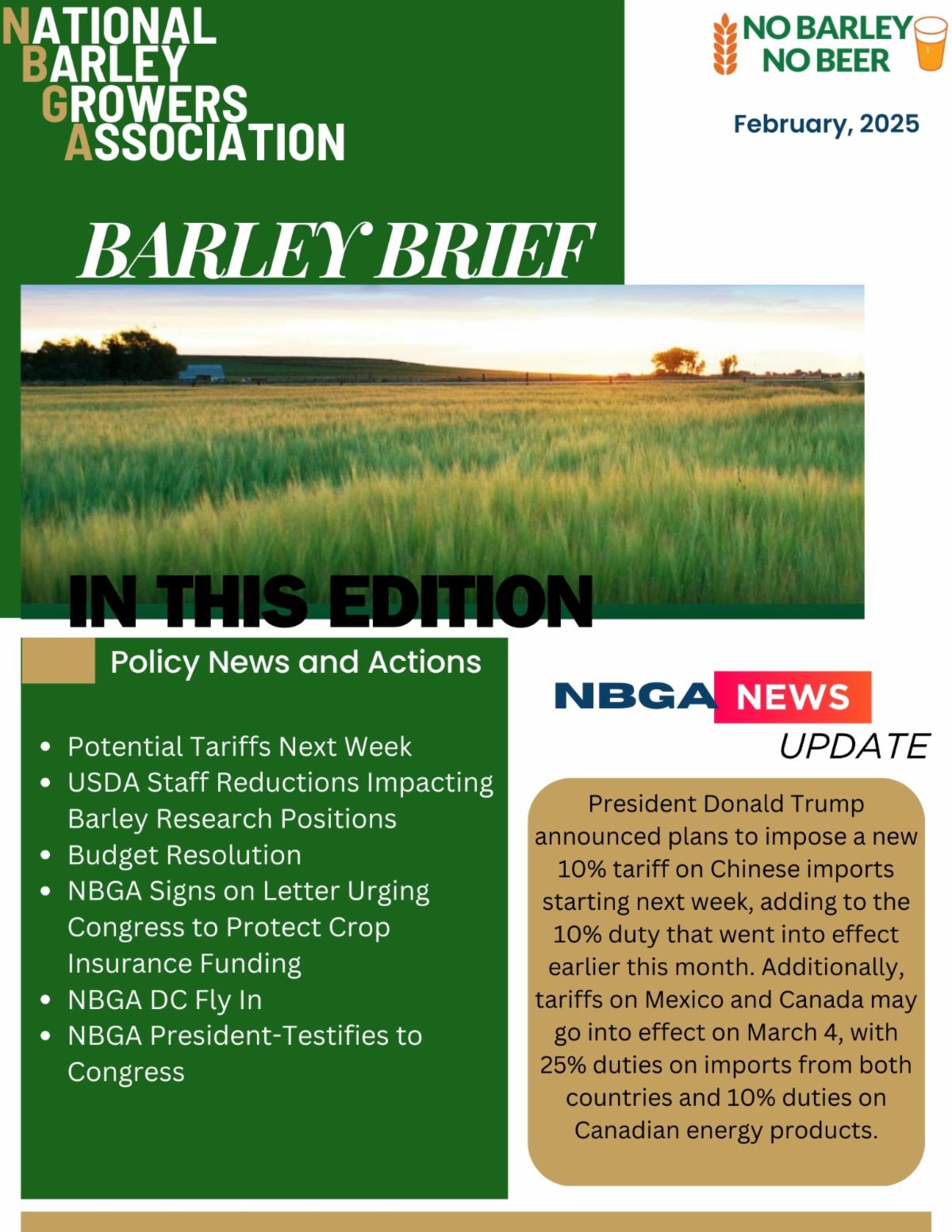
Company Newsletter.jpg

Washington Watch

POTENTIAL TARIFFS NEXT WEEK


President Donald Trump announced plans to impose a new 10% tariff on Chinese imports starting next week, adding to the 10% duty that went into effect earlier this month. In response, China has already implemented its own tariffs on U.S. exports, particularly agricultural equipment and vehicles.

Additionally, tariffs on Mexico and Canada may go into effect on March 4, with 25% duties on imports from both countries and 10% duties on Canadian energy products.


Trump has also confirmed that the April 2 deadline for imposing "reciprocal" tariffs will remain in place, though specific details have yet to be fully clarified. Furthermore, Trump has indicated that a new 25% tariff on European Union products, including cars, could be announced soon.


USDA STAFF REDUCTIONS IMPACTING BARLEY RESEARCH POSITIONS


The workforce reductions at USDA is impacting barley research positions as well as other USDA services and programs. Several federal positions within the Agricultural Research Service (ARS), including barley researchers, postdocs, technicians, and support staff, were terminated. These cuts have impacted barley research locations, such as the Cereal Disease Lab in St. Paul, Minnesota, and the Cereal Crops Research Unit Malt Quality Lab in Madison, Wisconsin. The immediately affected employees were on probationary status, with these periods ranging from six months to three years, depending on the position. Some research staff terminations have been reversed, but it remains unclear which specific positions will be reinstated and which employees will choose to return. The loss of these researchers and support staff could disrupt ongoing research and collaborative efforts and creates uncertainty for barley and other research functions going forward.


USDA ARS staff indicated that an impact analysis on the staff reductions would occur with the potential for positions to be reinstated. They indicated that, in addition to the probationary employees that were terminated, there is also the pool of employees that will accept the deferred resignation offer. The number and specifics of the deferred resignations is still in process and outcomes not yet fully known. Over the course of this week, news reports of some positions that are being reinstated have trickled out and those reports suggest that the top categories of research positions as well as farm loan officers and positions associated with animal disease monitoring and response are among those in the initial reinstatements or offers to be re-hired. It was also reported that Members of Congress have been meeting with the White House, Elon Musk and the Department of Government Efficiency (DOGE) on these actions.


BUDGET RESOLUTION

House Republicans passed a budget resolution tis week with a narrow 217-215 vote. The bill outlines at least $1.5 trillion in spending cuts to fund military spending, border security, and tax cuts. One key component of these cuts includes $230 billion in reductions by the House Agriculture Committee, primarily targeting the Supplemental Nutrition Assistance Program (SNAP).


Chairman Glenn Thompson emphasized that the goal is to maintain the program's integrity rather than cutting benefits. The resolution has faced criticism from Democrats, particularly concerning the potential impact on SNAP, which could become a major sticking point. Despite these concerns, the budget resolution would enable them to proceed to the next step toward a Budget Reconciliation package.

NBGA SIGNS ON LETTER URGING CONGRESS

TO PROTECT CROP INSURANCE FUNDING


NBGA has signed on to a letter urging Congress to protect crop insurance funding during the development of the FY 2026 budget and appropriations bills. The letter highlights the essential role crop insurance plays as the first line of defense for farmers and ranchers, particularly in times of natural disaster and economic uncertainty. As many farmers are facing difficult financial challenges, cutting crop insurance would undermine efforts to maintain rural economic stability and food security. The full letter can be read here


NBGA PRESIDENT-TESIFIES TO CONGRESS


Chris Engelstad, NBGA President was invited to testify at the Senate Agriculture, Nutrition, and Forestry Committee hearing on February 5, 2025. The hearing focused on producers' perspectives on the agricultural economy. Chris was able to provide four minutes of testimony sharing insights into key issues affecting barley farmers and the broader agricultural sector as well as answering questions on the impact on young farmers. The hearing was recorded and can be viewed here


BARLEY IN THE NEWS

Beer Institute Releases December 2024 Domestic Tax Paid Estimate

National Barley Improvement Committee sets 2025 legislative priorities

EVENTS AND INFO

Facebook  Instagram  Web  X

SHARE THE NEWSLETTER BELOW

X Share This Email
LinkedIn Share This Email