|
Economic Assistance for Growers and Farm Bill Extension Enacted after Rollercoaster Ride in Congress
After much back and forth, the year-end package to extend the Continuing Resolution for government funding, extend the Farm Bill and provide disaster assistance as well as $10 billion in economic assistance for growers was included and signed into law on December 21st. The measure passed the House 366-34, with the support of 196 Democrats and 170 Republicans and passed the Senate by a vote of 85-11. The bill requires that USDA to make the one-time payments for economic assistance “not later than 90 days after enactment”, so payments to growers will come sometime before the end of March.
The economic assistance for growers will be provided for the commodities covered under the Farm Bill Title I farm programs, which includes: barley, wheat, corn, grain sorghum, oats, upland cotton, extra-long staple cotton, long-grain rice, medium-grain rice, peanuts, soybeans, other oilseeds (e.g., sunflower seed, rapeseed, canola, safflower, flaxseed, mustard seed, crambe, sesame seed, or any oilseed designated by the Secretary), dry peas, lentils, small chickpeas, and large chickpeas.
The assistance for each commodity will be determined in one of two ways, a formula that uses: a) cost of production and revenue with a 26% payment factor or b) a “minimum payment” calculation that uses 8% of the Reference Price multiplied by yield. For barley, it is expected that the minimum assistance calculation will be higher and will be the calculation used.
For payments calculated according to the formula that uses Cost of Production minus Revenue (price x yield) and applies a payment factor of 26%, the prices for barley, corn, soybeans, wheat, cotton, rice, sorghum, and oats will be determined by the most recent USDA WASDE report, with cost-of-production estimates based on USDA ERS data. For other eligible crops, USDA would establish the price and cost of production values.
There is also a provision that provides a minimum payment for eligible producers. Specifically, the economic assistance payment to a producer for an eligible commodity cannot be less than the product of the following:
- 8% of the Reference Price for the commodity as established in the Farm Bill.
- The national average payment yields for the commodity as established in the Farm Bill.
- The number of eligible acres for the commodity.
The economic assistance will be subject to payment limits, which are $125,000 if less than 75% of the average gross income for the 2020, 2021, and 2022 tax years is derived from farming, ranching, or silviculture activities. If 75% or more of the average gross income for those years is derived from farming, ranching, or silviculture, the payment limit increases to $250,000.
| |
|
|
|
Craig to be Top Democrat; Newhouse among Republicans Added to House Ag Committee
Minnesota Representative Angie Craig was elected to serve as the top Democrat on the House Agriculture Committee, where she will lead her party on farm policy during the next Congress. Craig defeated California Rep. Jim Costa and takes over from Georgia Rep. David Scott, who dropped out. On the Republican Majority side, Rep. Glenn “GT” Thompson will remain Chairman and five-term Rep. David Newhouse of Washington will join the committee along with GOP Reps.-elect Tony Wied (WI), Rob Bresnahan (PA), Mark Harris (NC), Mark Messmer (IN) and David Taylor (OH).
| | | |
South Korea Tightens Import Tolerance for 2,4-D on Barley | |
|
The U.S. Grains Council (USGC) alerted stakeholders that the temporary import tolerance of 0.5 parts per million (ppm) for 2,4-D on barley established in South Korea will officially be revoked and default to 0.01 ppm on January 1, 2025. USGC indicated they are working with USDA’s Foreign Agricultural Service and lead registrant, Corteva, for the 2.4-D Task Force to find a solution to reduce potential risk to trade.
| |
H-2A Wage Rates To Rise Over 4% Nationally in 2025
On December 16th the Department of Labor issued a notice announcing updates to the Adverse Effect Wage Rates (AEWR) for the employment of temporary or seasonal nonimmigrant foreign workers under the H-2A program. The minimum wage rate that farmers are required to pay H-2A workers is rising by an average of 4.47% nationally to $17.74 per hour for 2025.
The wage rates vary from a low of $14.83 an hour in Arkansas, Louisiana and Mississippi to $19.97 an hour in California and $20.08 in Hawaii. For the primary barley growing states, the rates will range from $16.83 in Idaho and Montano to $19.21 in North Dakota.
The new AEWR rates are effective December 16th in most states. However, litigation over program rules has resulted in an injunction of its enforcement in Arkansas, Florida, Georgia, Idaho, Indiana, Iowa, Kansas, Louisiana, Missouri, Montana, Nebraska, North Dakota, Oklahoma, South Carolina, Tennessee, Texas, and Virginia. The effective date of the new rates in these states will be December 30th.
The full notice can be read here
| | | |
|
Key Highlights of the Rule for Monarch Butterfly and Designation of Critical Habitat
The Fish and Wildlife Services has released their findings on the monarch butterfly, proposing that it be classified as a habitat under the Endangered Species Act. The proposed boundary for the designated critical habitat would be made up of 7 counties in California. A 90-day comment period will be opened with the FWS requesting information on several factors including whether an exemption from the use of pesticides should be included in the final ruling. Pesticides were cited to contribute to the loss of the monarch butterfly due to unintentional contact with the species but more largely due to the loss of milkweed. FWS has requested comments on how to approach pesticide use under the 4(d) rule, requesting information on which pesticides and or application methods result in an adverse effect to monarchs. As well as what mitigation measures should be considered if a rule is applied to pesticide use, currently mitigation measures from the EPA’s Herbicide strategy are being considered. Exemptions to agriculture lands already converted have been listed and include the following
- Habitat restoration and management activities
- Livestock grazing and routine ranching activities
- Routine agricultural activities, including plowing, drilling, disking, mowing, and other mechanical manipulation and management of lands already in use for agricultural production
- Fire management actions
- Silviculture practices and forest management activities that use State-approved best management practices.
- Maintenance, enhancement, removal, and establishment of milkweed and nectar plants on residential and other developed properties.
- Vegetation management activities
The full proposal, along with further information on the agriculture exemption can be read here
| |
Designation of Critical Habitat for the Rusty Patch Bumblebee
The Fish and Wildlife Service (FWS) previously declared the Rusty Patched Bumblebee endangered and is now proposing critical habitats for its protection. The proposed critical habitat includes 33 counties across Illinois, Iowa, Minnesota, Virginia, West Virginia, and Wisconsin. FWS has divided the designated critical habitat into 14 areas, which include: the Minneapolis-St. Paul Metropolitan Area, Northfield, Rochester, Winona, Denzer, Bunker Hill, Madison, Milwaukee, Rockford, McHenry, Elgin, Lost Nation, Iowa City, and Black Creek Mountain. FWS will be accepting comments on the proposed critical habitat until January 27th.
The full proposal can be read here
| | | |
USDA Farm Sector Forecast Shows Price Declines in 2024
On December 3rd, USDA Economic Research Service (ERS) released The Farm sector income & finances: Highlights from the farm income forecast.
Net farm income, a broad measure of profits, is forecast at $140.7 billion in calendar year 2024, a decrease of $6.0 billion (4.1 percent) relative to 2023 in nominal (not adjusted for inflation) dollars. After adjusting for inflation, net farm income is forecast to decrease $9.5 billion (6.3 percent) in 2024 relative to 2023. Despite this expected decline, net farm income in 2024 would be 15.9 percent above its 20-year average (2004–23) of $121.4 billion.
Net cash farm income is forecast at $158.8 billion in 2024, a decrease of $1.8 billion (1.1 percent) relative to 2023 in nominal dollars. When adjusted for inflation, 2024 net cash farm income is forecast to decrease by $5.7 billion (3.5 percent) from 2023. In 2024, net cash farm income is forecast to be 9.8 percent above its 2004–23 average of $144.7 billion. Net cash farm income encompasses cash receipts from farming as well as cash farm-related income (including Federal Government payments) minus cash expenses. It does not include noncash items (including changes in inventories, economic depreciation, and gross imputed rental income of operator dwellings) reflected in the net farm income measure.
Cash receipts from the sale of agricultural commodities are forecast to decrease by $4.0 billion (0.8 percent, in nominal terms) from 2023 to $516.9 billion in 2024. Total crop receipts are expected to decrease by $25.0 billion (9.2 percent) from 2023, led by lower receipts for corn and soybeans. In contrast, total animal/animal product receipts are expected to increase by $21.0 billion (8.4 percent), following increases in receipts for cattle/calves, eggs, milk, broilers, and hogs.
Direct Government payments are forecast to fall by $1.7 billion (13.6 percent) from 2023 to $10.6 billion in 2024. This decrease is expected largely because of lower Dairy Margin Coverage Program payments and lower supplemental and ad hoc disaster assistance in 2024 relative to 2023. Total production expenses, including operator dwelling expenses, are forecast to decrease by $8.0 billion (1.7 percent) to $453.9 billion in 2024. Feed, fertilizer (including lime and soil conditioners), and pesticide expenses are expected to see the largest declines in 2024.
Read More
| | | | |
|
|
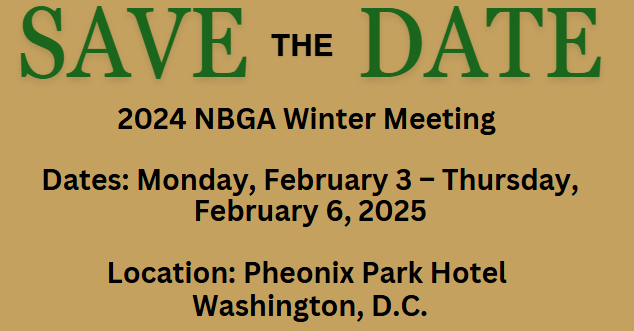
To book your room for the NBGA winter meeting click here.
Group Code: NBGA486
Cutoff Date to Book a Room: Tuesday, January 7, 2025
| |
|
STAY CONNECTED
Want to keep up with the latest updates. Follow and like us below!
| |
SHARE THE NEWSLETTER BELOW | | | | |