|
|
Congress Passes Continuing Resolution and Adjourns Until After Election Day
On September 25th the House and Senate passed a Continuing Resolution to extend the current fiscal year government funding through December 20th. Each chamber is adjourning for the stretch run up to election day and are scheduled to return for the post-election “Lame Duck” session.
| | |
|
Farm Bill Still Possible in 2024, Congress also Considering Ag Assistance Package
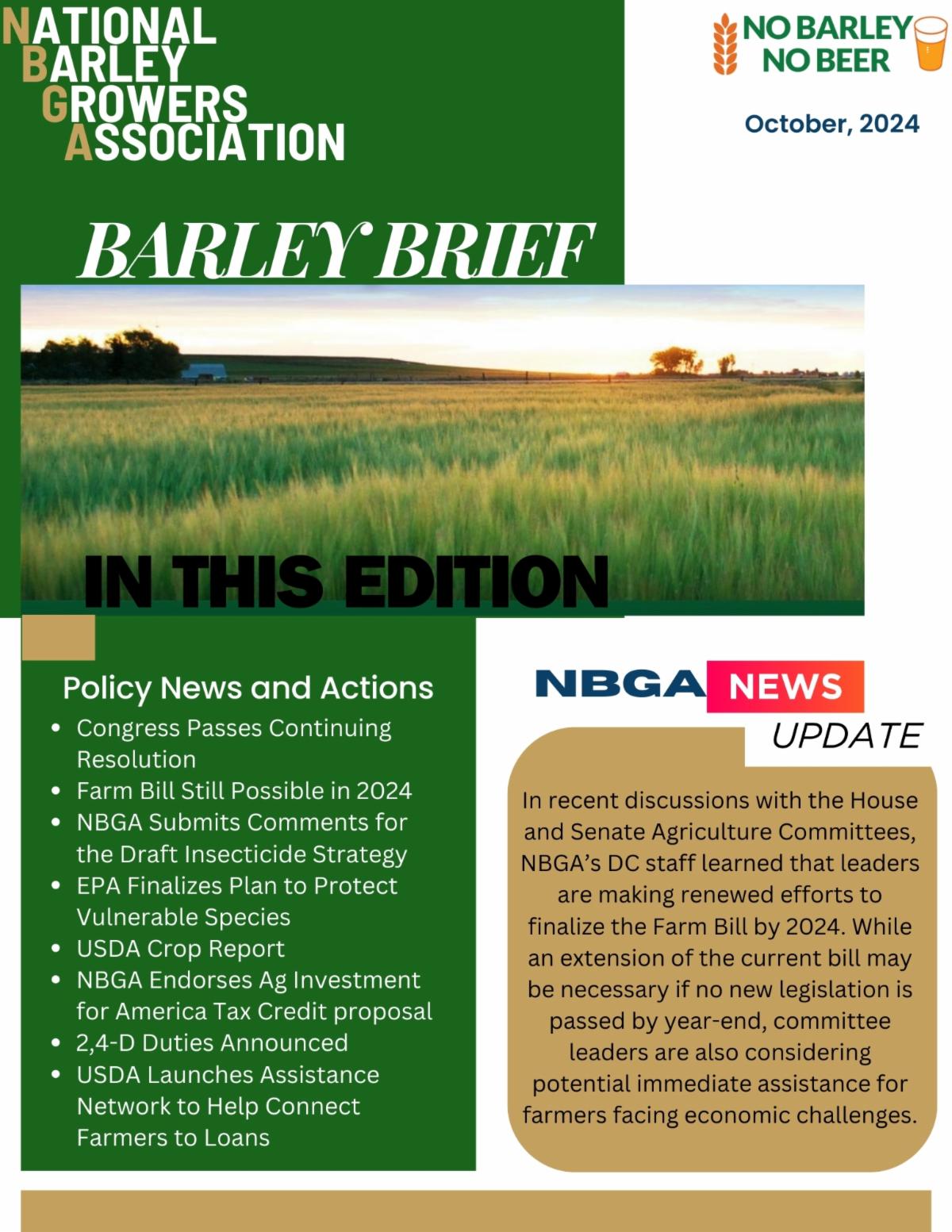
Over the past few weeks, NBGA’s DC staff have met with staff from the House & Senate Agriculture Committees to discuss the status of the Farm Bill. The committee staff indicated that discussions are occurring between the Committee Chairs and Ranking Members in the House and Senate in a renewed effort to complete the Farm Bill in 2024.
Action on an extension of the current Farm Bill won't be needed until the end of the calendar year (if a new bill isn’t passed by then). If the Agriculture Committee leaders can reach agreement on the framework of a new Farm Bill, it will have to bypass “regular order” such as votes on amendments by the full House and Senate or a formal Conference Committee. Instead, it could move through an expedited process and likely be attached to a year-end omnibus appropriations package or another Continuing Resolution.
The Committee leaders are aware of the current challenges facing farmers, including low prices and financing concerns, and could potentially consider some form of more immediate ad hoc assistance. They have indicated they are closely monitoring data from Farm Credit and bankers regarding the status of loans and forecasts for financing operations in 2025. Additionally, they are keeping an eye on weather conditions and other potential disasters. At this time, no concrete plans or framework for emergency assistance has been developed.
| |
NBGA Submits Comments for the Draft Insecticide Strategy | |
|
The National Barley Growers Association submitted comments to the EPA regarding the recently released Draft Insecticide Strategy. The proposed EPA Insecticide Strategy shares many similarities with the finalized Herbicide Strategy released last month. This Strategy assigns point values to pesticides and requires farmers to obtain points through either relief points or mitigation points. Relief points are determined based on a map designed by the EPA that distinguishes levels of runoff risk. Additionally, farmers can earn mitigation points by implementing certain measures, such as planting cover crops, installing barriers, or attending training sessions.
In our comments, the NBGA emphasized the importance of incorporating low-cost mitigation measures for farmers and allowing flexibility for quick responses to pest threats. The association also expressed concerns about the need for clear and consistent labeling requirements, as well as adaptive guidelines that can evolve with new technologies. Furthermore, the NBGA urged the EPA to continue refining the strategies to simplify requirements and enhance clarity.
The EPA is currently working to finalize the Insecticide Strategy and recently released the finalized Herbicide Strategy. The NBGA also signed on to comments from other organizations addressing the Insecticide Strategy. The NBGA's comments to the EPA can be found below.
The full comments can be read here
| |
EPA Finalizes Plan to Protect Vulnerable Species
The U.S. Environmental Protection Agency (EPA) has launched its Vulnerable Species Action Plan (VSAP) as part of its commitments under the Endangered Species Act. This plan builds on the earlier Vulnerable Species Pilot and focuses on identifying particularly at-risk species while implementing measures to reduce pesticide-related harm, even before formal assessments are conducted.
The VSAP has identified 27 vulnerable species, which include various plants and animals, and utilizes a structured three-step approach. This framework evaluates potential pesticide impacts, outlines appropriate mitigation strategies, and specifies where these measures will apply. Mitigations will be implemented only in specific geographic areas known as Pesticide Use Limitation Areas (PULAs). The EPA is currently working on refining the species maps for these areas and will delay the implementation of the VSAP in registration review until the maps are completed, which is expected to occur later in 2024. The plan aims to adapt and include additional species over time through collaboration with wildlife agencies and addresses multiple exposure routes to ensure thorough protection. The finalized VSAP and supporting documents are available for public access and review.
The full plan can be read here
| |
|
USDA Crop Report
The USDA's September Crop Report estimates that 2024 barley planted acreage will exceed 2.4 million acres. The report included this information on the harvest: By August 4, 97% of the nation’s barley had reached the headed stage, which is slightly behind last year and the five-year average. By that date, 7% of the crop had been harvested, 6 percentage points behind last year and 4 percentage points behind the five-year average. Progress improved by August 18, with 30% of the crop harvested, still trailing last year's 43% and the five-year average. By August 25, 65% of the barley acreage was rated in good to excellent condition, an increase from the previous year. By September 1, 75% of the nation’s barley crop had been harvested, matching last year’s progress but falling 1 percentage point short of the five-year average. Notably, four out of five estimating states experienced a harvest increase of 22 percentage points or more.
The full report can be viewed here
| | | |
|
NBGA Endorses Ag Investment for America Tax Credit Proposal
The NBGA Board of Directors moved to support the Ag Investment for America proposal, which is a diverse coalition of domestic growers and manufacturers advocating for tax policies that promote demand for American-made products through tax policies.
Following the global supply chain disruptions caused by the pandemic and ongoing trade tensions with China, there is a heightened focus on ensuring that agricultural products are sourced domestically. To support American growers and encourage businesses to prioritize domestic sourcing, the coalition proposes establishing a tax credit for companies that source agricultural commodities produced in the U.S. This initiative aims to strengthen markets for growers, promote investment in domestic manufacturing, and enhance the security of the U.S. food supply chain.
| |
|
2,4-D Duties Announced
On September 10, the U.S. Department of Commerce announced preliminary countervailing duty (CVD) rates for 2,4-D, which are detailed below. NBGA joined other crop groups on letter expressing opposition to duties on 2,4-D imports due to cost and availability concerns.
For India, the rates are as follows: Atul Limited at 5.29%, Meghmani Organics at 3.28%, and all other producers at 4.13%. In China, Jiangxi Tianyu Chemical is set at 27.68%, Shandong Rainbow at 3.10%, and all other producers at 27.34%.
| | | |
|
USDA Launches Assistance Network to Help Connect Farmers to Loans
On September 21, 2024, the USDA announced the launch of the Distressed Borrowers Assistance Network and updates to farm loan programs to support financially troubled farmers and ranchers nationwide. This initiative aims to connect distressed borrowers with personalized assistance through Cooperative Agreements. Producers are encouraged to reach out to their local FSA farm loan staff to explore the range of available loan options for starting or expanding their agricultural operations.
The FSA has announced updates to its Farm Loan Programs through the Enhancing Program Access and Delivery for Farm Loans rule, set to take effect on September 25, 2024. These changes are designed to increase opportunities for borrowers to improve profitability and make strategic investments in their farms. To assist the more than 26,000 producers applying for direct loans annually, the FSA is also streamlining its process with several key enhancements. USDA encourages producers to contact their local FSA loan staff to fully understand the various loan options available.
| | | |
|
STAY CONNECTED
Want to keep up with the latest updates. Follow and like us below!
| |
SHARE THE NEWSLETTER BELOW | | | | |