|
Indiana General Assembly Meets
to Discuss Redistricting
On Tuesday, lawmakers in the House Elections and Apportionment committee heard hours of testimony on mid-decade redistricting, most against. They passed HB 1032 out of committee on an 8-5 voted. The House will hear the bill on 2nd reading on Thursday, 12/4. Legislators can propose amendments at that time.
| | |
Lessons from the ACA: Simplifying Choices to
Optimize Health Coverage
The Affordable Care Act has increased health coverage and improved access to care. Selecting a health plan, though, remains a frustrating experience for many consumers.
In a new Commonwealth Fund brief, experts discuss an array of options for simplifying health plan choices that could lead to greater satisfaction and more affordable coverage. At the same time, they warn against proposals that could further complicate health choices, undermine consumer protections, and raise costs.
| |
Low-Income Disabled Youth Face Significant
Challenges Upon Coming of Age
More than 4 in 10 Supplemental Security Income (SSI) youth lose benefits when they turn 18 because they have not demonstrated meeting SSI’s adult definition of disability although there is no improvement in the health conditions that limit daily activities.
Around the same time, these young people often lose key supports such as school-based services, health care, long-term services and supports, and foster homes.
There are ways to support young people with disabilities as they transition to adulthood, both by providing more work supports and incentives to SSI youth, and by improving access to economic security programs beyond SSI.
| | SCHOOLS & EARLY CHILDHOOD | | | | |
Call for ISHN Proposals is Open! | | The theme of ISHN 2026 is Champions in Action: Empowering Healthier Hoosier Kids. This conference offers a winning opportunity for school health professionals and youth-serving adults to share expertise and foster collaboration while earning free continuing education credits. Consistent, caring relationships are the foundation of youth well-being, learning, and long-term success. Learn practical tactics and inspiring strategies to guide and support kids on their journey to becoming confident champions of their health and future. | | Oral Presentation and Digital Poster Submissions Accepted - Proposals should be informed by theory, research, and practice, and address Hoosier kids' diverse perspectives and health-related social needs. Presentations should include techniques and strategies to engage attendees with the topic and to provide ways to incorporate lessons learned into their work. All oral presentations are 60 minutes long, including Q&A and evaluation. Digital posters will be showcased during the 2-day conference and highlighted during breaks. Please read the Call for Proposals guidelines before you begin the submission process. | | |
Using the Wraparound Approach for Children with Complex Behavioral Health Needs
Many children with complex behavioral health care needs lack access to effective services. The Wraparound model, an evidence-based approach to intensive care coordination, helps families navigate health and social services to address these needs. Wraparound is associated with positive outcomes, including greater stability at home and in the community, reduced need for residential care, improved clinical and functional outcomes, and lower costs.
This Evidence Roundup highlights emerging evidence on the effectiveness of Wraparound to support children with complex behavioral health needs, including findings on effective program design and implementation. It offers insights for policymakers, state agencies, health plans, and providers interested in understanding opportunities to better support children with complex behavioral health needs.
| | | | |
|
Waiver Reset
The Indiana Bureau of Disabilities Services (BDS) is planning to create new home and community-based service waivers to improve services. This is known as the “waiver reset.”
BDS currently oversees four separate Home and Community Based Services (HCBS) Waivers and has been making a series of updates to support better alignment across the waiver programs while making enhancements in response to feedback from individuals and families and legislative directives. Instead of simply redesigning the current waivers, BDS plans to create entirely new waivers that effectively serve people across all disabilities and levels of care.
| | |
Open Feedback Call
BDS has been working with the Human Services Research Institute (HSRI) to host conversations about what changes are needed. Based on the feedback received, HSRI will develop recommendations for the waiver reset.
During the December 5th call, HSRI will provide an overview of the waiver reset, answer questions, and listen to feedback from the community about suggested changes to the waivers.
Date: December 5, 2025
Time: 12-1:30pm ET
Location: Zoom
Cost: Free
| | |
PE Performance Standards
An IHCP bulletin from September reviewed updated performance standards for qualified providers making presumptive eligibility determinations. The date for the first evaluation quarter has been delayed three months to December 31, 2025 to March 31, 2026.
The updated performance standards will be reviewed on a quarterly basis.
- 95% of individuals determined presumptively eligible by qualified providers must submit a full application.
- 95% of applications completed by presumptively eligible individuals must be completed with sufficient information to determine eligibility.
- 95% of individuals who submit the full application must be determined eligible for an Indiana Health Coverage Program (IHCP).
| | |
Data Says….
Several tools can assist in understanding the current state of healthcare coverage in Indiana.
- The Indiana Family and Social Services Administration (FSSA) started a Medicaid Enrollment Dashboard during the pandemic. The data can be sorted by county(ies) for up to the last 2 years. Data can be further sorted by gender, age, race, ethnicity, Medicaid program, and managed care company. For example, if sorting by county and MDwise, it is possible to see how many Hoosiers in that county will need to switch insurance companies.
- Enrollment Trends – As the state releases new monthly enrollment reports, Covering Kids & Families reviews the information and reports on the data and identifies trends. This Enrollment Trends report is shared in this newsletter as the final listed item. Current and past ones can also be found at CKF Newsletter Archive - Covering Kids & Families of Indiana.
-
CKF Indiana – Uninsured Snapshot – Covering Kids & Families uses census data that can be organized by county(ies) or zip code(s) to understand who is uninsured by age, federal poverty level, gender, and race. Information can be viewed by percentage or numeric total and printed or saved for further sharing.
| | |
Married Households with Children Decline
Newly released estimates from the U.S. Census Bureau’s historical America’s Families and Living Arrangements tables show that fewer than half (47%) of U.S. households in 2025 were married couples — a significant shift from 50 years earlier, when nearly two-thirds (66%) were.
Among married-couple households, the share with their own children declined over the past half-century. In 1975, more than half (54%) of married-couple households included their own children under age 18; by 2025, that share had declined to about 37%.
Healthcare coverage policies that ignore the demographic reality of the US will miss people. For example, traditional coverage models, like getting insurance through a spouse's employer, may not meet the needs of the current population that is not marrying at the same rate as 50 years ago. Changing demographics must be part of the conversation in healthcare coverage policy.
| | |
Improving How We Communicate in Health Policy
Science is a never-ending process through which truth is pursued, yet choices about what to study, how to study it, and how to interpret evidence involves value judgments that exist outside the scientific process. When those values are not recognized or communicated, trust can erode.
This event will explore how the scientific and public health communities can acknowledge how values and uncertainty intersect in science and policy, and how transparency and humility can strengthen trust.
Date: December 9, 2025
Time: 3-4:30pm ET
Location: Zoom
Cost: Free
| | |
The GENEROUS Model
With the Centers for Medicare & Medicaid Services’ (CMS) announcement of the GENErating cost Reductions for U.S. Medicaid (GENEROUS) Model, life science companies, states and other stakeholders are seeking to understand how the Most Favored Nation (MFN) pricing model may impact them and Medicaid patients seeking access to drugs.
Topics to be covered:
- An overview of the GENEROUS Model and participation requirements
- MFN pricing metrics and how they compare to those previously used by CMS
- Opportunities and risks of applying and participating for both pharmaceutical manufacturers and state Medicaid programs
- Outstanding questions on the model’s design
Date: December 9, 2025
Time: 1-2pm ET
Location: Virtual
Cost: Free
| | |
Save the Date
Join Indiana Youth Institute for a dive into the recently released 2026 Indiana KIDS COUNT® Data Book! Learn and engage with the best and most recent information on child well-being to inform leaders, policymakers, youth workers, and advocates with go-to sources for critical data to create positive change for youth.
Date: February 18, 2026
Time: 12-1pm ET
Location: Zoom
Cost: Free
| | TOBACCO PREVENTION & CESSATION | | |
Indiana Cigarette Consumption Down, Quit Program Enrollment Up After Tax Hike
After a $2-per-pack tax increase on cigarettes (implemented July 1 under House Enrolled Act 1001), the Indiana Department of Health (IDOH) reported that cigarette consumption in Indiana dropped by 40% in the first three months of the hike, from roughly 1.5 billion cigarettes to about 900 million over that period. At the same time, enrollment in the state quit program Quit Now Indiana surged by nearly 40%, increasing from 620 to 1,241 participants, with July enrollments alone more than doubling compared to the same month last year, suggesting many smokers were motivated to quit.
IDOH officials praised the tax hike as a powerful public-health tool, not only discouraging smoking through higher costs, but also prompting more people to seek help quitting, rather than switching to other nicotine or tobacco products.
| | | |
|
IHCP Membership
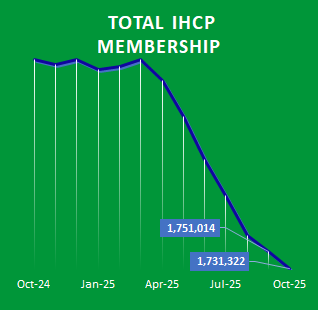
Total Membership decreased in October. With 1,731,322 members, there were 19,692, or 1.12%, less members in October 2025 than in September 2025.
In the last six months, IHCP membership dropped by nearly 240,000.
| | | | | |