|
Employers & PBMs Face Heightened
Regulatory Scrutiny
The regulatory environment for pharmacy benefits is changing significantly at both federal and state levels. Benefits advisors have been warned that it is imperative to distinguish between the requirements that new federal laws impose, the obligations that emerging state regulations introduce, and the changing role of Employee Retirement Income Security Act (ERISA) protections for plan sponsors. Federal reforms, most notably the Consolidated Appropriations Act of 2026, impose direct, enforceable mandates directly on pharmacy benefit managers (PBMs).
| | |
AI Enters ERISA’s Document-Heavy World
The Employee Retirement Income Security Act (ERISA) is a federal law that sets minimum standards for many private (read: not governmental) retirement and health plans. The Affordable Care Act amended ERISA to include healthcare coverage and to protect against preexisting condition denials.
Artificial intelligence is increasingly being used in the management and review of retirement and benefits plan documents, offering efficiencies in tasks such as document review, claim analysis, and litigation discovery. However, legal experts emphasize that plan sponsors and fiduciaries cannot delegate their responsibilities entirely to AI systems and must continue to monitor and evaluate the recommendations and outputs generated by these tools.
While AI can improve efficiency, it also introduces risks such as generating inaccurate or fictional information (hallucinations), potential breaches of confidentiality, and algorithmic bias. The sensitive nature of ERISA plan data, including financial and medical information, heightens the need for robust cybersecurity and privacy safeguards.
| | SCHOOLS & EARLY CHILDHOOD | | | | |
ISHN Conference
The theme of ISHN 2026 is Champions in Action: Empowering Healthier Hoosier Kids. This conference offers a winning opportunity for school health professionals and youth-serving adults to share expertise and foster collaboration while earning free continuing education credits.
Consistent, caring relationships are the foundation of youth well-being, learning, and long-term success. Attendees will learn practical tactics and inspiring strategies to guide and support kids on their journey to becoming confident champions of their health and future.
Date: June 15-17, 2026
Location: Plainfield, IN Embassy Suites Hotel
Cost: FREE
| | |
Changes to Medicaid: Exemptions & Exclusions
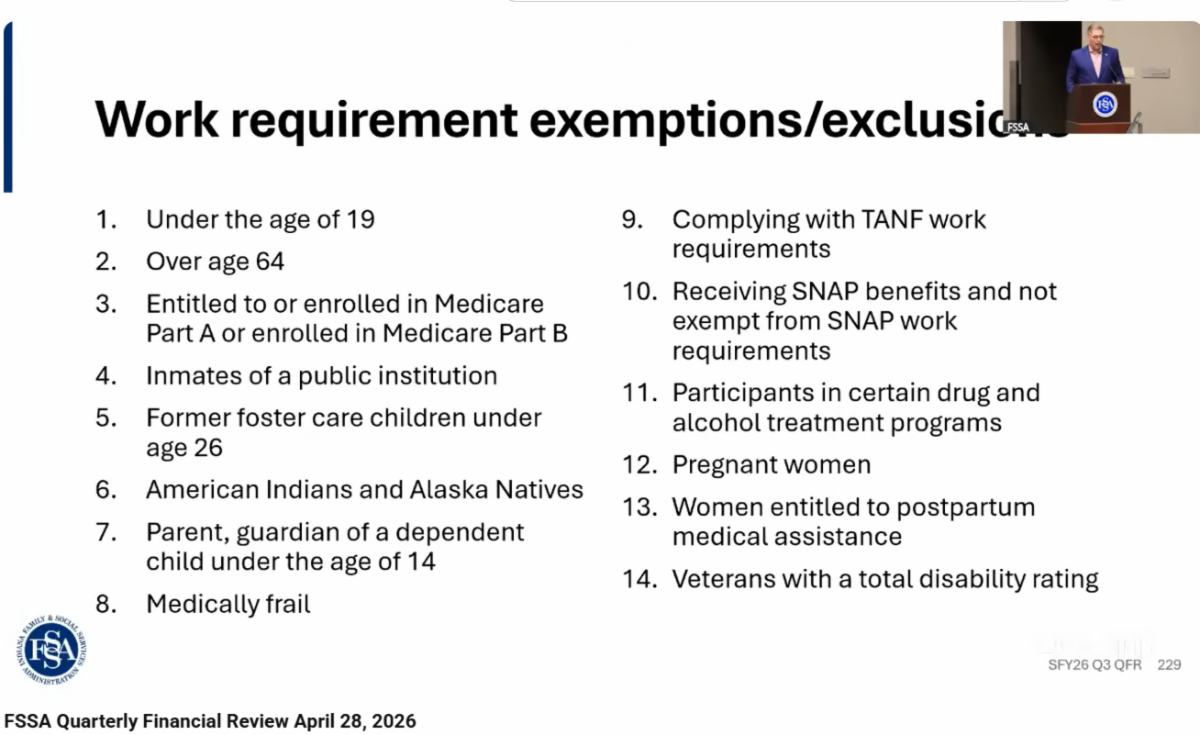
At the Family & Social Services Administration (FSSA) quarterly financial review on April 28, 2026, FSSA Secretary Mitch Robb shared information on community/work requirement exemptions/exclusions for HIP members. (See picture.)
An additional exemption for a parent, guardian, caretaker relative, or family caregiver of a disabled individual is listed in an informational bulletin from the Centers for Medicare & Medicaid Services (CMS).
States also have the option to provide an exception for “short-term hardship events” that members would need to request. Per the Georgetown University Center for Children and Families’ Tracking Implementation of H.R. 1 Medicaid Work Reporting Requirements, administration leadership at Indiana FSSA decided NOT to allow the following exemptions:
- Receiving care in a hospital/nursing facility
- Living in an area where an emergency or disaster has been declared
- Living in an area with a high unemployment rate
- Needing to travel for medical treatment
Community engagement/work requirements will go into effect January 1, 2027 for current HIP members. Also starting in January 2027, anyone applying for HIP coverage will have a three-month look back period during which they must meet requirements UNLESS they qualify for an exemption/exclusion. No information is available regarding the process to prove that potential HIP members meet exemption/exclusion requirements.
| | |
2027 Marketplace Final Rule Summary
Beyond the Basics shared a summary of the Centers for Medicare and Medicaid Services (CMS)'s recently issued final rule that makes changes to ACA Marketplace plans for 2027 and beyond.
New Requirements for Agents and Brokers
- Prohibition of certain marketing practices beginning in Plan year 2027
-
Standardized consent form for agents, brokers and web-brokers starting in January 2028
Changes to the Enrollment Process and Premium Tax Credit (PTC) Eligibility Determinations
- Permanent ban on low-income Special Enrollment Periods (SEP)
- New requirements beginning in Plan Year 2027
- One-year failure-to-reconcile policy beginning in Plan Year 2027
- HealthCare.gov will conduct verification for at least 75 percent of new enrollments through SEPs beginning in Plan Year 2027
Changes to Bronze and Catastrophic Plans
- Increased maximum out-of-pocket (MOOP) for bronze plans beginning in Plan Year 2027
- Increased MOOP for catastrophic plans
- Expanded eligibility for catastrophic plans
- Multi-year catastrophic plans will be allowed
Other Changes
- Eliminates standardized plans and removes limits on the number of plans an insurer can offer in HealthCare.gov states starting in Plan Year 2027
- Prohibits states from including routine adult dental services as an Essential Health Benefit starting in Plan Year 2027
Some changes may be impacted by current or future court cases. Beyond the Basics will be sharing additional resources on this topic soon.
| |
|
Drop in ACA Coverage and the Effect on Hospitals
Under ACA rules, patients receiving a Marketplace Premium Tax Credit (PTC) have a 90-day grace period after missing a payment to pay all past-due premiums, but the insurer is only required to pay claims during the first month. For the remaining two months, hospital executives warn they are left to estimate which patients will ultimately lose coverage and reserve accordingly. Patients who lose or drop Marketplace coverage become uninsured, leading to uncompensated care that is significantly harder for hospitals to collect on and may also result in medical debt for the patients.
| | |
Average Marketplace Deductibles Saw Steep Increase
The average Affordable Care Act (ACA) Marketplace deductible experienced the steepest increase in its history—growing by 37% or over $1,000, from $2,759 in 2025 to $3,786 in 2026 as enhanced premium tax credits expired, according to a new KFF analysis.
Sign-ups for silver Marketplace plans fell from 57% to a record-low 43%, dropping from 13.7 million to 9.8 million people. The share of Marketplace enrollees who signed up for cost-sharing reduction (CSR) silver plans—which reduce out-of-pocket costs for deductibles, copayments, and coinsurance for lower income enrollees—also fell to 37%.
In Indiana, Marketplace enrollment decreased by 16% from 359,240 in 2025 to 300,049 in 2026. Indiana is one of six states seeing a decline great than a 10%.
| | |
Tracking H.R. 1 Requirements
The Georgetown University Center for Children and Families implemented a new project, Tracking Implementation of H.R. 1 Medicaid Work Reporting Requirements. This project will track the implementation of community engagement reporting requirements by states, across states, including policy and operational decisions, administrative and technology costs, and the impact on Medicaid enrollment.
| |
Drowning Alert Ahead of Memorial Day
According to the Centers for Disease Control and Prevention (CDC), drowning is the leading cause of injury or death for children ages 1 to 4 years.
Two-thirds of drowning deaths occur between May and August, and boys account for three out of four child drowning deaths. More information about water safety, including toolkits, potential hazards and training resources, is available on the IDOH website.
In partnership with the National Center for Fatality Review and Prevention, IDOH participates in the National Drowning Registry. Through this registry, local Child Fatality Review teams conduct comprehensive surveillance of all pediatric drownings. Standardizing the investigation process leads to better understanding of the burden of drowning deaths among youth and may prevent future fatalities from occurring.
| |
Linking Nutrition, Health, and Medicaid
Nutrition, food access, and health are closely connected. Diet-related chronic conditions, including diabetes and obesity, are among the largest cost drivers for health care payers. “Food is Medicine” — an approach that connects people to nutrition supports to prevent and manage chronic conditions — is gaining traction among Medicaid programs and other health care stakeholders.
Services such as medically tailored meals, produce prescriptions, and nutrition counseling can improve health outcomes and reduce costs. Greater alignment across public benefit programs, including the Supplemental Nutrition Assistance Program (SNAP), the Special Supplemental Nutrition Program for Women, Infants, and Children (WIC), and Medicaid, can also support better health through improved nutrition.
Health care payers are increasingly reimbursing for nutrition services to improve health outcomes and reduce costs related to chronic disease and more acute care. This Evidence-to-Action Collection highlights emerging and promising evidence-based nutrition interventions, with a focus on medically tailored meals, healthy grocery initiatives, and produce prescription programs.
| | |
Wednesday, June 3 at 1pm
On June 3, Healthier Generation will convene leaders from nationally recognized organizations, state and local officials, and community partners to:
- Explore common sources of vaccine misinformation
- Clarify recent updates to the childhood vaccine schedule
- Highlight areas where additional guidance or cross‑agency coordination may be needed to better support students and families
Register now to attend live and receive the recording. A certificate for one (1) continuing education contact hour is provided upon completion.
| | TOBACCO PREVENTION & CESSATION | | |
First Fruit-Flavored Vaping Products Approved
The FDA authorized the first fruit-flavored vaping products for adults, a major regulatory shift after years of enforcement against flavored e-cigarettes. The agency cited digital ID-based age verification to curb youth access, but health advocates remain skeptical. Public health leaders point to evidence that flavored products drive underage appeal and that e-cigarettes pose risks including lung damage and cardiovascular harm.
| | |
The Majority of E-cigarettes on the Market Are Illegal
The Truth Initiative explains that many e-cigarettes currently sold in the U.S. market are unauthorized by the FDA and are therefore considered illegal products. Many of these devices are flavored, inexpensive, and contain high levels of nicotine, making them especially appealing to youth and increasing the risk of nicotine addiction.
The article highlights concerns that the rapidly evolving vape market is outpacing regulation and enforcement, allowing unauthorized disposable products to remain widely available both in stores and online. It also emphasizes that these illegal products undermine public health efforts by contributing to youth vaping, dual use, and long-term nicotine dependence. Stopping this trend calls for stronger enforcement, retailer accountability, and stricter regulation to protect young people from addiction.
| | | |
|
IHCP Membership
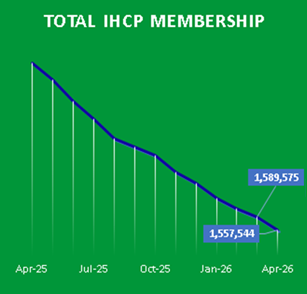
Total Membership decreased in March.
With 1,557,544 members, there were 32,031, or 2%, less members in April 2026 than in March 2026. Membership is dropping at a rate of over 1,000 members per day.
If this rate of disenrollment and coverage loss continued, there would be no IHCP members in about 4 years.
| | | | | |