|
Immigration Status
In the September 1st IHCP bulletin, the Family and Social Services Administration (FSSA) announced changes to the immigration statuses that qualify for Medicaid. Eligibility determinations for all Medicaid programs are impacted except Package E – Emergency Services Only (ESO).
Beginning October 1, only Hoosiers with the following immigration status will qualify for Medicaid:
- U.S. citizen or national
- Lawful permanent resident (“green card” holders) after a five-year waiting period
- Cuban/Haitian entrant
- Compact of Free Association (COFA) migrants – citizens of the Federated States of Micronesia, the Republic of the Marshall Islands, and the Republic of Palau
The bulletin noted that certain lawful permanent residents are exempt from the five-year waiting period including:
- Immigrants who have their status adjusted to lawful permanent resident status from a humanitarian status (asylee, refugee, or victim of trafficking)
- Lawful permanent residents who are honorably discharged veterans or the spouse, unmarried widow, or child of such a veteran
Beginning October 1st, Presumptive eligibility (PE), which is restricted to only those who qualify for full Medicaid, applications will include updated immigration status options for the citizenship question. If someone does not qualify for Medicaid based on immigration status, they can apply for emergency services only (ESO) – Medicaid Package E – by submitting a standard Medicaid application. If eligible and approved for ESO coverage, the benefit would begin the first day of the month of application and potentially for one or more retroactive months based on the Medicaid aid category assigned.
| | |
FSSA Updates to HIP Work Requirements Website
The Family and Social Services Administration (FSSA) continues to update the HIP Work Requirements website with information and tools. Over the past month, FSSA has added resources in both Spanish and English including a flyer about the work requirement pre-screening tool.
The website also added additional FAQs, including:
Q: Can you tell me when my three-month lookback period will begin?
A: For new applicants to be approved for HIP, the lookback period will be three months before the application month.
Example: Apply in January, look back will be December, November, and October.
For existing HIP members, the lookback period will be three months before the renewal month or three months before the quarterly work requirements review.
Example: Renewal month is May, look back will be April, March, and February
Note: The example given for HIP members does not clarify when the first quarterly lookback period will occur.
| |
|
Town Halls on HIP Work Requirements
The Indiana Family and Social Services Administration (FSSA) in partnership with Covering Kids & Families of Indiana is hosting a series of public town hall meetings for Healthy Indiana Plan (HIP) members, providers, and community partners. These sessions are being held in counties across the state with rules and processes related to implementation of upcoming HIP work requirements.
Current town halls are listed below, and additional ones will be announced throughout the year.
September 14 - Ivy Tech Terre Haute
- Sue Ellspermann Community Room - E102 - 8000 S. Education Drive, Terre Haute, IN 47802
- Time: 6 to 7:30 p.m. ET
September. 18 - Ivy Tech Evansville
- Vectren Auditorium 0 3501 N First Avenue, Evansville, IN 47710. Note: Please use the entrance at Door C, the North side of the building on Colonial Drive.
- Time: 6 to 7:30 p.m. CT
September 21 - Indianapolis - Indiana Government Center South
- Conference Room A - Indiana Government Center South - 402 W. Washington St. Indianapolis, IN 46207
- Time: 1 to 2:30 p.m. ET
September 24 - South Bend Technology Resource Center
- Community Common Space - 1165 Franklin St. #100 - South Bend, IN 46601
- Time: 9 - 10 a.m. ET
October 1 - Ivy Tech Sellersburg
- Building Ogle – Door 8 - Community Room 179 - 8204 Highway 311 - Sellersburg, IN 47172
- Time: 6 to 7:30 p.m. ET
| | |
Timely Tips for Work Requirement Implementation
The National Health Law Program (NHeLP) is publishing weekly tips to help advocates navigate work requirements and other issues stemming from the One Big Beautiful Bill Act. Here are several of the recent tips. Please note: These tips cover federal rules interpreted by NHeLP. Implementation in Indiana may look different.
-
Deemed-Compliance Income: The $580 monthly threshold for deemed compliance with work requirements should be based on the household Modified Adjusted Gross Income (MAGI) not individual income. MAGI counts only taxable income; it excludes SSI, child support, TANF, tax refunds and credits, workers’ compensation, veterans’ benefits, gifts, and inheritances. Income does not have to be earned.
-
Education Hours for Less Than Half-Time Students: Enrollment at least half-time in an educational program satisfies work requirement compliance. The definition of half-time is determined by the rules of the educational institution. If enrolled less than half-time, they will need to add additional hours doing other qualifying activities. To convert less than half-time hours, the Centers for Medicare and Medicaid Services (CMS) assumes 1 credit hour carries 2 hours of out-of-class work for a total of 3 hours per week. That number is then multiplied by 4.33 to reach a monthly total.
| | |
ERISA 101
Nearly half of the United States’ non-elderly population—136 million Americans—are enrolled in health insurance coverage regulated by the Employee Retirement Income Security Act of 1974 (ERISA).
ERISA 101: Key Terms and Concepts breaks down ERISA’s complex legal jargon. In this explainer, you’ll learn:
- ERISA Basics: What constitutes ERISA health plans vs. non-ERISA plans
- Plan Components: What are plan documents and plan assets, and why they matter
- Key Players: Who are the key players involved in ERISA health plan oversight and administration
- Legal Essentials: What legal labels and obligations attach to these players
- Preemption: How ERISA preemption relates to affordability
| | |
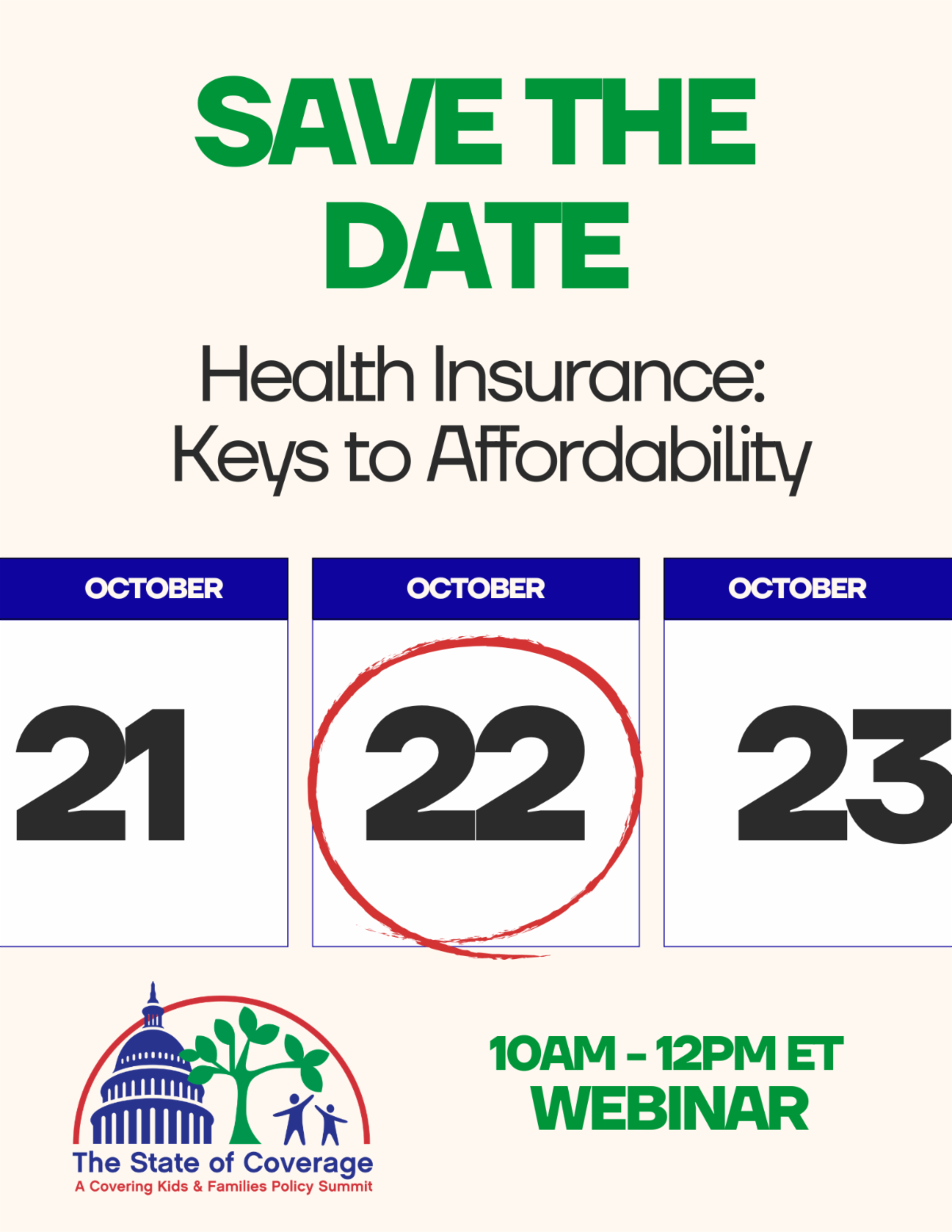
Monday, September 17 at 1pm ET
Georgetown University’s Center on Health Insurance Reforms and Families USA are presenting Preparing for Marketplace Open Enrollment: What Diabetes Providers and Assisters Need to Know. Millions of people with diabetes rely on Marketplace coverage but federal policy changes mean this year’s open enrollment period comes with new challenges. Join this webinar for a breakdown of what to expect and how to help people with diabetes get ready.
Register here.
| | |
Thursday, September 24 from 9am - 4:15pm ET
Registration is now open for Indiana Family to Family’s virtual Heart to Heart Conference. This free annual conference is an opportunity for families and professionals to learn and connect in support of children and youth who have various health and mental health needs and disabilities.
Learn more here.
| | |
On demand
The Alliance for Health Policy posted their August 12 webinar, Health Insurance Fundamentals: How the U.S. System Really Works, on their website. The webinar covers the history of health insurance in the United States, core concepts and terminology, and the different major health insurance markets.
| | |
The Beyond the Basics annual webinar series takes place ahead of open enrollment each fall. The webinars are presented by policy experts who provide in-depth training on a wide range of eligibility and enrollment topics to help prepare assisters for open enrollment. Register for one or all here.
September 22 at 2 pm – Medicaid Work Requirement
Experts from the Center on Budget and Policy Priorities will explain the Medicaid work requirement, how it will affect people applying for and renewing coverage, and what enrollment assisters can do to inform their community and mitigate unnecessary coverage loss.
October 6 at 2 pm – Premium Tax Credits
Experts from the Center on Budget and Policy Priorities will review premium tax credit eligibility rules and how premium tax credits are calculated.
October 15 at 2 pm – Verifying Eligibility
Experts from the Center on Budget and Policy Priorities will explain the marketplace eligibility verification process, how to prevent data matching issues from occurring, and how to resolve them when they do.
October 20 at 2 pm – Health Coverage Eligibility Based on Immigration Status
Immigration policy experts from the Center on Budget and Policy Priorities will explain immigration-related eligibility requirements for Medicaid, the Children’s Health Insurance Program, and coverage through the Affordable Care Act marketplaces.
| | TOBACCO PREVENTION & CESSATION | | | |
|
IHCP Membership
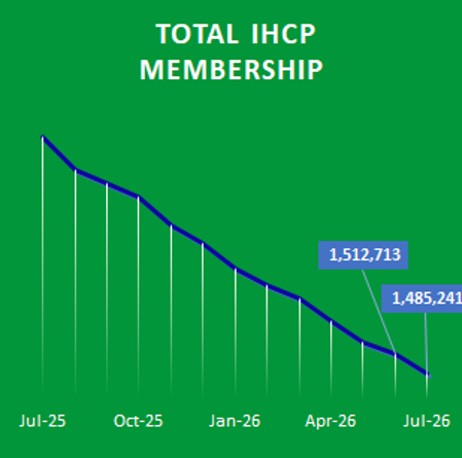
Total Membership decreased in July. With 1,485,241 members, there were 27,472, or 1.82%, less members in July 2026 than in June 2026.
Membership has dropped for fifteen months straight.
| | | | | |