NEWS & VIEWS

Covering Kids & Families of Indiana Newsletter   

January 29, 2026

PUBLIC POLICY

2026 Indiana Legislative Session


In a rare occurrence, lawmakers delayed the start of this week due to winter weather across Indiana. To accommodate, the House pushed 2nd and 3rd reading deadlines back to Thursday and Monday, respectively, compressing an already short session.


As deadlines pass, the number of bills remaining in the process wanes. To see all the bills still moving, scroll this page. Bills in blue type are still active and those in gray type are dead.


CKF is watching several bills relating to schools and child health. HB 1004 has language related to automated external defibrillator (AED) requirements in schools. In recent years, the General Assembly passed legislation requiring schools to have AEDs in more spaces, but this year are seeking to relax that provision. Senate Bill 78, which requires schools to have a "bell to bell" plan for prohibiting student devices, passed but not without opposition, 28-19.


Senate Bill 1 codifies Medicaid provisions from H.R. 1/OBBBA including changing some immigrant eligibility, limiting continuous eligibility/requiring more frequent redeterminations, and setting up the framework for work requirements. In addition, the bill limits SNAP enrollment as well as what items can be purchased with SNAP benefits.


Senate Bill 285 makes camping in public a misdemeanor, aka criminalizing homelessness. The author's stated goal is to connect homeless neighbors with resources, but the policy is one that has been shopped to states from a conservative think tank, Cicero Institute. SB 285 passed out of the Senate 29-19 amid concerted efforts from those serving the homeless community. 


The legislature is also discussing bills about the death penalty, jury duty exemption for women breastfeeding, hospital matters, and tax provisions, to name a few. Follow everything CKF is tracking here.

CMS Approves Waiver Amendment for FSW


The Centers for Medicare and Medicaid Services (CMS) has approved a waiver amendment for the Family Supports Waiver (FSW). 


The amendment includes:

  • new self-directed options for participant assistance and care (PAC), respite, and workplace assistance
  • the addition of benefits counseling as an available service
  • updating behavioral support services
  • combining the two separate services of home modification and home modification assessment into one service
  • recreational and music therapy limits of 6 hours monthly
  • replacement of level-of-care screening tools
  • and more.

SCHOOLS & EARLY CHILDHOOD

Call for ISHN Conference Partners is Open!

Sponsors & Exhibitors


Submission Deadline: May 1, 2026


The theme of ISHN 2026 is Champions in Action: Empowering Healthier Hoosier Kids. This conference offers a winning opportunity for school health professionals and youth-serving adults to share expertise and foster collaboration while earning free continuing education credits. Consistent, caring relationships are the foundation of youth well-being, learning, and long-term success. Attendees will learn practical tactics and inspiring strategies to guide and support kids on their journey to becoming confident champions of their health and future. 

Census Bureau Releases SAIPE Data


The median estimated poverty rate of children ages 5 to 17 in U.S. school districts in 2024 was 12.5%, according to data released by the U.S. Census Bureau. The new data come from the 2024 Small Area Income and Poverty Estimates (SAIPE), which provide the only single-year income and poverty statistics for the nation’s 3,143 counties and 13,126 school districts.


The U.S. Department of Education plans to use the 2024 estimates to calculate and provide funding to states and school districts in the 2026-2027 school year for Title I and several other federal education programs.

OUTREACH & ENROLLMENT

Data from State-Based Health Insurance Marketplaces


A new analysis from the State Marketplace Network looks at preliminary enrollment data reported from the State-based health insurance Marketplaces (SBMs). Several SBMs indicate that early trends are a warning sign of more disenrollments in the months to come, while a significant number of those who remain enrolled have shifted from gold or silver to bronze plans.

Work Requirements


While work requirements are not expected to be implemented until the end of 2026, they are not altogether new. The resources below can help Hoosiers better understand work requirements and how they may be implemented*.


KFF has a website dedicated to tracking implementation of the 2025 Reconciliation Law Medicaid work requirements. The site includes an overview of state and federal data and policies.


Modern Medicaid Alliance created a brief defining “medical fraility under OBBBA. The Act delegates authority to the Centers for Medicare and Medicaid Services (CMS) to establish an operative definition and determination process, which will rely on current US code as detailed in the brief. CMS implementation and state administration will determine the scope and application of the medical frailty exemption. States will be required to determine if medical fragility is a temporary (certification every six months) or permanent (certification every 12 months) designation.


*Readers are cautioned that the final rules governing Indiana's policies will be published by the Indiana Family & Social Services Administration (FSSA) in releases, bulletins and updates to the policy manual.

Federal Poverty Guidelines


Federal Poverty Guidelines are updated annually in January. Traditionally, Indiana has updated Medicaid Guidelines on March 1st.

Persons in Household

Poverty Guideline

1

$15,960

2

$21,640

3

$27,320

4

$33,000

5

$38,680

6

$44,360

7

$50,040

8

$55,720


Add $5,680 for each additional person

RESOURCES

2025 Mental Health Index


Indiana Mental Health Roundtable released the 2025 Mental Health Index that breaks down key data points as well as information on training and providers available in each county. They also produced a state-level narrative

Benefit Management Resources


The Indiana Justice Project is a non-partisan, non-profit legal advocacy organization that focuses on health, housing, and food insecurity. The following resources are available for use and sharing:


Tactical Urbanism Grants


The Division of Nutrition and Physical Activity (DNPA)’s tactical urbanism demonstration project grant funding is open for applications through the end of February. The announcement can be found here.

TRAININGS

Culture as Catalyst: Youth Action to Take Down Tobacco


Culture defines what is celebrated, what is ignored, and what is considered “normal.” For decades, Big Tobacco has used culture, from music to media and identity to market harmful and addictive products to young people and communities of color.


To prepare for Take Down Tobacco National Day of Action, this installment of Campaign for the Culture conversation series will center youth voices at the intersection of identity, creativity and advocacy. Panelists will explore what becomes possible when young people transform culture into a catalyst for change – and how momentum can be turned into meaningful action


Date: February 25, 2026

Time: 7pm ET

Location: Virtual

Cost: FREE

TOBACCO PREVENTION & CESSATION

Multiple Tobacco and Nicotine Product Use

Among Young People


A Preventive Medicine Reports study shows that multiple tobacco and nicotine product use among youth ages 15–24 increased from 2021 to 2024, with dual use of cigarette and e-cigarette being most common. Oral nicotine pouches are increasingly used alongside, rather than instead of, e-cigarettes and cigarettes, raising concerns about higher nicotine exposure. Usage patterns vary by age, gender, race, and financial status, and the growing prevalence of poly use raises concerns about increased nicotine dependence and health harms, underscoring the need for ongoing monitoring and expanded cessation support.

ENROLLMENT TRENDS

IHCP Membership


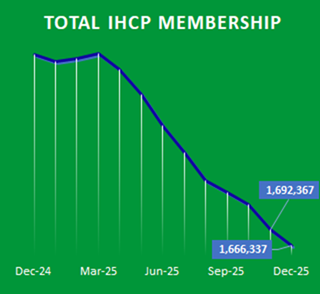
Total Membership decreased in December. With 1,666,337 members, there were 26,030, or 1.54%, less members in December 2025 than in November 2025.


Total Membership has fallen by over 304,000 since March 2025.

Facebook  X  LinkedIn

© 2024 Covering Kids & Families of Indiana | All Rights Reserved