NEWS & VIEWS

Covering Kids & Families of Indiana Newsletter   

September 11, 2025

PUBLIC POLICY

Catastrophic Coverage


The Centers for Medicare and Medicaid Services (CMS) and the Department of Health and Human Services (HHS) have revealed that access to catastrophic health coverage will be expanded starting November 1st this year. The announcement comes ahead of the projected soar in health insurance premiums for the 2026 plan year, as enhanced tax credits for Affordable Care Act (ACA)-compliant plans are set to expire due to Congress's decision not to renew.


Catastrophic plans offer lower monthly premiums - but high deductibles - to protect consumers from high medical costs in the event of serious illness or injury. Catastrophic plans are NOT comprehensive health insurance; however, plans are required to cover three primary care visits pre-deductible. The coverage is for consumers who are ineligible for advance payments of the premium tax credit (APTC) or cost-sharing reductions (CSRs).

ACA Tax Subsidies


At the same time HHS issued new guidance to broaden access to lower-cost catastrophic plans based on income, House Republicans introduced a bill to extend the subsidies for one year—pushing the debate past the 2026 midterms—as both parties position around policies affecting ​​the affordability of health coverage that 24 million people now get in the federal and state marketplaces.

2025 State of Coverage Policy Summit


With the One Big Beautiful Bill Act and Indiana's own SEA 2, the Medicaid program has been the target of many proposals and concepts for reform. Throughout the Federal and State policy discussions, the rising costs of the Medicaid have been at the forefront, but rarely were the details of the federal-state partnership explained. 


Please attend the 2025 CKF State of Coverage Policy Summit to hear experts introduce the history and role of the Federal Medical Assistance Percentage (FMAP) formula. Speakers will also explore the current and proposed ideas of how the State meets its share of the Medicaid funding equation. 

SCHOOLS & EARLY CHILDHOOD

Questions About the Impact of Social Media on Children and Youths' Mental Health?


The AAP Center of Excellence on Social Media and Youth Mental Health has created a Q&A Portal where families, educators, clinicians, and young people can find evidence-based answers to their most pressing questions about social media, technology, and youth wellbeing.

OECOSL Announces Updated Child Care Voucher Rates


The Indiana Family and Social Services Administration’s Office of Early Childhood and Out-of-School Learning (OECOSL) announced revised Child Care and Development Fund (CCDF) voucher reimbursement rates.


As of July, approximately 55,000 Hoosier children rely on CCDF vouchers—a decrease from the December 2024 peak of 68,000, yet still markedly above the pre-pandemic average of 35,000 recipients.

 
Facebook  LinkedIn

OUTREACH & ENROLLMENT

PE Performance Standards


Indiana Health Coverage Programs released a new bulletin on September 2, 2025 outlining required updated performance standards for qualified providers (QPs) in making presumptive eligibility (PE) determinations.


The Family and Social Services Administration (FSSA) will use the following performance standards to review qualified providers on a quarterly basis:

  • 95% of individuals determined presumptively eligible by QP must submit a full application.
  • 95% of the full applications completed by presumptively eligible individuals must be completed with sufficient information to determine eligibility.
  • 95% of those who submit the full application must be determined to be eligible for an IHCP program.


If providers are found to have violated these performance standards, then:

  • For the first violation in a calendar year, the QP will be notified in writing no later than five days after determination of a violation.
  • For the second violation within a 12-month period of the first violation, the QP will be notified in writing no later than five days after determination of a second violation.
  • For a third violation within a 12-month period of the second violation, the QP will no longer be qualified to make presumptive eligibility determinations.


Training will be offered at a later date. For questions, email presumptiveeligibility@fssa.in.gov. 

Uninsured


The US Census released new reports showing that in 2024, 92% of the population had health insurance for all or part of the year with 53.8% of people getting their coverage through employment based health insurance.


Other reported data include:

  • In 2023, the uninsured rate was also 8%.
  • In 2024, farming, fishing and forestry occupations had among the highest uninsured rates.
  • The 2024 public coverage rate was 0.8% lower than in 2023 due to changes in Medicaid coverage post pandemic (Medicaid unwinding). Medicaid covered 17.6% of the insured in 2024 compared to 18.9% in 2023.

RESOURCES

The Importance of Diapers and Period Products


Families with young children often struggle to afford basic necessities like diapers and period products. Caregivers are forced to make trade-offs that can  can negatively impact the health and well-being for the family. According to the National Diaper Bank Network’s Diaper Check 2024, about half of families with children ages 3 and younger struggle to afford diapers. For families with low incomes, about 60% said they could not purchase enough diapers to keep their children healthy and dry. Fewer diaper changes can put children at risk of developing rashes or even urinary tract infections.


For postpartum and menstruating mothers, the financial challenges of being a new parent are compounded; 35% of families that are diaper insecure also struggle to afford period products.


A new Urban Institute analysis estimates how many diapers it would take to address the gap faced by households with children three and younger with incomes below 300% federal poverty level (FPL). Their interactive map shows the need for each county in the country. For example, it would take 851,400 diapers to ensure families with incomes under 300% FPL in Monroe County, Indiana had enough diapers to keep their young children healthy and dry.

TRAININGS

Heart to Heart Conference


The Heart to Heart Conference happens this month! Indiana Family to Family offers a free virtual conference for families and professionals to learn and connect in support of children and youth who have various health and mental health needs and disabilities. Covering Kids & Families of Indiana will be presenting on Medicaid in 2025.


Visit https://www.inf2f.org/heart-to-heart-conference.html to register and learn more!

Coverage for People with Diabetes


Georgetown University’s Center on Health Insurance Reforms and the American Diabetes Association are hosting a webinar, Navigating New Coverage Changes – What People with Diabetes Need to Know at 1 pm ET on Thursday, September 18, 2025. 

Marketplace Webinars


Beyond the Basics continues their annual fall Marketplace webinar series every Tuesday through October 28th. Visit this page to review topics and sign up for the webinars.

TOBACCO PREVENTION & CESSATION

Are Kids Using Nicotine in the Classroom?


According to the Truth Initiative, educators and parents should be alert to discreet yet increasingly popular nicotine products like flavored oral pouches (e.g., Zyn, On!, Rogue, Velo) and high-tech e-cigarettes featuring screens, Bluetooth, speakers, and even built-in games that can resemble gaming devices. These products are easy for youth to conceal and appeal to them through flavors and novel design, though as of 2024, only around 1.8% of middle and high schoolers reported using oral nicotine pouches. Schools are encouraged to respond with supportive interventions, not punitive discipline, by educating students about the risks, offering cessation resources and helping students quit rather than penalizing them.


Connect with CKF

Tobacco Prevention & Cessation program on social media!

Facebook

ENROLLMENT TRENDS


IHCP Enrollment


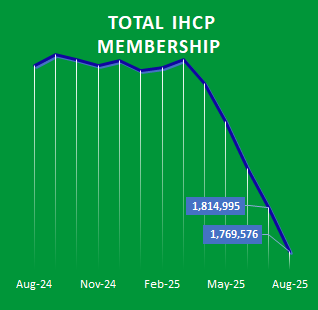
Total Membership decreased in August. With 1,769,576 members, there were 45,419, or 2.5%, fewer members in August 2025 than in July 2025.


In the last five months, IHCP membership dropped by over 201,000! 

 
Facebook  X  LinkedIn

© 2024 Covering Kids & Families of Indiana | All Rights Reserved