|
Marketplace Updates
Beyond the Basics is offering Frequently Asked Questions (FAQs) on the new marketplace regulation and the new budget law. These FAQs answer questions on enrollment, eligibility for immigrants, post enrollment issues, and advance premium tax credits (APTC).
Here are a few of the items covered:
- As of August 25, 2025, the low-income special enrollment period (SEP) for people with incomes below 150% of federal poverty level (FPL) will no longer be in effect.
- Insurance issuers can now condition future enrollment on paying past due premiums with no limit on the look back period. States can prohibit this practice.
- Starting in tax year 2026, there will be no repayment limits protecting people from owing large sums when they file their taxes if they experience an increase in income during the year.
- Beginning January 1, 2026, lawfully present immigrants with income below 100% FPL who are ineligible for Medicaid due to their immigration status will also be ineligible for APTC. This includes immigrants in the five-year waiting period for Medicaid.
- Beginning January 1, 2027, only U.S. citizens, legal permanent residents (also known as green card holders), Cuban and Haitian entrants, and Compact of Free Association (COFA) migrants will be eligible for premium tax credits (PTCs). People with other immigration statuses, including refugees, people granted asylum, certain victims of domestic violence, certain survivors of labor or sex trafficking and many other statuses will no longer be eligible for PTCs.
| |
Becoming a CDO
Certified Application Counselor Designated Organizations (CDOs) offer application assistance for the Marketplace by managing the work of Certified Application Counselors (CACs). CDOs must go through an approval process with the Centers for Medicare and Medicaid Services and then CACs can go through the approved training to be certified. CDOs can be health centers, health care providers, community service agencies, non-federal government agencies or nonprofit organizations.
To provide application services for the next Marketplace open enrollment (November 1, 2025 – January 15, 2026), organizations should sign up to become a CDO before September 2025.
If you are unsure whether your organization has an active or expired CDO agreement, email CMS at cacquestions@cms.hhs.gov.
| | |
Medicaid Work Requirements Implementation: Engaging Members and Community-Based Organizations
With the passage of the 2025 budget reconciliation bill (H.R. 1/One Big Beautiful Bill Act), state Medicaid agencies must implement new work requirements for certain Medicaid members ages 19 to 64. With an implementation deadline of December 31, 2026, these federal mandates challenge states to develop policies that are understandable and easy to navigate for members.
This new brief from the Center for Health Care Strategies (CHCS) outlines approaches states can use to partner directly with Medicaid members and CBOs in implementing work requirements that reflect community input and help minimize coverage disruptions.
See also a new CHCS Policy Cheat Sheet, A Summary of National Medicaid Work Requirements, that synthesizes key details of the new federal Medicaid work requirements, including timeline, populations impacted, exemption categories, and more.
| | |
Yearly Income Guidelines and Thresholds
for Coverage Year 2026/Tax Year 2025
This reference guide from Beyond the Basics includes important information for the coming coverage and tax years, including federal poverty level income equivalents, expected premium contribution percentages by income, the employer coverage affordability threshold, out-of-pocket maximums, the affordability exemption threshold, federal tax filing thresholds, and repayment caps for the advance premium tax credit. Previous year guidelines including Coverage Year 2025/Tax Year 2024 are also available.
| | |
Medicaid Food Security Network (MFSN)
Quarterly Convening
The Medicaid Food Security Network brings together food advocates and healthcare stakeholders to discuss current policy challenges and solutions for improving food security through Medicaid.
This quarterly convening will include voices that will showcase how Food is Medicine (FIM) in Medicaid remains important as ever because it can create long-term healthcare savings in an environment impacted by federal cuts to Medicaid and SNAP.
This meeting will be on September 4, 2025 at 1:00 pm EST
| | |
Marketplace Fall Series
Beyond the Basics has scheduled their annual Marketplace Fall Series every Tuesday starting September 9th. Visit this page to review topics and sign up for the webinars.
| | |
From Longevity to Vitality: Applying the Science of Aging
Join the National Academies of Sciences, Engineering, and Medicine for the kickoff of a compelling three-part webinar series that applies insights from the social and behavioral sciences to one of the most urgent challenges of the time: supporting healthier, more connected lives as people age. Sponsored by the Hauser Policy Impact Fund, these webinars work to connect social science analysis and synthesis to help guide evidence-based policy decisions.
In this webinar, participants will explore:
- How people learn and adapt as they grow older
- Strategies to boost cognitive health and healthy aging across the lifespan
- The profound public health impacts of loneliness and isolation
- What policymakers at all levels can do today to support aging populations
| | TOBACCO PREVENTION & CESSATION | | |
E-cigarette and Cigarette Sales Decline After California Law Eliminates Sale of Flavored Tobacco
A recent study by the CDC Foundation, Truth Initiative, and the University of Southern California demonstrates that California’s ban on flavored tobacco—enacted beginning in January 2023—led to substantial reductions in both e-cigarette and cigarette purchases: average per-capita nicotine sold via e-cigarettes dropped by 37% and cigarette pack sales fell by 10.6% in the first 18 months. Although non-compliant flavored products continued to circulate—especially disposable “clear” or unbranded e-cigarettes, which comprised 94% of illegal e-cigarette sales—the overall decline in tobacco product consumption remained clear. In response to the rise of these cooling-sensation substitutes, California expanded its law in January 2025 to ban any products that produce such sensations. In 2025, Indiana introduced a bill to ban flavored tobacco but was not passed.
| | | | |
Connect with CKF
Tobacco Prevention & Cessation program on social media!
| | | |
|
IHCP Enrollment
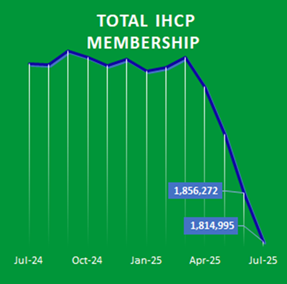
Total Membership decreased in July.
With 1,814,995 members, there were 41,277, or 2.22%, less members in July 2025 than in June 2025.
In the last four months, IHCP membership dropped by over 155,000!
| | | | | |