|
2026 Indiana Legislative Session
And just like that, the 2026 legislative session is over.
Last edition, CKF detailed some bills that had been signed into law, including SEA 1, that makes significant changes to Medicaid. Many more bills have been signed, a handful are awaiting signature, and one went into law without being signed. (In Indiana, if bills are not signed within the allotted time, they automatically become law.)
Other items of interest:
-
SEA 78 bans cellphones, personal laptops, smart watches, and other devices from schools for the full school day AND says any learning on devices must be done with school issued devices.
-
SEA 144 increases the penalty for a person who: (1) makes a delivery sale of an e-liquid to an individual less than 21 years of age; (2) sells or distributes a tobacco product to a person less than 21 years of age; and (3) purchases a tobacco product for a person less than 21 years of age. It also prohibits advertising an e-liquid or vapor product within 1,000 feet of a school property.
-
SEA 285 makes it a misdemeanor to camp in public (aka criminalization of homelessness). You can find a summary here from Prosperity Indiana, one of the major opponents of the legislation.
-
HEA 1004 is a continuation of the deregulation of public education. CKF was focused on the section requiring Automated External Defibrillators (AEDs) at school events. Early in session, there were efforts to remove the requirement, but in the end, AEDs are required and schools have guidance on how to incorporate AED locations in school emergency plans.
-
HEA 1114 requires coverage for certain prescriptions for advanced, metastatic cancer and associated conditions.
-
HEA 1358 changes the statewide standing order for the dispensing of a "smoking cessation product" to a "tobacco, vaping, or nicotine cessation product".
-
HEA 1408 limits minors’ use of social media by dictating how social media providers can operate in Indiana, similar to the adult site age verification law from a few years ago.
The governor still has time to act on the following bills:
-
SB 185 prohibits wholesale distribution of tobacco products without a certificate and details actions if violated. It explicitly does not authorize manufacture or sale of products containing a controlled substance. It defines "foreign adversary product" and prohibits those from being sold in Indiana. Manufacturers of an e-liquid or product must obtain a permit starting in 2024. As of 3/12/26, this bill was not yet signed into law.
-
SB 1277 amends the duties of FSSA concerning Medicaid home and community based services waivers. As of 3/12/26, this bill was not yet signed into law.
What happens next? Some laws go into effect immediately, many go into effect on July 1, and some go into effect on the start of the next state fiscal year, October 1. Other laws may need state agencies to develop the policies outlined by the General Assembly. In those cases, CKF will watch for implementation details and communicate them here.
| |
|
Notice of Change in Applied Behavioral Analysis Coverage
FSSA's Office of Medicaid Policy and Planning (OMPP) published a notice of proposed changes to methods and standards governing ABA coverage and policies. FSSA-OMPP proposes to submit a State Plan Amendment to modify coverage for ABA services. The amendment would revise ABA coverage to only be available through Early and Periodic Screening, Diagnostic, and Treatment (EPSDT), Learn more about EPSDT here.
The full notice can be found here.
| | SCHOOLS & EARLY CHILDHOOD | | | | |
ISHN Conference
The theme of ISHN 2026 is Champions in Action: Empowering Healthier Hoosier Kids. This conference offers a winning opportunity for school health professionals and youth-serving adults to share expertise and foster collaboration while earning free continuing education credits.
Consistent, caring relationships are the foundation of youth well-being, learning, and long-term success. Attendees will learn practical tactics and inspiring strategies to guide and support kids on their journey to becoming confident champions of their health and future.
Date: June 15-17, 2026
Location: Plainfield, IN Embassy Suites Hotel
Cost: FREE
| | |
Sponsors & Exhibitors
Submission Deadline: May 1, 2026
| | |
Helping Low-Income Families Access WIC
and Free Early Childhood Education
In a newly released study, administrative burdens are analyzed in the application process for public assistance programs. Specifically, researchers looked at whether Louisiana could increase take-up rates for WIC (the Special Supplemental Nutrition Program for Women, Infants, and Children). Researchers found that providing information and/or support has large effects on WIC application rates yet smaller effects on actual enrollment.
| | |
New IHCP Eligibility Guidelines
As of March 1st, Indiana Health Coverage Programs (IHCP) aka Medicaid updated income eligibility guidelines. New income guidelines can be found here.
| |
Health Savings Accounts
Starting this year, consumers with Marketplace bronze and catastrophic plans are eligible to set up Health Savings Accounts (HSAs). Beyond the Basics created a new “Key Facts” Explainer on HSAs which includes 12 FAQs about HSA eligibility, enrollment, tax parameters, and other considerations. While Certified Application Counselors can NOT assist consumers with signing up for HSAs, they can share this document and direct consumers to information offered by the Federal Deposit Insurance Corporation (FDIC).
In light of this change and others being proposed, the Center on Budget and Policy Priorities published a blog, Health Savings Accounts Can Be a Bad Deal for Low-Income Marketplace Enrollees, which discusses how HSAs provide less financial benefit to people with low or moderate incomes and are not a substitute for quality health coverage.
| |
Enrollment Data
The Georgetown University Center for Children and Families launched a new tracker, State by State Medicaid and CHIP Enrollment Data, utilizing data from January 2025 to the most recent month available. It also has some historical data back to December 2019.
Note: The Covering Kids & Families of Indiana newsletter - News & Views - also includes regularly updated enrollment data and analysis. Scroll to the bottom of this email!
| |
|
Presumptive Eligibility
The Family and Social Services Administration (FSSA) updated the Provider Reference Module for Presumptive Eligibility (PE). Some of the updates include adding certified community behavioral health clinics (CCBHCs) to the list of qualified providers (QPs) for PE and clarifying PE end dates which can vary depending upon whether or not a full application is submitted.
Additionally, it added a section about performance standards that are being evaluated quarterly starting with the first quarter this year including:
- 95% of individuals determined presumptively eligible by the QP must submit a full application.
- 95% of the full applications must be completed with sufficient information to determine eligibility.
- 95% of those applications must be determined eligible
| | |
Updates to the NASHP/HARP
Reentry Resource Repository
NASHP, in partnership with The Health and Reentry Project (HARP), added new resources to the Reentry Resource Repository, including materials on the One Big Beautiful Bill Act (OBBBA) and its implications for reentry, health coverage, and public safety.
Explore the repository to find resources on topics such as Medicaid and reentry, data sharing and system integration, engaging individuals with lived experience, and new federal policy developments like OBBBA.
| | |
Local Governments' Role in Medicaid Financing
In a recent article in Health Affairs, the author outlines how local governments play an important role in Medicaid financing. Medicaid is jointly financed by the federal government and states, but local governments also play a significant role as they help contribute to the state’s share of Medicaid. While funding for the federal share comes from federal tax revenue—the state share actually comprises three different buckets: state general funds; health care-related provider taxes; and local government funds.
| | |
Strategies and Innovations in Medicaid Managed
Long-Term Services and Supports
Tuesday, March 31, 3–4 p.m. ET
NASHP, in partnership with Arnold Ventures, is hosting a webinar to address policies, strategies, and innovations to improve care for individuals enrolled in Medicaid managed long-term services and supports. Indiana is one of the states included in the report.
Given federal changes and Medicaid budget constraints, these state strategies are more important than ever.
| |
Virtual Sexual Assault Forum
Thursday, March 26, 11am ET
The Latino Coalition invites all service providers to the Virtual Sexual Assault Forum. This year’s forum will provide valuable tools, knowledge, and practical strategies to better support survivors of sexual assault and technology-facilitated abuse. Don’t miss this opportunity to gain critical insights, strengthen your skills, and connect with others committed to supporting survivors and building safer communities.
For free registration, click here or call 317-926-4673.
| |
Facing the Future: Understanding Federal Policy Changes and their Effect on Coverage and Affordability
Wednesday, April 8, 3pm ET
The Consumer Healthcare Experience State Survey (CHESS) consistently reveals that affordability remains the top barrier preventing individuals from obtaining health insurance and accessing necessary care. With the enactment of the House Reconciliation bill (H.R. 1), these financial challenges are poised to intensify for many Americans. Join the Hub and a panel of experts for a webinar providing an overview of the projected impacts of H.R. 1 on Medicaid and Marketplace coverage and affordability.
| | |
What Changed, What Matters: Navigating the Latest Vaccine Schedules
Tuesday, May 12, 3-4pm ET
Join Dr. Tracie Newman, MD, MPH, FAAP as she provides a description of the most significant updates, compares the new HHS schedule with evidence-based recommendations, and highlights areas that may create confusion in clinical practice.
| | TOBACCO PREVENTION & CESSATION | | |
Nicotine Dependence: Screening to Support
Webinar Recording
On March 11, CKF hosted a webinar Nicotine Dependence: Screening to Support where subject matter experts discussed the harmful effects of smoking and the effects of a $2 cigarette tax increase. Panelists discussed how nicotine dependence impacts referrals for addiction and substance use disorder treatment. Keep an eye on this space in future editions for the link to the recording.
| | | |
|
IHCP Membership
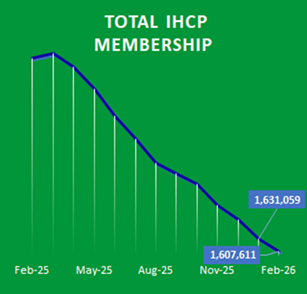
Total Membership decreased in February. With 1,607,611 members, there were 23,448, or 1.44%, less members in February 2026 than in January 2026.
Total Membership has fallen for eleven months in a row.
| | | | | |