|
ISHN 2026 Photo Recap
YOU are what makes the ISHN Conference great. Thank you!
| | You can find all the photos from ISHN 2026 here. | | |
Chronic Absence as a Public Health Priority
Chronic school absence, which is tied to adverse educational, health, and social outcomes, has been on the rise since the Covid-19 pandemic and now affects more than one in four students in the United States. In a recent article, Catherine Falconer of the Johns Hopkins Bloomberg School of Public Health frames chronic absenteeism as a public health issue that reflects unmet health and social needs.
Key points from the article include:
- Chronic absence should be recognized as a public health indicator and early warning sign that systems are failing to meet the developmental, social, and health needs of students.
- Improving student attendance requires cross-sector policy action across education, health, and public health to address the structural and social determinants of chronic absence.
- A prevention-oriented public health approach is essential, focusing on root causes that schools cannot address alone such as poor health, housing instability, and unreliable transportation.
| | |
Community Engagement Resources
A recent IHCP bulletin (BT2026108 - June 16, 2026), announced that on July 6th, the Indiana Family and Social Services Administration (FSSA) will release a partner toolkit on FSSA: Home. The toolkit will include materials for providers to develop digital and print materials as well as key resources such as FAQs, core messaging, and a glossary of terms for the community engagement/work reporting requirements set to go into effect on January 1, 2027.
| |
|
Presumptive Eligibility
IHCP bulletin (BT2026100 - June 16, 2026) clarifies when hospitals and other providers will be evaluated on meeting presumptive eligibility performance standards.
- The first evaluation quarter for hospitals will be January 1 – March 31st, 2026.
- The first evaluation quarter for other qualified providers will be July 1st – September 30th, 2026
| | |
Medical Frailty
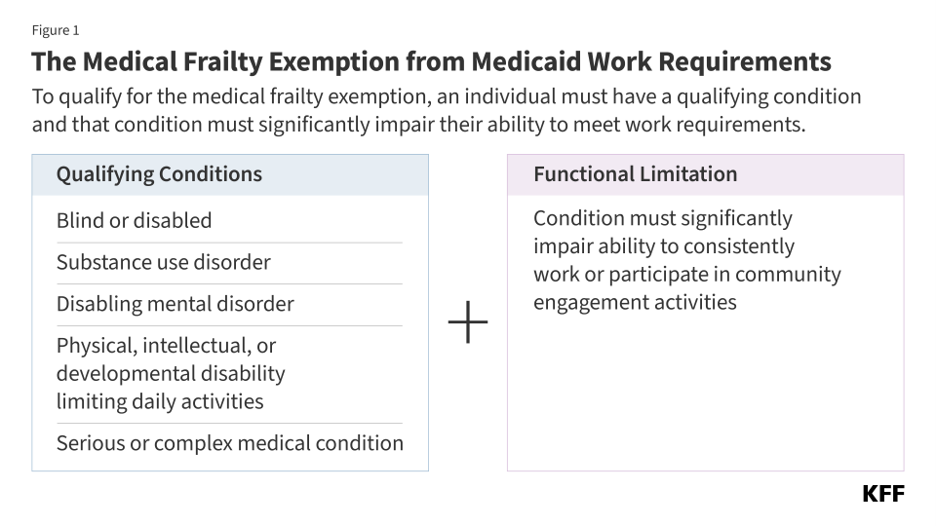
National organizations and states are still responding to the Interim Final Rule released June 1st by the Centers for Medicare and Medicaid Services (CMS), which adopts a more restrictive definition of medical frailty than in OB3. The Rule requires states to not only consider if a person falls into one of a few categories, but to also consider whether the condition impairs the person’s ability to participate in community engagement activities. The additional layer to medical frailty will create challenges for states to implement by the January 1, 2027 deadline, not to mention increasing barriers to individuals seeking an exemption.
The Indiana Family and Social Services Administration (FSSA) is tasked with creating the rules and policies to comply with OB3. The following are elements should be considered:
- States are required to use claims and encounter data from the preceding 12 months to verify medical frailty status before requesting information from the individual; however, it will be difficult to use claims data alone to verify an individual’s ability to work.
- The rule does not provide details on criteria states should use for measuring severity of conditions or ability to meet new requirements.
- Data limitations make it likely that medical frailty determinations will not be automated for many individuals.
- While states may need to rely on confirmation from treating providers to verify medical frailty conditions and ability to participate in community engagement activities, the rule offers little information on what information states need to collect from providers.
- While states are permitted to use self-attestation to verify medical frailty, the rule limits reliance on self-attestation starting in January 2028.
- The rule requires states to verify medically frail exemption status at least every 12 months.
| | |
This is a BIG change to the Medicaid expansion program. Here are some of the many resources covering community engagement/work reporting requirements.
| | |
Certain Marketplace Changes Not Taking Effect
On August 22, 2025, a federal court issued an injunction temporarily stopping seven provisions in the 2025 Marketplace Integrity Final Rule from taking effect. On June 12, 2026, the same federal court struck down certain provisions in the 2025 Marketplace Integrity Final Rule.
The following provisions were struck down by a federal court and will not take effect as planned:
Would have taken effect August 25, 2025
- Allowing insurance companies to add past-due premiums to enrollees’ binder payments. A binder payment is the initial payment required to activate a new insurance policy.
Took effect on August 25, 2025, blocked beginning June 2026
- Allowing less time to resolve data matching issues.
Would have taken effect Plan Year 2026
- Charging some people a fee for passive reenrollment.
- Enabling insurers to offer lower value plans.
Would have taken effect Plan Year 202
- Shortening the open enrollment period.
| | |
6 Things to Know About Heat Illness
Summertime heat is ramping up early this year! Your Local Epidemiologist created a resource to increase knowledge and awareness of heat illness. Stay diligent and informed during the summer heat to be able to assist others in case of heat related symptoms.
| |
Find a Cooling Center Near You with Indiana 211
Extreme summer heat is expected across Indiana over the next several days. Cooling centers will be open throughout the state for those in need of a safe and cool place to stay. Indiana 211 is your trusted resource for an up-to-date, searchable list of cooling center locations and hours in your area. To find a cooling center near you, visit IN211.org.
To report, update or add a cooling center location, contact the Indiana 211 resource team at in211database@fssa.in.gov.
| |
MASH
Medicaid Access Strategy Hub (MASH) a project of NHeLP is offering a nationwide online community to share resources, ideas and questions related to the implementation of OBBBA. MASH is designed for individuals engaging in Medicaid advocacy, those helping individuals enroll in Medicaid, and those monitoring implementation of OBBBA. Be prepared to share information during registration that will be validated before access is granted to MASH resources.
| | |
Tuesday, July 14th at 3pm EST
The Indiana Immunization Coalition’s webinar, Vaccination Updates, will share information on vaccine developments after the June ACIP meeting.
Register here.
| | |
Wednesday, July 22nd 2pm EST
Justice in Aging is presenting, Understanding New Medicaid Work Requirements Rules, which will include an overview of the updated federal rules and major Medicaid eligibility changes introduced by H.R. 1.
Register here.
| | |
Wednesday, July 29th 12pm EST
The Indiana Coalition for Human Services is offering a practical, compliance-focused session on how nonprofits can support civic participation. Participants will learn:
-
What nonprofits can do around elections, and how to stay compliant
- Key advocacy do’s and don’ts
- Current voter-focused initiatives in Indiana
- Tools for voter registration and education, including Vote411
- Insights into voter rights efforts
Register here.
| | |
3rd Tuesday of the month at 2pm EST
The Georgetown Center for Children and Families is hosting a Medicaid Connections webinar series.
July 21, 2026 - Maternal and Infant Health & Justice
August 18, 2026 - Children and Youth with Special Health Care Needs: Health & Justice
September 15, 2026 - Substance Use: Health & Justice
October 20, 2026 - Immigration: Health and Justice
December 15, 2026 - Mental Health and Well-being
January 19, 2027 - Family Preservation: Health & Justice
Register here for the series.
| | TOBACCO PREVENTION & CESSATION | | |
What’s Inside a Vape?
The Truth Initiative explains that while many people assume e-cigarettes contain only nicotine and flavoring, vape products can also expose users to a variety of potentially harmful substances. That includes heavy metals, volatile organic compounds, ultrafine particles, and other toxic chemicals produced during heating.
The ingredients and chemical composition of e-cigarettes vary widely by product, especially among unauthorized and flavored devices, making it difficult for consumers to know exactly what they are inhaling. There are concerns that these substances may pose risks to lung and cardiovascular health, particularly for youth and young adults whose bodies and brains are still developing.
The Truth Initiative emphasizes the importance of educating the public about what is inside vape products and reinforces that avoiding all tobacco and nicotine products is the safest choice for protecting long-term health.
| | | |
|
IHCP Membership
Total Membership decreased
in May.
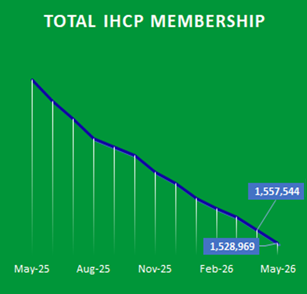
With 1,528,969 members, there were 28,575, or 1.83%, fewer members in May 2026 than in April 2026. Membership has decreased for thirteen months in a row.
| | | | | |