ISHN Conference
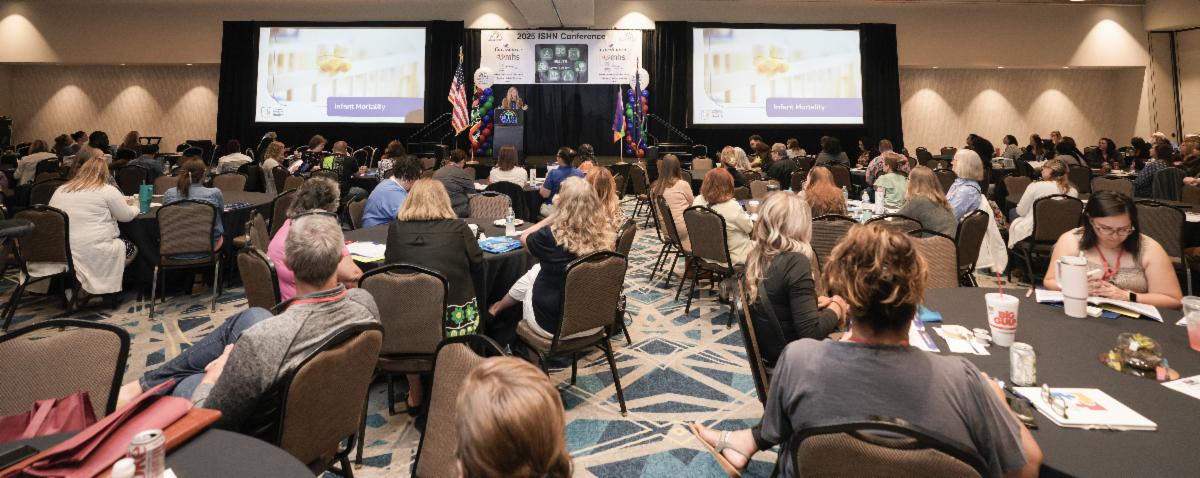
The theme of ISHN 2026 is Champions in Action: Empowering Healthier Hoosier Kids. This conference offers a winning opportunity for school health professionals and youth-serving adults to share expertise and foster collaboration while earning free continuing education credits.
Consistent, caring relationships are the foundation of youth well-being, learning, and long-term success. Attendees will learn practical tactics and inspiring strategies to guide and support kids on their journey to becoming confident champions of their health and future.
Date: June 15-17, 2026
Location: Plainfield, IN Embassy Suites Hotel
Cost: FREE
| | |
Food & Nutrition
Security Matters
When addressing hunger in America, the focus is often on food access. For children's health, the difference between food security and nutrition security is profound. Many families have access to food but struggle to afford or get nutritious options that support a child's healthy growth and development.
| | |
Later Sleep & Wake Times in Teens
When considering ways to improve cardiovascular health, diet and exercise are often at the top of the list. But long-term health, especially in adolescents, might start with something more fundamental: sleep.
| | |
Healthcare.gov
Organizations registered as Certified Application Counselor Designated Organizations (CDOs) recently received a reminder to maintain up-to-date records throughout the two-year certification period. Updates include staff member roster, service locations, available times of service and leadership contacts.
| |
2026 Marketplace Open Enrollment
The Centers for Medicare and Medicaid Services (CMS) released the 2026 Marketplace Open Enrollment Report.
Some key findings include:
- There was a 5% decrease in consumers who signed up for coverage.
- 43% of consumers enrolled in bronze or catastrophic plans.
-
Consumers selecting silver plans decreased from 56% to 43% leading to a lower percentage of
consumer plan selections included cost-sharing reductions (CSRs).
- The number of new consumers declined by 13%.
- Automatic re-enrollees decreased by 19%.
- Remaining steady, 46% of enrollees had income between 100 – 150% federal poverty level (FPL).
CMS also released Public Use Files at the state, county and zip code level.
| | |
Medicaid Enrollees Should Check for
Duplicate Enrollments
Starting January 1, 2027, OBBBA requires “regular” address checks to identify individuals who are enrolled in Medicaid in multiple states. By October 1, 2029, states must submit certain information at least monthly and at every redetermination to a forthcoming HHS system to check for duplicate enrollment. Advocates should advise enrollees to check for duplicate Medicaid enrollment now and to immediately cancel their enrollment in any state where they do not live to avoid coverage loss later.
| | |
Primary Care
Comprehensive primary care can unlock health improvements and cost savings for patients and taxpayers. By investing in primary care, policy makers can improve the health and wellbeing of all Americans. Click here to see the state of primary care in Indiana.
| | |
How Many People Are Uninsured?
State Health Access Data Assistance Center (SHADAC) and the Robert Wood Johnson Foundation released their annual brief, Comparing Federal Government Surveys That Count the Uninsured: 2025. Based on information from five different surveys, the brief includes the latest estimates of the national uninsured rate, trends in uninsured rates over time, as well as the latest state-level estimates. Indiana’s uninsured rate ranges from 6.2% to 7.5% depending which surveys are used. The brief also analyzes factors that impact variations in these estimates and explores the impact of recent events external to the surveys such as Medicaid continuous coverage during the pandemic.
| | |
Cost of Medical Care
State Health Access Data Assistance Center (SHADAC) updated the Forgone Care Due to Cost measure which shows that rates of forgone care have been steadily increasing in recent years to 12.4% in 2024. For people with Medicaid/CHIP the rate is 17.3% and for the uninsured, the rate is 43.3%. Indiana did the same or slightly better than national averages.
| | |
Hoosiers Vaccinate
Real conversations about vaccines can happen unexpectedly with a friend, family member, coworker, client, or neighbor. Short, calm explanations are more effective than long, complicated ones. Being prepared to share concise, trustworthy facts can help with responses to questions or concerns..
For example, “Vaccines are carefully tested for safety and continue to be monitored even after approval.” These small moments can help combat misinformation and build a healthier community. For more quick and easy advocacy tips, sign up for Hoosiers Vaccinate’ s monthly newsletter.
| | |
Tuesday, April 21 at 2pm EST
Join Beyond the Basics for a webinar Medicaid Changes Coming Soon: Work Requirements and More Frequent Renewals. Presenters will explain the policies, how they affect people applying for and renewing coverage, and what navigators can do to inform their community and help prevent coverage loss.
| |
Wednesday, May 6 at 23:30 pm ET
Substance use disorder (SUD) affects millions of people in the U.S., including a disproportionate share of Medicaid members. About 21 percent of Medicaid members are estimated to have an SUD, and many face barriers to treatments due to limited service capacity, stigma, and fragmented systems. A “no wrong door” approach to care helps address these gaps by ensuring that Medicaid members can connect to appropriate treatment through any entry point — whether emergency response, correctional settings, primary care, or community-based services.
Health care systems and providers, Medicaid and behavioral health officials, plans, and representatives from community-based organizations are encouraged to attend this 90‑minute event. Register here.
| | |
Maternal Child Health Healthcare Coverage Handbook
The Maternal Child Health Healthcare Coverage Handbook was recently released by Covering Kids & Families of Indiana (CKF‑IN). Special thanks to the project sponsors, the Indiana Department of Health (IDOH) and the Indiana Family and Social Services Administration (FSSA). This project represents a significant collaborative achievement, and we are grateful to the individuals across Indiana who were essential to bringing this resource to life. The collective effort reflects a shared commitment to clarity, impartiality, and practical guidance for all those navigating maternal and infant health coverage options.
The handbook is available as an electronic, web-based resource that includes live links to programs, policies, and supporting materials. This format allows for easier navigation, timely updates, and expanded access for providers, partners, and families throughout the state. It is the hope that this handbook will serve as an evergreen, valuable, user-friendly resource that strengthens coordination, supports informed decision-making, and ultimately improves health outcomes for Hoosier mothers and their infants. A printed hard copy is available upon request to info@ckfindiana.org.
| TOBACCO PREVENTION & CESSATION | | |
Understanding ENDS & Dual Use
Electronic Nicotine Delivery Systems, such as e-cigarettes and vapes, continue to rise in popularity across Indiana, especially among younger adults. While often perceived as a safer alternative, many individuals engage in dual use, meaning they use both traditional cigarettes and e-cigarettes.
Dual use is important to recognize because individuals may not always consider vaping to be “tobacco use,” leading to missed opportunities for education and support. According to the Centers for Disease Control and Prevention (CDC), using multiple nicotine products can delay quit attempts and increase overall exposure to harmful substances.
- According to IDOH, nearly 20% of adults who smoke also use e-cigarettes.
- According to the CDC, e-cigarette use is highest among young adults ages 18–24.
- According to the National Cancer Institute, dual use is associated with lower quit success rates.
Everyone, including providers, community partners, and outreach professionals, plays a role in addressing this issue. Using a simple Ask, Advise, Refer approach can make a meaningful impact:
-
Ask about all forms of nicotine use, including vaping
-
Advise that dual use can make quitting more difficult
-
Refer individuals to free, evidence-based services like Quit Now Indiana
Providing clear, non-judgmental information and connecting individuals to trusted resources can help support healthier communities across Indiana.
| | | |
|
IHCP Membership
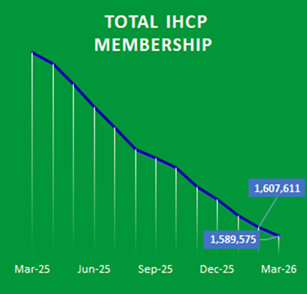
Total Membership decreased in March. With 1,589,575 members, there were 18,448, or 1.12%, less members in March 2026 than in February 2026.
Total Membership has fallen every month for an entire year.
| | | | | |