|
All Eyes On Nebraska
The One Big Beautiful Bill Act (OB3) requires states to implement community engagement requirements for the Medicaid expansion population, or be making a good faith effort, by January 1, 2027. Section 71119 directs states to require certain Medicaid enrollees to spend at least 80 hours each month in activities, such as work, job training, education, or community service, as a condition of eligibility. The requirement applies to able-bodied adults between the ages of 19 and 64 who have no dependents under the age of 14.
Nebraska plans to "go live" with their work requirements on May 1, 2026, making them the first state in the nation to implement the new requirement. Folks in the Medicaid space are watching closely.
Note: Those in traditional Medicaid, including those with lower incomes, pregnant women, children, and those with certain disabilities, will not have to comply with work requirements.
| | |
Financial Stability = Preventive Public Health
In a new Milbank Quarterly Opinion, Catherine Ettman and Andrew Anderson of the Johns Hopkins Bloomberg School of Public Health argue that financial stability is a form of preventive public health.
“By aligning labor, education, financial, and social policy with public health objectives, policymakers can address affordability as a root cause of health disparities,” the authors say. “Policies that strengthen household wealth are not peripheral to public health; they are essential infrastructure for improving population health.” Read more here.
| | SCHOOLS & EARLY CHILDHOOD | | | | |
ISHN Conference
The theme of ISHN 2026 is Champions in Action: Empowering Healthier Hoosier Kids. This conference offers a winning opportunity for school health professionals and youth-serving adults to share expertise and foster collaboration while earning free continuing education credits.
Consistent, caring relationships are the foundation of youth well-being, learning, and long-term success. Attendees will learn practical tactics and inspiring strategies to guide and support kids on their journey to becoming confident champions of their health and future.
Date: June 15-17, 2026
Location: Plainfield, IN Embassy Suites Hotel
Cost: FREE
| | |
How Cannabis Affects Adolescent Brains
In a study of more than 11,000 kids and teens, those who use cannabis showed slower progression over time when it came to memory, attention, language, and cognitive processing speed. Often, those who used cannabis displayed a cognitive advantage at early ages, only to be surpassed by those in the control group as they aged.
The research, published in Neuropsychopharmacology, used data from the NIH-supported Adolescent Brain Cognitive Development Study, following youth from around age nine through 17. Cannabis use was self-reported and confirmed with biological testing from hair, urine, and saliva samples.
Relatedly, another study published in JAMA Network Open found that rates of adolescent cannabis use increased after recreational use was legalized in California, but decreased after the Covid pandemic.
| | |
Social Media Addiction
Algorithms. Beauty filters. Endless scrolling. The lawsuit over "social media addiction" against Meta and Google ultimately came down to these elements. A jury found social media companies were negligent when designing apps where tweens and teens would come to spend roughly one-fifth of their day. Learn more here.
| |
Student Mental and Behavioral Needs
Student mental and behavioral health needs are growing more complex. In a recent national survey, 58 percent of school-based providers reported that student mental health has worsened, up from 46 percent the previous year. With needs rising and staff stretched thin, many school districts are struggling to keep pace. Read more here.
| | |
OB3 Marketplace Applicants Required to Submit Proof
Beginning in plan year 2028, OB3 requires Marketplace applicants to submit proof of eligibility before subsidies can take effect. Applicants must verify their household income, immigration status, eligibility for other coverage, place of residence, family size, and additional requirements are potentially forthcoming. Marketplaces can only waive these requirements for people enrolling during a special enrollment period (SEP) due to a change in household size. Advocates should educate stakeholders on this new requirement now, emphasizing the importance of maintaining necessary documentation.
Read more about OB3’s eligibility and enrollment changes here.
| | |
The Value of Medicaid
The Commonwealth Fund recently reshared an updated explainer, What is Medicaid’s Value?
Some insights from the explainer:
- Evidence shows Medicaid coverage helps people gain better access to health care services leading to improvements in health and well-being.
- Studies show Medicaid expansion (such as the Healthy Indiana Plan) is associated with decreased mortality rates, increased rates of early cancer diagnosis, improved access to care for chronic disease, improved maternal and infant health outcomes, and better access to medications and services for people with behavioral and mental health conditions.
Community Catalyst offers videos from individuals who answer the question "How has having Medicaid helped you?"
| | |
Lower-Paid Workers Are More Likely to Be Uninsured
On average, three in four employees are offered health insurance through their employer, and nearly two-thirds of those offered insurance enroll in the benefit. Workers in occupations with lower wages are much less likely to have access to health benefits at their jobs (94% of workers in higher-wage jobs vs. 44% in lower-wage jobs) and, even when health coverage is offered, workers with lower wages are much less likely to enroll (72% vs. 49%).
| | |
The Promise and Peril of AI in Health Care
Rapidly advancing AI technology presents opportunities for improving productivity through the automation of routine tasks and for creating early disease warning systems through patient data analysis. Sarah Klein writes that one of the central challenges of integrating AI into health care is that its “promise and peril are so entwined.” That’s because the technology is also linked to bias, environmental harm, and other negative outcomes. Read Klein’s article to learn how employees at health systems are prioritizing uses for AI, thinking through risks, and earning trust.
| | |
Tuesday, April 28 from 3-4pm ET
Pediatrician and author Dr. Whitney Casares introduces a practical, evidence-based framework for fostering confidence and health literacy through a lens of whole-child wellbeing. Participants will explore a Book Club Guide designed to help school nurses, educators, and counselors translate professional concepts into everyday practice. Join to reimagine school health as a cohesive, standards-aligned approach that empowers all students to respect and care for their bodies without shame. Register here (must make an account).
| |
Tuesday, May 12 from 3-4pm ET
Recent changes to the vaccine schedule have left many healthcare providers with questions about what has changed, why it matters, and how it may affect patient care. In the webinar, What Changed, What Matters: Navigating the Latest Vaccine Schedules, Dr. Tracie Newman, MD, MPH, FAAP will help participants examine the potential public health implications of adopting a less science-backed vaccine schedule and gain practical strategies for addressing patient and community concerns with clarity and confidence.
| |
|
Wednesday, May 20 from 2-3pm ET
This webinar, Supplemental Security Income (SSI) Basics, will explain the benefits SSI provides, how SSI differs from other Social Security benefits, the eligibility requirements for the program, and strategies to prevent individuals from having their benefits incorrectly reduced or terminated. This webinar will be most useful to aging, disability, and legal aid providers and advocates who work with individuals who might be eligible for SSI.
| | |
Via email
The Fundamentals of Public Health is an email series that covers:
- What public health really is and how it impacts everyone
- Key factors that shape health and opportunity
- How public health professionals create lasting impact
- How the frameworks of public health help advance key concepts
- How resilience, innovation, and equity are shaping the future
| | |
On demand
The Indiana University Kelley School of Business is offering a free AI course to help attendees understand how to utilize artificial intelligence by sharing practical skills.
| | TOBACCO PREVENTION & CESSATION | | |
Breaking the Cycle of Nicotine Addiction and Withdrawal
The Truth Initiative explains that nicotine addiction is driven by a repeating cycle of cravings, temporary relief, and withdrawal symptoms that keep people dependent on cigarettes, vapes, or other nicotine products. They note that many people mistake nicotine use as a stress reliever, when in reality it often only relieves the discomfort caused by withdrawal before restarting the cycle. They emphasize that symptoms such as irritability, anxiety, and trouble concentrating are temporary signs of recovery as the brain adjusts without nicotine. Truth Initiative encourages people trying to quit to understand these patterns, prepare for triggers, and use proven support tools such as quit programs, counseling, and nicotine replacement therapy to successfully break free from nicotine addiction.
| | | |
|
IHCP Membership
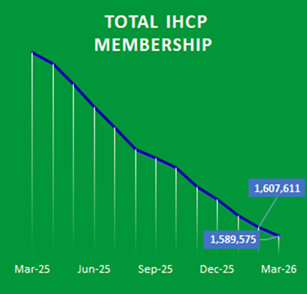
Total Membership decreased in March. With 1,589,575 members, there were 18,448, or 1.12%, less members in March 2026 than in February 2026.
Total Membership has fallen every month for an entire year.
| | | | | |