|
Nicotine Dependence: Screening to Support
The Tobacco Prevention and Cessation (TPC) program of CKF-IN is sponsoring a virtual webinar called Nicotine Dependence: from Screening to Support. Subject matter experts and community partners will be featured as a multidisciplinary panel considers how nicotine dependence impacts referrals for addiction and substance use disorder treatment. Panelists will also consider the effect of the $2 cigarette tax in Indiana and current efforts addressing nicotine dependence in treatment facilities across the State.
Whether you work in behavioral health, social services, or community outreach, this session will provide valuable insights and support for your work.
Free Continuing Education Credits Available for nurses and social workers.
Date: March 11, 2026
Time: 10-11:30am ET
Location: Zoom
Cost: FREE
| | |
2026 Indiana Legislative Session
The Indiana General Assembly is closing up shop this week, so lawmakers are BUSY. Bills are being discussed in conference committees and on both the House and Senate floors, and lawmakers are making final pushes to get their bills over the finish line.
Some bills have already been signed into law, including HB 1296 Mental health services, which requires the director of the Division of Mental Health and Addiction to "certify integrated reentry and correctional support programs to ensure adherence to standards determined by the division or a certification body approved by the division." This affects the Integrated Reentry and Correctional Support (IRACS) program.
A few bills on their way to the governor include:
-
SB 1 which puts into code the strictest options regarding Medicaid from H.R. 1, additionally enacting some policies not included in H.R. 1 regarding household members of Medicaid or SNAP applicants whose legal immigration status the state cannot confirm. Coverage loss and access to benefits will be affected.
-
SB 76 which adds state-level penalties for employers who knowingly or intentionally hire unauthorized workers, and require local police to hold inmates at the request of Immigration and Customs Enforcement (ICE).
-
SB 78 will require a "bell-to-bell" restriction on cell phones in all Indiana schools. There was a lot of debate on this bill, with the main concern being from parents who want to be able to contact their student in the event of a school shooting. Read more here.
Still to come today and tomorrow include conference committee and votes on HB 1004 which is a continuation of the deregulation of public education and SB 285 which makes it a misdemeanor to camp in public (aka criminalization of homelessness).
A full rundown will be in a future edition of News & Views.
| | SCHOOLS & EARLY CHILDHOOD | | | | |
ISHN Conference
The theme of ISHN 2026 is Champions in Action: Empowering Healthier Hoosier Kids. This conference offers a winning opportunity for school health professionals and youth-serving adults to share expertise and foster collaboration while earning free continuing education credits.
Consistent, caring relationships are the foundation of youth well-being, learning, and long-term success. Attendees will learn practical tactics and inspiring strategies to guide and support kids on their journey to becoming confident champions of their health and future.
Date: June 15-17, 2026
Location: Plainfield, IN Embassy Suites Hotel
Cost: FREE
| | |
Sponsors & Exhibitors
Submission Deadline: May 1, 2026
| | |
Project AWARE School Mental Health
and Wellness Mini-Grants
The Indiana Division of Mental Health and Addiction announces the availability of Project AWARE School Mental Health and Wellness Mini-Grants.
These competitive mini-grants aim to:
- Enhance educators’ mental health and well-being
- Provide middle and high schools with a license to conduct the Mindwise Signs of Suicide student training which teaches youth to ACT (acknowledge, care, and tell a trusted adult)
- Build capacity for school staff suicide prevention trainings in schools throughout the state through Question, Persuade, Refer (QPR) Instructor trainings.
Complete details of this opportunity are listed on the state’s Euna Grants Network site. Click here to view if interested in learning more about this opportunity.
For assistance or inquiries regarding the application process, please contact Hope Thompson at hope.thompson@fssa.in.gov.
| | |
Address Verification
CSH, an organization working on affordable, supportive housing, published an article, Medicaid Compliance and Address Verification: Strategies to Prevent Coverage Loss as part of a series exploring the impacts of H.R.1 (known as the One Big Beautiful Bill Act). The article explores the impact of the requirement for states to design and implement a federally approved address verification process by January 1, 2029.
The article focuses on concerns that individuals risk losing Medicaid eligibility due to challenges verifying their address. Populations most at risk of losing coverage include people experiencing homelessness or housing instability. Many in this group use social service or health care organizations as their address. This practice may lead to additional questions about their current living arrangements based on the validity of the address provided. Children in state custody and individuals recently released from incarceration are also likely to have issues verifying an address for use during the application process.
The article encourages collaboration between advocates and state officials to reduce administrative barriers and to help people facing complex challenges maintain coverage. Indiana Navigators can assist Hoosiers now by verifying addresses provided to FSSA and working with clients to ensure address updates are completed on a timely basis.
| |
Indiana KIDS COUNT Data Book
The newly released Indiana KIDS COUNT® Data Book provides the most recently available information on Hoosier child well-being in the areas of family and community, health, economic well-being, and education. Indiana improved to 25th in the nation in overall child well-being with gains in education and economic well-being.
Included in the report are health coverage statistics. In 2023:
- 103,091 Hoosier children did not have health insurance at any point, totaling 6.1% of Hoosier children which is higher than the national rate of 5.4%
- 11% of children lived with an uninsured parent which is the lowest rate in a decade
| | |
Prenatal Care
The share of U.S. births in which mothers began prenatal care in the first trimester declined from 78.3% in 2021 to 75.5% in 2024, according to new CDC data. The decline was steeper among Black mothers and comes amid growing concerns about maternity care deserts.
| | |
National Children’s Dental Health Month
February is National Children’s Dental Health Month and represents more than just healthy teeth, but the foundation for kids overall health! Dental issues can make everyday activities more challenging for children from concentrating in class to getting a good night’s sleep, and even their confidence with peers.
Medicaid and the Children's Health Insurance Program (CHIP) cover essential dental benefits like regular check-ups, x-rays, dental sealants, and treatments. The Connecting Kids to Coverage National Campaign offers a variety of resources to help partners promote good oral health for children and encourage families in their communities to enroll in Medicaid and CHIP to access essential dental benefits.
| | |
Teen Dating Violence Awareness Month.
Awareness only becomes powerful when it leads to action.
It is nearing the end of Teen Dating Violence Awareness Month. Teen dating violence is not just a private issue; it is a public health concern. With so many young people affected, everyone has a role to play in creating safer, healthier relationships. More awareness means earlier recognition of unhealthy patterns and more opportunities for adults and peers to step in.
Prevention education includes programs that reduce risk, build skills for strong relationships, and teach communication, consent, and boundaries.
| | |
Teen Birth Rate Declines
Over the last two decades, the country’s teen birth rate has declined significantly. In 2023, 140,977 babies were born to females ages 15 to 19. This equates to a U.S. birth rate of 13 births per 1,000 teens, as reported in the 2025 KIDS COUNT® Data Book.
The teen birth rate has sharply declined over the last four decades, as indicated below.
- 1990: 60 births per 1,000 teens
- 2000: 48 births per 1,000 teens
- 2010: 34 births per 1,000 teens
- 2020: 15 births per 1,000 teens
Teen birth rates vary by state but some clear regional trends exist. See Indiana specific data here.
| | |
Support for Youth Returning From Incarceration
A new webinar seeks to maximize collaboration among child welfare professionals, Medicaid systems, and juvenile justice partners to better serve young people returning to their communities after being incarcerated. The session will focus on using Medicaid for youth health and well-being and will feature experts from the Center for Health Care Strategies, which is a grantee of the Annie E. Casey Foundation.
Date: Wednesday, March 4, 2026
Time: 2 p.m. ET
Location: Virtual
Cost: FREE
| | |
Urban Institute Data Tool
The Urban Institute created a web tool that provides information in one place on eligibility and participation estimates for seven different programs including SSI, TANF, SNAP, WIC, childcare subsidies, public and subsidized housing, and energy assistance. Users can extract graphics for analysis and communication.
Date: Friday, March 6, 2026
Time:12-1 pm ET
Location: Virtual
Cost: FREE
| | TOBACCO PREVENTION & CESSATION | | |
New Study Shows That Mental Health Messaging Resonates with Young E-cigarette Users
A new study from Truth Initiative found that mental health–focused messaging about vaping resonates with young e-cigarette users and is linked to their quitting intentions, especially among those planning to quit within the next year. The research, published in the Journal of Adolescent Health, showed that young people who agreed that vaping nicotine can worsen anxiety, depression, and stress were more likely to be further along in the quitting process, suggesting that highlighting these mental health associations in campaign messages makes them more relevant and impactful for this audience. The study also highlights that while many users start vaping to cope with stress and anxiety, mental health concerns can also motivate their desire to quit, emphasizing the need for tailored quit-vaping support that addresses these challenges.
| | | |
|
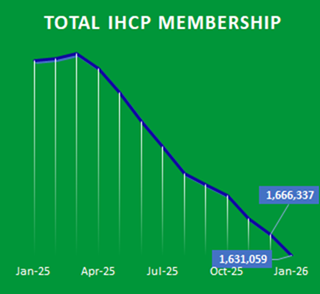
IHCP Membership
Total Membership decreased in January. With 1,631,059 members, there were 35,278, or 2.12%, fewer members in January 2026 than in December 2025.
Total Membership has fallen by nearly 340,000 since March 2025.
| | | | | |