Connect | Elevate | Advance | | |
Hello Lisa,
Welcome back to LeaderEdge, where we bring insights, intel, and ideas to sharpen your leadership edge.
This month, we're zeroing in on one of the most vital—and most vulnerable—capacities in leadership: strategic focus.
It’s not always dramatic. More often, it’s subtle. A stale strategy that lingers too long. A leadership lens that’s slightly off. A hiring choice that solves for now—but not for what’s next. The result? Missed signals. Lots of motion. No momentum.
We kick things off with Strategic Focus: Preventing Stale Strategies, Wasted Resources, and Value Erosion, featuring my interview with the founder of HighRidge Strategy. In this interview article, we explore how even smart strategies lose steam when focus drifts—and share a practical framework for course correction and value protection.
Next, in Mismatched Leadership Focus: When PE PortCo Leaders Mistake Signals and Miss the Mark, we'll look at how high-stakes private equity settings test leadership focus—where misreading a signal can mean missing the mark entirely. And critically, why strategic focus and situational awareness are everything.
And in Hiring for Trajectory: How Leadership Decisions Compound Over Time, I make the case for forward-focused hiring—where each leadership selection decision either compounds long-term value or quietly sets it back.
Let’s cut through the clutter and refocus on what actually moves the needle.
| | Strategic Focus: Preventing Stale Strategies, Wasted Resources and Value Erosion | | |
A Candid Conversation—Navigating Uncertainty Through Strategy, Prioritization and Meaningful Momentum
Good strategic focus and prioritization mean using your resources to their highest and best use. Both require a combination of leadership intentions, capabilities, a strong strategy process, and a commitment to execution.
Lacking either of these often leads to value erosion. Let’s discuss how strategic focus and prioritization impact valuation.
I reached out to Nick Cox, founder of HighRidge Strategy, and a former executive in Accenture’s Growth & Corporate Strategy practice to offer his thoughts. Nick helps leadership teams across PE-backed PortCo’s and privately owned middle-market companies overcome stagnating valuations. We discussed the impact of “strategic focus and prioritization” on value creation, and explored how the two are interdependent.
| | Strategic Focus and Prioritization: What Leaders Often Overlook | | |
Nick, we agree, strategic focus and prioritization are different concepts, yet they have a symbiotic relationship. Here’s what I mean. Strategic focus informs priorities, and prioritization keeps strategic focus on track and advancing. We’re talking about both because one affects the other.
Let’s start with a fundamental question.
How do the leaders you work with typically think about strategic focus and prioritization? Tell us why this relationship matters.
Right – these concepts are intertwined. Getting either wrong can mean the difference between becoming a market leader and becoming next year’s B-school case study.
Business leaders typically think of strategic focus as the output of a strategic planning process. Many see it as an annual process that looks out 3-5 years. However, for 364 days out of the year, “strategic focus” guides activities against a “plan” that was set in the past.
Focus over time has a compounding effect, but only if the historical context remains unchanged. For most organizations, that context evolves. Prioritization plays a part in strategic focus yet; leaders are more likely to view prioritization as a daily or month-to-month decision, influenced by current realities, events or challenges—often losing sight of the strategic focus. This leads to veering away from strategic priorities and allocating resources toward reactionary tactical plans.
Both strategic focus and prioritization are about choosing—what warrants focus, and how limited resources and time will be allocated to achieve a desired outcome.
What happens next is what separates traction from distraction...keep reading.
Click below to read the full article: Where do leaders typically go wrong? The Hidden Cost; Common Missteps that derail strategic focus; Leadership discipline: choosing what not to do; When to strengthen and when to shift strategic focus; A framework for navigation; Strategic and savvy leadership that's focused, flexible, and fluid; Is your strategy earning it's keep?
| | |
You have to decide what your highest priorities are and have the courage—pleasantly, smilingly, non-apologetically—to say ‘no’ to other things.
- Stephen R. Covey
| |
Mismatched Leadership Focus: When PE PortCo Leaders Mistake Signals and Miss the Mark
Why do portfolio company leaders sometimes lose sight of what matters most? How to get leadership focus and prioritization back into strategic alignment with the business and its stakeholders.
The Misalignment Trap: A Compounding Risk in Leadership Focus
In a PE-backed environment, leadership focus is pressure-tested in ways unlike other business structures. Portfolio company CEOs and executives feel the weight of navigating internal strategic priorities while managing layered expectations of private equity sponsors, board members, and investors, each with their own nuanced definitions of value, urgency, and success.
With the best intentions, every leader wants to believe their focus is aligned with what the organization truly needs. But leadership focus can subtly or significantly drift from what the business and its stakeholders require most. Sometimes misaligned focus is due to poor leadership fit.
More often, it’s the product of accumulated distractions and distortion: conflicting priorities, shifting perceptions, and pressure from multiple fronts. What starts as well-intended responsiveness can become a pattern of reactive leadership.
In PE-backed businesses, where timelines are compressed and capital efficiency is paramount, the cost of misalignment compounds quickly.
| |
Signal vs. Noise: Finding Clarity in Conflicting Communication
Portfolio companies operate in complex, accelerated environments—rife with “noise.” Necessary, but not necessarily prioritized.
And within these environments, the noise is relentless. There’s internal noise: inherited management structures, legacy initiatives, and operational firefighting. Then there’s stakeholder noise: evolving investor priorities, board input, reporting requirements, and expectations set by the PE firm’s value creation plan.
Distilling signal from the swirl of internal and external noise is an ongoing challenge for leaders. And too often, leadership focus shifts to what’s loudest. Maybe it’s a board directive, an investor request, or a KPI dashboard. Sometimes the volume is the signal. But other times, decibels are diversions at the expense of what’s most critical to sustainable growth.
Sometimes the risk isn’t that leaders focus on the wrong thing. It’s that they believe they’re focused on the right thing while continuing to drift off course.
Bias Under Pressure: Distorted Thinking in the Moments that Matter
If you follow my work, you know cognitive and emotional bias is rarely left out of my discussions on judgment and decision-making. Why? Because bias is always one of the loudest ‘voices’ in a leader’s ear.
Let’s face it, high-pressure situations demand fast decisions. And that’s when bias predictably takes the wheel—unless a leader is bias-aware.
In PE-backed companies, urgency is embedded into the leadership culture. Timelines are compressed. Growth plans are aggressive. There’s little room for indecision, but plenty of room for distortion.
Curious about where this goes? You should be. Click in and you'll see why...
Click below to read the full article: Biases that can take control when leaders are under pressure; When priorities go rogue - the pitfalls of misguided leadership focus; The AGILE Leadership Focus Filter - situationally agile and in action; When focus "feels" right, but isn't; The story of GE DOWn and Out; The compounding cost of focus drift; Realigning focus - an executive strategic reset; and Takeaways you won't want to miss.
| | Pressure-driven mandates, expectations, and messages come from all directions. And that creates motion. But motion isn’t momentum. - LT | | |
Hiring for Trajectory: How Leadership Decisions Compound over Time
Everyone talks about “hiring the right leader.” But the real question is: the right leader for what?
For today’s firefight—or for the trajectory your organization needs to follow over the next three years?
Too often, the urgency of the moment drives the decision. Most hiring decisions are made with present challenges in mind. Whether there’s a gap to fill, a team to stabilize or an initiative to get back on track.
That usually results in hiring teams focusing on the right credentials, experience, and personality match for the current challenges and situation.
In cost-sensitive organizations, this is too often the approach. Consider these common mismatches:
- A senior sales account executive is hired when the real need is Chief Commercial Officer to lead revenue across multiple channels.
- An excellent controller is hired to manage the ledger, when the company actually needs a CFO to lead funding, financial planning, and strategic transactions.
- A strong operations professional is deemed “good enough” to stabilize operational performance, but lacks the experience needed to scale across multiple locations.
The truth is, when someone steps in and gets things moving in the right direction, it’s a win. Not usually for the bigger picture, but for today.
There are two problems with this approach: First, since the individual wasn’t hired for their “potential” to lead forward beyond today’s problems, they’re rarely the strategic leadership solution. Second, leadership misalignment doesn’t usually show up right away. Rather, it compounds over time. That means no real momentum, and typically, setbacks on multiple fronts. And then… new things to fix.
And that’s why hiring with a short-term lens is one of the most expensive strategic mistakes a cost-conscious organization can make.
| | |
The Leadership Compound Effect: Always On
This builds on a concept I explored in my article, The Leadership Compound Effect: Every leadership hire sets off a chain reaction. The ripple effects touch performance, culture, strategy execution, outcome, and even future hiring decisions. But the leadership compound effect is not a one-time event. It’s a directional force. And it’s always in motion.
Which means the real leadership priority isn’t just filling the role in front of you. It’s about choosing the executive who has the “leadership positioning” to move your organization in the direction you want to go, strategically.
Trajectory and fit. Strategic positioning over short-term payoff.
The best leaders aren’t just a good fit for now. They’re aligned with the bigger picture—your goals, your context, your constraints, and your targeted trajectory.
The rest of the article reveals a few hard truths - and smart moves - read on...
Click below to read full article: A strategic filter for leadership trajectory; Rearview mirror vs. windshield thinking for leadership positioning and potential; Trajectory isn't linear: 7 traits of leaders who can navigate the curve; Amazon in Action - with strategic momentum; Are you hiring for today's fix - or for the trajectory that drives your strategic momentum?
| | |
Don’t mistake activity for achievement.
– John Wooden
| | |
Know your Knots
—the knots that can tie you down, and the knots that can give you speed and move your forward.
Navigating Intuition Bias
"The intuitive mind is a sacred gift, and the rational mind is a faithful servant. We have created a society that honors the servant and has forgotten the gift."
- Albert Einstein
When it comes to strategic focus, judgment, and prioritization, intuition can be a gift, or a gnarl - depending on how you use it.
Ask yourself these questions:
- Do I use intuition as a starting point to generate hypotheses that are then tested with evidence?
- Do I seek diverse perspectives from my inner circle, as well as external experts?
- Or do I rely solely on my intuition?
| | |
Try these tacking techniques to ensure intuition is your gift—and not your gnarl.
- Find a "fact-based" accountability partner to challenge your "intuitive" ideas.
-
Use analysis to narrow down decision options, and use intuition to choose the best one.
- Practice good questioning, and critical thinking to challenge your assumptions.
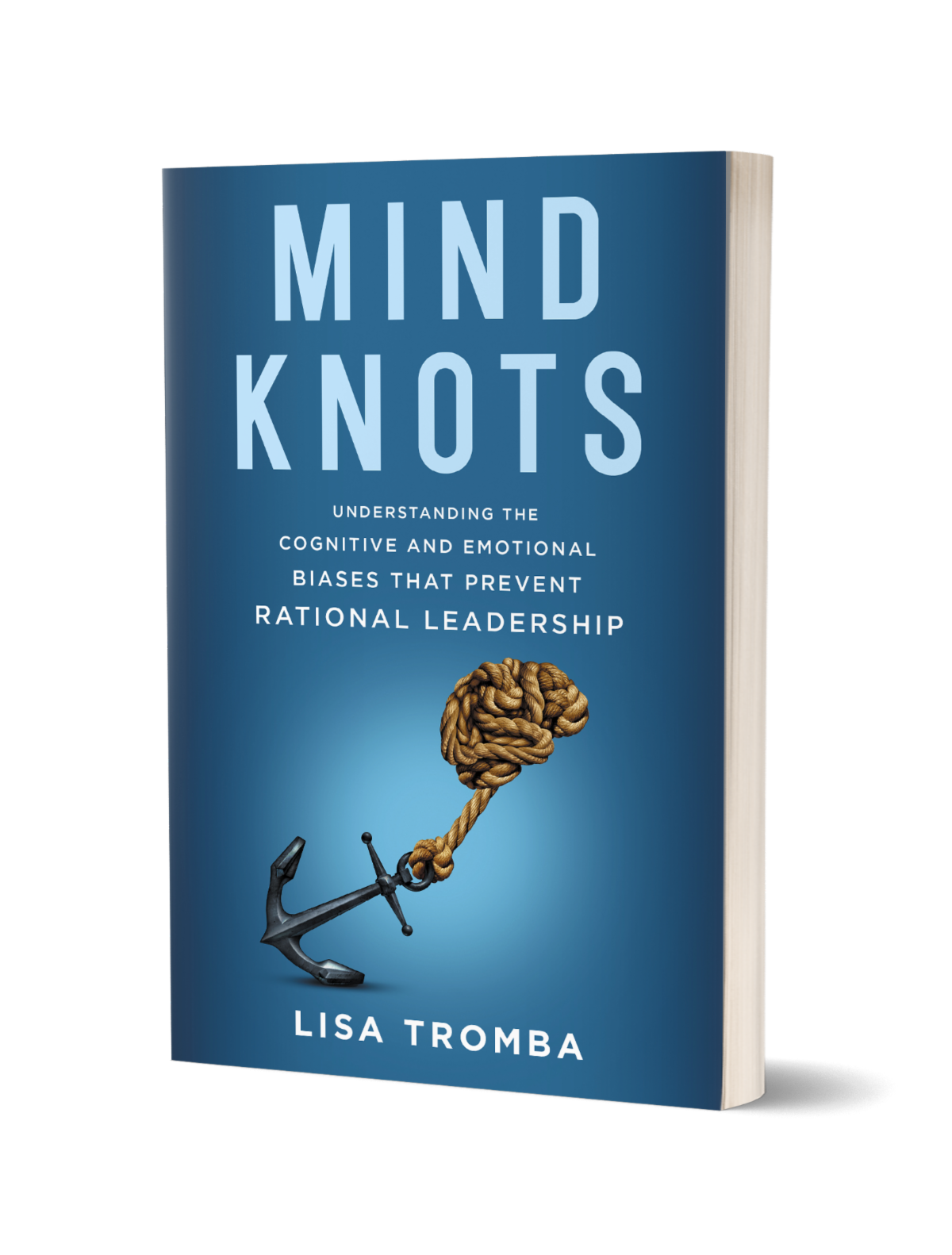
| | To learn more about recognizing and managing biases that may be tying you down... | | For a deeper dive into bias-aware leadership, frameworks and strategies you can use to harness your biases to work for you instead of against you, join us on our Mind Knots journey. | | Connect - Elevate - Advance | | LTA... Executive Search & Leadership Solutions for the lifecycle of leadership. | |
Have questions or want to learn more about how we can support your organization's leadership goals?
We’d love to hear from you!
Let's connect to discuss how our team can help support, elevate, and advance
your organization and leaders.
| | | |
Thank you for your leadership
and your readership!
We hope you enjoyed this issue of LeaderEdge.
Stay tuned for our May issue where we'll dive into Executive Assessment & Selection Excellence
| | | |
Great leadership isn't just found—it's strategically positioned.
| | |
Know Someone Who Would Find This Interesting?
Feel free to share this issue with your team or colleagues. Simply forward this email to
help someone else sharpen their Leadership Edge!
| | |
Was this newsletter shared with you?
If this was forwarded to you and you'd like to receive it directly, click below to join our LeaderEdge community and stay informed with insights, intel, and ideas you can use to
sharpen your leadership edge!
| | | | |