|
The Camperdown Elm: A Contorted Cultivar
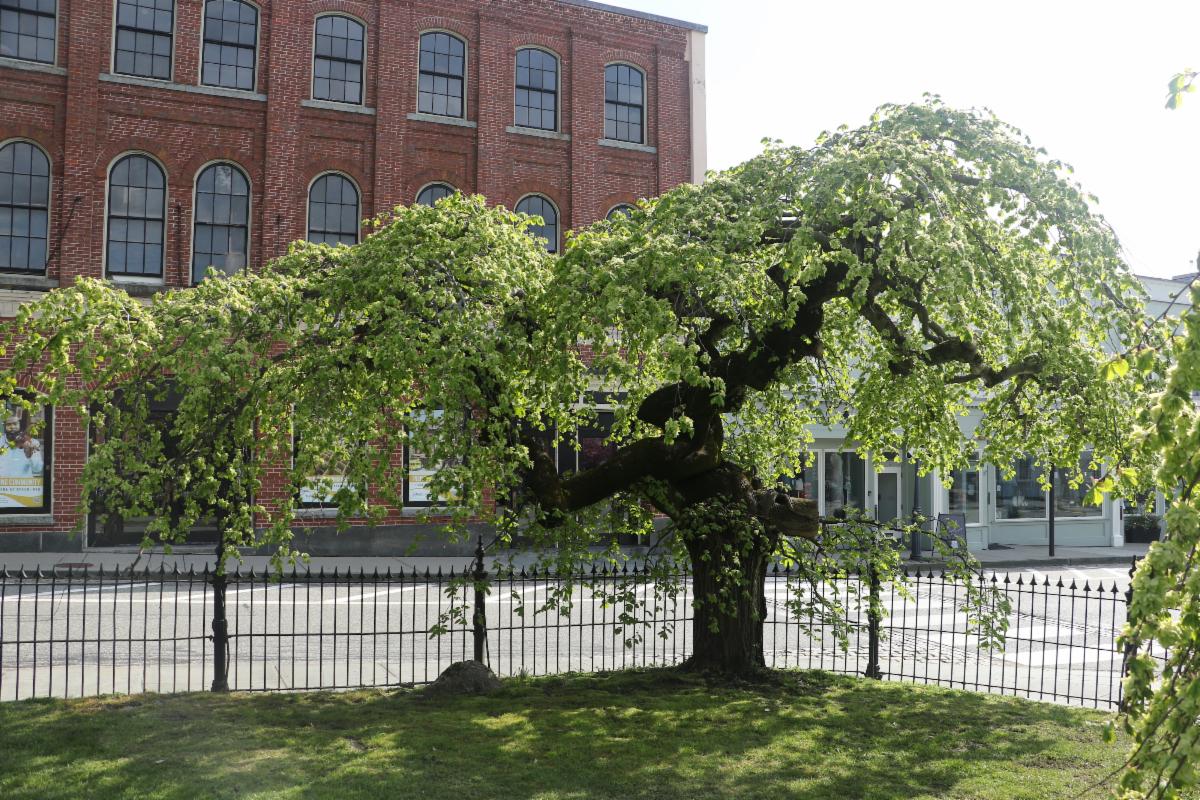
Originating from the area of Camperdown House of Dundee Scotland and propagated by head forester David Taylor, the aptly named Camperdown elm (Ulmus glabra ‘Camperdownii’) is noted for its short stature, contorted branches, and weeping habit. The nature of this plant is remarkable because the true species of wych or Scotch elm (Ulmus glabra), is known to grow 80 feet tall and 60 feet wide with an upright and spreading rounded crown, much like the one on the southwest corner of the Redwood Library. ‘Camperdownii’, in comparison, typically reaches only 15 feet high though will spread up to 30 feet wide. It should not be confused with the other short statured cultivar ‘Horizontalis’ that has flatter, more layered branching than the smoothly mounding arcs of the ‘Camperdownii’.
While the original tree grows on its own root system in what is now Camperdown Park, the cultivar entered the horticultural scene in the 1840s as a grafted product and continues as such today, making all Camperdown elms genetic clones of that original plant. This includes the eight successful propagules residing at the Heritage Tree Center, whose genetics originate from one of the pair of Camperdown elms at the tip of Eisenhower Park, taken as cuttings, or scions, in 2020 and 2021. The park, while dedicated in 1960 to president Eisenhower, has its origins back to the 17th century when it was part of The Great Common. Whittled down over time to its current shape and size, it is thought that the elms, along with ash, lindens, and willows, were planted in the park by 1850, however the first solid evidence of the Camperdowns’ presence is in a 1895 plat map by Olmsted, Olmsted & Eliot, which lists them as shrubs.
Read more here!
|