|
Hello MSA Members and Supporters,
As many of you are already aware, the Miramichi Salmon Association adult stocking proposal submitted in partnership with regional collaborators was recently denied by Fisheries and Oceans Canada. While this outcome is disappointing, it unfortunately reflects what continues to be a highly cautious approach toward enhancement and recovery initiatives for Atlantic salmon.
DFO continues to rely heavily on guidance developed through North Atlantic Salmon Conservation Organization (NASCO) when informing decisions related to adult supplementation and stocking. While precaution and scientific oversight are important, we believe the time has come to acknowledge that accepting some level of carefully managed risk may be necessary if we are serious about increasing salmon numbers in our rivers.
At present, the prevailing management perspective appears to remain that rivers must reach a state of near-complete extirpation before meaningful intervention is pursued. Many of us within the conservation community struggle with that philosophy. Waiting until populations are at critically collapsed levels before implementing stocking initiatives is not a strategy that inspires confidence for the future of Atlantic salmon on the Miramichi.
Despite these setbacks, important work continues.
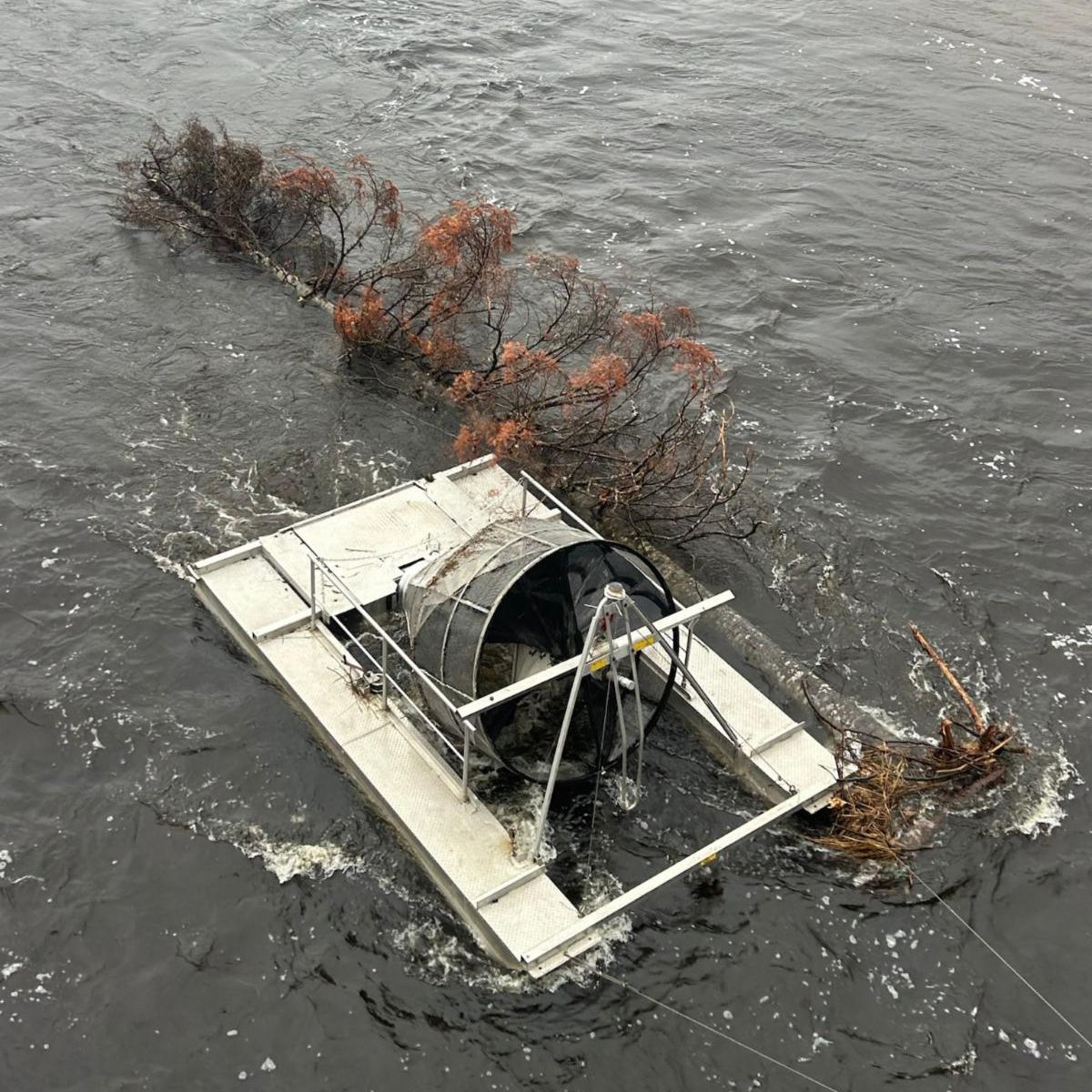
Our smolt wheels have now been successfully installed at Wayerton Bridge on the Northwest Miramichi and at Dungarvon and Ludlow on the Southwest Miramichi as part of our ongoing smolt monitoring and data collection efforts. Lyndsay and her team have already been dealing with a few spring challenges, including localized flooding and trees becoming lodged in a few of the wheels. By the time you read this, we expect those issues will have been resolved and operations will continue as planned. These monitoring programs remain critically important in helping us better understand smolt production and outmigration trends within the watershed.
At the hatchery, we are pleased to report that eggs have (mostly) now hatched into fry for our comparative fry stocking research project on the Dungarvon River. This project, now entering its fourth year, continues to evaluate different fry stocking approaches and their effectiveness relative to natural production. The information generated through this work will play an important role in informing future salmon enhancement and recovery strategies not only on the Miramichi, but potentially elsewhere in Atlantic Canada.
We are also proud to report that our four-year Canada Nature Fund for Species at Risk project focused on enhancing and restoring cold-water refuge pools has now been successfully completed and formally closed out. This important initiative helped identify, protect, and improve critical thermal refuge habitat for salmon during increasingly warm summer conditions. We are extremely grateful to all our partners, staff, contractors and volunteers who contributed to the success of this project over the past four years.
We were also encouraged to see the recent announcement regarding funding support for the Atlantic Salmon Strategy. Additional investment and national attention toward Atlantic salmon conservation is certainly welcome news and demonstrates recognition that these populations are facing serious challenges. However, as with many large-scale initiatives, the devil will ultimately be in the details. Much will depend on how the funding is rolled out, what types of projects are prioritized, and whether practical, on-the-ground conservation actions and enhancement initiatives are supported in a meaningful way. We remain hopeful that this strategy will lead to real action and measurable outcomes for salmon rivers like the Miramichi.
As always, none of this work would be possible without the continued support of our members, volunteers, donors, affiliate organizations, and conservation partners. Thank you for standing with us and continuing to advocate for the future of Atlantic salmon on the Miramichi.
|