| |
Maryland Legislative Session Convenes
Wednesday, January 14th at noon
| | |
Dear Community Members,
Constituent concerns guide my legislative priorities and the work of my office. One issue I continue to hear about is the state budget which is expected to be released on January 21, 2026. Last session, taxes and fees were increased by $1.6 billion, despite opposition from myself and my fellow Republican legislators. Now, we are entering this session facing a $1.4 billion budget shortfall, alongside promises from Governor Moore to expand funding without clearly identifying how Maryland will pay for these new and expanded services.
We recently saw the state pause Child Care Scholarships after the program reached 48,000 children, increasing by nearly 600% from 2018. When the program first launched, it supported 12,000 children from low-income households. While programs like this are important and help bridge gaps, Maryland simply does not have the resources to sustainably provide subsidies to families of three earning up to $106,000 per year. These are difficult but necessary conversations, and many Marylanders may not fully understand the true cost of expanding programs without stable funding.
Governor Moore has also announced spending above and beyond the Kirwan Blueprint, despite repeated warnings from the Department of Legislative Services and the Spending Affordability Committee about the long-term costs of the Blueprint and its role in driving future deficits. While the Governor has stated his budget will not raise taxes or fees, Marylanders should closely review both the Budget Bill and the Budget Reconciliation and Financing Act (BRFA). Any tax or fee increases signed into law ultimately place the burden squarely on working Marylanders who are already struggling to keep up with rising costs. The proposed budget will be released on January 21.
As the Maryland Legislative Session officially begins at noon today, my focus remains on affordability, public safety, government accountability and transparency, as well as standing up for the residents and businesses I represent. In the weeks ahead, there will be critical discussions and decisions that directly impact our communities, and I will continue to keep you informed every step of the way.
| |
Transparency, Accountability, and Security:
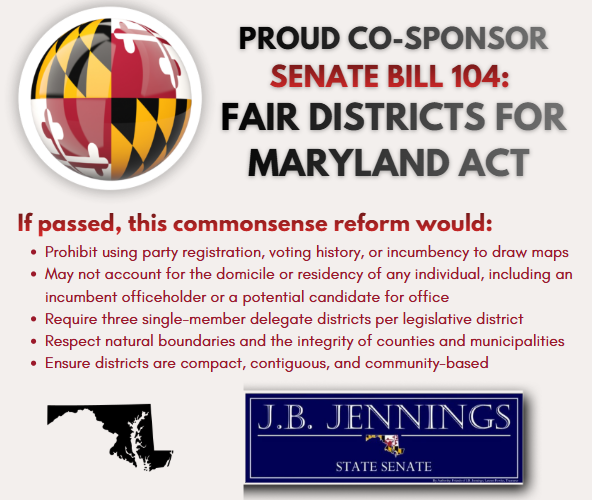
I'm a proud co-sponsor of Senate Bill 104 - Legislative and Congressional Redistricting and Legislative and Congressional Redistricting and Apportionment Commission (Fair Districts for Maryland Act). The Maryland Senate Republican Caucus pre-filed this bill due to recent attempts by Governor Moore to establish a partisan commission responsible for drafting a new Congressional map.
This bill will ensure districts are community based, respect natural boundaries, and prohibit the use of party registration, voting history, or incumbency to draw maps. Additionally, the bill does not account for the residency of any individual, including potential candidates for office.
Senate Bill 99 - Open Meetings Act - County Boards of Education - Enhanced Requirements (Local Boards of Education Transparency Act) establishes enhanced requirements to maintain unedited archived video recordings of each meeting on the Board of Education's website for a minimum of 5 years after the meeting.
House Bill 207 - Election Law - Certificate of Candidacy for Congressional Offices - Stock Trading Activities (Congressional Stock Trading Transparency Act) prohibits U.S. Representatives in Congress from buying, selling, or exchanging individual stocks. If violated, information will be published on the State Board's website.
Senate Bill 213 - State Procurement - Transparency and Procedures aims to improve transparency, fairness, and accountability in government contracting. Key elements include a debriefing requirement for unsuccessful bidders and clarifying competitive restrictions to ensure no one has an unfair advantage. Senate Bill 213 allows for fair and equitable contract adjustments when changes in law affect costs or timelines. The bill also updates the appeals process and revises requirements and deadlines for change orders, notices of claims, and other procedural steps, making Maryland’s procurement system more transparent, efficient, and easier to navigate.
House Bill 119 - Energy Performance Contracts - Navigators, Funding, and Requirements appropriates $1,500,000 from the Strategic Energy Investment Fund to the Maryland Clean Energy Center to hire or contract with navigators to assist public bodies in creating an energy performance contract.
House Bill 264 - Maryland Data Privacy and Protection Act of 2026 sets limits to the data that can be shared, while House Bill 268 - Information Technology - Establishment of the Office of Enterprise Data and State Chief Data Officer and Collaboration With Agency Data Officers, which establishes the Office of Enterprise Data and creates the State Chief Data Officer.
| | | | |
Senate Bill 26 - Public Utilities- Off-Grid Electricity Providers - Exemption creates a narrow regulatory exemption for certain electricity generators that operate completely "off the grid," simplifying some permitting requirements while preserving key construction-related safety rules.
An “off-grid electricity provider” is defined as a person or entity that owns or operates an electric generating facility that is not connected to the state’s electric grid, does not cross state lines, and is not located in, or extend through, public roadways or rights-of-way. An entity’s off-grid status would be revoked if the facility later connects to the grid, crosses state lines, or becomes located within applicable public roadways or rights-of-way.
| | | |
House Bill 77 - Public Utilities- Electric Companies - Multi-Year Rate Plan (Limitations) places new limitations and guardrails on multi-year rates (MYRPs) submitted by electric utilities to the Maryland Public Service Commission.
Key provisions include:
- Limits on the duration of the plan, preventing long-term rate increases that lock customers into higher costs for several years
- Restrictions on what utilities may recover through these plans, tightening controls on projected expenses, capital investments, and future rate adjustments.
- Strengthening PSC oversight, requiring closer review and justification of costs before approval
- Preserving the PSC's authority to modify, reject, or reopen rate plans if assumptions prove inaccurate or costs become unreasonable.
Senate Bill 116 - Board of Public Works - Contract Review - Climate and Sustainability Information alters project categories, requires contribution toward the State's "net-zero carbon goals," and requires sustainable practices that meet certain construction guidelines.
| |
Juvenile Justice Concerns after Middle River Robbery
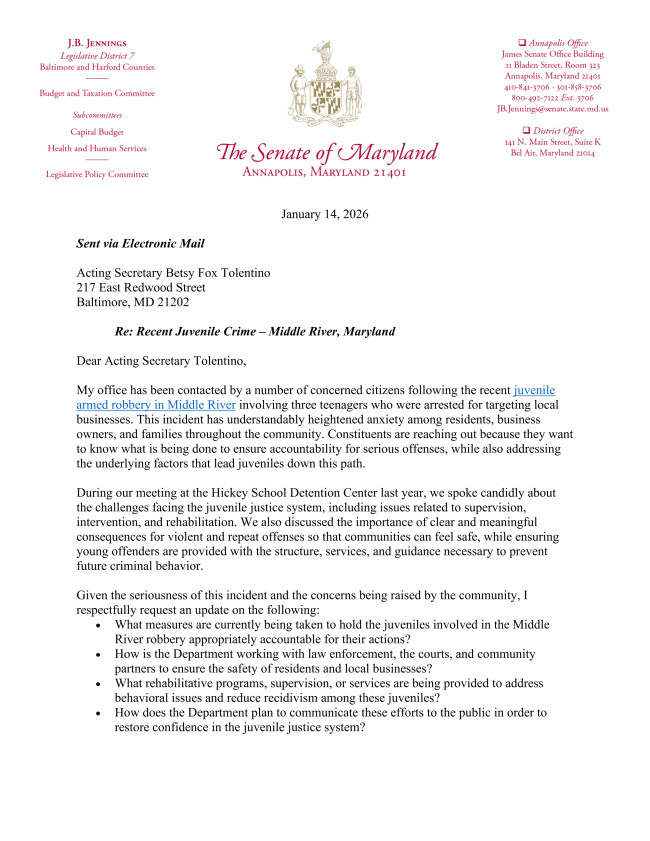
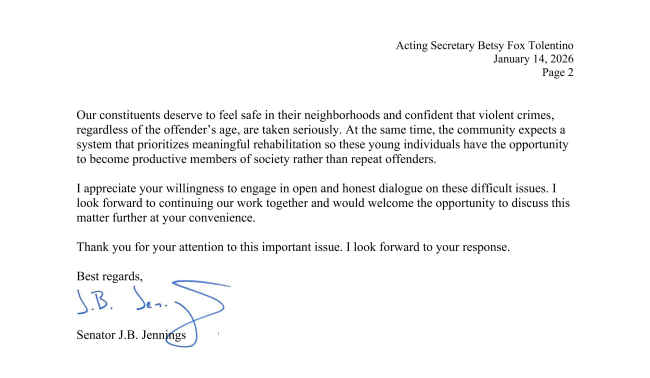
I have long supported meaningful juvenile justice reform that balances accountability with rehabilitation. Juveniles must be held responsible for their actions, especially in serious cases. Following the recent armed robbery in Middle River involving three juveniles, I wrote to the Acting Secretary of the Department of Juvenile Services to raise my concerns and seek answers. I will share an update as soon as I receive a response.
I look forward to reviewing meaningful legislation to address this issue. For additional information on Juvenile Crime, Click Here.
To read the article regarding the recent juvenile armed robbery in Middle River, Click Here.
| | New Traffic Pattern on Southbound I-95 Begins the Week of January 19th: | |
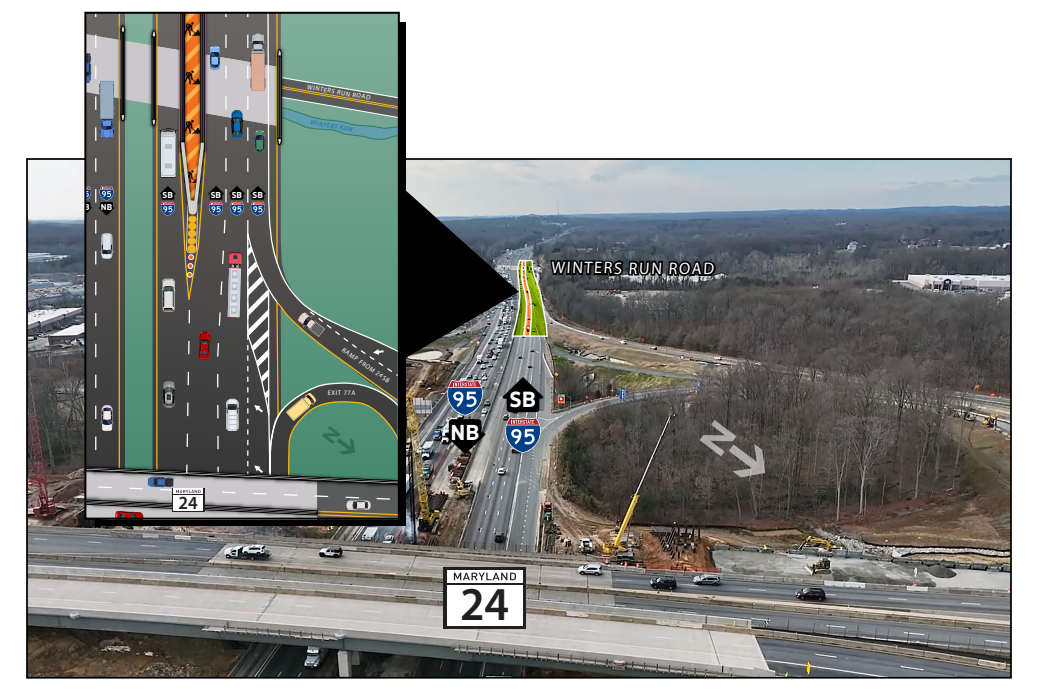
(Above: Screen shot from MDTA) For additional project details visit MDTA's website for the project.
Harford County residents and Marylander's travelling I-95, please be aware of an important traffic change coming soon to southbound I-95 near the MD 24 interchange (Exit 77).
Beginning the week of January 19, weather permitting, the Maryland Transportation Authority will implement a new traffic pattern as part of its ongoing $1.1 billion project to reduce congestion and improve safety along I-95 between Baltimore and Harford counties.
What You Can Expect
- Southbound I-95 traffic will split just south of MD 24
- One lane to the left
- Three lanes to the right, separated by barrier walls
- Clear signage will guide motorists as they approach the split
- This change allows crews to continue construction of the new bridge over Winters Run
| |
Safety Is the Priority
- The work zone speed limit will be reduced to 55 mph
- Automated Speed Enforcement is in effect
- Fines range from $60 to $1,000
- Flashing lights will be active when workers are present
- Crews will be working behind barrier walls so please slow down and stay alert
Changes to MD 24 On-Ramp
Motorists traveling southbound on MD 24 should note:
- Two left lanes will continue south on MD 24
- Two right lanes will exit to the I-95 southbound on-ramp
- The on-ramp will merge to one lane before entering I-95
How Long Will This Last?
This traffic pattern is expected to remain in place through Fall 2026 as reconstruction of the I-95/MD 24 interchange continues.
| | Mt. Vista Park Underground Water Tank Input: | | |
Our Company | Contact Us | FAQs | Privacy Policy |
| | | |