|
|
August 15, 2023
Summer Issue #8
|
Weekly activities and lessons to keep your child thinking and progressing all year long. |
|
"Experience is the hardest kind of teacher. It gives you the test first and the lesson afterward."
|
|
Hello Flyer Folks,
We did it. The end is in plain sight as another summer is coming to a close. The contrast of emotions I feel at this time of the year are overwhelming. The dread of summer vacation ending and the work load that will soon follow verses the joy and expectations of a new school year and fresh beginnings. The joy always wins out once I am with my class and we start our journey together. I hope your child's journey this school year will be positive, productive and full of new discoveries.
There is no better time to begin dusting away the cobwebs of summer and throw yourself into actively learning new content and concepts than right now. Give some of these learning activities a try. I've recommended a powerful new memoir about a girl who escaped from Nazi Germany during WWII. There is a fun design challenge to build a paddle boat as well as five writing prompts, math problems, games and an art activity. A little bit of practice this week will make the transition back to school that much easier.
If you know anybody who you think would benefit from the weekly learning activities in this flyer, please share it with them and encourage all your friends to join The McManus Files mailing list by following the links on this page.
Peace,
Mr. McManus
|
|
If you feel your child might benefit from an individual or group tutoring program to prepare them for the next phase of their education, please contact McManus Tutoring.
Programs are structured so that students learn independence, accountability, and self-reliance. They will develop a repeatable structure that can be used to build success in the future.
|
|
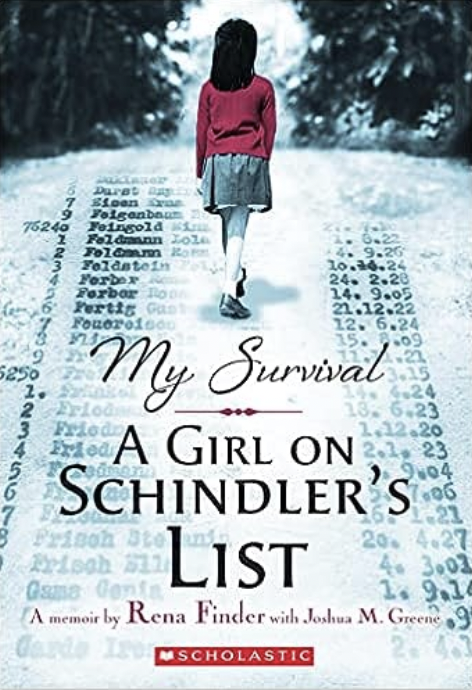
My Survival: A Girl of Schindler's List
•••
by Rena Finder & Joshua M. Greene
|
|
|
|
I highly recommend this beautiful book, written for children, but it should be read by adults as well. It is an important story of survival, coming from a women with a beautiful heart and soul. Though she survived unimaginable hatred, she attests that her survival is a product of love. Of course, the subject is unfathomable and heartbreaking, but Mrs. Finder does a remarkable job in writing this book. I’m grateful to have had her first-hand story and to know she lived to be able share it. This is a straightforward and accessible Holocaust survivor's memoir that shows Oskar Schindler through the eyes of a young person he saved... It offers a vital look at one complicated man's unwillingness to be complicit. Rena, now 90, is a Holocaust educator, and her matter-of-fact narration reflects the book's simple message, "when you see a bully, do something. Go get help." I hope this story will never be forgotten, so this never happens again!
Enjoy!
|
|
|
|
|
|
|
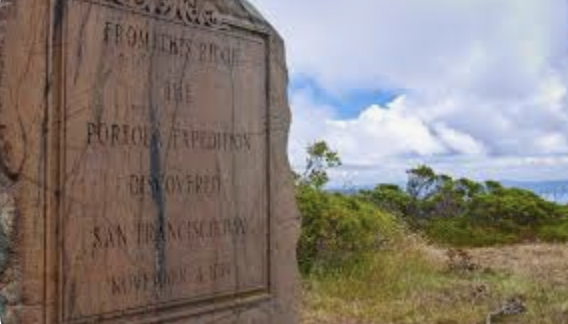
Ohlone-Portola Heritage Trail on Sweeny Ridge |
|
|
|
|
The Sweeney Ridge Trail is one trail of many in beautiful Sweeney Ridge, a prime bicycling and hiking area in San Mateo County. Inaccessible by automobile, the trail must be reached by any of its connecting trails: Sneath Lane Trail, Baquiano Trail, Mori Ridge Trail or Notch Trail (hiking only).
Sweeping views of the surrounding hills and the Pacific Ocean in the near distance bring hordes of visitors to the trail. Two destinations also attract hikers and cyclists: the Portolá Discovery Site marks the approximate location where a Spanish explorer discovered the San Francisco Bay in 1769, while the remnants of a Cold War era Nike missile site commemorate a very different time in history. The Sweeney Ridge Trail is paved between the two landmarks, while a natural surface welcomes the same user types at either end.
Parking and Trail Access
The Sweeney Ridge Trail can only be reached on foot, horse or bicycle. Park at one of the trailheads for the Sneath Lane Trail, Baquiano Trail or Mori Ridge Trail to access the scenic path by car. (Refer to the individual TrailLink pages for exact parking locations.)
|
|
Make the Fastest Rubber Band Paddle Boat
Rubber band paddle boats are a fun bathtub or pool toy that you can build yourself. How do you make a boat that goes the fastest? Find out in this project as you build and test your own boat.
Paddle boats were very common in the 1800s. They were usually powered by steam engines. While most modern boats use propellers instead of paddles, there are still smaller human-powered paddle boats with pedals like a bicycle, and even smaller rubber-band powered paddle boats that can be used as bathtub or pool toys.
Your paddle boat will be powered by a rubber band. When you wind the rubber band up, it stores potential energy. When you release the rubber band, the paddle spins, pushing on the water, or exerting a force. Since the paddle pushes on the water, the water also pushes back on the paddle, pushing the boat forward (this is called Newton's third law of motion, or "for every action there is an equal and opposite reaction"). The potential energy stored in the rubber band is converted to kinetic energy, the energy of motion, as the boat moves forward.
Other forces also act on the paddle boat as it moves forward. The paddle boat's own weight pulls it down, but the buoyant force from the water makes it float. Friction from the water sliding past the boat, or drag, slows the boat down.
To make the boat go as fast as possible, you want to have the biggest push from the paddle, and the smallest amount of drag. There are different ways you can change these forces; for example, by changing the shape of the paddle or the hull (body) of the boat. You can also try making your boat from different materials. In this project you will use the engineering design process to design, test, and improve your boat. How fast will your boat go?
Terms and Concepts
- Paddle boat
- Potential energy
- Force
- Newton's third law of motion
- Kinetic energy
- Weight
- Buoyant force
- Drag
- Hull
Questions
- What materials do you think you can use to build a paddle boat?
- What forces act on a moving paddle boat?
- How do you think you could change the shape of a paddle boat to make it go faster?
Materials and Equipment
- Rubber band
- Materials for the boat, such as:
- Cardboard (requires duct tape for waterproofing)
- Balsa wood
- Popsicle sticks (requires hot glue gun for assembly)
- Optional: Small pieces of foam to make the boat float better
- Pencil
- Ruler
- Hobby knife or scissors
- Bathtub or kiddie pool
-
Stopwatch or tape measure
|
|
Experimental Procedure
1.Fill your bathtub or kiddie pool so you are ready to test your boat.
2.Depending on the materials you have available, there are three different basic boat designs you could build. These three videos show boats made from balsa wood, cardboard, and popsicle sticks. Try building one of these boats to start, but you can also combine materials (for example, use a mix of balsa wood and popsicle sticks):
|
|
3.Test the boat in water. Write down your observations about the boat and any problems you notice; for example:
- How far does it go before it stops? You can measure this with a tape measure if your boat does not make it all the way across the pool/tub.
- If it does go all the way across the pool/tub, how long does it take? You can measure this with a stopwatch.
- Does the boat go straight?
- Does the boat seem to struggle through the water or does it sink?
4.Based on your observations, think about how you could improve your boat. For example:
- The boats in the video above have completely flat hulls. Can you make a hull that is more three-dimensional and shaped like a real boat?
-
Can you add a rudder that helps the boat go straight?
- Can you build a paddle with more than two blades, like a real paddle boat?
- What happens if you wind the rubber band more tightly, or use a different rubber band?
5.Try making improvements to your boat and test it again. Keep iterating and testing your design until you are happy with your boat's performance.
Variations
- The boats in this project are not waterproof for a very long period of time. If you let them soak in the water for too long, they might fall apart or start to bend. Can you design a boat that is completely waterproof?
- Can you make a 3D-printed boat instead of building one with craft supplies?
- For examples of more complex designs built with popsicle sticks, see these two videos:
|
|
Three Creative Writing Prompts
These prompts and questions will help jump-start your daily writing. Just as it's important to read for at least 30 minutes each day, you should also write for 30 minutes a day. Don't worry about your organization or spelling, just write!
"I had just finished crocheting the small grey elephant for and was placing it in a gift bag when it let out a little trumpeting noise..."
"Teddy had always known there was something fishy about the new girl, and his suspicions were confirmed when he saw the live __________ in her backpack."
"I had never taken an interest in Randy until we both attended the teen fantasy club and..."
|
|
August 15th Writing Prompts
On this day in 1869 the Transcontinental Railroad was completed. Describe how you think the men working on this railroad may have felt when they saw their goal achieved?
Today is “National Relaxation Day.” Describe one way you like to have fun and relax.
|
|
Creativity Corner
Set your art free
|
|
|
|
This fun project will allow you to create a kaleidoscope using your name. It is a great project for studying the elements of art: shapes and colors. Balance is the principle of design for this project. You can learn to create your own name kaleidoscope by watching the step-by-step directions in this video. |
|
|
|
|
Marbles Solitaire Game
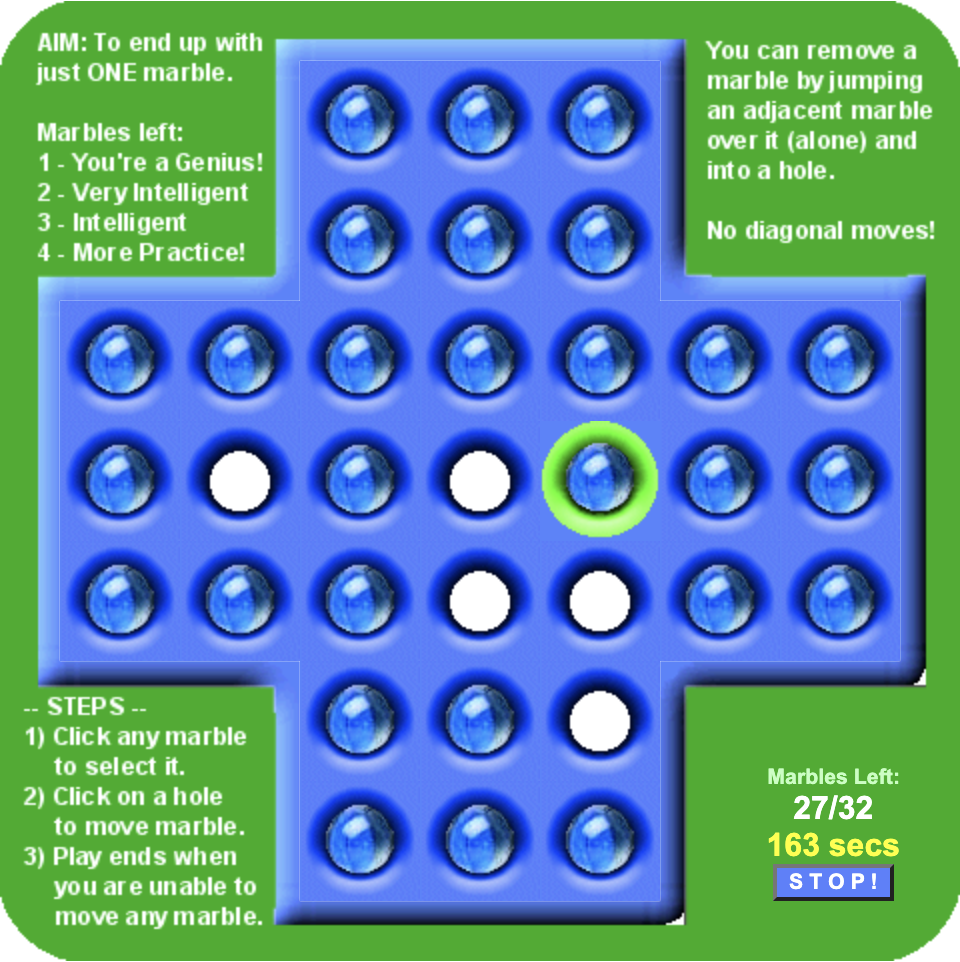
Click this link play the Marbles Solitaire Game. In this game you try to eliminate as many marbles as you can. You will rank as a genius if you only have one marble left.
|
|
|
|
|
|
|
|