|
|
August 2, 2022
Summer Issue #6
|
Weekly activities and lessons to keep your child thinking and progressing throughout the school year and summer. |
|
“You have a choice! You can throw in the towel, or you can use it to wipe the sweat off your face!” |
|
Hello and Happy Tuesday,
August is here and returning to school is real and on the radar. This is the perfect time to shake out any of the cobwebs and bad habits that may have developed over summer. This week's flyer has some rich math problems to solve and a slue of different writing opportunities. Just the thing to wake up sleepy brains. This week's book recommendation is the perfect quick read to end the summer with. This lovely story has so much to offer. It is not too difficult and most students will gobble it up in a few days. Yes, the story is that engaging. Enjoy these last few weeks .
If you know anybody who you think would benefit from the weekly learning activities in this flyer, please share it with your friends and encourage them to join The McManus Files mailing list by following the links on this page.
Have a great week,
Mr. McManus :-)
|
|
Children acquire skills throughout the school year, but they can lose ground if learning stops during the summer break. Fortunately, learning never has to stop. Children who read throughout the summer gain skills, can start the new school year with a better understanding of language and the world around them, and discover the joy of reading. The more they like to read, the more they will read.
It's not hard to help your children keep their interest in reading and learning. Children learn through a variety of activities, and almost everything we do presents an opportunity to read. Here are weekly activities that involve reading and related skills. There's no special order, and you don't have to do everything listed in a particular week. Just pick the ones that look interesting and fun!
|
|
Week 7: Become a publisher
• Make your own joke book. Collect jokes and riddles from your family and friends.
• Cut out pictures from an old magazine or catalog. Write a story about them.
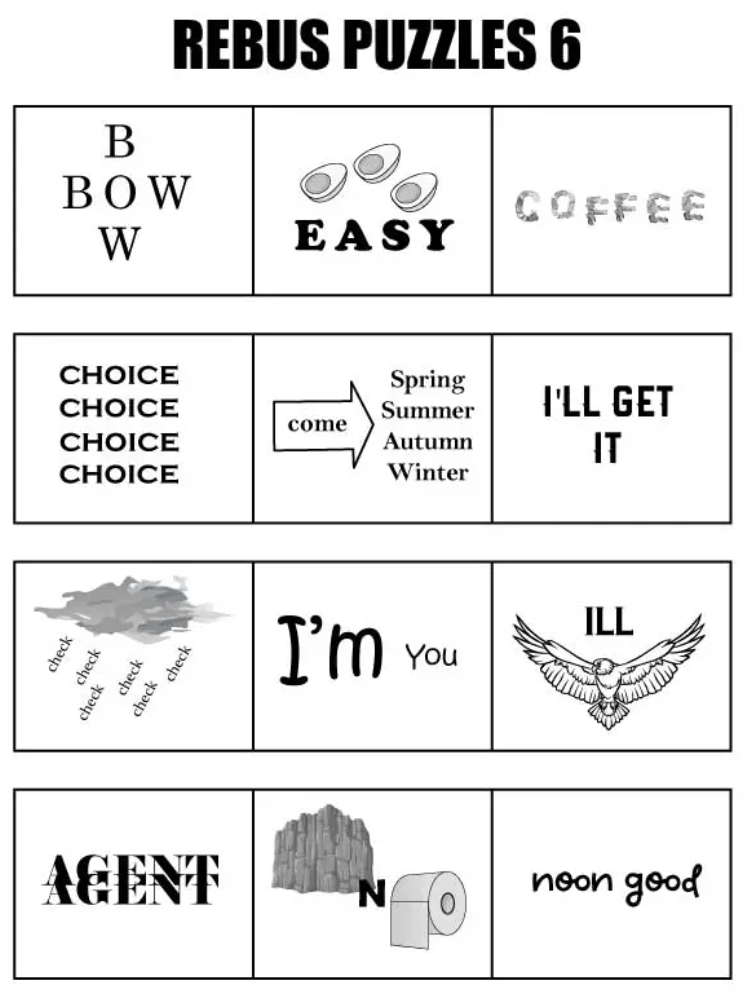
• Create a rebus story (a story that uses pictures to represent words). Write a short story, and then substitute pictures (that you draw or cut out) for some of the words.
• Start a round-robin story. Write the beginning, then ask friends to add to it until it has an ending.
|
|
Habits of Mind
Habits of Mind are thinking habits that push us far past simple answer retrieval. They change our pattern of thinking to help us gain success when we don’t know the answer to a question or problem.
|
|
The 16 Habits of Mind include:
• Persisting
• Thinking and communicating with clarity and precision
• Managing impulsivity
• Gathering data through all senses
• Listening with understanding and empathy
• Creating, imagining, innovating
• Thinking flexibly
• Responding with wonderment and awe
• Thinking about thinking (metacognition)
• Taking responsible risks
• Striving for accuracy
• Finding humor
• Questioning and posing problems
• Thinking interdependently
• Applying past knowledge to new situations
• Remaining open to continuous learning
|
|
Creating, Imagining, Innovating
What is it? – Looking for creative ways to solve problems or finding alternative possibilities. Being creative.
Sounds like – “I wonder what would happen if…” Let’s try this a different way.” Let’s look at this from a new angle”
Looks like – Trying several alternatives, analyzing differences for the most precise one.
Feels like – Not being happy with the first possible solution. Striving for the new and different. Enjoying new ways to solve problems. Being creative
All human beings have the capacity to generate novel, clever, or ingenious products, solutions, and techniques –if that capacity is developed. Creative human beings try to conceive problem solutions differently, examining alternative possibilities from many angles. They tend to project themselves into different roles using analogies, starting with a vision and working backward and imagining they are the object being considered. Creative people take risks and frequently push the boundaries of their perceived limits. They are intrinsically rather than extrinsically motivated, working on the task for the aesthetic challenge rather that the material rewards.
Creative people are open to criticism. They hold up their products for others to judge and they seek feedback in an ever-increasing effort to refine their technique. They are uneasy with the status quo. They constantly strive for greater fluency, elaboration, novelty, parsimony, simplicity, craftsmanship, perfection, beauty, harmony, and balance.
Some students tend to believe that they are not and cannot be creative. We need to help them find out how and when they are creative and help support and nurture their individual creativity.
“The future is not some place we are going to but one we are creating. The paths are not to be found, but made, and the activity of making them changes both the maker and the destination.” John Schaar, Political Scientist
|
|
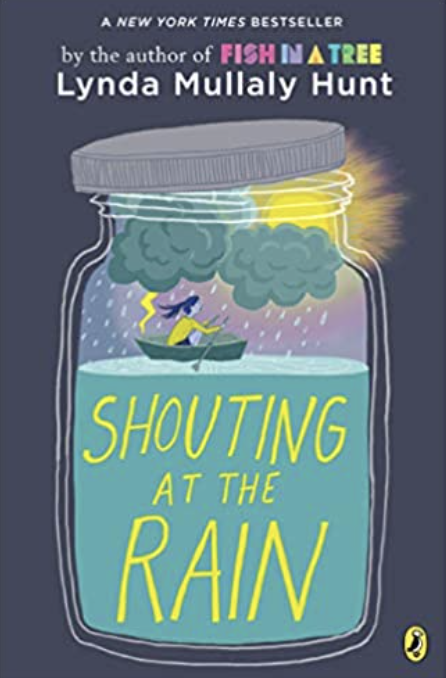
Shouting at the Rain
by Lynda Mullaly Hunt
|
|
|
|
Shouting at the Rain is a heartwarming story about a young girl who lives on Cape Cod and her summer of discovery. She must learn to deal with broken friendships, the truth about her mother, the angry new boy, and what it means to be part of an untraditional family. Most kids will relate to the issues in the book: wanting a “normal” family, being rejected by friends, blue collar life, grief, abandonment, neighbors who are family, mean kids, anger, finding your “herd,” unexpected friends, standing up for yourself. I fell in love with Delanie and her family - she made me laugh, then cry, then cheer for her. I love Esme’s strong shoulder, Henry’s wise words, and Grammy’s unconditional love. This is a richly embroidered cast of characters, a thoughtful exploration of how real friends treat one another, and the true meaning of family all combine to make this a thoroughly satisfying coming-of-age tale.
5 stars and all the love for this wonderful, beautiful book!
Enjoy!
|
|
|
|
|
5 National Parks Offering Virtual Tours You Can Take From the Comfort of Home
Experience some of the country's best national parks — from Florida to Alaska — right from your couch.
You can still get your fill of the great outdoors, even if you have to stay inside. And while many have taken solace in exploring the great outdoors over the past year, we're not all lucky enough to live within driving distance of some of America's most stunning natural sights.
Luckily, Google Arts & Culture has teamed up with five national parks in the U.S. so people can enjoy the beauty of the natural world while sitting safely on their couch. These parks feature different climates and environments from across the country, including famous desert vistas and snowy terrains.
Below is a list of the national parks that are currently offering virtual tours through Google Arts & Culture.
Which park would you like to visit? Research the animals you might see at one of the parks.
|
|
Kenai Fjords National Park, Alaska
This virtual tour lets you explore glaciers, fjords, and icebergs located in the Alaskan wilderness. Descend into an icy crevasse, kayak through majestic icebergs, and even see how a glacier melts and the effects that climate change has on this frozen terrain. Kenai Fjords has over 40 glaciers in the Harding Icefield, according to the National Park Service website, and the tour begins with a peek into Exit Glacier, one of the only accessible glaciers by road within the national park.
Hawai’i Volcanoes National Park, Hawaii
One of the most popular national parks in Hawaii is now totally accessible online. This virtual tour lets you explore the Nahuku Lava Tube, which is a cave formed by flowing lava, which can drain lava from a volcano during an eruption. On the tour, you can also enjoy the stunning view from the volcanic coastal cliffs, "fly" over an active volcano, and see the effects of an eruption from 1959.
Carlsbad Caverns National Park, New Mexico
Located in the Chihuahuan Desert of southern New Mexico, this popular park has over 100 caves. On this virtual tour, you can take a walk through the fascinating caverns, view incredible rock formations, and even see thousands of bats who live in the cave system. You can even "experience" life as a bat thanks to this park's impressive simulation.
Bryce Canyon National Park, Utah
The beautiful, red and orange hoodoos of this famous desert landscape are now on full display, even if you're in your living room. This virtual tour centered on Sunset Point lets you enjoy the star-filled night sky from this Dark Sky certified national park, get up close and personal with the park's unique rock formations, and even take a horseback ride through the canyon from the comfort of your own home.
Dry Tortugas National Park, Florida
This remote and severely underrated park is located 70 miles west of Key West, according to the National Park Service website. Thanks to this virtual tour, you no longer have to book a seaplane or boat to get there. Visit the Civil War-era Fort Jefferson, swim through the third largest coral reef in the world, and even take an exploratory dive into a shipwreck from 1907.
|
|
If you feel your child might benefit from a group or individual tutoring program to prepare them for the next phase of their education, please contact McManus Tutoring.
Programs are structured so that students learn independence, accountability, and self-possession. They will develop a repeatable structure that can be used to build success in the future.
|
|
Three Writing Prompts and an Essay Topic
These prompts and questions will help jump-start your daily writing. Just as it's important to read for at least 30 minutes each day, you should also write for 30 minutes a day. Don't worry about your organization or spelling, just write!
"The limo pulled up to take me to..."
"A young fan of my movies interrupted my breakfast and asked..."
"The clock struck 2:00am and I knew..."
|
|
Someday
Have you thought about what you want to be when you grow up? Write an essay explaining why you think you’d like that career.
|
|
You've been asked to buy 100 squeegees, using 100 dollars to do so. You may buy no more or less than 100 squeegees, and the total price must be exactly 100 dollars. There is no sales tax. Red squeegees cost $6.00. Yellow squeegees cost $3.00. Blue squeegees cost $0.10. How many of each must you buy?
|
|
Last week's answer...
It should only take nine minutes to cook the egg. To start, flip both hourglasses over and put the egg in the water. When the four minute hourglass runs out, flip it back over immediately. When the seven minute hourglass runs out, flip that back over immediately too. One minute later, the four minute hourglass will run out again. At this point, flip the seven minute hourglass back over. The seven minute hourglass had only been running for a minute, so when it is flipped over again it will only run for a minute more before running out. When it does, exactly nine minutes will have passed, and the egg is done.
|
|
|
|
|
|
|
|
|
|