|
|
July 12, 2022
Summer Issue #4
|
Weekly activities and lessons to keep your child thinking and progressing throughout the school year and summer. |
|
“For the things we have to learn before we can do them, we learn by doing them.” |
|
Hello and Happy Tuesday,
What glorious warm days! In this week's flyer you will find many fun learning activities. The inquiry quest is a hands on building project teaching about gears and how they work. The book recommendation is a delightful read. If you like magical realism, you will like this book about a young, Haitian girl's immigrant story to Brooklyn. There are three more story starters and a descriptive writing essay project along with two problems of the week and a new page of rebus puzzles. Have fun!
If you know anybody who you think would benefit from the weekly learning activities in this flyer, please share it with your friends and encourage them to join The McManus Files mailing list by following the links on this page.
Have a great week. Stay Curious.
Mr. McManus :-)
|
|
Children acquire skills throughout the school year, but they can lose ground if learning stops during the summer break. Fortunately, learning never has to stop. Children who read throughout the summer gain skills, can start the new school year with a better understanding of language and the world around them, and discover the joy of reading. The more they like to read, the more they will read.
It's not hard to help your children keep their interest in reading and learning. Children learn through a variety of activities, and almost everything we do presents an opportunity to read. Here are weekly activities that involve reading and related skills. There's no special order, and you don't have to do everything listed in a particular week. Just pick the ones that look interesting and fun!
|
|
Week 4: Travel the world
• If you are going on a family vacation this summer, read about your trip. Mark your travel route on a map.
• Pretend you are going to visit another city, state, or country with a friend or relative. Write to the tourist bureau for more information. If you plan to visit a foreign country, write to the embassy. Visit the library and find books about the place you want to visit. Or search online for information. Plan your itinerary and don't forget to check the weather!
• Pick an important news event from another city, state, or country. Find as much information on the topic as possible read newspapers, listen to the radio, and watch TV news. Talk about what you learned.
• Word game! Look for out-of-state license plates. Make a list of all the state names and slogans. Decide which ones you like the best. Ask friends and relatives which are their favorites.
|
|
Habits of Mind
Habits of Mind are thinking habits that push us far past simple answer retrieval. They change our pattern of thinking to help us gain success when we don’t know the answer to a question or problem.
|
|
The 16 Habits of Mind include:
• Persisting
• Thinking and communicating with clarity and precision
• Managing impulsivity
• Gathering data through all senses
• Listening with understanding and empathy
• Creating, imagining, innovating
• Thinking flexibly
• Responding with wonderment and awe
• Thinking about thinking (metacognition)
• Taking responsible risks
• Striving for accuracy
• Finding humor
• Questioning and posing problems
• Thinking interdependently
• Applying past knowledge to new situations
• Remaining open to continuous learning
|
|
Managing Impulsivity
What is it? – Thinking before acting
Sounds like – “Just a minute, let me think” “What will happen if I do this?” “What’s the right thing for me to do now?”
Looks like – Looking both ways before crossing the street. Examining directions before beginning a task. Pausing.
Feels like – Slow down. Take a deep breath. Count to ten. Pause to think. This person cares enough to really listen to me. Comforting, Trusting, Vulnerable
Effective problem solvers are deliberate. They think before they act. They plan, set goals, and develop strategies for success. Reflective individuals consider alternatives and consequences of several possible directions before they take action. Often students blurt out the first answer that comes to mind. Sometimes they start to work without fully understanding the directions or lack an organized plan or strategy for approaching a problem or make immediate value judgments about an idea (criticizing or praising it). Students need to consider their alternatives and plan accordingly.
“Goal directed, self-imposed delay of gratification is perhaps the essence of emotional self-regulation: the ability to deny impulse in the service of a goal, whether it be building a business, solving an algebraic equation , getting a college degree, or pursuing the Stanley Cup. “ Daniel Goleman
|
|
The Year I Flew Away
by Marie Arnold
|
|
|
|
Buy this book for your teens, tweens and read it to your children. I've read many of her other books under her other name (Lola StVil) and she is an absolute master at painting magical worlds with her writing. In this novel, ten-year-old Gabrielle finds out that America isn’t the perfect place she imagined when she moves from Haiti to Brooklyn. With the help of a clever witch, Gabrielle becomes the perfect American—but will she lose herself in the process? Gabrielle is a funny and engaging heroine you won’t soon forget in this sweet and lyrical novel. Readers will find themselves unable to set the book down during the final chapters. The characters are well developed—even the school bully—and the prejudices that Gabrielle both witnesses and experiences are portrayed in a way that is frank and easy to understand. The interpersonal relationships and fantasy elements complement each other well. It is a fantasy adventure combined with a loving portrayal of Haitian culture and the immigrant experiences that creates an action-packed story with a lot of heart.
Enjoy!
|
|
|
|
|
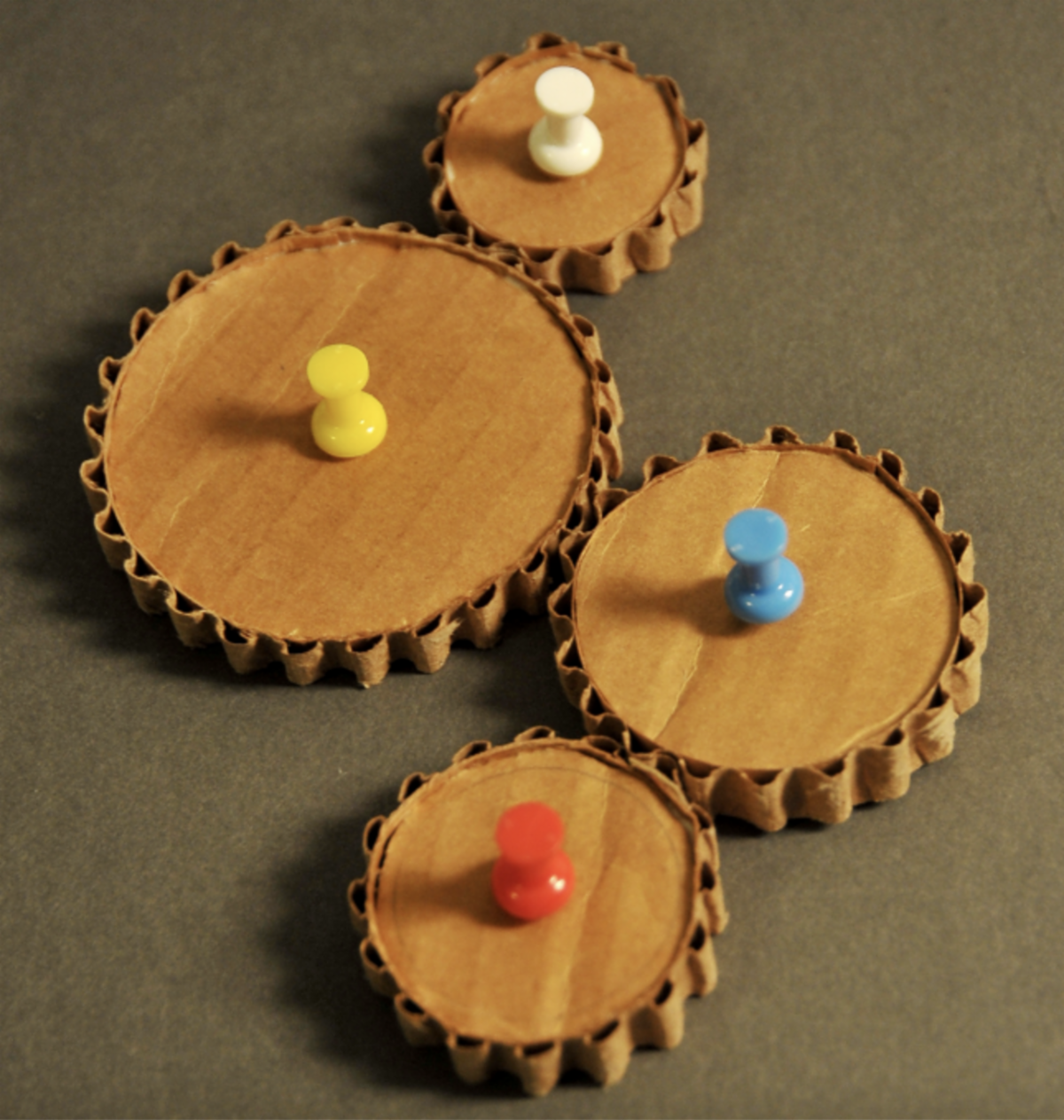
Gears are the toothed wheels used in many machines, including bicycles, where they work together to change the relationship between the driving mechanism and the moving parts. You pedal the cranks to turn the chainring, which is connected by a chain to smaller gears that move the rear wheel. You change gears depending on terrain. If you are riding up a steep hill, you might want to shift into a lower (larger) gear. This makes it easier to turn the cranks, but the rear wheel doesn’t turn as much with each rotation of the cranks. When you get to a level or downhill stretch of road, you probably switch to a higher gear, where each turn of the cranks leads to more turns of the rear wheel.
Your muscles might know all about bike gears, but your mind might need an opportunity to play around with them to really understand how they work. In this activity, you will learn how to make gears from scratch. Then, you can move them around. Let’s learn some math before we get started.
The radius of a circle is the distance from its center to its edge. Diameter is twice the radius—it’s the straight line distance across the center of a circle. Circumference is the distance around a circle. Thousands of years ago, Greek mathematicians discovered the ratio of a circle’s circumference to its diameter and called it π (pi), which is approximately equal to 3.14159. The circumference of a circle can be found using the following equation: πd=C. This equation will come in handy when cutting out your cardboard gear teeth.
Problem
How do gears work?
Materials
- Cardboard box made of corrugated cardboard. Corrugated cardboard has the ridges inside. Most shoe boxes are not made of corrugated cardboard.
- Grown up to help with cutting cardboard
- Ruler
- Pencil
- Compass (the kind you draw circles with)
- Sharp scissors, box cutter, or razor
- Glue
- Permanent Marker
Procedure
- Cut out a piece of cardboard that is at least 8“x8”. This will be your base.
- On another piece of cardboard, use the compass to trace out at least four circles with 1 inch, 1.5 inch, 2 inch, and 3 inch diameters. Remember that a radius is half the diameter, so if you set the compass radius at 1 inch, you will get a circle with a two inch diameter.
- Ask your grown-up assistant to help cut out the circles you traced. The rounder your circles are, the better they will work.
- Figure out the circumference of each of your circles by multiplying the diameter by π. For example, for the 3 inch circle, the circumference would be about 9.42 inches.
- Next, you are going to give each of your gears toothed edges. Making sure to cut along the corrugates, cut a long strip of cardboard ¼” wide.
- Jam your fingernail into the corrugate and carefully remove the brown paper on one side of the corrugated cardboard. You should be left with lots of bumps, without any paper still stuck on. This can be tricky, so be patient!
- Using the circumferences you calculated, cut out a piece of stripped corrugated cardboard for each of your circles.
- Cover your work area with newspapers to keep it clean.
- Spread glue around the edge of your first circle.
- Roll the correctly measured piece of corrugated cardboard around the circle, making sure the bumps are on the outside.
- Secure the stripped corrugated cardboard with a push pin or painter’s tape until dry.
- Repeat for each of your other circles.
- Let your gears dry overnight.
- Use a black permanent marker to make a black mark at one tooth of each of your gears. This way you will able to track when each has made a rotation.
- Attach the 3-inch and 1 ½-inch gears to your board, using pushpins at the center of each and making sure that the gears’ teeth interlock.
- Rotate the 3-inch gear clockwise. Which way does the 1 ½-inch gear turn?
- Using the black marks to keep track, turn the 2-inch circle once. How many times does the 1 ½-inch gear turn?
- Now, turn the 1 ½-inch gear once. How many times does the 3-inch gear turn?
- Arrange the other gears as you wish, and experiment!
Results
When you turn the 3-inch gear clockwise, the 1 ½-inch gear turns counter-clockwise. When you turn the 3-inch gear once, the 1 ½-inch gear goes around twice. When you turn the 1 ½-inch gear once, the 3-inch gear makes half of a rotation.
Why?
Gears transmit torques (twisting forces) in predictable ways—this is why they are so useful in machines that require exact movements, like clocks. The 3-inch circle made the 1 ½-inch gear spin around twice because the 3-inch gear has twice the circumference.
|
|
If you feel your child might benefit from a group or individual tutoring program to prepare them for the next phase of their education, please contact McManus Tutoring.
Programs are structured so that students learn independence, accountability, and self-possession. They will develop a repeatable structure that can be used to build success in the future.
|
|
Three Writing Prompts and an Essay Topic
These prompts and questions will help jump-start your daily writing. Just as it's important to read for at least 30 minutes each day, you should also write for 30 minutes a day. Don't worry about your organization or spelling, just write!
"After I won the Lottery, I..."
"The ants on the picnic blanket suddenly began to form into letters. They were sending me a message to..."
"A popsicle truck is selling delicious popsicles that have a strange effect on everyone..."
|
|
Describe an Insect
Look at a picture of an insect. Describe what you see in detail. Then give someone your description and have them draw the insect as they imagine it. Compare the drawing to the original picture. Are they close?
|
|
A man has 100 coins (there are no quarters or nickels) that add up to $5.00. How many coins did he have of each denomination? |
|
Last week's answer...
There are four canaries and three cages.
|
|
|
|
|
|
|
|
|
|