|
|
July 18, 2023
Summer Issue #4
|
Weekly activities and lessons to keep your child thinking and progressing all year long. |
|
"I love summertime more than anything else in the world. That is the only thing that gets me through the winter, knowing that summer is going to be there."
|
|
Hello,
I'm so happy I get to share this week's flyer with you. This flyer adds up to 100% fun and learning. I've recommended another book from my new favorite author, Jonathan Auxier. His stories are the perfect summer books for reluctant readers. They have such vivid and likable characters and the plots are simply unimaginable. His books are so much fun to read, especially as family read alouds. Many flyers ago I recommended his book, The Night Gardener, so you may already appreciate his work as much as I do.
This week's Inquiry Quest is one of my favorite classroom experiments and answers a question that I get asked every year, "Why does the sea stay salty?" Your child will like the designing and experimentation involved in this project. It offers a lot of learning opportunities. While they are waiting for their desalinator to do its work, they can respond to one of the four writing prompts, solve a multi-step math problem, play a computer game, or do an art project. See... 100% fun and learning :-)
I hope you are as excited as I am about the beginning of the Women's World Cup Tournament in Australia and New Zealand. It is going to be so much fun to have morning soccer binges for the next month. The athletes are amazing and the competition is going to be intense. I hope you have a great week.
If you know anybody who you think would benefit from the weekly learning activities in this flyer, please share it with your friends and encourage them to join The McManus Files mailing list by following the links on this page.
Peace,
Mr. McManus
|
|
If you feel your child might benefit from an individual group or tutoring program to prepare them for the next phase of their education, please contact McManus Tutoring.
Programs are structured so that students learn independence, accountability, and self-reliance. They will develop a repeatable structure that can be used to build success in the future.
|
|
Peter Nimble and His Fantastic Eyes
•••
by Jonathan Auxier
|
|
|
|
I've developed such a fondness for the author Jonathan Auxier. He is so talented, the way he builds suspense, develops characters, and expresses his creativity make his books so much fun to read. This particular book has thrilling plot twists throughout the entire book, and all of the characters develop in some way or another, whether they turn out to be backstabbing traitors, or loyal friends. With a whimsical mix of realistic fiction and fantasy he creates loveable characters, vivid scenes, and engrossing events that inspire sympathy, relate humor, and make you want to root loudly for the hero and wildly boo the villain, which you probably shouldn't do out loud in public if you care about what others think of you. However, true lovers of these kinds of tales are often just the sort of people who don't care what others think, so root or boo as you feel comfortable. Enjoy!
|
|
|
|
|
|
|
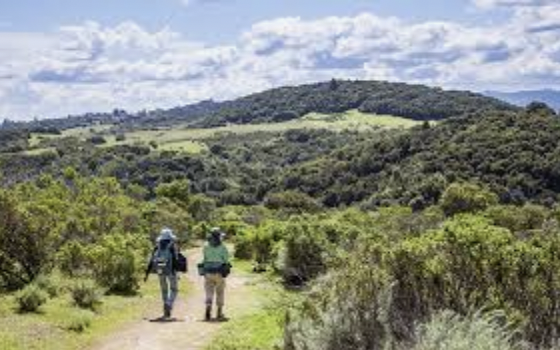
Pulgas Ridge Open Space Preserve
Who wouldn't want to hike on the Dusky-footed Woodrat Trail? If you do, look for their homes that look like a tangle of piled sticks.
|
|
|
|
|
Pulgas is a small, well-managed preserve with a large off-leash dog area where dogs can run through the poison oak and brush to their hearts' content. If you don't want to hike with dogs about, go across the canyon to Edgewood Park, where dogs are not permitted. However, if you aren't bothered by the occasional dog barking and charging down the trail at you, or if you are a dog owner, give this preserve a shot.
The 293 acres that now comprise Pulgas were formerly a tuberculosis sanitarium owned by the City of San Francisco. MROSD purchased the land in 1983. Buildings were demolished in 1985, and most of the non-native plants have been removed, but there are still some old walls and steps off Hassler Trail.
In 2006 MROSD added a new parking lot and two trails to the existing small trail network. A third route, Dusky-footed Woodrat Trail, opened in 2007. Dick Bishop Trail (formerly named Sagebrush Trail) begins up on the ridge, and connects the end of Polly Geraci Trail with Blue Oak Trail, avoiding the off-leash dog area. A short (as far as I know, unnamed) path departs from the parking lot and connects to Cordilleras Trail, so hikers no longer have to walk along Edmonds Road to connect a loop.
|
|
From Brine to Beverage: Solar-Powered Salt Removal
Have you ever thought about being stranded on a desert island? How would you find water to drink? What would you need to survive? In this science fair project you'll discover how to turn the ocean into a source of freshwater by using the power of the Sun.
Introduction
"Water, water, everywhere,
Nor any drop to drink."
Have you heard these famous lines from Samuel Taylor Coleridge's old sea poem Rime of the Ancient Mariner? In the poem, the sailors have run out of water and are suffering because they can see water in the ocean all around them, but cannot drink it because of its salinity (salt content). Nearly all of the water on Earth, 97%, is undrinkable salt water, and much of the remaining 3% of freshwater is locked up in glaciers and icecaps. Only a tiny fraction of all the water on Earth, about 1%, is freshwater that is available for people to use, and much of that water is deep in the ground and not easily accessible from the surface. As this freshwater begins to run out, people are trying to make more freshwater from oceans and other bodies of saltwater by removing the salt.
Removing the salt is called desalination. With current technology, it requires great amounts of energy to desalinate ocean water on a scale large enough to meet the needs of a whole city. For this reason, most cities stick with traditional sources of freshwater, such as underground aquifers, rivers, lakes, and runoff from snowpack. Some people, like those in rural Indian villages, use an alternative to burning oil for desalination-solar power. While solar power is not yet able to produce enough water to sustain entire villages, it can supplement underground aquifers that are running dry.
|
|
The Water Cycle
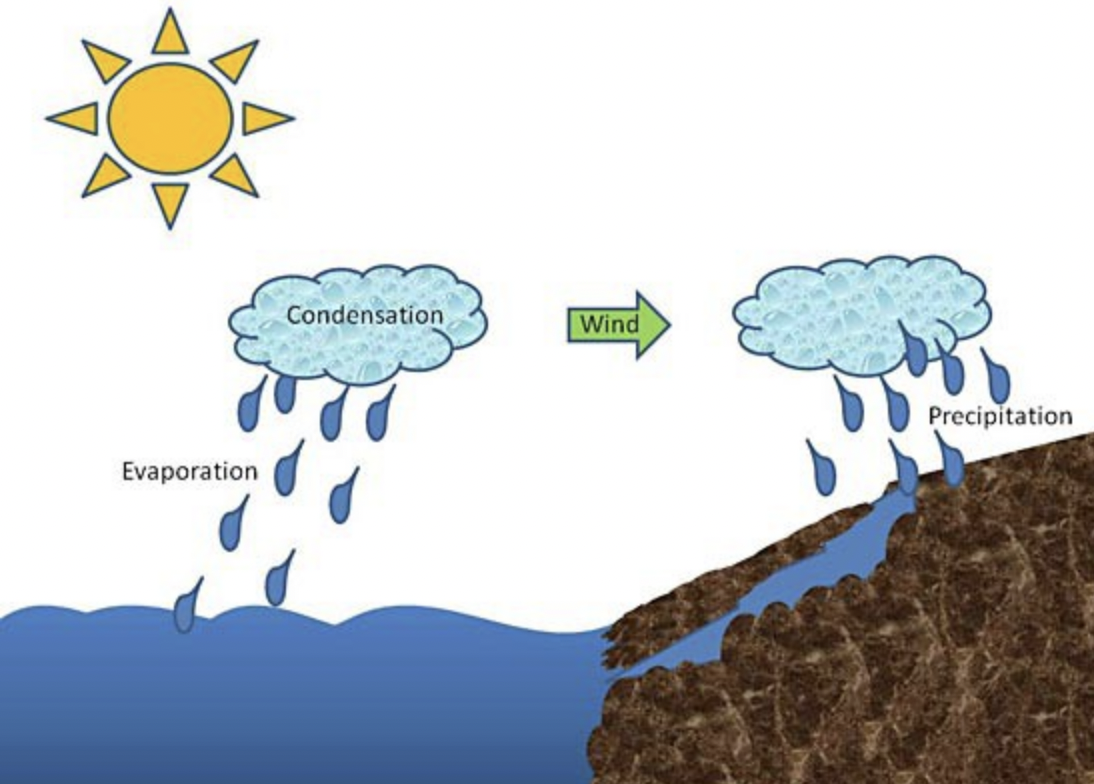
The water cycle is the process by which the Sun warms the ocean, giving water molecules at the surface enough energy to escape their liquid state and change into a gas called water vapor. This change of water from liquid to gas is called evaporation. The freshwater vapor rises up and cools, forming clouds, in a process called condensation. Winds float the clouds over land and when they become fully saturated with water vapor, either by cooling or by the addition of more moisture, they release their freshwater, most often in the form of rain or snow, in a process called precipitation. That's when you get out your rain boots! For your science fair project, you will see the water cycle in action inside a bowl!
|
|
Materials and Equipment
To make your saltwater, you will need:
- Water (4 cups)
- Liquid measuring cup (2-liter or 8-cup size)
- red food coloring
- Microwave
- Oven mitt
- Newspaper for your work surface
- Salt (1 box or container)
- Teaspoon measuring spoon
- Tablespoon measuring spoon
- Deep bowls (6)
- Dry measuring cup (1/2 cup)
- Spoon
- Sticky notes
To make your desalinators, you will need:
- Small cups or glasses (6), they should be less than half the height of the bowl and heavy so they will not float; small glass or ceramic cups work best
- Plastic wrap (1 box)
- Elastic bands (6), must fit snugly around the top of the bowls
- Small, heavy objects (6-18), like rocks or ball magnets
To test your desalinators, you will need:
- Medicine cup
- Clock
- Access to sunlight for a full day
- Lab notebook
|
|
Experimental Procedure
Make Your Saltwater
- Add 4 cups of water to the liquid measuring cup.
- Add a few drops of the coloring to the water. The coloring "marks" the water with a contaminant, just like those that exist in real saltwater.
- Put the liquid measuring cup and its contents inside the microwave. Turn the microwave on high power until the water comes to a boil. Turn off the microwave as soon as it comes to a boil. Remove the liquid measuring cup carefully from the microwave using an oven mitt. Be careful with the hot water so you don't get burned.
- Lay out newspaper on your work surface because red food coloring stains.
-
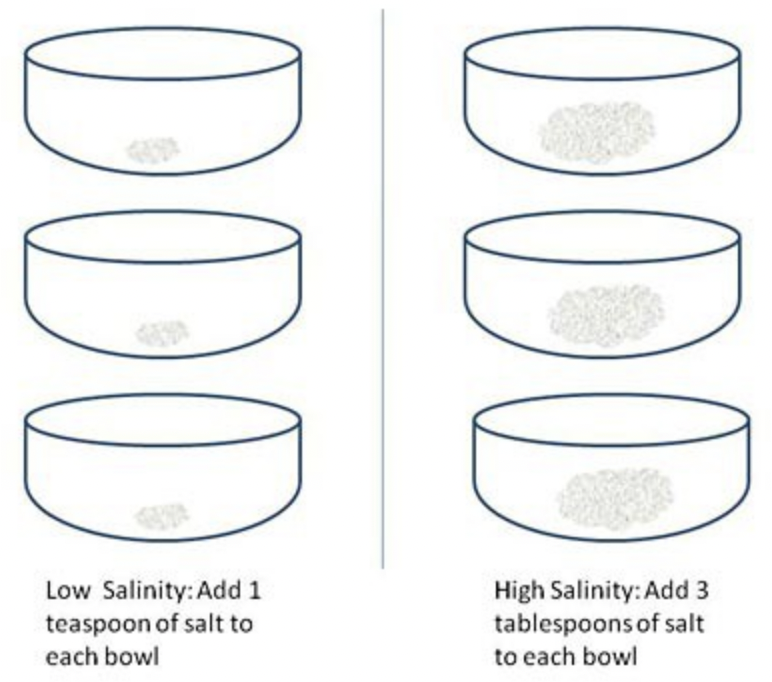
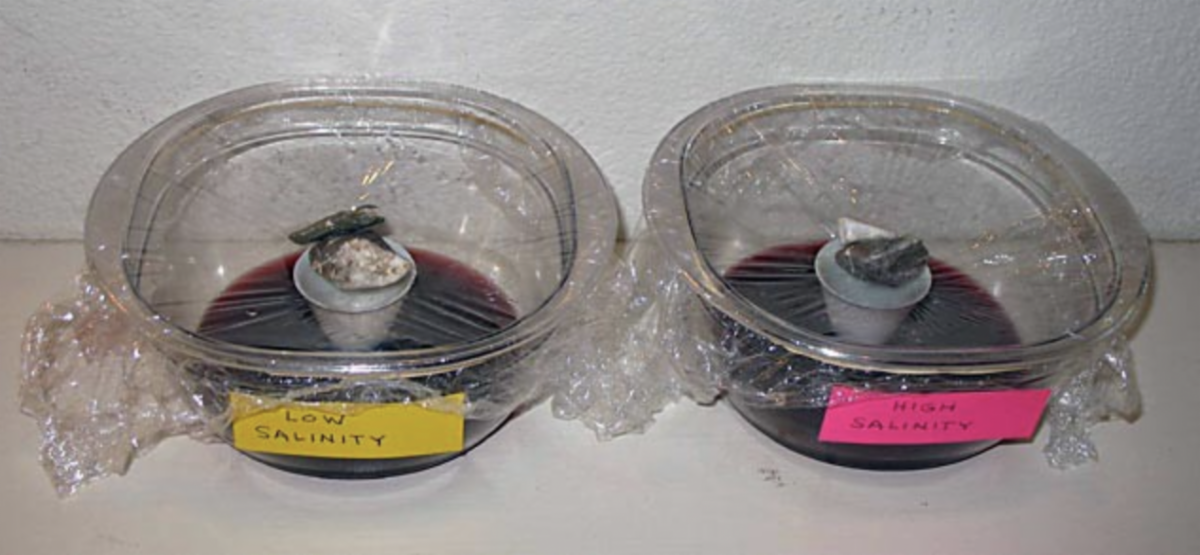
Add 1 teaspoon of salt to each of three bowls. These will be your low-salinity bowls. Label them by amount of salinity, with a "D" for "Desalinator," and a number to keep track of them individually, as follows: Low Salinity D1, Low Salinity D2, and Low Salinity D3, with sticky notes.
-
Add 3 tablespoons of salt to each of three bowls. These will be your high-salinity bowls. Label them by amount of salinity, with a "D" for "Desalinator," and a number to keep track of them individually, as follows: High Salinity D1, High Salinity D2, and High Salinity D3, with sticky notes.
- Using your dry measuring cup, add ½ a cup of hot red water from your liquid measuring cup to each of the six bowls. Use caution when pouring the hot water so you don't get burned.
- Stir the water in each of the bowls with a spoon for 1-2 minutes to help the salt dissolve. Now you have six bowls, each representing the Red Sea, one of the saltiest bodies of water in the world!
|
|
Make Your Six Desalinators
- Place each of your six small cups inside each of the six bowls. Position the cups in the middle of the bottom of the bowls.
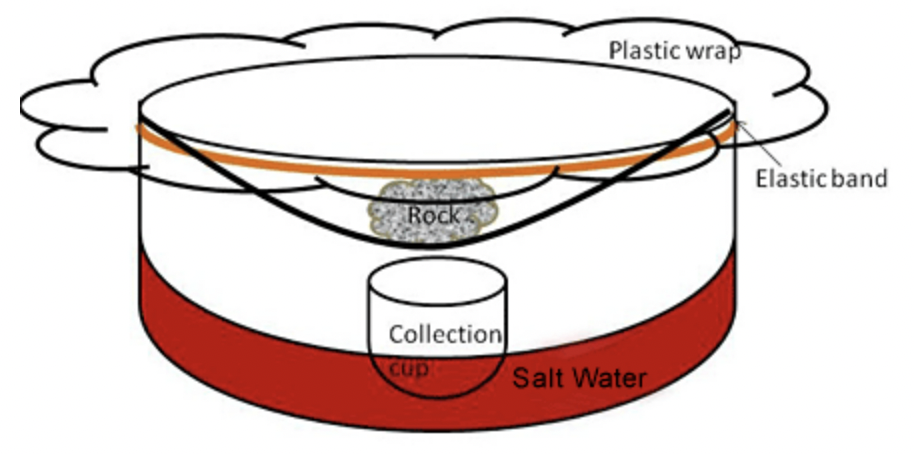
- Cover the top of each bowl with a large piece of plastic wrap. Leave extra around the edges. Press down slightly with your fingers into the middle of each piece of plastic so that it sags down toward the cup.
- Fasten the elastic bands around the top of each bowl so that there is a tight seal between the plastic wrap and each bowl, but still a sag in the middle, toward the cup.
- Place 1-3 rocks or other small heavy objects on the sagging portion of the plastic, directly over the small cup. You may need to tug the overhanging plastic slightly to get the plastic to sag evenly over the cup.
|
|
Test Your Desalinators
- Find a location where your desalinators can receive direct sunlight. Carefully set your desalinators side by side in the sun. Note: warmer climates have faster rates of desalination than cooler climates, so if you live in a cooler climate, start your test in the morning so you have enough daylight hours to complete the test.
- Check on your desalinators once every hour to make sure they are all still in the sunlight. If they are not, gently move them to a sunny location.
- Also peek through the plastic and look at the water that has collected in the small cups once every hour. If any of the cups look like they are about three-quarters full, then stop the desalination. Otherwise, continue to leave the desalinators out in the sun.
- Stop the desalination when any of the small collection cups are at least three-quarters full, or if the sunlight has ended for the day. Carefully and slowly remove the weights, elastic bands, and plastic wrap from each desalinator.
- Look in your small collection cups. What is the color of the collected water? Was your desalinator able to remove the red contaminant? Write down your observations in your lab notebook.
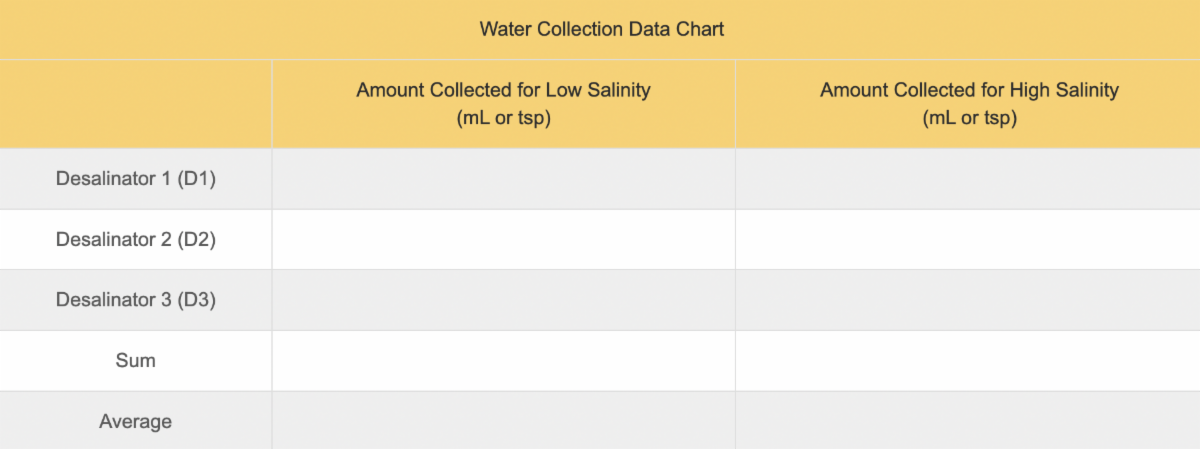
- For each desalinator, pour the water you collected in the small cup into the medicine cup, as shown in Figure 6, and measure what you collected. Record your measurements in a data table, like the one below. Then pour the contents of the medicine cup back into the small collection cup and place it back inside its corresponding bowl.
Once you have measured all your collected water, dip your finger into one of the collection cups and taste what you collected. Now dip your finger into the red saltwater and taste that. Is there a big difference between the taste of the two waters? Write down your observations for each bowl. Compare the average freshwater collected from the low-salinity desalinators with the average freshwater collected from the high-salinity desalinators. Which type of desalinator produced the most freshwater?
|
|
Variations
There are many variations that you can try for this experiment to see what factors affect how much water is collected:
- Compare amounts of water collected from desalinators with the same salinity topped with different colors of plastic wrap.
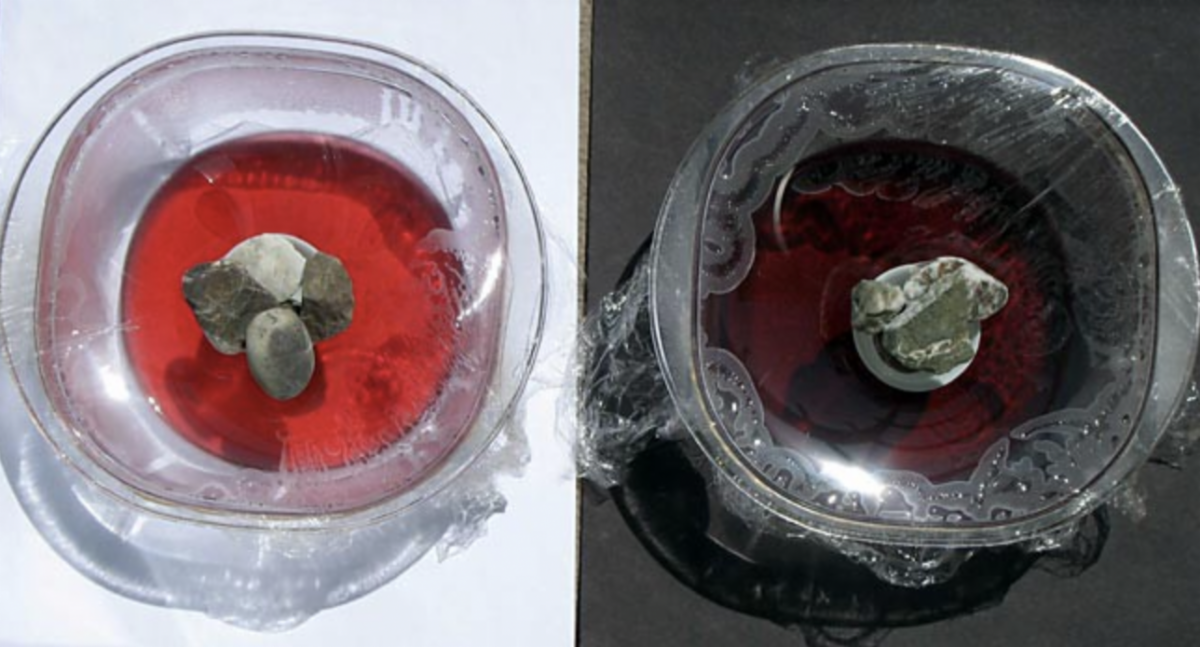
- Compare amounts of water collected from desalinators with the same salinity resting on different materials in the same location. For example, put one desalinator on grass, one on cement, and another on dirt. Or try setting them on different colors of paper, as shown below. Does this have any affect on the amount of water collected or have no impact?
- Compare amounts of water collected from desalinators with the same salinity and same bowl material, but that have different bowl shapes. Compare tall and narrow bowls with broad and flat bowls. This will test different surface areas.
- Can you think of ways to increase the amount of water collected? What about a reflector or something that concentrates the Sun's rays? What about a different type of material other than plastic wrap?
|
|
Three Creative Writing Prompts
These prompts and questions will help jump-start your daily writing. Just as it's important to read for at least 30 minutes each day, you should also write for 30 minutes a day. Don't worry about your organization or spelling, just write!
"The checkout line at the grocery store wouldn’t have been my preferred place to 'be discovered' but who am I to say no to Elizabeth Van Zee?"
"Is it even worth showing up here again if nobody’s ever going to come and answer my questions about my grandma?"
"I can’t justify the crimes I committed, even though they saved lives..."
|
|
July 18th Writing Prompts
July is “National Ice Cream Month.” First, describe your favorite flavor of ice cream. Next, create a new flavor of ice cream. What are the ingredients? What is your flavor’s name? Where will you sell your flavor of ice cream?
|
|
Creativity Corner
Set your art free
|
|
|
|
Shade a Sphere with Chalk Pastels |
Color chalk pastels are used for this awesome blending activity. Here you will learn how to shade a sphere as create your own unique sphere masterpiece. |
|
|
|
|
Play Mad Virus
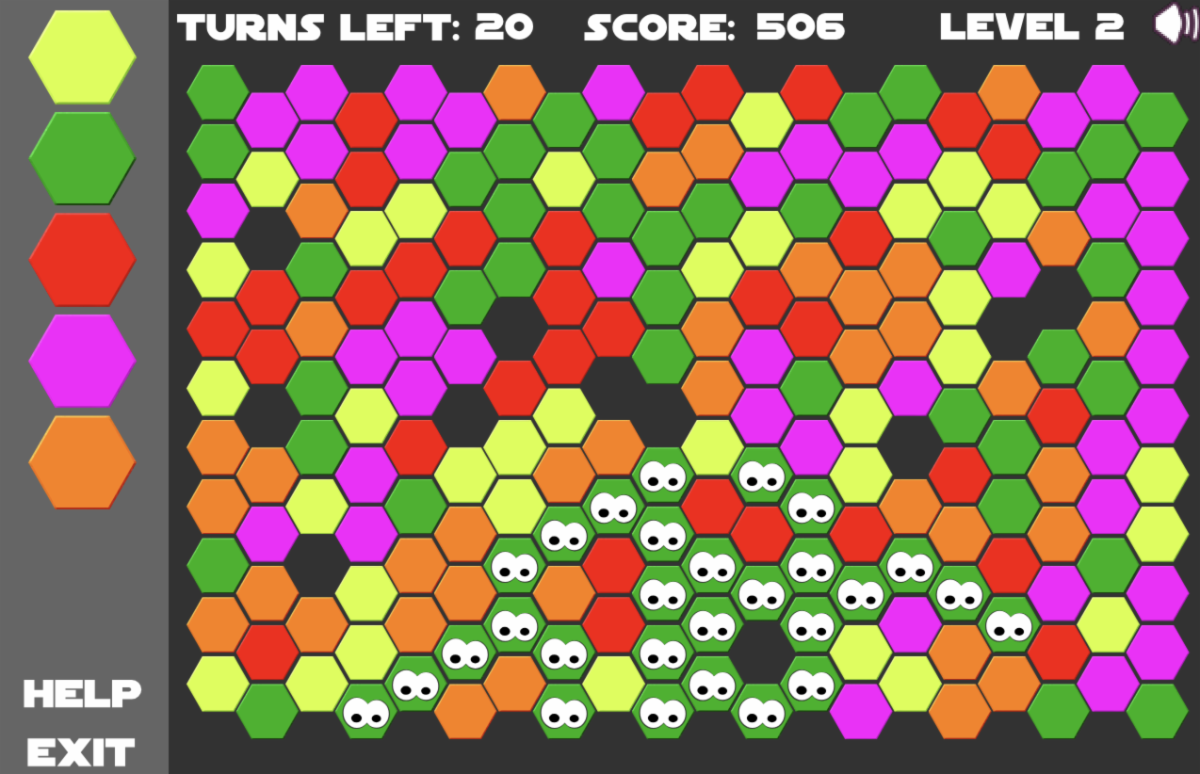
Click this link to solve these tricky virus puzzles. These look easy, but the game get hard fast.
|
|
|
|
|
|
|
|