|
|
June 21, 2022
Summer Issue #1
|
Weekly activities and lessons to keep your child thinking and progressing throughout the school year and summer. |
|
“And so with the sunshine and the great bursts of leaves growing on the trees, just as things grow in fast movies, I had that familiar conviction that life was beginning over again with the summer.” |
|
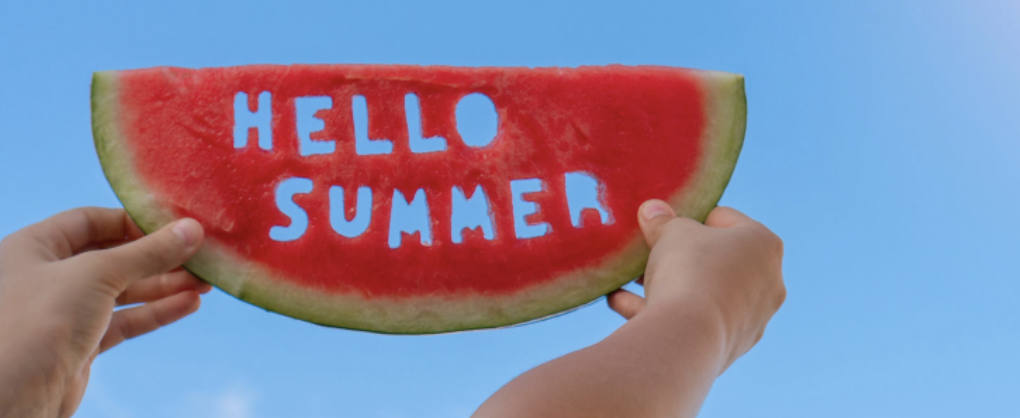
Hello and Happy First Day of Summer,
Yes! Summer is here. The long days and the lazy mornings are such a treat. This school year has been long and we all deserve a restful and relaxing summer break to recharge our batteries and to prepare for the upcoming year. I hope you all have exciting plans ahead where you can enjoy visiting with friends and family.
In this summer season of The McManus Files, I'll be experimenting with some new learning activities. There will always be creative writing prompts, a weekly book recommendation, problems of the week, and investigations to build critical background knowledge, but keep checking your Tuesday emails for innovative and active learning activities that will keep your child thinking and moving forward over the summer. This is an excellent time to review and improve on the necessary skills that are essential for success in the upcoming school year. Thank you again for all your loyalty and support. I am always open for suggestions and comments about my flyer... Feel free to email me anytime: bfloydmcmanus@gmail.com
If you know anybody who you think would benefit from the weekly learning activities in this flyer, please share it with your friends and encourage them to join The McManus Files mailing list by following the links on this page.
Stay curious and always ask questions.
Mr. McManus :-)
|
|
Children acquire skills throughout the school year, but they can lose ground if learning stops during the summer break. Fortunately, learning never has to stop. Children who read throughout the summer gain skills, can start the new school year with a better understanding of language and the world around them, and discover the joy of reading. The more they like to read, the more they will read.
It's not hard to help your children keep their interest in reading and learning. Children learn through a variety of activities, and almost everything we do presents an opportunity to read. When you're eating breakfast, read the cereal box; if you're in a restaurant, read the menu. Read the newspaper with your children and discuss what's happening in the world.
Reading every day, even if it's for just a few minutes, improves children's ability to read and learn all year long. Here are weekly activities that involve reading and related skills. There's no special order, and you don't have to do everything listed in a particular week. Just pick the ones that look interesting and fun!
|
|
Week 1: Celebrate Summer
- Write a list of things you want to do this summer. Don't forget to include reading!
- Make a chart to keep track of all the books you read this summer.
- Write down on your calendar the time the sun sets today.
- Start a summer scrapbook. Include souvenirs of any trips you take, photos, ticket stubs, and projects you work on during the summer.
- List all the books by your favorite author. See how many you can read this summer.
- Swap books with a friend. Keep sharing books throughout summer.
- Take a walk. Write about or draw the things you see that show summer is here.
|
|
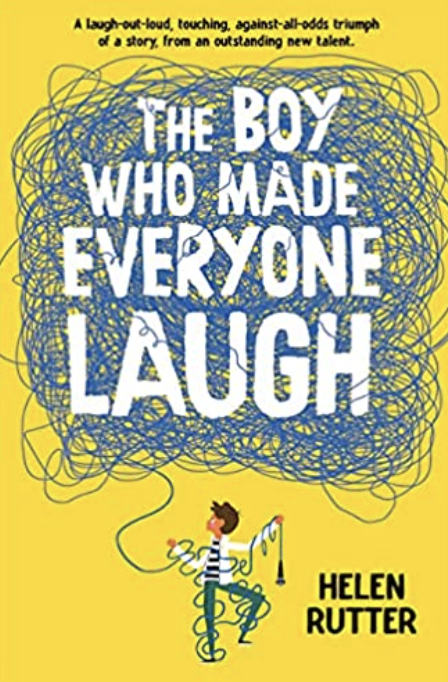
The Boy Who Made Everyone Laugh
by Helen Rutter
|
|
|
|
The second I opened this book I knew that I was going to love it. Billy Plimpton is a wonderful boy, honest, kind, and very funny. He has a big dream which seems impossible to achieve and a big problem to overcome. I immediately developed a rapport with Billy so it was a joy to go through the ups and downs of his life with him. Billy is a great character. He’s smart, funny and flawed. Watching him evolve is a pure pleasure. The supporting characters add depth and perspective to Billy's struggles. By the end, Billy realize everyone has something about them they’d like to hide, but for Billy, that’s near impossible. After his secret is out, things go pretty much as expected, and then they don’t. As Billy opens up and takes risks, he gets a taste of friendship and freedom he thought he'd never achieve. I laughed and I cried, at the end I felt a deep sense of satisfaction and hope for the future. Hooray for Billy Plimpton, long may he live.
Enjoy!
|
|
|
|
|
The Reasons for the Seasons |
|
Summer is here! You can feel it in the air, smell it in the earth, and see it in the long days and early mornings.
While we’re reveling in the warmer weather, you might be wondering why the seasons change. So, in honor of the first day of summer—the summer solstice—I'm taking the opportunity to help you answer some questions you may have about the seasons and the science behind the season.
What causes day and night?
The earth rotates on the imaginary axis running through its center from top to bottom or north to south. This axis or pole also permanently tilts the earth at a 23.5-degree angle. (More on that later.) The earth makes one complete rotation approximately once every 24 hours, or one “solar day.” As one side of the earth rotates toward the sun, that side experiences daylight. The side facing away from the sun experiences darkness or night.
To help visualize this, grab a ball or globe and a flashlight. If you’re using a ball, stick a Post-it Note marked “You are here!” on one side. Turn off the room lights and, holding the ball or globe in one hand, shine the flashlight onto one side of the ball. Now, slowly turn it counterclockwise while looking down from its “north pole.” See how the “earth’s” rotation makes the difference between day and night where you live?
Why do the seasons change?
So, we know that the earth is spinning on its axis one full turn every 24 hours. At the same time, the earth is also moving around the sun in an elliptical or egg-shaped orbit that takes one full year or 365 days to complete. Contrary to what you might think, this elliptical orbit actually moves the earth closer to the sun in December and farther from the sun in June. So the earth’s orbit isn’t the answer!
The answer lies instead in the earth’s tilt. Again, the earth tilts at a constant 23.5 degrees along an imaginary axis running north to south. As the earth moves around the sun over the course of the year, the northern or “top” half tilts toward the sun in summer and then away from the sun in winter. So it’s the earth’s tilt toward or away from the sun, not its distance from the sun, that explains our change of seasons.
If all this rotating and orbiting has your head spinning …
Check out this fun video from Bill Nye the Science Guy, where he demonstrates why “the earth’s tilt is the reason for the seasons!”
|
|
Take an astronomical stroll through the seasons in this 90-second National Geographic video. |
|
When is the first day of spring? Why is it called the vernal equinox?
In the Northern Hemisphere, the first day of spring occurs on March 20 or 21 of each year. This year it happens on March 20!
On March 20, the sun shines directly over the earth’s celestial equator, the imaginary line above the earth that divides it into northern (top) and southern (bottom) hemispheres or halves. Because of this perpendicular alignment, we get approximately 12 hours of daylight and 12 hours of night.
On September 22 or 23, when the earth has traveled halfway around the sun, its tilt will align this way again—causing another 12 hours of day and 12 hours of night. We refer to this day as the autumnal equinox.
In the Northern Hemisphere, the vernal equinox signals the beginning of spring and the autumnal equinox signals the beginning of autumn. In the Southern Hemisphere, the seasons are reversed, so when it’s the spring equinox here in the United States, it’s the autumnal equinox in countries that lie below the equator like Argentina and Peru.
When are the first days of summer and winter?
In the Northern Hemisphere, the first day of summer, or summer solstice, occurs between June 20 and June 22. At that time, the earth’s axis tilts the Northern Hemisphere closest toward the sun. The first day of winter, the winter solstice, occurs sometime between December 21 and December 22 when the earth’s axis tilts the Northern Hemisphere away from the sun.
What’s the difference between an equinox and a solstice?
To sum up, an equinox is a day that has an equal number of hours of day and night. A solstice is either the longest night of the year (winter) or the longest day of the year (summer). Put another way, the winter solstice has the fewest hours of daylight in the year, and the summer solstice has the most hours of daylight.
An equinox occurs when the earth’s tilt aligns the equator perpendicularly to the sun. A solstice occurs when the earth’s tilt, as it moves through its yearlong orbit, either points farthest from the sun (winter) or closest to the sun (summer).
Now that you know the reasons for the seasons, we hope you’ll appreciate the first day of summer even more!
|
|
Here are some fun links with Summer Solstice Activities
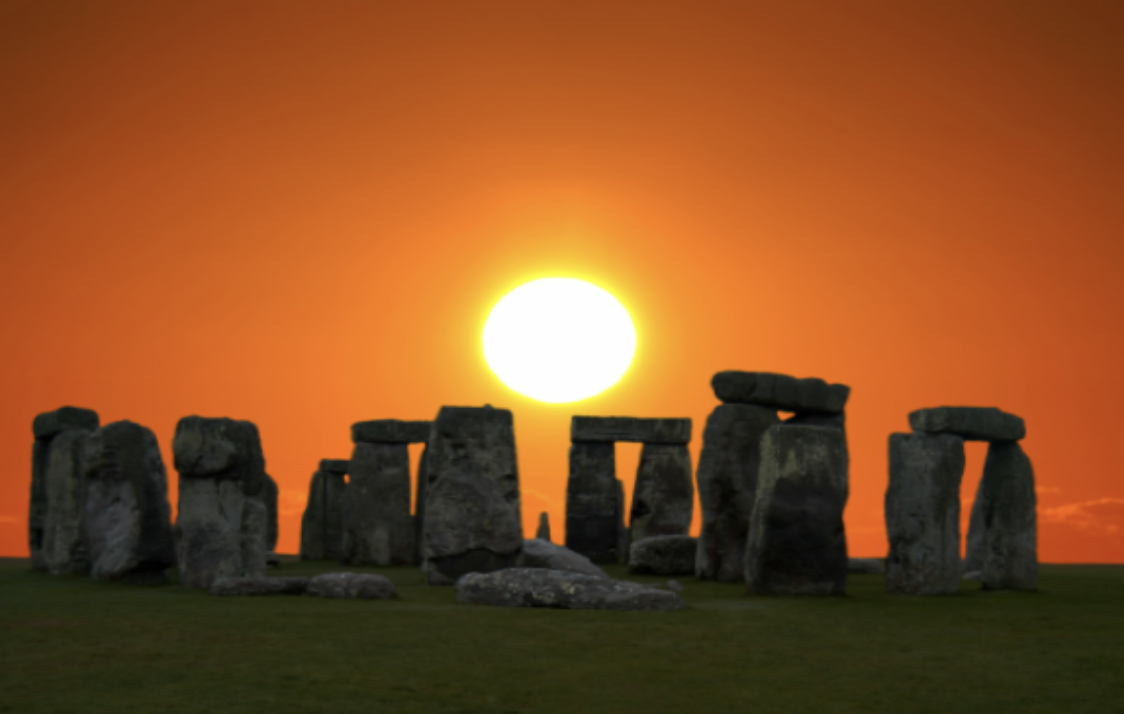
I feel the best way to celebrate is to either watch the sun rise and/or the sun set. You can do this any day, but on the solstice it is extra special ;-)
|
|
If you feel your child might benefit from a group or individual tutoring program to prepare them for the next phase of their education, please contact McManus Tutoring.
Programs are structured so that students learn independence, accountability, and self-possession. They will develop a repeatable structure that can be used to build success in the future.
|
|
Three Writing Prompts and an Essay Topic
These prompts and questions will help jump-start your daily writing. Just as it's important to read for at least 30 minutes each day, you should also write for 30 minutes a day. Don't worry about your organization or spelling, just write!
"The flower began to bloom and out came a..."
"As the heat became unbearable we still had to..."
"I looked out the window just as a skydiver landed in my yard with..."
|
|
Which is the Best Frozen Treat and Why?
Everyone likes to raid the freezer for something sweet and cold on a hot summer day. Which is your favorite cold treat (from creamsicles to Klondike Bars to Choco Tacos), and why is it the best?
|
|
What two numbers have a product of 48 and, when the larger number is divided by the smaller, a quotient of 3? |
|
Last week's answer...
Since the trains are 100 miles apart, and the trains are traveling toward each other at 40 and 60 mph, the trains will collide in one hour. The bird will have been flying for an hour at 90 miles per hour at that point, so the bird will have traveled 90 miles.
|
|
|
|
|
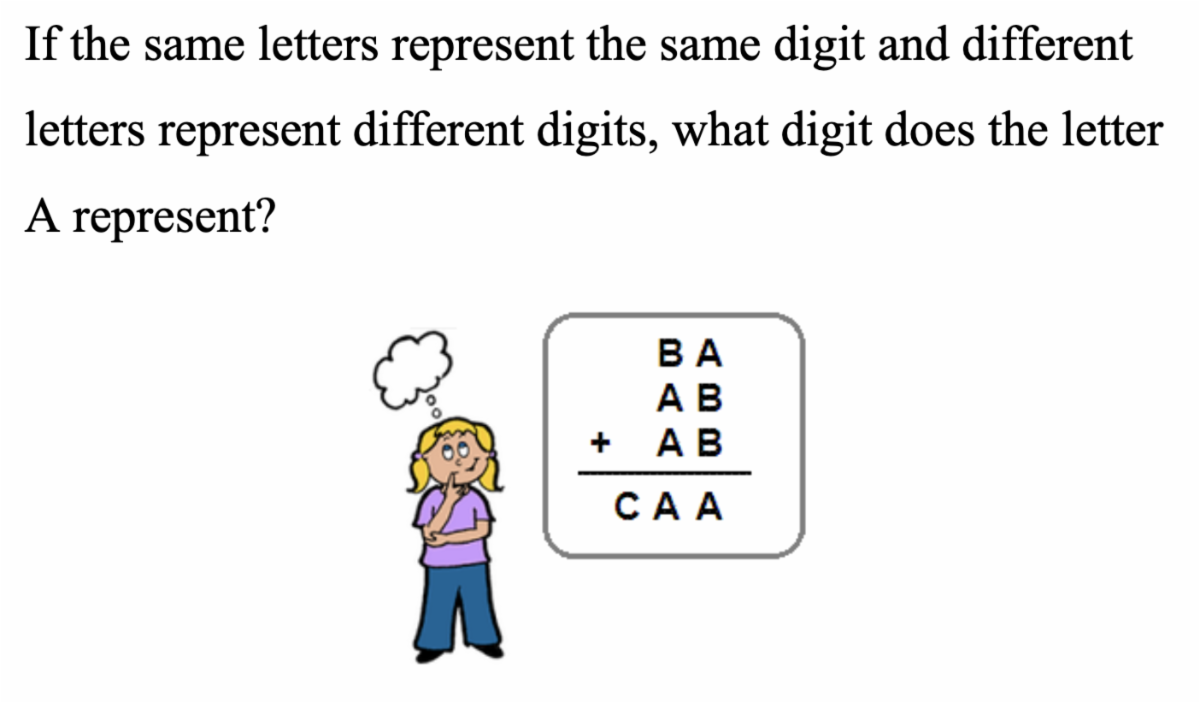
A+B+B=A? What is the value of A? |
|
|
|
|
|
|