|
|
June 28, 2022
Summer Issue #2
|
Weekly activities and lessons to keep your child thinking and progressing throughout the school year and summer. |
|
“The more that you read, the more things you will know, the more that you learn, the more places you’ll go.”
|
|
Hello and Happy Tuesday,
I hope all of you are well and enjoying these beautiful days.
In this issue I'm continuing my stroll through the "Weeks of Summer" with thinking, writing and reflecting activities that will add a little diversity to your child's day.
Also, I'm introducing a new segment which explores the importance of developing Habits of Mind. These practices will ultimately help your child become more resilient and better problem solvers. I hope you find this material useful. I incorporate these strategies into my daily curriculum and I have made it a goal to provide more direct instruction on the Habits of Mind with my future students.
The 4th of July is this week so I thought it would be fun for the kids to try a little experiment with static electricity where they could make their own "fireworks" :-) These are easy, fun and safe ways to experiment with electricity.
This week's book recommendation is a find! If you are looking for a meaningful and impactful summer read full of humor that will provoke introspection, this is the book for you.
If you know anybody who you think would benefit from the weekly learning activities in this flyer, please share it with your friends and encourage them to join The McManus Files mailing list by following the links on this page.
Stay curious and try new things,
Mr. McManus :-)
|
|
Children acquire skills throughout the school year, but they can lose ground if learning stops during the summer break. Fortunately, learning never has to stop. Children who read throughout the summer gain skills, can start the new school year with a better understanding of language and the world around them, and discover the joy of reading. The more they like to read, the more they will read.
It's not hard to help your children keep their interest in reading and learning. Children learn through a variety of activities, and almost everything we do presents an opportunity to read. When you're eating breakfast, read the cereal box; if you're in a restaurant, read the menu. Read the newspaper with your children and discuss what's happening in the world.
Reading every day, even if it's for just a few minutes, improves children's ability to read and learn all year long. Here are weekly activities that involve reading and related skills. There's no special order, and you don't have to do everything listed in a particular week. Just pick the ones that look interesting and fun!
|
|
Week 2:
Keep in touch
• Make a personal phone book. List phone numbers and addresses of your friends and relatives.
• Design your own stationery and write a letter to a friend.
• Start a journal with a friend or relative. Take turns writing in it all summer long. You can even do this by mail or e-mail.
• Write a letter to your favorite author. A librarian can help you find a postal or e-mail address.
• Draw a picture postcard of an imaginary place. On the back, write a message. Mail it to a friend or relative or put it in your scrapbook.
• The first U.S. postage stamps were designed in 1847. Be a philatelist. Design your own stamp.
• Word game! Invent a code (A=1, B=2, for example). Send a message in code to a friend.
|
|
Habits of Mind
Have you ever heard someone tell you that it takes 21 days to form (or break) a habit? Well, scientific studies have determined that to be unfounded.
When it comes to something easy, such as grabbing a coffee at your local Starbucks on your way to school, it might take only a few days for a habit to form. But if it is a habit that is challenging, studies have shown that it may actually be more like 66 days. Or for very challenging habits, it could take up to a year!
Habits of Mind are thinking habits that push us far past simple answer retrieval. They change our pattern of thinking to help us gain success when we don’t know the answer to a question or problem.
Nearly all successful people, regardless of their profession, have mastered these habits. This makes teaching the Habits of Mind crucial as we strive to teach our children. Since they are cross-curricular, they can be applied to all subjects and grade levels.
These habits are not as easy to master as that daily Starbucks stop, so it is important that the language and mindset is woven throughout instruction. This way, students have an opportunity to practice frequently to help them become automatic. Additionally, it results in resilient children who are able to tackle real-world problems without giving up.
|
|
The 16 Habits of Mind include:
• Persisting
• Thinking and communicating with clarity and precision
• Managing impulsivity
• Gathering data through all senses
• Listening with understanding and empathy
• Creating, imagining, innovating
• Thinking flexibly
• Responding with wonderment and awe
• Thinking about thinking (metacognition)
• Taking responsible risks
• Striving for accuracy
• Finding humor
• Questioning and posing problems
• Thinking interdependently
• Applying past knowledge to new situations
• Remaining open to continuous learning
|
|
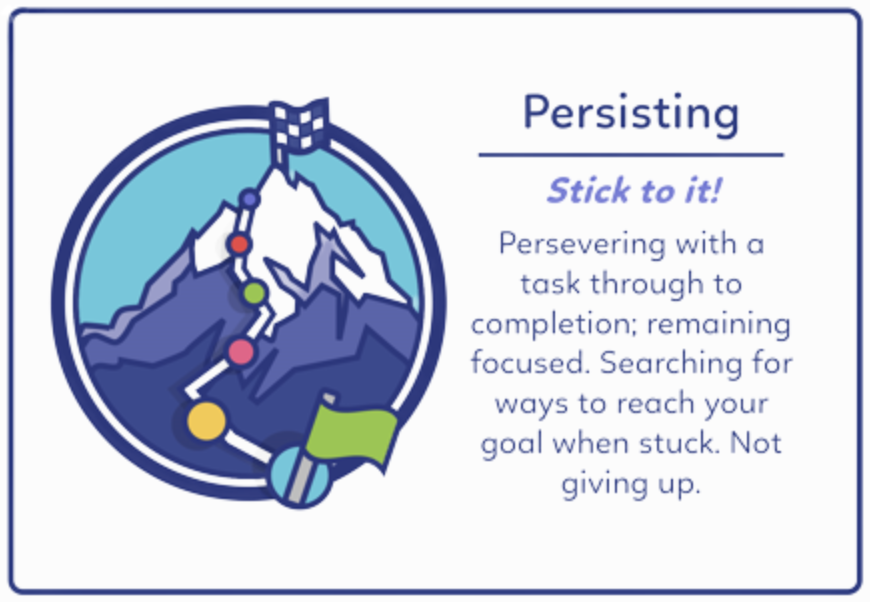
Persisting
What is it? – Sticking to a task even when you want to give up.
Sounds like – “I think I can, hang in there, keep at it, you can do it!”
Looks like – Attending even with distractions. Trying again.
Feels like – Even though I’d like to quit, I have the strength to continue.
Some students give up when the answer is not immediately known. They crumble their paper, or say, “it’s too hard, I can’t do this!” Sometimes they write down any answer or hurry through their work, to “get it done”. Students with the habit of persisting have a method for analyzing the problem, they know how to begin. They consider the steps that must be performed and what data or information they need to accomplish the task. They are able to sustain a problem solving process over time. They are comfortable with new challenges.
“Success seems to be connected to action. Successful people keep moving. They make mistakes but they never quit.” Conrad Hilton
|
|
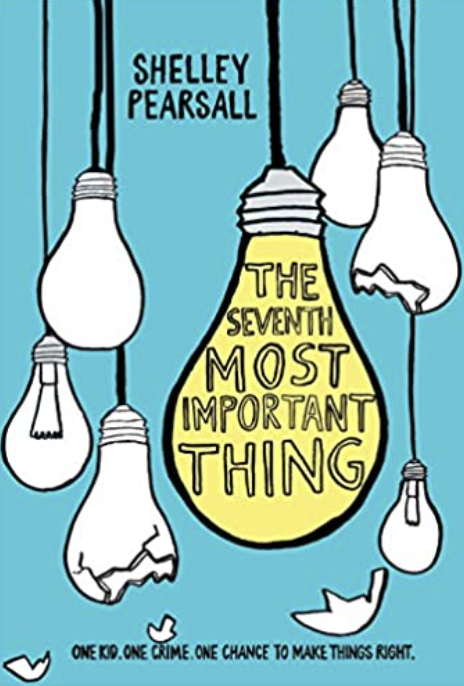
The Seventh Most Important Thing
by Shelley Pearsall
|
|
|
|
Arthur T. Owens grabbed a brick and hurled it at the trash picker. Arthur had his reasons, and the brick hit the Junk Man in the arm, not the head. But none of that matters to the judge—he is ready to send Arthur to juvie forever. Amazingly, it’s the Junk Man himself who offers an alternative: 120 hours of community service . . . working for him. Arthur is given a rickety shopping cart and a list of the Seven Most Important Things: glass bottles, foil, cardboard, pieces of wood, lightbulbs, coffee cans, and mirrors. He can’t believe it—is he really supposed to rummage through people’s trash? It isn’t long before Arthur realizes there’s more to the Junk Man than meets the eye, and the “trash” he’s collecting is being transformed into something more precious than anyone could imagine. . . This marvelous story vividly puts you there, experiencing it all. Emotional, profound, yet relatable on a simple, human level. You will appreciate all the details. At the end, there's a surprise you'll be so glad you waited for, and want to chase down other info about. Don't ruin it for yourself and peek, but I wouldn't want you to miss it..
Enjoy!
|
|
|
|
|
HOW TO MAKE LIGHTNING
Have you ever wanted to be a mad scientist? Has your lack of control over lightning disheartened you? Never fear; this experiment will let you bend electricity to your will by showing you how to make lightning!
|
|
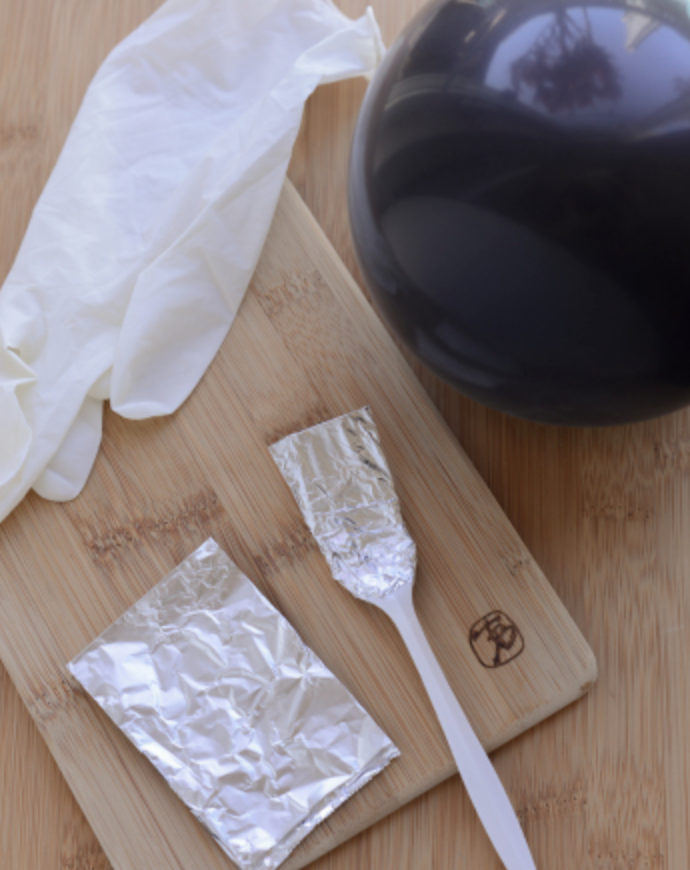
On a cool, low-humidity day, use a foil-covered fork and a balloon to create a “lightning storm”. Turn down the lights to get a better view of the static electricity you’re creating. |
|
Materials
- Rubber glove
- Plastic fork
- Tin Foil
- Wood or plastic cutting board
- Styrofoam plate or rubber balloon
- Head of hair or wool
- Cool, low-humidity day (< 45% humidity, < 75 F temperature)
Procedure
- Fold tin foil around your plastic fork so that it looks like a big spatula. Make sure it’s as flat as possible with no sharp corners.
- Put on the rubber glove and use your gloved hand to rub the Styrofoam plate or rubber balloon on your hair or wool.
- Place the plate or balloon on your cutting board, and use the gloved hand to pick up your tin foil spatula.
- Place the tin foil part of your spatula on the balloon or plate. Touch the foil with your other hand. What happened? How can you explain what you saw?
- Pull the spatula up from the balloon or plate, and touch it again. What happened this time? Did you expect that?
- Experiment with other materials. Recharge your charged object using your hair or wool if necessary. Does your hand spark when it touches the balloon? Why do you think this is so?
Extra: for even cooler results, conduct this experiment in a room that you can darken as much as possible!
Results
You should have seen and felt a spark when you touched the foil. When you lifted the foil off and touched it again, you should have felt another spark. Your hand doesn’t spark, and most non-metallic objects won’t spark when you touch the charged object either. All metals insulated by your glove that touch both your charged object and your hand will spark.
Why?
You’re experimenting with static electricity. The static electricity you see is caused by the movement of electrons. Electrons carry a negative electrical charge, which causes them to be attracted to protons and repelled from other electrons. When you rub an object on your hair, it does one of two things: it either puts electrons onto the balloon, or strips electrons off of the Styrofoam plate. This gives the balloon or plate a net charge, meaning the object has either more electrons or fewer electrons than protons.
Metals are special materials in that their electrons are free to move almost wherever they like, instead of being stuck on the material’s molecules. When a metal object is placed near something with a net charge, all of the electrons in the metal will move to be either as far away from a negative charge as possible or as close to a positive charge as possible. Metals are called conductors. Your plate and your balloon are both insulators—they don’t let their electrons move where they want.
When your spatula moves close to the charged object, the electrons either want to get close to or far away from the object. When you bring your hand up to touch the spatula, the electrons flow to you or flow onto the spatula, depending on whether the spatula is touching the Styrofoam plate (towards) or the rubber balloon (away). Your skin is actually quite conductive! After the electrons move, the tin foil has a good number of electrons for its location (close to the charged object). When you move the tin foil spatula away from the charged object, it suddenly has a lot more or way fewer electrons than it needs, and so more will jump from your body to balance it out. You can keep going back and forth like that for a long time, since the electrons (or lack of electrons) on the charged object doesn’t change.
Your hand doesn’t spark because your body provides a path to ground. What that means is that when you bring your hand close to the balloon, all the extra electrons needed come from or go into the ground you’re standing on! Because of the rubber glove you’re wearing, the tin foil spatula has no path to ground, so it cannot equalize its charge. When you touch it, you are providing it with a path to ground for the electrons to move and balance things out. The earth has plenty of electrons to spare, and they move all over the place.
So what makes lightning? Lightning occurs when there’s a big charge difference between the clouds in the sky and the earth. Lightning is just a bigger version of the sparks you saw!
|
|
This activity looks like a lot of fun. Can you create a magic act that uses static electricity to trick your audience? |
|
If you feel your child might benefit from a group or individual tutoring program to prepare them for the next phase of their education, please contact McManus Tutoring.
Programs are structured so that students learn independence, accountability, and self-possession. They will develop a repeatable structure that can be used to build success in the future.
|
|
Three Writing Prompts and an Essay Topic
These prompts and questions will help jump-start your daily writing. Just as it's important to read for at least 30 minutes each day, you should also write for 30 minutes a day. Don't worry about your organization or spelling, just write!
"I rented the room to..."
"The hidden door led through the backyard and to a winding alley..."
"To meet in secret we had to..."
|
|
Do we need fireworks to celebrate July 4th?
Persuade someone to celebrate July 4th just as you do. Explain why you think fireworks are an essential part of an Independence Day celebration, or tell why you think the Fourth of July celebration should end the tradition of fireworks.
|
|
Two alligator breeders were talking one day, and in the course of their conversation they noticed a curious coincidence. If alligator breeder #1 were to sell alligator breeder #2 seven alligators, then breeder #1 would have exactly as many alligators as breeder #2. On the other hand, if alligator breeder #2 were to sell alligator breeder #1 seven alligators, then breeder #1 would have exactly twice as many alligators as breeder #2. How many alligators did each breeder have? |
|
|
|
|
|
|