|
|
March 14, 2023
Winter Issue #15
|
Weekly activities and lessons to keep your child thinking and progressing all year long. |
|
"Happiness is not something readymade. It comes from tour own actions."
|
|
Happy Wind-day,
What an awesome and destructive storm we had this afternoon. I went on a wind walk this afternoon through Coyote Point and up to Bayside Park. Sadly, I saw at least 20 large fallen trees. All I could think about was a time in college when I was taking Biology. The professor had a question on a test that was, "Who is the best tree trimmer?" The correct answer was Mother Nature. Today was an example of her great gardening power. Unfortunately, cars, and roads, and fences get in the way. This winter will end soon and all this rain is going to make for a glorious spring.
This week's flyer recommends an incredible book. I felt lucky to stumble across it. Aside from being a beautifully written story between a surly grandson and an elderly, bedridden grandmother, the novel explains a deeply troubling part of Ukrainian history. This contemporary story, set during the Covid lockdown, is relevant and important today with the Ukrainian crisis beginning its second year. Wow! Yes, that is what you will say when you finish this memorable book. Check it out...
Builders are going to love this week's Inquiry Quest. Just follow the directions and this little device will provide hours of fun. This is the kind of homemade toy I wish I had access to as a kid. Keep thinking and trying new things.
If you know anybody who you think would benefit from the weekly learning activities in this flyer, please share it with your friends and encourage them to join The McManus Files mailing list by following the links on this page.
Peace,
Mr. McManus
|
|
If you feel your child might benefit from a group or individual tutoring program to prepare them for the next phase of their education, please contact McManus Tutoring.
Programs are structured so that students learn independence, accountability, and self-possession. They will develop a repeatable structure that can be used to build success in the future.
|
|
The Lost Year
by Katherine Marsh
|
|
|
|
This book is a poignant story for all ages. It has every lesson a teenager (actually, anyone) needs to learn: empathy, history, curiousity, and perseverance. The author masterfully intertwines the stories of teen girls living during the Holodomor, the Russian oppression of the Ukrainians during the 1930's when the Soviets starved farmers to make them collectivize, with the life of Matthew, an American boy living during the outbreak of Covid. This book has a stunning plot twist at the end which you will never forget. The inclusion of Matthew balances the gripping famine tale with a contemporary and relatable storyline for middle-grade readers. This book is also particularly timely given the Russian invasion of Ukraine. I wish everyone would read this powerful novel.
Enjoy!
|
|
|
|
|
Height Sight
Find the height of a tree, a flying paper rocket, or even the North Star!
Build an inclinometer, a tool that can measure the height of a distant object, no matter how far away it is.
|
|
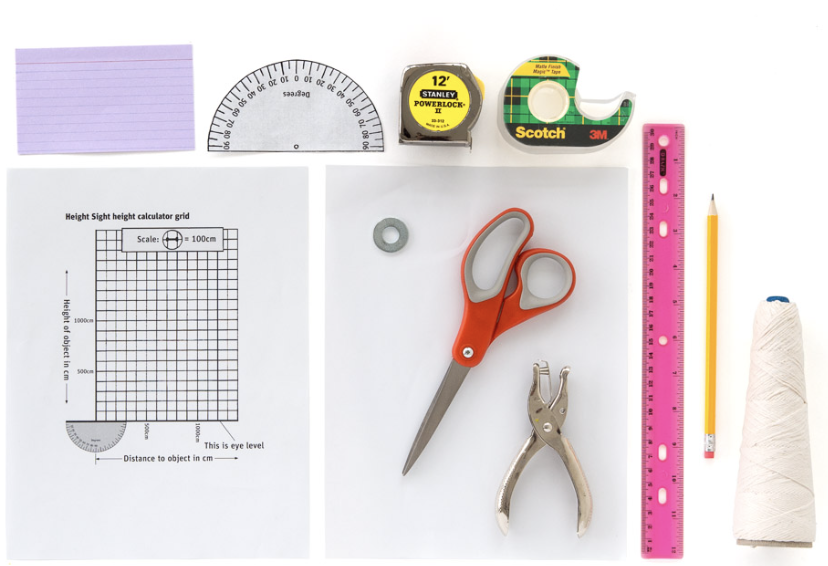
- Materials you’ll need:
- Inclinometer Protractor template
- Scissors
- Clear tape
- 3 x 5 index card
- Hole punch
- 20 inches string
- Washer or other small weight that can be tied with string, such as a ring magnet or binder clip
- Sheet of 8.5 x 11 paper
- Pen or pencil
- Measuring tape
- Height Calculator Grid
- Ruler
- Optional: partner
|
|
|
Assembly
-
Print out the protractor. Then, using your scissors, cut out the printed protractor, cutting carefully along the straight line on the top edge.
- Tape the protractor to the 3 x 5 index card so the protractor’s straight side matches up with the card’s long side. Tape carefully around the curve of the protractor so it stays in place on the card.
- Use the hole punch to punch a hole through the circle on the protractor.
- Push one end of the string through the hole, and then through the washer. Tie the ends of the string together, making a loop on which the washer can freely slide.
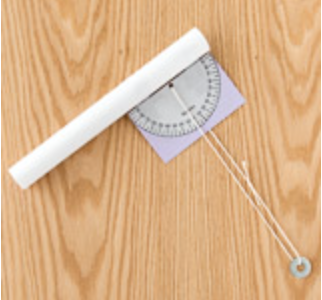
- Roll a sheet of 8.5 x 11 paper into a cylinder that’s 8.5 inches long, and about 1 inch in diameter. Tape the seam so the rolled-up paper stays in place.
- Tape the paper cylinder to the card along the straight edge of the protractor. One end of the cylinder should line up with the edge of the card, as shown below.
|
|
To Do and Notice
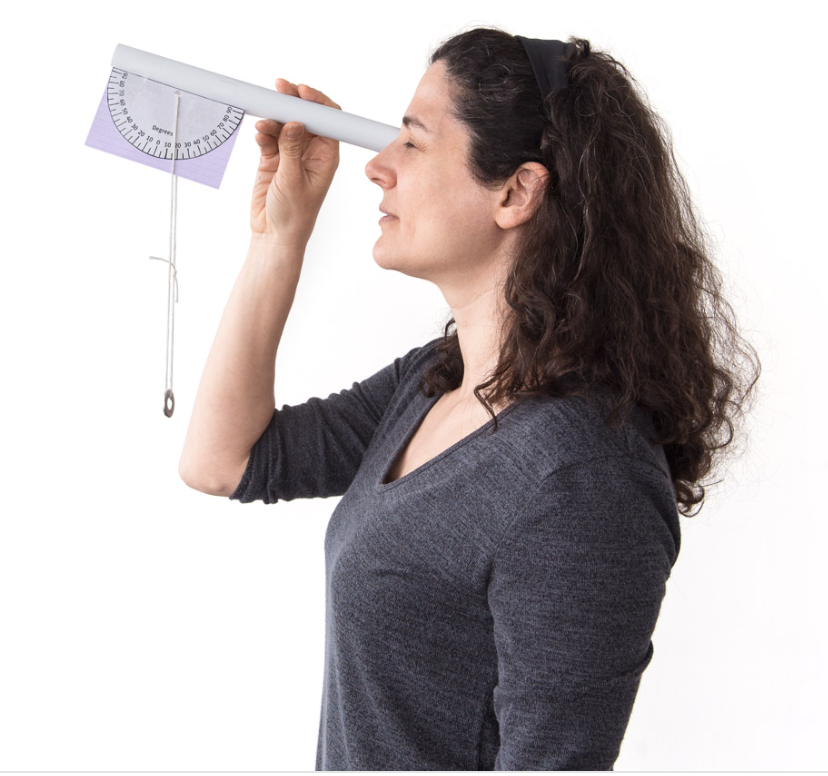
Look through the free end of the tube, opposite the protractor, or sight along the tube’s top edge.
Focus on something at eye level. Ask your partner to read the angle where the string crosses the protractor. If your inclinometer is level, the string should cross the protractor at about 0 degrees.
If you’re trying this without a partner, look through the tube and pinch the string against the card to hold it in place. Then take the tube away from your eye and read the angle on the protractor. (Be careful not to move the string and change the angle!) Try this a few times, until you get the hang of it.
Now look through the tube at the top of something tall. If you’re indoors, look at something near the ceiling and find the angle where the string crosses the protractor. What do you think will happen if you change the distance between where you’re standing and the tall object you’re sighting? Make a guess, then take a few steps toward or away from the object and check your inclinometer. What happened to the angle?
Try this:
- Use your inclinometer to measure the top of something tall, but not too far away. Determine the angle on your inclinometer and write it down. This is the angular height of the object.
- Use your measuring tape to find out how far the base of that object is (in centimeters) from where you’re standing. Write down this distance.
- Have a partner measure how far it is from the floor to your eye level. Write down this distance.
You now have all the data you need to find the height of the object. You could use trigonometry to find the answer, but we’ve provided a handy Height Calculator Grid that will also do the job.
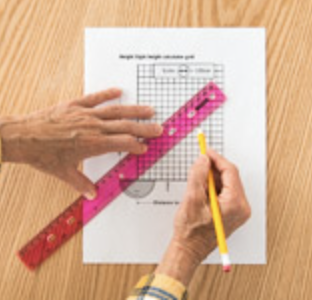
To begin, use a ruler to draw a line from the angle you measured through the origin and across the grid (see example in photo below).
Find the distance to your object along the horizontal (x) axis. Now note the scale of the grid. Draw a vertical line through that distance across the grid, and then find the place where the two lines intersect. Read the height along the vertical (y) axis. Notice the scale of the grid as you determine this height.
Notice that the x axis is labeled “eye level” because your measurement was taken from that height. To account for that measurement, add the height from the grid to the distance from your eye to the ground. This is the height of your object.
|
|
What's Going On?
When you use your inclinometer to look at something above your head, the inclinometer tilts. The string crossing the protractor marks the angle of that tilt, which depends both on the height of the object and your distance to it. When you measure the angular height of something, your distance matters. Measure the angular height of the same tall object from two different distances, and you’ll get a larger angle when you’re closer, and a smaller angle when you’re farther away.
Calculating the height of an object that you cannot directly measure requires knowing both its angular height and your distance to the object. The Height Calculator Grid helps you determine the height of the object indirectly using similar triangles.
The triangle you drew on the grid is similar to the triangle formed in the real world because, for both triangles, all three angles are the same: The first common angle is the one you measured with your inclinometer, which is the same as the angle you drew on your grid. The second common angle is the 90-degree angle formed by the intersection of the vertical and horizontal lines (in this case, the vertical line of the object and the horizontal line marking the measurer’s eye level). The third common angle is the same by definition: the sum of the interior angles of any triangle equals 180 degrees.
That means the triangle on the grid is a scaled-down version of the triangle in the real world. By drawing a triangle that’s exactly the same shape as the triangle in the real world, you can measure something indirectly that you can't easily measure with a ruler.
|
|
Three Writing Prompts and an Essay Topic
These prompts and questions will help jump-start your daily writing. Just as it's important to read for at least 30 minutes each day, you should also write for 30 minutes a day. Don't worry about your organization or spelling, just write!
"The night I discovered that the garden gnomes come to life after the sun sets I...
"Tabitha show up to her first day of school only to discover that her new teacher is a wizard who will teach her how to..."
"Nobody knew what the light switch in the closet was for until I..."
|
|
March 14th
Today in Moth-er Day; a day that honores moth collectors and specialists.
Prompt: Do you collect anything? What do you enjoy most about your collection? If you don't collect anything right now, imagine something you'd like to collect.
Also...
Today is Save a Spider Day
Prompt: How do you feel about spiders? Some people are scared silly. Do some research and find out one good fact about spiders.
|
|
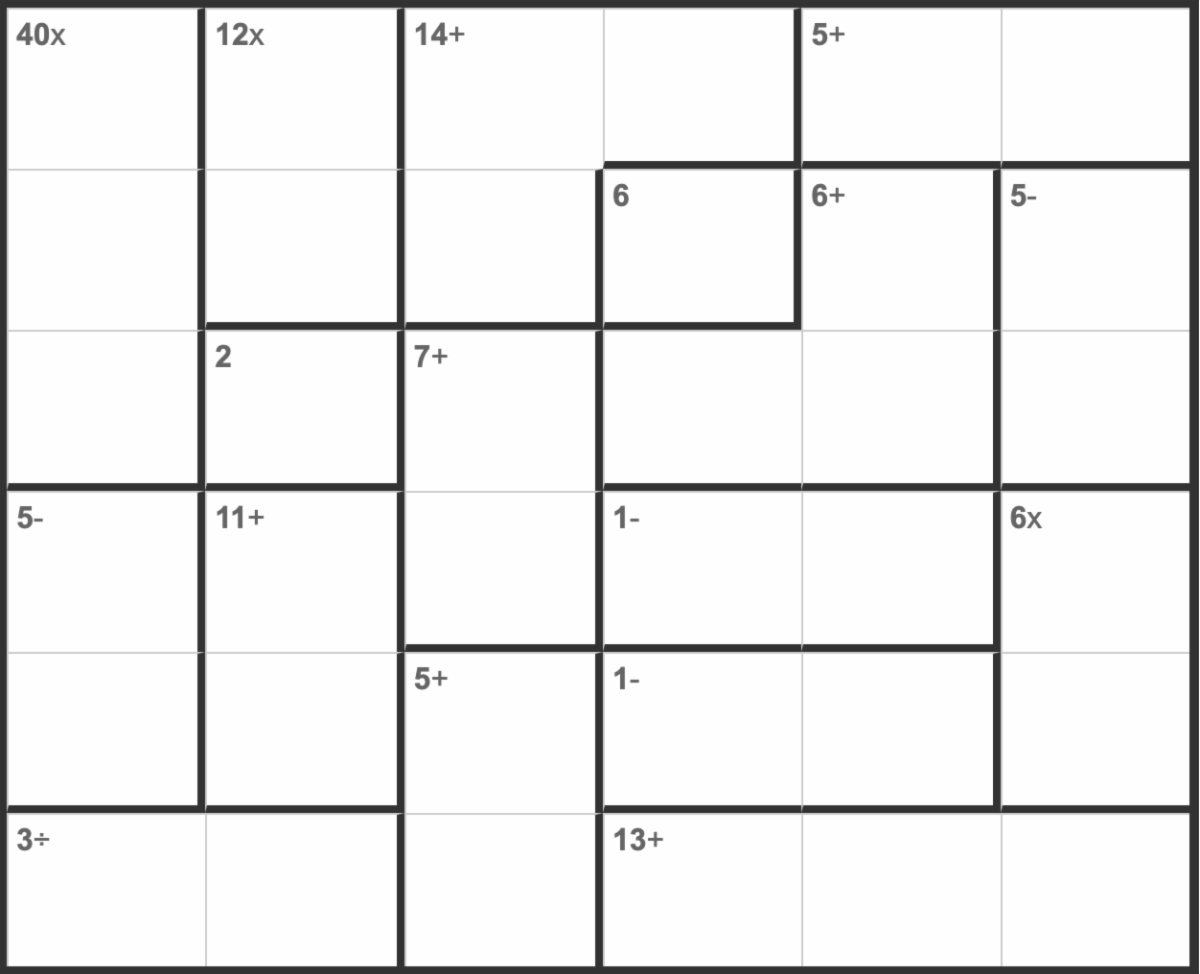
Try a KenKen
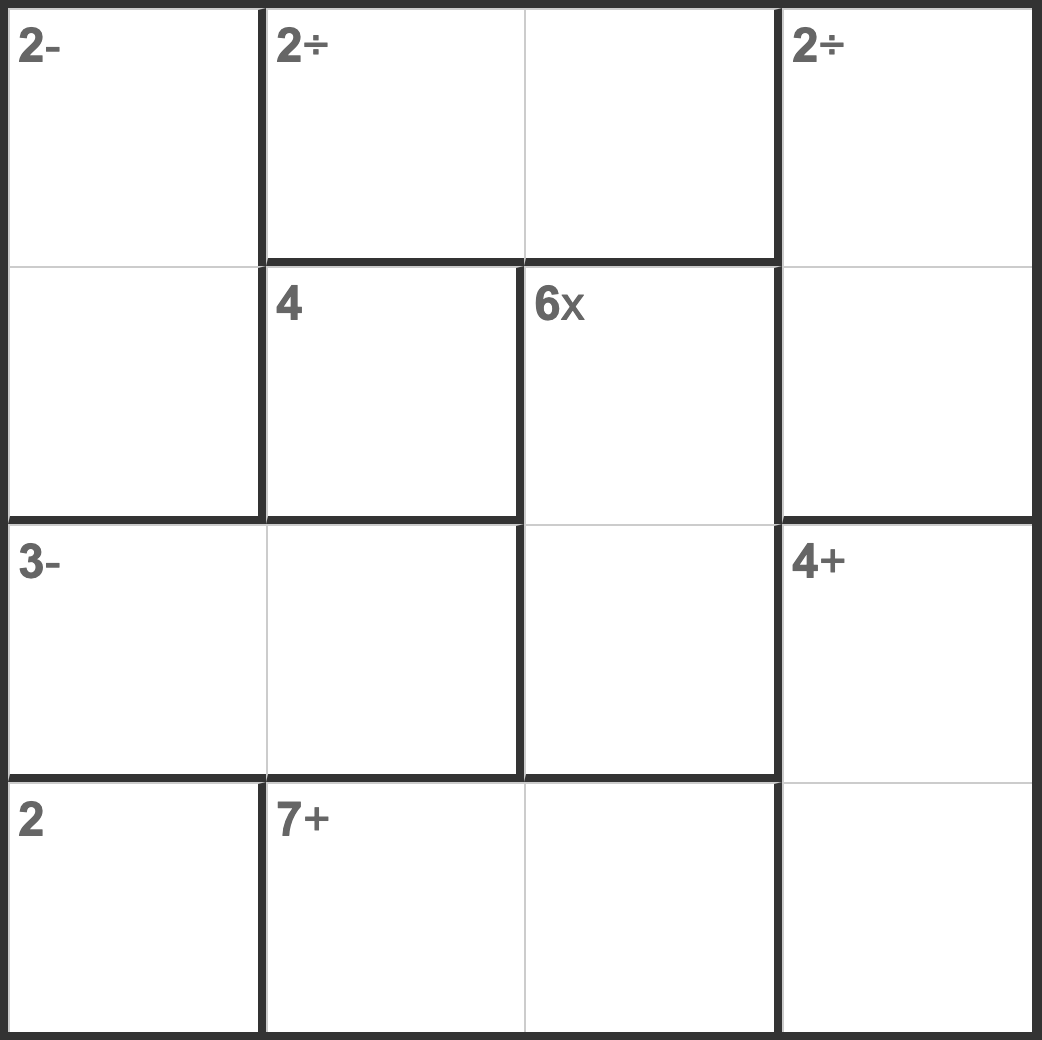
Sudoko is too busy for me, and I get overwhelmed with all the tiny boxes. About 15 years ago, I discovered KenKen puzzles which use the same logic as Sudoko but with a math twist. With practice they get easier. Give KenKen a try... Here is a medium and an easy puzzle
|
|
Rules For Playing KenKen
The numbers you use in a KenKen puzzle depend on the size of the grid you choose. A 3 x 3 grid (3 squares across, 3 squares down) means you use the numbers 1, 2, and 3. In a 4 x 4 grid, use numbers 1 to 4. A 5x5 grid requires you use the numbers 1 to 5, and so on.
The numbers in each heavily outlined set of squares, called cages, must combine (in any order) to produce the target number in the top corner using the mathematic operation indicated (+, -, ×, ÷).
Here's how you play:
- Use each number only once per row, once per column.
- Cages with just one square should be filled in with the target number in the top corner.
- A number can be repeated within a cage as long as it is not in the same row or column.
|
|
|
|
|
|
|