|
|
May 2, 2023
Spring Issue #6
|
Weekly activities and lessons to keep your child thinking and progressing all year long. |
|
“Coming together is a beginning, staying together is progress, and working together is success.”
|
|
Happy Tuesday!
Another year is wrapping up and what a fun ride this year has been. The number of activities I have planned for the next six weeks is daunting. These end of the school year activities are joyous because they recognize all the hard work and efforts made over the past ten months. My daughter is graduating from college this June and she still talks about Field Day, The Egg Drop, Pioneer Day, WamJam and the Renaissance Faire. The memories formed this spring will last a life time. I hope they are fun and positive. Well, the memories formed after state testing is completed :-) Have a great week.
If you know anybody who you think would benefit from the weekly learning activities in this flyer, please share it with your friends and encourage them to join The McManus Files mailing list by following the links on this page.
Peace,
Mr. McManus
|
|
If you feel your child might benefit from an individual group or tutoring program to prepare them for the next phase of their education, please contact McManus Tutoring.
Programs are structured so that students learn independence, accountability, and self-possession. They will develop a repeatable structure that can be used to build success in the future.
|
|
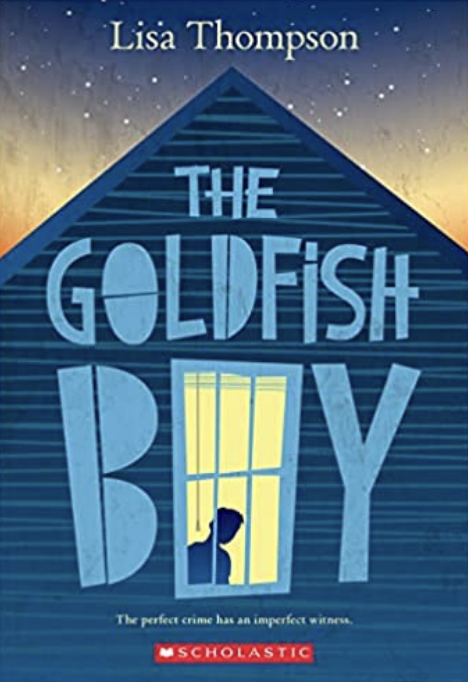
The Goldfish Boy
by Lisa Thompson
|
|
|
|
'The Goldfish Boy' provided me with a number of delights; an intriguing, unique and memorable mystery, a great cast of characters (Melody was my favorite), and a fascinating insight into the experience of someone suffering from OCD. The title of the book comes from the image of the protagonist, 12-year-old Matthew, watching events unfold on Chestnut Close from the safety of his bedroom window, almost like a goldfish in a tank. At times, the pain of Matthew's OCD is excruciating, both mentally and, quite often, physically. And as well as attempting to solve the mystery of a toddler who has disappeared from a neighbor's garden, the book also endeavours to uncover the orgins of Matthew's condition. In parts, the book is funny and huge credit must go to the author for carefully managing to tread that fine line of making the reader laugh at a situation without laughing at Matthew. Reading 'The Goldfish Boy' was like receiving a big, warm hug from an old friend and, in the closing chapter, I almost shed a tear. Almost. Enjoy! |
|
|
|
|
Ice Balloons
Have a ball experimenting with a frozen water balloon—and learn about water chemistry, phase changes, and density.
|
|
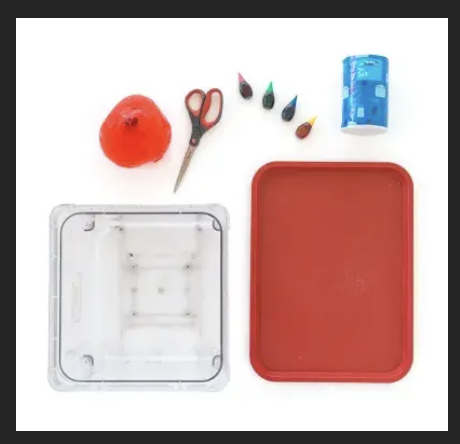
Tools and Materials
- 9-inch (20-cm) spherical balloons (12-inch will also work)
- Water faucet (or some other way to fill balloons)
- Access to a freezer
- Plastic tub big enough and deep enough to float an ice balloon: 12 x 12 x 9 inches (30 x 30 x 22 cm) or larger
- Scissors
- Cafeteria-style plastic tray (to catch the meltwater)
- Salt
- Food coloring
|
|
|
Assembly
- Stretch the neck of a balloon over a faucet and carefully fill with tap water. Work slowly to avoid pumping a lot of air into the balloon. When the balloon is at least 5 inches (25 cm) in diameter, remove it from the faucet, squeeze out the air at the top, and tie it closed.
- Make as many water-filled balloons as you will need. Then put them in the freezer and allow them to freeze for at least two days.
- When everything’s ready, fill a plastic tub with enough water to float an ice balloon. Don’t fill it all the way to the brim; leave room for the water to rise when you add the balloon.
|
|
|
|
To Do and Notice
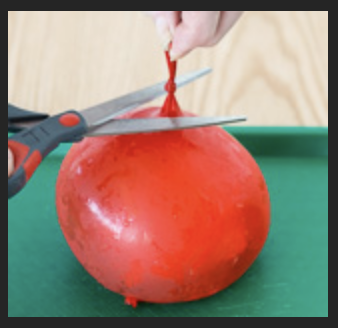
Cut off the neck and peel the balloon off the ice.
|
|
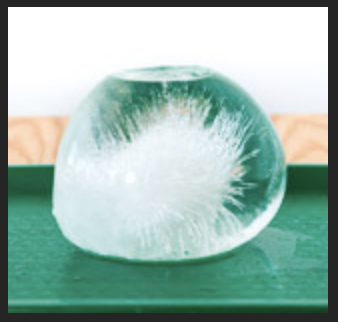
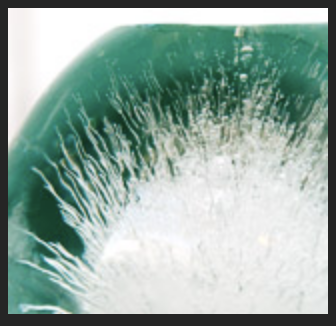
Put the ice balloon on the cafeteria tray and start by just taking a close look at it. What do you notice? A few things to look for are clear ice near the surface of the balloon, bubbles inside (some elongated, some making chains), the opaque center, and frost forming and then disappearing from the ice balloon’s surface. |
|
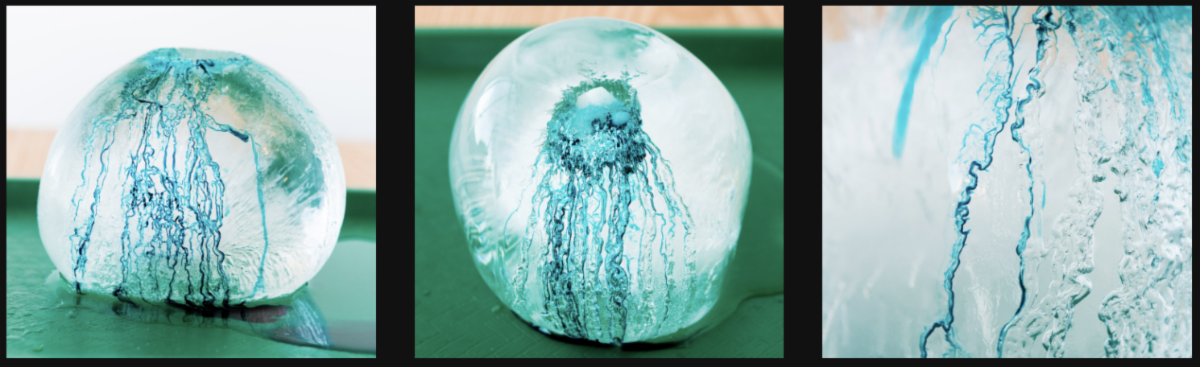
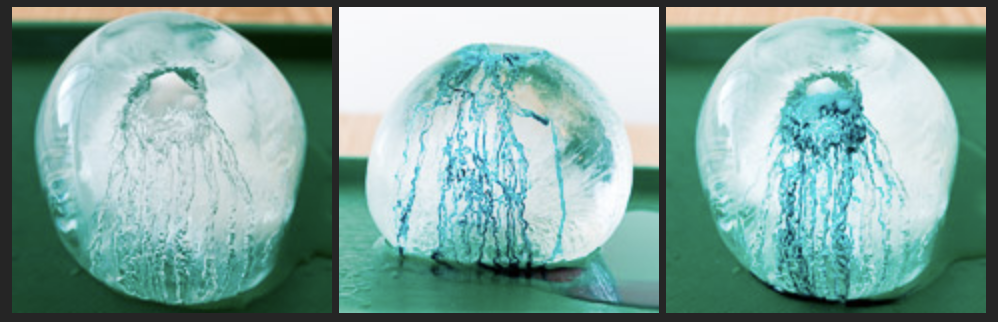
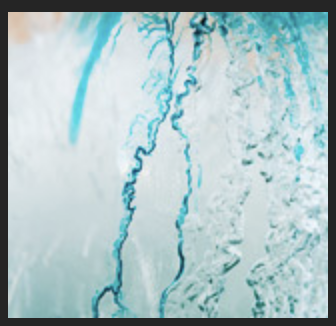
Sprinkle a small amount of salt on top of the balloon—about half a teaspoon. Then wait and watch. Notice how liquid water forms around the salt, creating meandering patterns as it flows down the balloon. Put a few drops of food coloring onto the salt to make the flow patterns more obvious. |
|
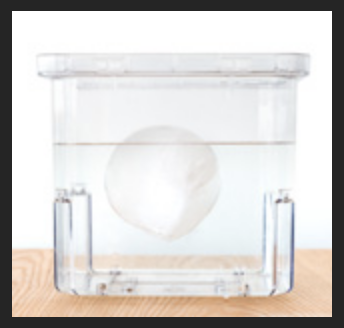
Finally, rinse the salt and food coloring and put the ice balloon into the water basin. Notice how it floats. How much of the balloon is above the water level, and how much is below? |
|
What’s Going On?
There’s plenty to learn from a frozen water balloon, starting with the patterns of bubbles—or lack thereof—in the ice.
The water in an ice balloon freezes from the outside in. As the water freezes, it creates pure crystals of water, which are clear. Meanwhile, impurities such as air or minerals are left behind in the liquid, where they concentrate until they come out of solution as bubbles. One bubble can seed a neighboring bubble, creating a radial chain of bubbles. Since bubbles scatter light of all wavelengths, they give the ice balloon a white, opaque center.
|
|
When the balloon comes out of the freezer, it’s often at a temperature of 0°F, much colder than the freezing point of 32°F. At these cold temperatures, water vapor in the air can freeze onto the balloon, creating a layer of frost. When the surface of the balloon warms to the freezing point, a visible film of water appears on the surface and the frost disappears.
Salt on the balloon will cause the ice to melt, even at temperatures below freezing. In any ice/water combination, there is an ongoing back-and-forth in which some liquid water molecules are freezing while some solid water (ice) is melting. Ions of sodium and chlorine from the salt get in the way of ice-crystal formation, turning the back-and-forth into more of a one-way street in which more ice melts then freezes.
As the salty liquid water flows down the balloon, it begins to form meandering streams, just as rivers do. As in rivers, the meanders shift over time, responding to subtle changes in flow and channel shape.
|
|
Most substances shrink as they cool, but water is a notable exception, freezing into hexagonal crystalline structures that take up about 10 percent more space than liquid water. This increased volume translates into lower density, causing ice to float. A solid ice balloon placed in water displaces its weight in water—this is Archimedes’ principle—with 10 percent of the ice balloon above the surface and 90 percent below. |
|
Going Further
Try adding sugar to the ice balloon. How is the result different from adding salt?
|
|
Three Writing Prompts and an Essay Topic
These prompts and questions will help jump-start your daily writing. Just as it's important to read for at least 30 minutes each day, you should also write for 30 minutes a day. Don't worry about your organization or spelling, just write!
"I never expected to see it, but there it was, soaring across the sky..."
"I'd been lost in the mall for hours. Finally..."
"When I opened the envelope, I never expected to see..."
|
|
May 2nd
Today is International Tuba Day, to recognize tubists all over the world who have to go through the hassle of handling a tuba.
Prompt
Imagine going through a revolving door carrying a flute. Now imagine going through a revolving door carrying a tuba! Get the idea? Make a list of ordinary daily activities that become 10 times tougher to accomplish while carrying a big tuba.
|
|
PLAY
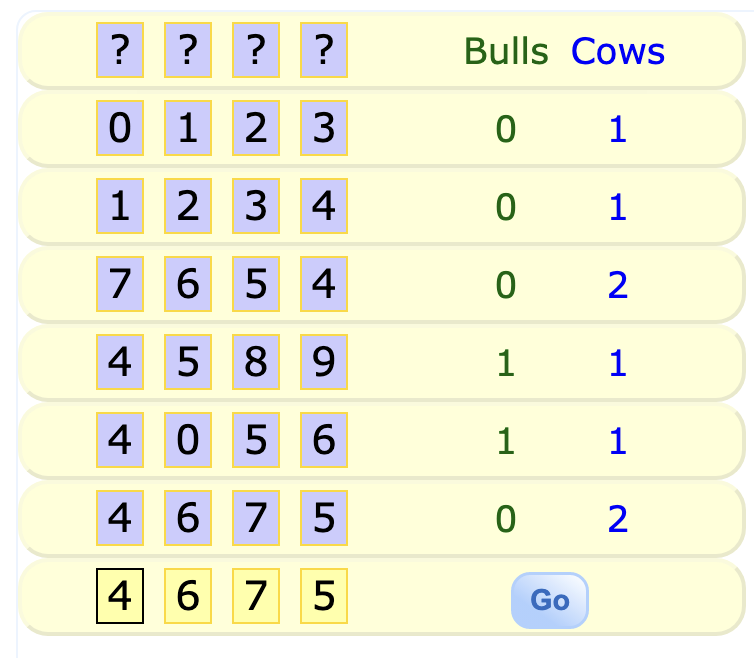
Bulls and Crows
Click the game or this link to try this challenging strategy game.
|
|
|
|
|
|
|
|