|
|
May 16, 2023
Spring Issue #8
|
Weekly activities and lessons to keep your child thinking and progressing all year long. |
|
“There are no wrong answers, only learning opportunities.”
|
|
Happy Tuesday!
I'm enjoying Outdoor Ed this week with my fifth graders. It is so great to be back on the mountain after a three year break. So much is the same which I appreciate, but some changes only make this place better. I'm in a new cabin and on the other side of the camp, so I get to explore a part of the facilities that I've never seen. I even got lost (really lost) yesterday trying to take a "short cut" to a teacher meeting. Missed the meeting and can't wait to go searching for that trail again. Kids are loving it and having a great time!
I hope you enjoy this week's flyer and the learning activities introduced. Have a great week "-)
If you know anybody who you think would benefit from the weekly learning activities in this flyer, please share it with your friends and encourage them to join The McManus Files mailing list by following the links on this page.
Peace,
Mr. McManus
|
|
If you feel your child might benefit from an individual group or tutoring program to prepare them for the next phase of their education, please contact McManus Tutoring.
Programs are structured so that students learn independence, accountability, and self-possession. They will develop a repeatable structure that can be used to build success in the future.
|
|
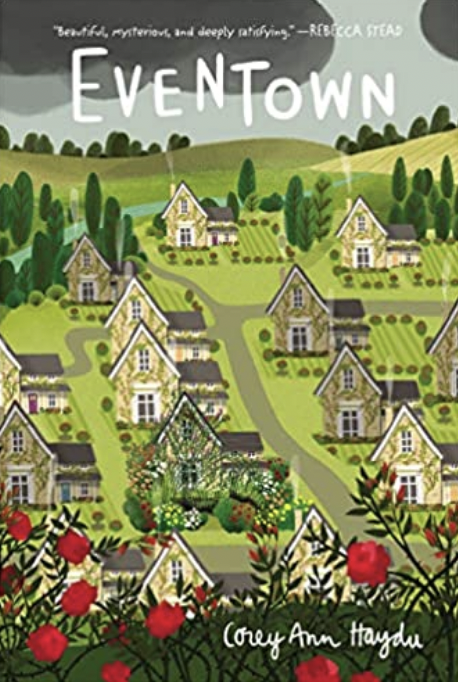
Eventown
by Corey Ann Heydu
|
|
|
|
I loved Eventown so much! It’s a beautiful, suspenseful, thought-provoking, and deeply emotional story about an 11-year-old girl named Elodee, whose family moves to Eventown to get a fresh start in the aftermath of something terrible. In Eventown, everything is pretty, pleasant, and predictable, but Elodee isn’t so sure that she fits in her perfect new home...or that she’s willing to let go of what she’s supposed to give up in order to stay there.
Eventown is a celebration of messiness, mistakes, love, human connection, and the way happy things and sad things are inextricably bound. It’s wonderful, and a great book to hand to kids (or adults) who strive to do everything right and feel shame when they make mistakes.
Enjoy!
|
|
|
|
|
Popsicle Stick Trusses:
What Shape is Strongest?
|
|
Introduction
Have you ever driven across a bridge or seen a building that is under construction and noticed the large metal support beams? What about all the wooden beams in a house that is under construction? Did you notice how sometimes the beams formed different geometric shapes, like triangles or squares? In this project you will be a structural engineer and make your own “support” shapes out of popsicle sticks. What shape will be the strongest?
|
|
Background
When civil engineers build large structures like bridges and buildings, they have to take into account how forces will act on the building materials. Forces, like the weight of cars driving across a bridge, can push (compression) or pull (tension) on things, causing them to break if they are not designed properly. Engineers also have to design things to handle torque, or “twisting.” You exert a torque on a screwdriver when you twist the handle with your hand, or on a ruler when you hold it on both ends and bend it.
Bridges and buildings usually have their frames built as a “truss,” or series of beams that are connected at their ends. The engineer’s goal is to design a truss that will not bend or break under load. In this project you will make trusses by connecting popsicle sticks end-to-end with binder clips. Can you guess what simple geometric shape will resist bending the most? Get ready to find out!
|
|
Tools and Materials
- Popsicle sticks (at least 7)
- Small binder clips (at least 7)
|
|
|
Assembly
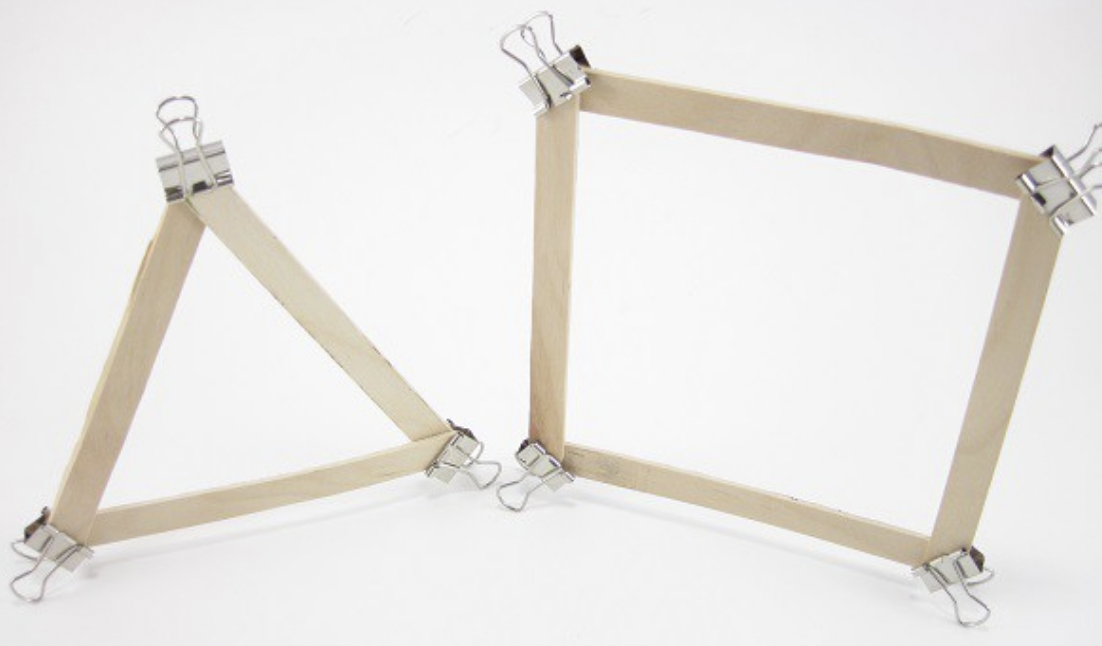
- Clip two popsicle sticks together end-to-end using a binder clip.
- Hold one end of each popsicle stick in one end. Gently try to twist them back and forth, rotating about the joint where they are connected by the binder clip (note: do this by sliding the flat surfaces of the popsicle sticks against each other, do not try to “break” them by bending them). How easy is it to rotate the popsicle sticks about the joint?
- Now, make a square out of popsicle sticks that are connected by binder clips at the four corners.
- Grip two adjacent popsicle sticks with your fingers, and gently try to rotate them relative to the joint that connects them. How easy is it to rotate the popsicle sticks? What happens to the shape of the entire square?
- Grip two popsicle sticks that are opposite each other, and gently try to slide them back and forth parallel to each other. How easy is it to slide the popsicle sticks back and forth? What happens to the shape of the entire square?
- Now, make a triangle out of popsicle sticks that are connected by binder clips at the three corners.
- Grip two adjacent popsicle sticks with your fingers, and try to rotate them just like you did with the square. What happens? Can you rotate the popsicle sticks, or does the triangle maintain its shape?
Extra: if you have more popsicle sticks and binder clips, try making a larger truss structure out of multiple connected squares and/or triangles. What happens when you push, pull, or twist different parts of the truss? Does one shape (triangle or square) tend to “hold its shape” better, while the other one slides around?
Extra: what happens if you add a diagonal across the square, dividing it into two triangles (secure two popsicle sticks together with multiple binder clips to make a single, longer stick that cannot rotate)? Can you still easily rotate the square?
Extra: if you have building toys available like K’nex, Tinker Toys or LEGO Technic pieces (note that this will not work with regular LEGO bricks, you need beams with holes that can be connected by pegs), try using them to make trusses instead of popsicle sticks. Do you get the same results?
|
|
To Do and Notice
Pull one pendulum toward you a short distance and let go.
Notice that after a few swings, the second pendulum will begin to oscillate, or swing back and forth, with the same frequency as the first pendulum.
With each swing, the second pendulum will increase its amplitude, or the height of its swing. Eventually, the pendulums will swing in unison—the second pendulum will swing in resonance with the first one.
|
|
What’s Going On?
You should have found that it was very easy to rotate the popsicle sticks in your square truss. When you rotate two adjacent popsicle sticks, or slide two sticks that are opposite each other, the sticks all stay connected, but the entire square deforms to form a parallelogram.
However, when you try to rotate the popsicle sticks in the triangle truss, they do not move. The triangle design is “stronger” – the popsicle sticks are arranged such that when you push or pull on them, none of them can rotate.
This happens because of something engineers call “degrees of freedom.” The square truss has one degree of freedom, which means it can move in one direction (in this case, a rotational direction – it can rotate from a square to a parallelogram). The only way to prevent the square from rotating at all is to pinch down very, very hard at the joints (imagine using much stronger binder clips). You can probably imagine why it would not be good to only use squares when building structures – all of the joints would have to be super strong! The triangle, however, has zero degrees of freedom – all of its popsicle sticks are fixed in place and cannot rotate. This means you can build a truss structure out of triangles that does not rotate or deform, even though the joints are only lightly held together by binder clips.
|
|
Three Writing Prompts and an Essay Topic
These prompts and questions will help jump-start your daily writing. Just as it's important to read for at least 30 minutes each day, you should also write for 30 minutes a day. Don't worry about your organization or spelling, just write!
"Bringing home the stray cat seemed like a good idea until..."
"It's not that hard living next door to aliens if..."
"My dad taught me how to use a metal detector, and you’ll never believe what I found..."
|
|
May 16th
On this day in 1866, the first US nickel, called the “Shield Nickel” was minted. Over the past several years, a series of state quarters have been minted. Design a new coin for your state that highlights an important place, event or symbol. Be sure to include a description of your coin, along with a sketch.
On May 16, 1929, the first Academy Awards ceremony was held. This is an annual event that honors film makers. Think back to some of the recent movies you have seen. In your opinion, which movie do you think should receive the Oscar? Be sure to explain why.
|
|
PLAY
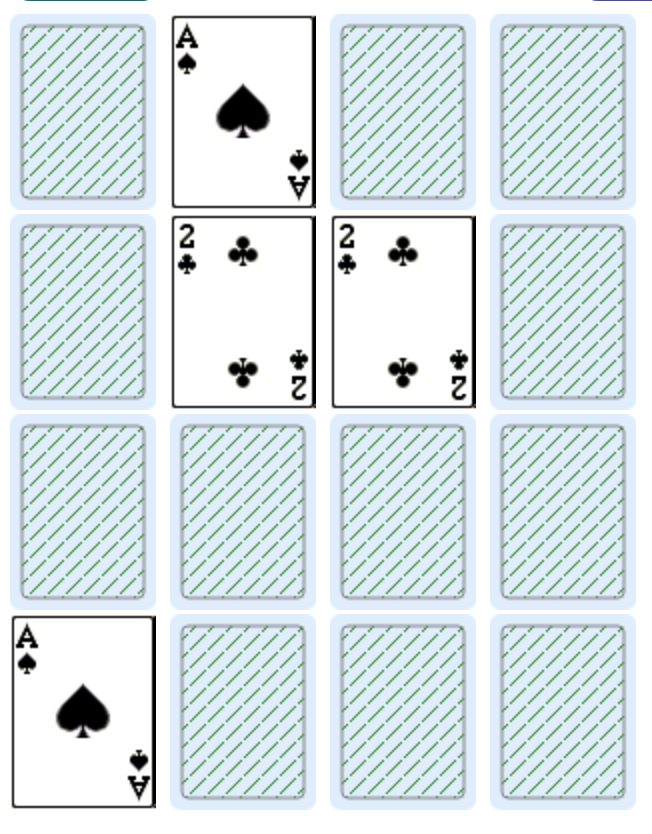
Card Match Game
Click this link to test your memory with this addicting card matching game.
Can you beat my score of 52 seconds?
|
|
|
|
|
|
|
|