|
|
September 6, 2022
Fall Issue #2
|
Weekly activities and lessons to keep your child thinking and progressing all year long. |
|
“Education is not the filling of a pail, but the lighting of a fire.” |
|
Hello,
Whew, we made it through one full week of school and thank goodness there was a three day weekend to follow. I sure needed a quick battery recharge. I hope you enjoyed the long weekend as much as I did. I appreciate Labor Day so much. Sure, for the extra day off, but also as a time to reflect and honor the workers and labor unions that have fought to secure the working conditions that we now consider normal.
In this week's flyer I am recommending an amazing book about a group of four homeless children escaping their violent households. It is an eyeopening adventure partially based on the author's real experiences as a teen. The story is written so well, you will be swept into another world. Sadly, this is not a world of make believe. This week's Inquiry Quest is a bit of nostalgia for me... As a child of the 70's, I remember the craze of homemade yogurt, and just like the InstantPot and air cookers today, every household in my neighborhood had a yogurt maker on the counter :-) Here is a science experiment where you and your child(ren) can make yogurt and learn how bacteria converts the lactose in milk and makes yogurt. This is a tasty topic.
If you know anybody who you think would benefit from the weekly learning activities in this flyer, please share it with your friends and encourage them to join The McManus Files mailing list by following the links on this page.
Happy learning and have a great week,
Mr. McManus :-)
|
|
Habits of Mind
Habits of Mind are thinking habits that push us far past simple answer retrieval. They change our pattern of thinking to help us gain success when we don’t know the answer to a question or problem.
Information on Habits of Mind are taken from the book Habits of Mind by Costa and Kallick.
|
|
The 16 Habits of Mind include:
• Persisting
• Thinking and communicating with clarity and precision
• Managing impulsivity
• Gathering data through all senses
• Listening with understanding and empathy
• Creating, imagining, innovating
• Thinking flexibly
• Responding with wonderment and awe
• Thinking about thinking (metacognition)
• Taking responsible risks
• Striving for accuracy
• Finding humor
• Questioning and posing problems
• Thinking interdependently
• Applying past knowledge to new situations
• Remaining open to continuous learning
|
|
Striving for Accuracy
What is it? – Working toward perfection, elegance, craftsmanship
Sounds like – “Making a list, checking it twice”, “Did I check my work?”, “Is this my best effort?”
Looks like – taking aim, double checking, using all your resources
Feels like – I’m proud of my finished product
People who value accuracy, precision, and craftsmanship take time to check their products. They review the criteria they are to use to confirm that they're finished product matches the criteria exactly. They continue to perfect their craft by working to attain the highest possible standards. They are learning to bring a laser like focus of energies to accomplish a task.
These people take pride in their work, and they desire accuracy as they check over their work. Mario Cuomo, a great speechwriter and politician, once said that his speeches were never done; it was only a deadline that made him stop working on them. In every endeavor from athletics, art, science, medicine, music, engineering, etc. striving for accuracy is valued and admired.
Some students turn in sloppy, incomplete, or uncorrected work. They are more anxious to get rid of the assignment than to check it over for accuracy and precision. They are willing to settle for minimum effort rather than invest their maximum. Helping students strive for accuracy at home, in extra-curricular activities and at school can help increase their chances for excellence in learning and in their own life successes.
“Measure twice, cut once” anonymous
“A man who has committed a mistake and doesn’t correct it is committing another mistake.” Confucius
|
|
The Bridge Home
by Padma Venkatraman
|
|
|
|
This book is everything! It is rich in humor, sweetness, love, and most importantly, it is full of heart and intelligence and rife with engaging action. If you are like me, it will keep you sobbing throughout. This is a story about two girls who run away from their home when the domestic violence on their mother starts reaching to them. They meet two boys during their struggle and they quickly become one family. The author doesn't write down to her young audience, or protect them, or her characters, from the grit and grime of life's underbelly. In contrast, she emphasises the value of resourcefulness and kindness in the midst of poverty and danger. If you want a captivating story that encourages readers to consider larger issues such as religion, poverty, and the caste system, this is an unforgettable tale of families moving ahead without leaving those they love behind.
Enjoy!
|
|
|
|
|
Bacteria Culture Club
Make yogurt from yogurt
|
|
Yogurt is the byproduct of hungry bacteria that digest the lactose in milk. You can make more yogurt just by feeding the bacteria more milk. |
|
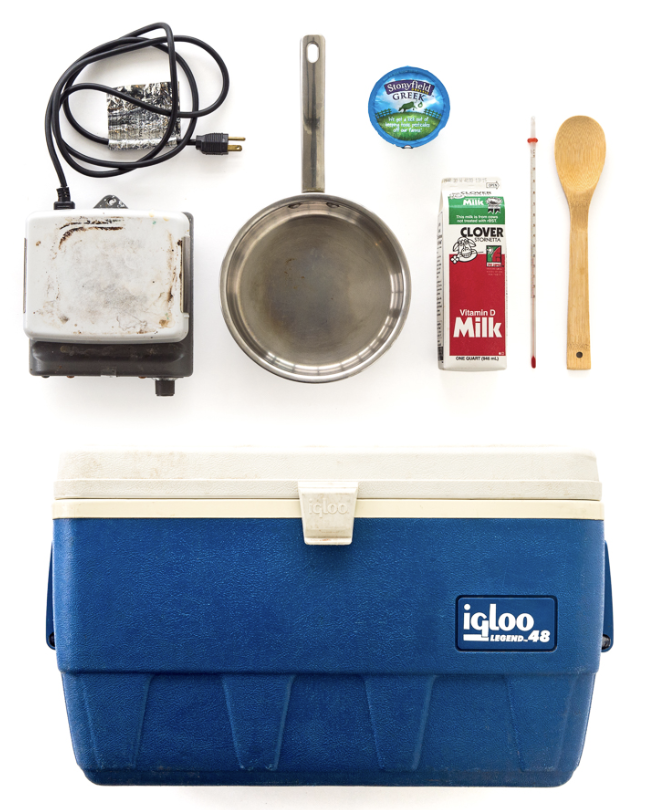
Tools and Materials
- One quart milk
- Four tablespoons of yogurt (use a yogurt that has only milk and live active cultures as listed ingredients)
- Spoon
- Pot
- Hot plate or stove
- Cups (not shown)
- Hot water bath. You can make a simple one by adding hot water to a cooler or plastic bin with a lid.
- Thermometer
- Optional: cheesecloth, strainer, compound microscope, slides
|
|
|
To Do and Notice
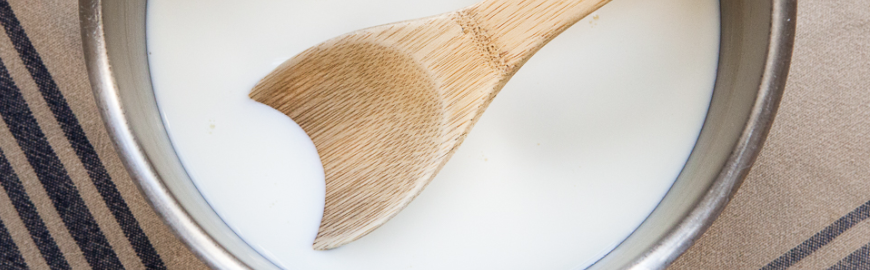
Heat the milk over medium heat until it reaches 180°F. Stir the milk as it heats to make sure it doesn’t scald the bottom of the pot.
Take the milk off the heat, and let it cool to 110–115°F. You can do this in a sink full of ice water to speed things up.
Thoroughly mix in the prepared yogurt.
Make a hot water bath in a cooler or plastic bin that will keep the yogurt insulated at 110–115°F.
Portion the milk/yogurt mixture into small cups and place them in the bath for 8–12 hours. If you don’t want individual servings, you can place the whole amount in a large container and make a giant batch.
Refrigerate the yogurt cups for at least two hours.
Optional: Strain through cheesecloth if you like thicker, Greek-style yogurt.
Eat and repeat.
|
|
What’s Going On?
Yogurt is the product that results from the bacterial fermentation of milk. When you buy yogurt that contains “live active cultures,” it means there are still living bacteria present inside. By feeding these bacteria and keeping them at their optimal temperature, they will eat and divide and process the milk into yogurt. These cultures are made up of a general class of bacteria called lactic acid bacteria. The ones used in yogurt-making metabolize lactose, a form of sugar present almost exclusively in milk, for energy, and create lactic acid as a waste product. This acid helps give yogurt its texture and tangy flavor.
Milk is made of proteins, carbohydrates (in the form of lactose), fat, and water. When you heat it up in the first step, the proteins denature from their tightly coiled state into relaxed chains. The temperature needed for this is too high for many bacteria to survive, so this has the added benefit of sterilizing your milk. The milk is then cooled to the optimal temperature for the yogurt bacteria to undergo metabolism. Adding a lot of acid at once would cause the protein chains to precipitate out of the milk into clumps, but since the bacteria produce lactic acid gradually, proteins gradually turn into solids and gently coagulate into a network of chains. This network is able to trap liquid inside, and the end product is a smooth gel that gets firmer over time. Even though the bacteria divide fairly quickly, it takes several hours for them to work through the entire quantity of milk. Longer fermentation times will yield a tangier and stronger-flavored yogurt since more metabolism occurs. Straining the final gel results in an even denser yogurt as it physically separates the solid curds from the liquid whey. The amount of fat in the milk doesn’t really participate in this process, but will affect the overall texture and flavor of the final product.
|
|
Going Further
If you have access to a compound microscope, it’s fun to look at yogurt bacteria at high magnification.
Make a wet mount with a tiny toothpick amount of yogurt and a drop of water. Under 400x, you can see individual bacteria swimming around. Store-bought yogurt often contains these species: Streptococcus thermophilus, Lactobacillus delbrueckii subsp. bulgaricus, Lactobacillus acidophilus, Bifidobacterium, and Lactobacillus casei.
The first two are the main yogurt-makers and work in synergy to digest lactose and produce lactic acid. They work so well together because they each make a waste product that the other uses for metabolism and are both thermophilic (survive at relatively high temperatures) bacteria that grow best at 105–113°F. The other three strains work better at temperatures closer to the human body temperature of 98.6°F. They are often added as probiotics since they are already present in different parts of your body. As the temperature and pH of the yogurt changes, different species are able to metabolize at better or worse rates, and the end result is a unique flavor profile of everyone’s waste.
In general, these bacteria come in two main shapes, with the Lactobacillus having an oblong rod shape and the Streptococcus, which is Greek for “twisted berry,” like little spheres. After they divide they can still be attached to each other; they sometimes look like beads in a chain.
|
|
If you feel your child might benefit from a group or individual tutoring program to prepare them for the next phase of their education, please contact McManus Tutoring.
Programs are structured so that students learn independence, accountability, and self-possession. They will develop a repeatable structure that can be used to build success in the future.
|
|
Three Writing Prompts and an Essay Topic
These prompts and questions will help jump-start your daily writing. Just as it's important to read for at least 30 minutes each day, you should also write for 30 minutes a day. Don't worry about your organization or spelling, just write!
"I tiptoed into the bathroom. If anyone caught me doing this, I’d be in big trouble."
"I went over to say hello to the cute little baby under the umbrella, but when I reached her, I saw that..."
"Irene gripped her mom’s hand harder as they walked through the doors of the..."
|
|
September 6th
By a 1986 Presidential Proclamation, this is Federal Lands Cleanup Day.
If you were in charge of "Local School Cleanup Day," what's the first order you would give? (You might want to take a look around your school, inside and out, before deciding.) What do you think the second and third orders of the day might be? Why would it be important to clean these places first?
|
|
|
|
|
|
|