EQUESTRIAN ORDER OF THE HOLY SEPULCHRE OF JERUSALEM
Middle Atlantic Lieutenancy
|
|
|
|
|
May 1 - St. Joseph the Worker
May 2 - St. Athanasius
May 3 - Fifth Sunday of Easter
May 10 - Sixth Sunday of Easter
May 13 - Our Lady of Fatima
May 14 - St. Matthias
May 14 - Ascension of the Lord
May 15 - St. Isidore
May 17 - Seventh Sunday of Easter
May 20 - St. Bernardine of Siena
May 22 - St. Rita of Cascia
May 24 - Pentecost Sunday
May 25 - St. Bede the Venerable
May 26 - St. Philip Neri
May 27 - St. Augustine of Canterbury
May 29 - St. Paul VI
May 31 - The Visitation of the Blessed Virgin Mary
May 31 - Trinity Sunday
| | | | |
A New Bishop in Wheeling-Charleston | |
On May 1, Pope Leo appointed Bishop Evelio Menjivar-Ayala as the next Bishop of Wheeling-Charleston. He succeeds Bishop Mark Brennan, KC*HS, who has faithfully served the diocese since 2019. We remember well and fondly the hospitality of Bishop Brennan for our Investiture Weekend a year ago in April 2025. Thank you, Bishop Brennan, for your faithful ministry in West Virginia and to our Lieutenancy.
And welcome to Bishop Menjivar-Ayala! All of us in the Lieutenancy, and especially the Knights and Dames in your diocesan section with Deacon Jacob Manning, KCHS, offer you our prayers, best wishes, and support for your service ahead.
|
| |
REFLECTIONS FROM OUR LIEUTENANT, MARK
Why Religious Freedom Is Not Abstract
for Holy Land Christians
| |
For many of us, religious freedom can feel like an abstract concept, something enshrined in law or defended in principle. But for Christians in the Holy Land, religious freedom is tangible, daily, and at times precarious. It shapes how families worship, how schools and parishes operate, and how entire communities live out their faith in the land where Christianity first took root.
Supporting these communities is not just a charitable act, it is a commitment to preserving the freedom that allows faith to flourish. Each school we help fund, each family we assist, each ministry we sustain ensures that Christians can continue to live openly, practice their traditions, and pass their faith to future generations. These acts, small and large, are a tangible affirmation of the right to worship, to serve, and to belong.
I am constantly humbled by the resilience I encounter. Families pray in homes that have sheltered faith for centuries. Clergy and religious ministers persevere in service even when resources are scarce. Young people grow up learning that faith is not merely an idea, but a lived reality that requires courage, commitment, and responsibility. Observing this steadfast devotion reminds me why our work in the Middle Atlantic Lieutenancy is so vital. Our support is not symbolic; it has real, lasting impact on people whose freedom to live their faith is precious and sometimes fragile.
For me, this work is both professional and deeply personal. Having served in roles for more than 40 years where I advised religious institutions and engaged with their needs, I have learned that protecting religious freedom requires more than legal knowledge or administrative skill. It requires attention, understanding, and a willingness to stand with communities in tangible ways. The Christian presence in the Holy Land is sustained not by abstract ideas, but by people, by the children in schools, the families at Mass, the religious who devote their lives to service. Their freedom is intertwined with our mission, and it is our responsibility to support it with clarity, dedication, and compassion.
As we continue our work together, I am reminded that religious freedom is never a given. It is nurtured, defended, and celebrated through concrete acts of support, encouragement, and solidarity. For the Christians of the Holy Land, it is the foundation upon which faith is lived, culture is preserved, and hope is sustained. Being part of this mission, and seeing firsthand the courage of those who live it every day, strengthens my own commitment to serve, learn, and stand alongside them in meaningful ways.
|
| |
Our Lady of Fatima
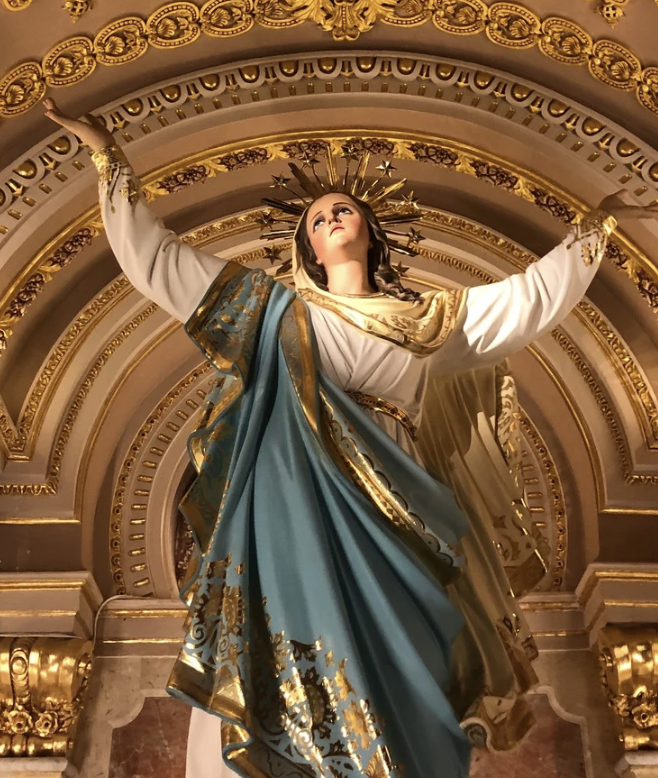
As the Church observes the feast of Our Lady of Fatima on May 13, it is fitting to reflect on the events that took place in 1917 and the enduring spiritual message entrusted to the world through three young shepherd children in Portugal.
The story begins in the small village of Fatima, where siblings Francisco and Jacinta Marto and their cousin Lucia dos Santos tended their families’ sheep. In the spring of 1917, as Europe was engulfed in the First World War and Portugal faced political turmoil, the children reported a series of apparitions of the Blessed Virgin Mary. From May to October, Mary appeared to them six times, offering a message that combined consolation, warning, and hope.
Mary’s words emphasized prayer, especially the Rosary, as a means of drawing closer to God and interceding for a world in need of peace. She called for conversion of heart, penance, and trust in God’s mercy. Her message was not one of fear but of profound maternal concern, reminding humanity that spiritual renewal begins with ordinary acts of faithfulness. The children, though young and uneducated, responded with remarkable sincerity and courage, embracing sacrifices and prayer with a maturity far beyond their years.
The apparitions culminated in what became known as the “Miracle of the Sun” on October 13, witnessed by tens of thousands who had gathered in Fatima. This extraordinary event affirmed the authenticity of the children’s testimony and drew global attention to the message entrusted to them. Over time, the Church carefully investigated the events and approved the apparitions, recognizing their spiritual significance for the faithful.
The message of Fatima continues to resonate today. In a world still marked by conflict, division, and uncertainty, Mary’s call to prayer, conversion, and peace remains both timely and urgent. The example of the three shepherd children reminds us that God often works through the humble and the small, inviting each person to participate in the healing of the world through fidelity to daily prayer and openness to grace.
As we honor Our Lady of Fatima, we are invited to renew our commitment to prayer, to seek peace in our own hearts and communities, and to trust in God’s enduring presence in history. Her message endures as a reminder that hope is never out of reach for those who turn to God with sincerity and faith.
| | | |
CARDINAL PIZZABALLA
Jerusalem, Gift of God for All Nations
| | |
In a time overshadowed by conflict and division, Cardinal Pierbattista Pizzaballa offers a deeply pastoral reminder: Jerusalem is not a prize of war, but a sacred gift entrusted to all humanity. Calling it the “heart of the world,” he points to its unique place in the life of billions of believers and urges the global community to safeguard its universal mission.
Reflecting on the violence following the Hamas attacks of October 7, 2023, the cardinal laments a growing culture of division, where the “other” is increasingly dehumanized and once-meaningful words like justice, dialogue, and human rights risk becoming empty. Yet even in this darkness, he directs the faithful toward a higher vision, one rooted in the heavenly Jerusalem of the Book of Revelation, an open city called not to exclude, but to reconcile and “heal the nations.”
For Christians in the Holy Land, this calling is concrete and immediate. They are not distant observers, but active members of their societies, invited to be witnesses of the Gospel from within. Through prayer, which he describes as the very breath of the Church, through strong families, faithful education, and works of charity, they become instruments of peace in a wounded land.
This witness, however, is being carried in an environment marked in 2026 by documented escalation in violence and intimidation against Christian communities, particularly in the West Bank. Reports from early 2026 describe settler attacks on Christian families in villages such as Taybeh, including stone throwing, property invasions, and intimidation tactics that have left residents fearful and disrupted daily life . In February 2026, accounts from the same region describe arson attacks on vehicles and repeated incursions into the only largely Christian village in the area, with clergy warning that the pattern is becoming systematic rather than isolated.
By March 2026, senior Church leaders publicly stated that “aggressions against Christians are multiplying,” including threats, land access restrictions, and vandalism such as burned cars and damaged property . These developments have contributed to a growing sense among local Christians that their physical security and long-term presence are increasingly under pressure.
The path is not easy, but it is clear. To reject the logic of violence and choose the way of life, without losing hope. Echoing the joy of the disciples in the Gospel of Luke, the cardinal calls the faithful to return to Jerusalem with a deeper, paschal joy, one rooted in the certainty that Christ’s light overcomes darkness and His love has the power to disarm even the deepest hatred.
| | Pope Francis Remembered as Missionary of Mercy One Year After His Death | | |
One year after the passing of Pope Francis, the Church in Rome gathered in prayer at the Basilica of Basilica of St. Mary Major to give thanks for a life marked by humility, mercy, and missionary zeal. Cardinals, bishops, clergy, and lay faithful filled the sacred space where the late pontiff now rests, entrusting him once more to the mercy of God.
At the same time, Pope Pope Leo XIV, traveling in Africa, offered his own remembrance through a message read at the Mass. He recalled Francis as a shepherd who proclaimed the Gospel “to everyone, everyone, everyone,” and who called the Church to be open, missionary, and close to the wounds of the world.
The liturgy was celebrated by the dean of the College of Cardinals, Cardinal Giovanni Battista Re, who echoed the enduring themes of Francis’ pontificate, the joy of the Gospel, the mercy of God, and the image of a Church that “builds bridges and not walls.” His words reflected a legacy rooted not in power, but in service.
Before the Mass, a commemorative plaque was unveiled honoring Francis’ frequent visits to the Basilica and his deep devotion to the icon of the Virgin Mary, Salus Populi Romani. It was a quiet sign of a life shaped by prayer and maternal trust, and a reminder of where he wished to rest.
The celebration concluded with prayer at the tomb of the late pope, as the Church commended him to God. In the words of the Jubilee he once proclaimed, hope does not disappoint, a truth now entrusted to memory, and to the future of a missionary Church still called to proclaim mercy to the ends of the earth.
| |
FOLLOW US ON FACEBOOK AND INSTAGRAM FOR UPDATES
Stay Connected To Your Faith
| | | | |