Follow us on LinkedIn and subscribe to our YouTube page for more updates. |
Continued Education Now Available to Mission Customers |
Mission Communications has launched their Technical Certification Program, offering comprehensive training on Mission applications, products, and services. This program offers four primary levels of achievement.
Level 1 — Weekly webinar attendance: Attend all four monthly topics. See the schedule below. Each week covers a different topic and you don’t have to attend them all in one month. You do have to be a registered attendee, so sign up to start earning credit.
Optional Addition — Special Topics webinar attendance: Participate in a Special Topics webinar. See more information below.
Level 2 — One–on–one, hands–on training: Fulfill an in–person training session with Mission Regional Sales Manager (RSM) at one of your sites as you install a Mission monitoring device and set up a web portal instance.
Level 3 — Distributor conference participation: Attend all sessions of the conference, learning directly from Mission product developers and experts, alongside our partners from around the U.S. and Canada.
Level 4 — All Inclusive: Pass the comprehensive practical test on the Mission–managed SCADA products.
The Special Topics webinar is typically scheduled when there is a fifth Wednesday in a month; however, participants who have completed Level 1 can request a special one–on–one or small group webinar. This is not a requirement of the program. Participants can proceed to Level 2 without participating in a Special Topics webinar.
|
June 21 – June 23
Boise, ID
July 16 – July 21
Lake Charles, LA
July 19 – July 21
Kearney, NE
July 30 – August 2
Memphis, TN
August 7 – August 10
Las Vegas, NV
August 22 – August 23
Poplar Bluff, MO
August 24
Plover, Wisconsin
August 29 – August 31
Wichital, KS
September 10 – September 13
Loveland, CO
September 10 – September 13
Hot Springs, AR
September 13 – September 15
Hulbert, OK
September 17 – September 20
Saint-Hyacinthe, QC
|
All trade show information is subject to change. Please confirm details with the individual association. |
Web Portal II—Advanced Features, Reporting, Supergraph, Volumetric Flow
Hardware and Instrumentation
Web Portal I—Unit Setup Options, Notification Setup Options, Alarm Groups, Website Tools
Web Portal II—Advanced Features, Reporting, Supergraph, Volumetric Flow
Survey of Features
Hardware and Instrumentation
Web Portal I—Unit Setup Options, Notification Setup Options, Alarm Groups, Website Tools
Web Portal II—Advanced Features, Reporting, Supergraph, Volumetric Flow
Special Topics—Digital Interconnect, Tank and Well, OPC, and More
Hardware and Instrumentation
Web Portal I—Unit Setup Options, Notification Setup Options, Alarm Groups, Website Tools
Certificates are available for any webinar attended, by request.
|
|
Mission Helps Utopian–Rooted Fairhope Keep Up with Rising Population |
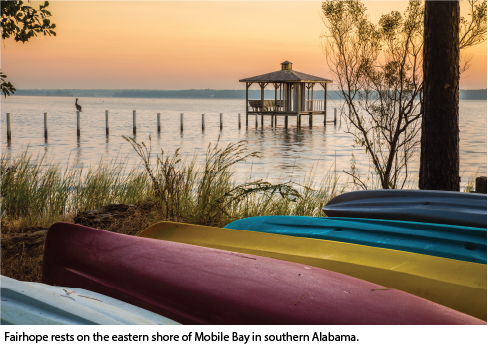
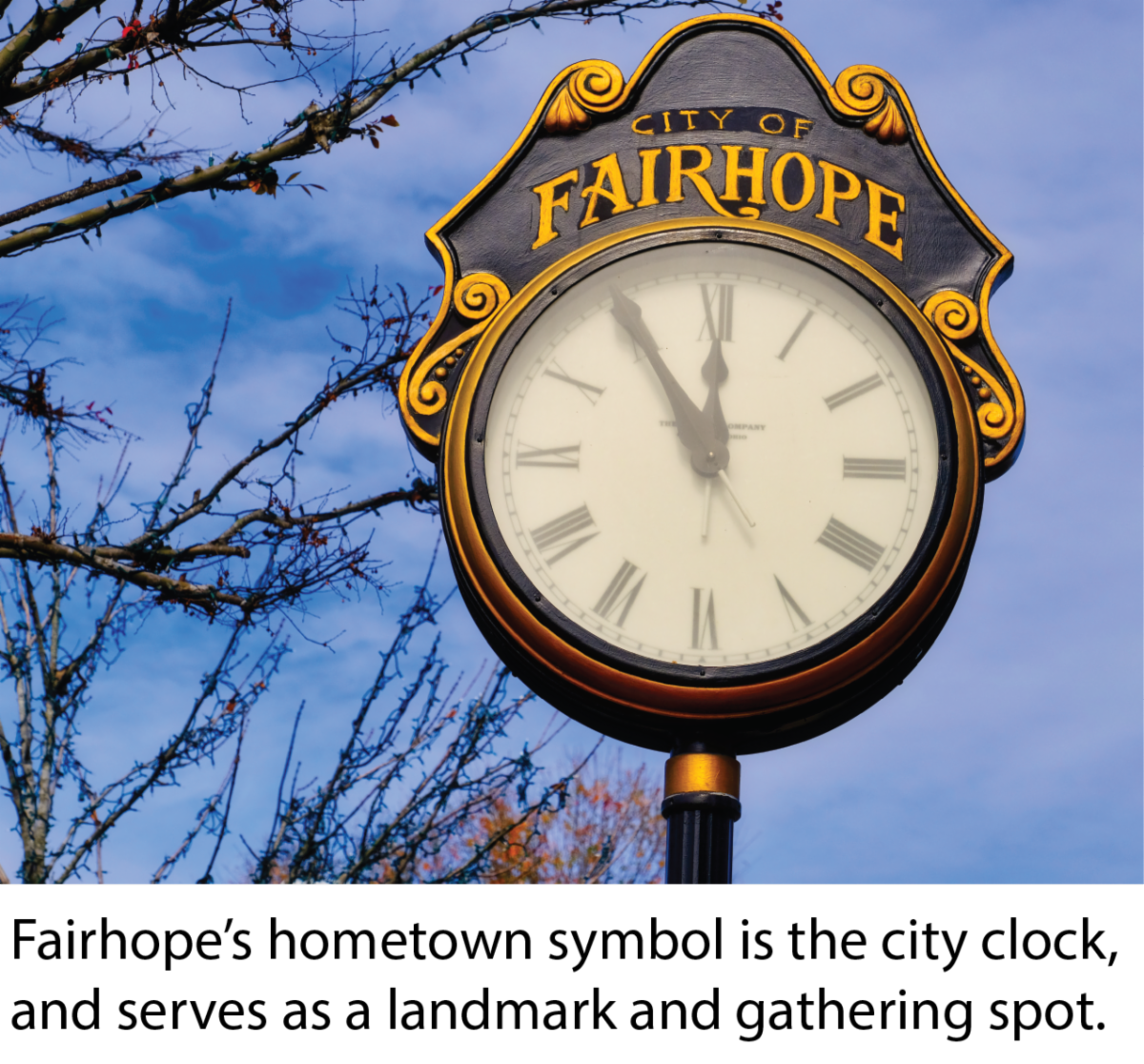
Growth is the name of the game in Fairhope, Alabama, and it has been that way for decades. Ever since the New York Times named it one of the top–10 retirement destinations in the United States in 1991 people have been showing up. Before that, Fairhope attracted some of the country’s more free–thinking citizens, artists, enigmatic architects, and utopian philosophers. The city was initially founded by 500 people as a single–tax community, a government philosophy that gained traction in the late 19th century. Fairhope remains one of only two such cities in the United States still operating on this doctrine. The New York Times featured Fairhope again in 2019—this time lauding it for keeping its charming history alive. With rising levels of attention, interest, and people come increasing demand on the water and wastewater systems.
Roscoe Safley has been working for the city of Fairhope for 12 years. He is the Lead Electrician for the Fairhope Public Utilities for Water and Wastewater and has led Fairhope efforts to get a handle on monitoring during the surges in growth. “Just 30 years ago we had 24 lift stations and now we have 81 in operation, with five more that are about to go online.” That number is going to keep getting bigger, but the challenge is more than just growing numbers. The needs of existing areas are changing. “We have stations originally designed to support a trailer park that grew into six new subdivisions.” Communities like Fairhope are finding similar situations as the smaller towns rush to maintain proportionality for their municipal services.
Fighting combined sewage overflow and sanitary sewage overflow became an issue with the increasing demand at Fairhope, and the old system wasn’t helping much. “We had a radio system that went to pagers, but the creator left, and after about 10 years, it was pretty suspect whether they were working correctly or not.” So the city decided to modernize, and asked Safley’s department to deploy the same monitoring tool that the electric department had recently acquired. They tried it, but that had issues as well. “That system gave us bad communications and bad data. It's good for electricity but it just wasn’t made for water and wastewater.”
Mission distributor J.H. Wright’s Paul Colletta recommended Mission devices to Safley. “We installed one. Then, we bought 12 and put them on our main stations. We had no communication issues at all, they were easy to install, and they did exactly what we wanted them to do without having to do any customized programming.” What they originally wanted was to monitor those lift stations and send alarms if anything went wrong. The Mission devices are specifically designed for water and wastewater and Safley, and the city of Fairhope, saw the value in that.
|
Slowly but surely, they added Mission devices to every wastewater station in the city. This has saved valuable staff hours so they can remain focused on other tasks. “Now I can save someone from a full day’s work of traveling to each station to read a meter, a task we used to have to do every week. With Mission I can get that every day without driving anywhere.”
Safley started to realize that the Mission system and its included 123SCADA web portal had even more features and uses than he originally used them for. “I would get curious and call Technical Support with a question and they would tell me how to set different things up.” That’s when he started to expand how to use the monitoring system to help Fairhope even more. Safley set out to learn as much as he could about Mission and the variety of applications. He inquired about formal training to Colleta, who connected him with Mission National Sales Manager Matt Crousillac, who was actively designing a process to become certified for operating Mission products.
Crousillac recalls speaking with Safley about it. “He really wanted to have more effective, in–depth training, something on the level of our Technical Support Specialists. He recognized the potential of the system and that there’s so much you can do with it.”
Safley became the first recipient of the Level 1 Mission Technical Certification Program. He completed the four–part cycle of weekly webinar training sessions. It was during one of those webinars that he learned how to connect load sensors to one of his Mydro units. Since Fairhope was using temporary generators at one of their new treatment plants, he used this opportunity to apply this knowledge. “Connecting the Mission unit to load sensors is great! I ran it up to a motor contactor and now I can be sure when I’m not on–site that it’s running.”
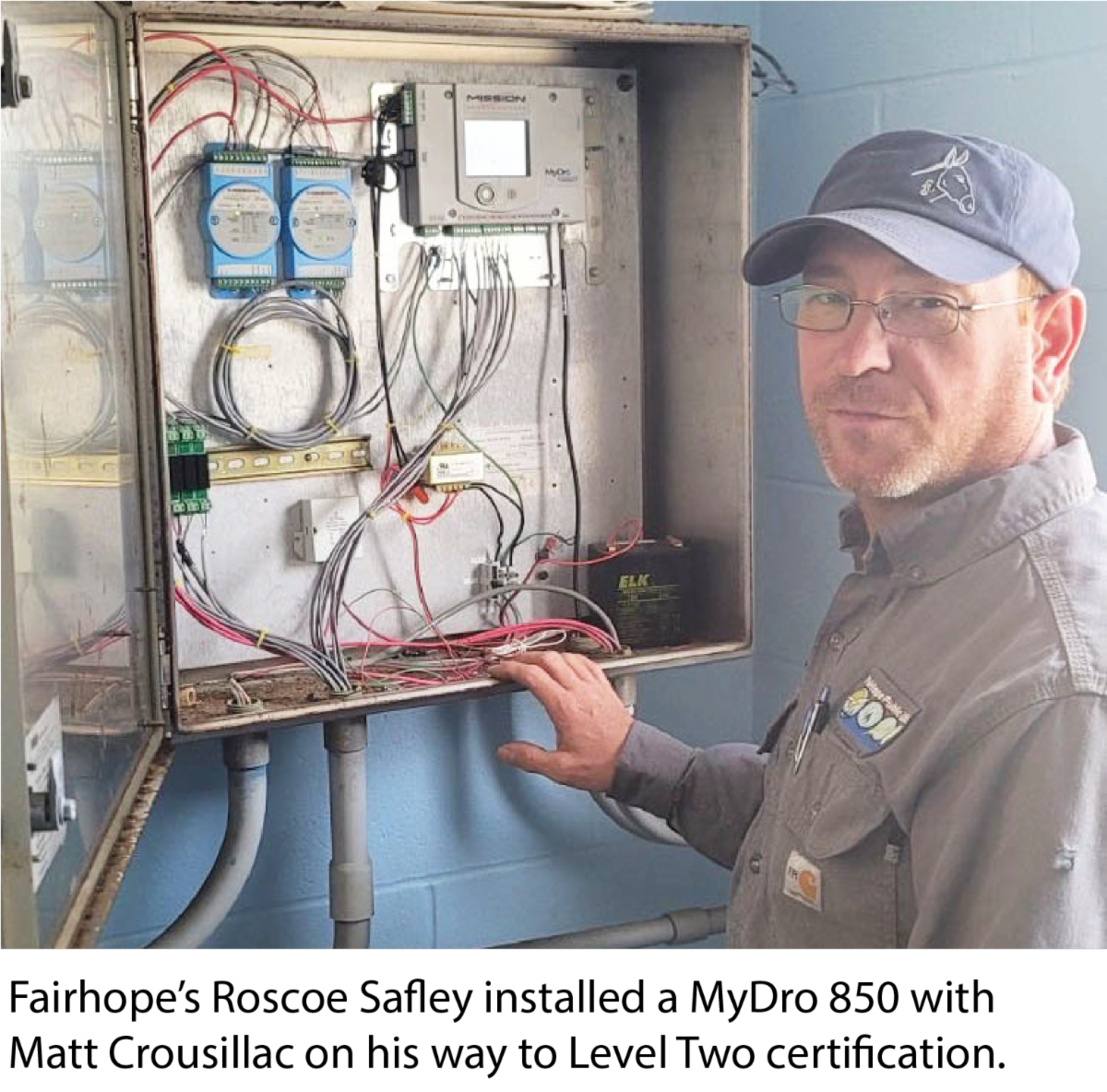
But Safley didn’t stop there. He continued his education even more, reaching Level 2 of the program, which required him to install a monitoring device under the watch of a Regional Sales Manager and set up a new web portal instance under the observation of a product expert. In this case, that was Crousillac. “Roscoe is a great electrician and his obvious product knowledge really came through. We have always been proud to have him as a customer, but watching him lead the way through this program is truly special for us.”
|
With his growing knowledge, Safley has helped Fairhope maximize the Mission monitoring system and apply it to more than just wastewater service. He explains, “I have a Mission monitoring device on each of the clean water wells. We also hook them up to PRVs in areas on the water side where the high pressure used to blow the mains there. We haven’t had a pressure–related blow since we installed them.” He also took a MyDro unit and monitored a bypass pump at a powerless location using a solar panel for power—another idea that came about while speaking with Technical Support.
As far as learning more about Mission, Safley plans to continue all four levels of the certification process. “I want to know more and see more from the back–end so I can learn what else is possible, get better knowledge so Fairhope can get done what we need to get done.”
If you have questions about Mission products, contact sales@123mc.com. Or sign up for our free weekly webinar to get started on your Level 1 certification. |
Watch the Manhole Monitor Plus Installation Demo Video |
Watch our Manhole Monitor Plus Installation video to see how easy it is to get this advanced sewer overflow alarm and tracking system into a variety of manhole environments. Experience the reliability and feature–rich solution for effective control and management of the Manhole Monitor Plus.
|
A Look at Squirt Guns: From the Civil War to Modern Day Super Soakers |
One unlikely cousin of the technology used in the water and wastewater world shows up mostly around home swimming pools, backyard BBQs, and beach parties. No, it’s not the pump in the pool’s filtration system. In this case, it’s the squirt gun, also known as the water gun. The purpose for moving water may be different, but their functions are similar. A wastewater lift station pumps water to gain back its elevation allowing gravity to do its thing and get the water to a treatment plant. A clean water pump moves water from a source into a water tank, providing clean water to houses and businesses. Squirt guns move water to splash someone, to help cool them off in the summer heat.
Splashing water in the face is also a novelty that goes way back into U.S. history. Early movies and television shows often reverted to it in their climax scenes. Laurel and Hardy, the Three Stooges, episodes of I Love Lucy all showcased multiple water splashing finales during their runs. In fact the first gag ever filmed in the silent movie era in 1895 featured a boy stepping on a hose, perplexing a farmer trying to water his crops. When the confused farmer inspected the nozzle more closely, the boy stepped off. And from then on, splashing water on people was funny.
|
In addition to hoses, devices specifically designed for squirting water for amusement have a long history too. General William Techumsah Sherman was quoted arguing with President Lincoln before the American Civil War, “You might as well attempt to put out the flames of a burning house with a squirt gun." That’s the earliest reference to a squirt gun that anybody can find.
The oldest documented squirt gun came in 1897 when Russel Parker, a business man in Brooklyn New York, applied for and received a patent for the U.S.A. Liquid Pistol. The patent documents reveal that it was made of nickel and contained a refillable bulb within the handle and, when compressed by the trigger, pushed air into the bulb, forcing the liquid through the discharge tube. Parker sold these for 40 cents apiece, and advertised it as protection for cyclists. These original squirt guns are rare, and exist mostly in antique collections.
Throughout most of the 20th century, squirt guns became popular toys. Molded plastic replaced the metallic versions. Instead of a single liquid bulb they were hollow and filled completely, like a tank, and the finger trigger pumped water out of the barrel and into your friends’ faces. It became a popular merchandising piece, branded with the likes of Roy Rogers, Flash Gordon, and even Barbie.
People also found practical uses for squirt guns over the years. Pet owners and trainers use them to curb unwanted behavior. Gardeners use them to scare away pests. Killing household insects around people who are sensitive to chemicals might take a steady hand and some practice, but it works. You can even clean with them if you need something stronger than a normal spray bottle or if something is a little out of reach.
Water gun technology got a big burst in 1989 when former NASA jet propulsion scientist Lonnie Johnson was trying to invent a new kind of water pump. During one of his early tests, water shot in a perfect stream across his bathroom. “I thought to myself, that might make a cool water gun,” he reminisced to CBS news in 2017. And what was eventually known as the Super Soaker was born.
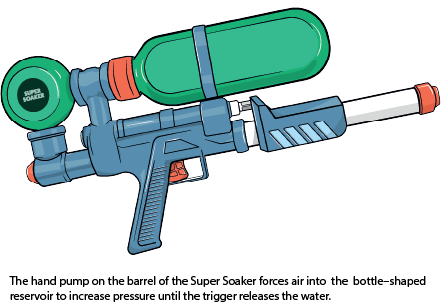
The Super Soaker uses hand–pump action to create a constant pressure system (CPS) that builds up the pressure and holds it until the trigger opens a valve and releases the water. The more pressure, the farther it goes. This created a billion dollar product line. But the power also came with some required caution—no more squirting water in the face at close range. In fact, the Super Soaker 2000 had to be taken off the market in 2001 because of rumors of injuries.
|
34 years have passed since the Super Soaker was created and Innovators are still looking to top it and improve the squirt gun technology, employing every conceivable pump. But it has still come a long way from Sherman’s quip about the Civil War and it can make hot summer days a little more bearable. Who knows? Maybe the next water and wastewater technological advancement will come from a toy company. |
|