St. Patrick Parish News & Updates

August 22, 2025 | Issue 34


A Word from the Pastor


August 22, 2025


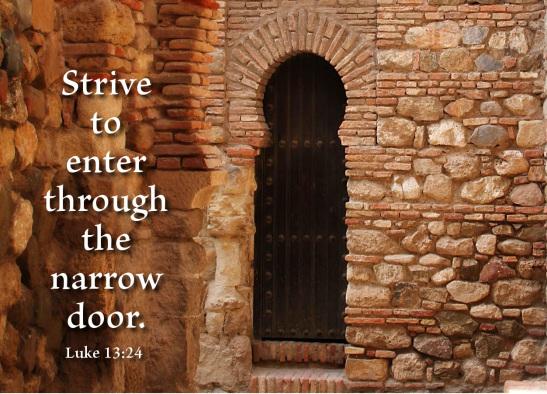
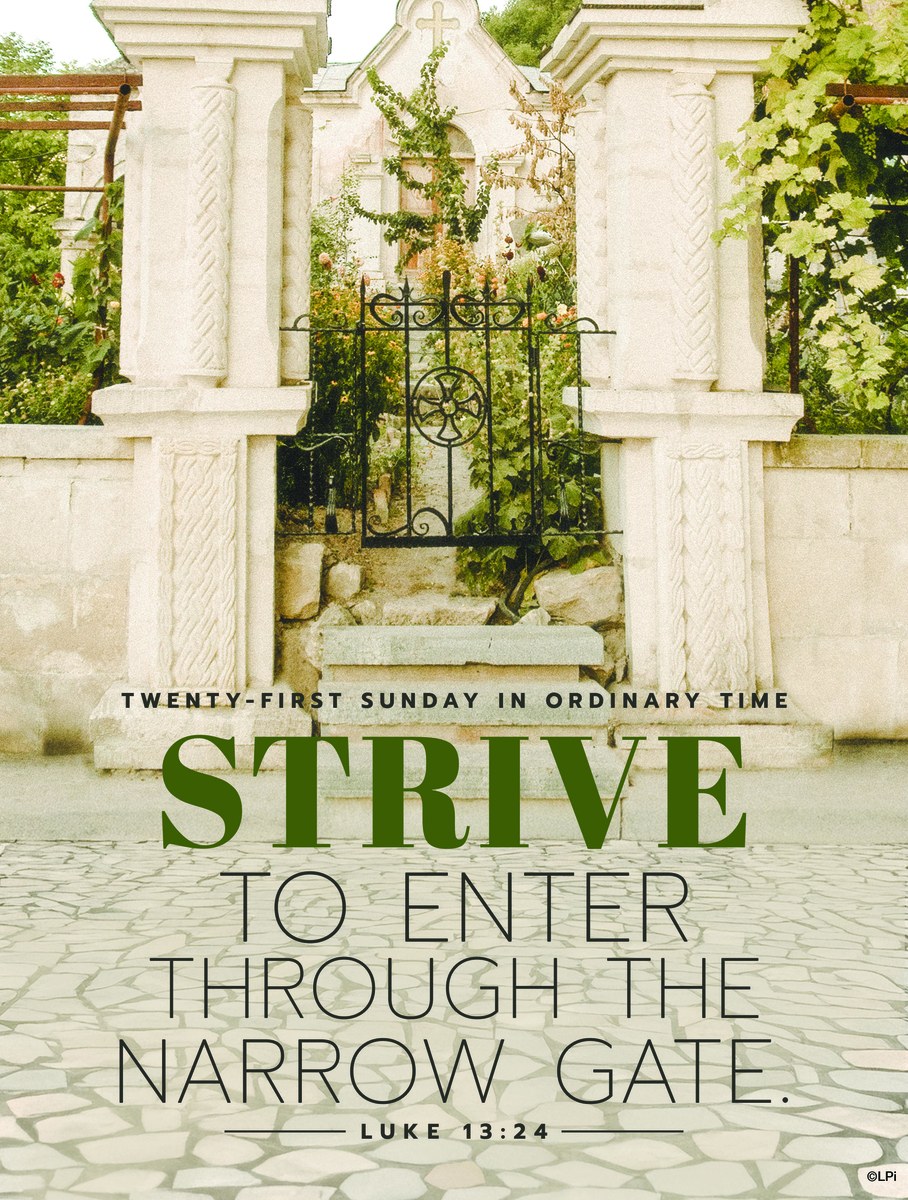
Jesus tells us in this Sunday’s gospel “to enter by the narrow gate.” What does he mean by this? I think it signifies a commitment to a life of virtue, sacrifice, and adherence to God's will, which ultimately leads to eternal life. This concept is contrasted with the wide gate and broad way that leads to destruction, which many choose.


Some of the Church Fathers and other Catholic writers have offered some thoughts on what it means to enter by the narrow gate. Pope St. John Paul II notes that the Greek text of Matthew 7:13-14 implies an intense struggle, or “agonizing,” to enter the narrow gate. It requires a vigorous fight with all one's strength, without ceasing, and with firmness of purpose. It is not an easy route.


Pope St. Leo the Great said that the narrow way demands a detachment from worldly pleasures and carnal goods. St. John Chrisostom noted that it means “not carrying superfluities or being weighed down by numerous earthly cares,” adding that one must be “lightly equipped” to navigate this path. In another homily he mentions divesting oneself of riches and avoiding the “thorns” of wealth and covetousness, which make the path more difficult.


St. Augustine stresses that the narrow way is characterized by virtue, which, though initially challenging, becomes easier through its ultimate good end: eternal life. It involves bearing burdens such as almsgiving, love for humankind, goodness, and meekness. The path of virtue is often hidden and requires faith in unseen, eternal things rather than visible, temporal ones.


Pope St. Leo the Great pointed out that Christ himself is the Way, and to enter the narrow gate means to walk as he walked. He makes the impossible possible through his divine power, providing the means to accomplish the journey.


In today’s gospel Jesus also observes that “there be few that find” this path. This highlights the carelessness of the majority and encourages believers not to follow the crowd but to emulate the few who choose the more difficult path. It is a call to not be troubled by the pleasures that seem so important to many, but to embrace the more challenging way of the few.


Origen of Alexandria (250 AD) notes that the broad way is crowded with those who are prone to worldly joys and carnal desires, enduring toil more willingly for pleasure than for virtue. Those who travel the broad way are often “those who boast of being part of the Church but live weakly and contrary to God's word.”


In essence, entering by the narrow gate means choosing a life of intentional discipleship, marked by self-denial, active pursuit of virtue, and unwavering faith, recognizing that this challenging path is the true way to eternal life. That is why I often say that being a Christian is not easy. It takes discipline and effort.


In one Heart,


Fr. Ron 


 rmbagley@yahoo.com

Thank You!


We are grateful to all those who made a donation to help offset the cost of the new roof for the Parish Center and the parish offices. Through your generosity we received $161,465 toward the total cost.


If you still wish to contribute to this effort, please contact the office or use Online Giving.

Order of Christian Initiation of Adults (OCIA)


The Order of Christian Initiation of Adults (OCIA) is the process through which people become fully initiated into the Catholic community. This includes:


  • Adults who have never been baptized
  • Adults who were baptized in another Christian religion but now want to join the Catholic Church
  • Adults who were baptized as Catholics but never received the Sacrament of Confirmation (OCIA is not for adolescents; adults only)


Our program meets on Sunday mornings after the 9:00 am Mass. It is held in the parish center from 10:00 to 11:00 am. Except for a few holiday weekends, it meets every Sunday. The first session will be Sunday, September 14, 2025.


Regular attendance is important. Those who complete the process will receive the sacraments at the Easter Vigil (April 4, 2026).


To get enrolled, you need to make an appointment with Fr. Ron. Email him at rmbagley@yahoo.com

How Often Should Catholics Receive Holy Communion?


By John Rziha


This article gives an historical overview of the practice of Catholic communicants over the centuries. It helps us to understand the changing practices of the Church.

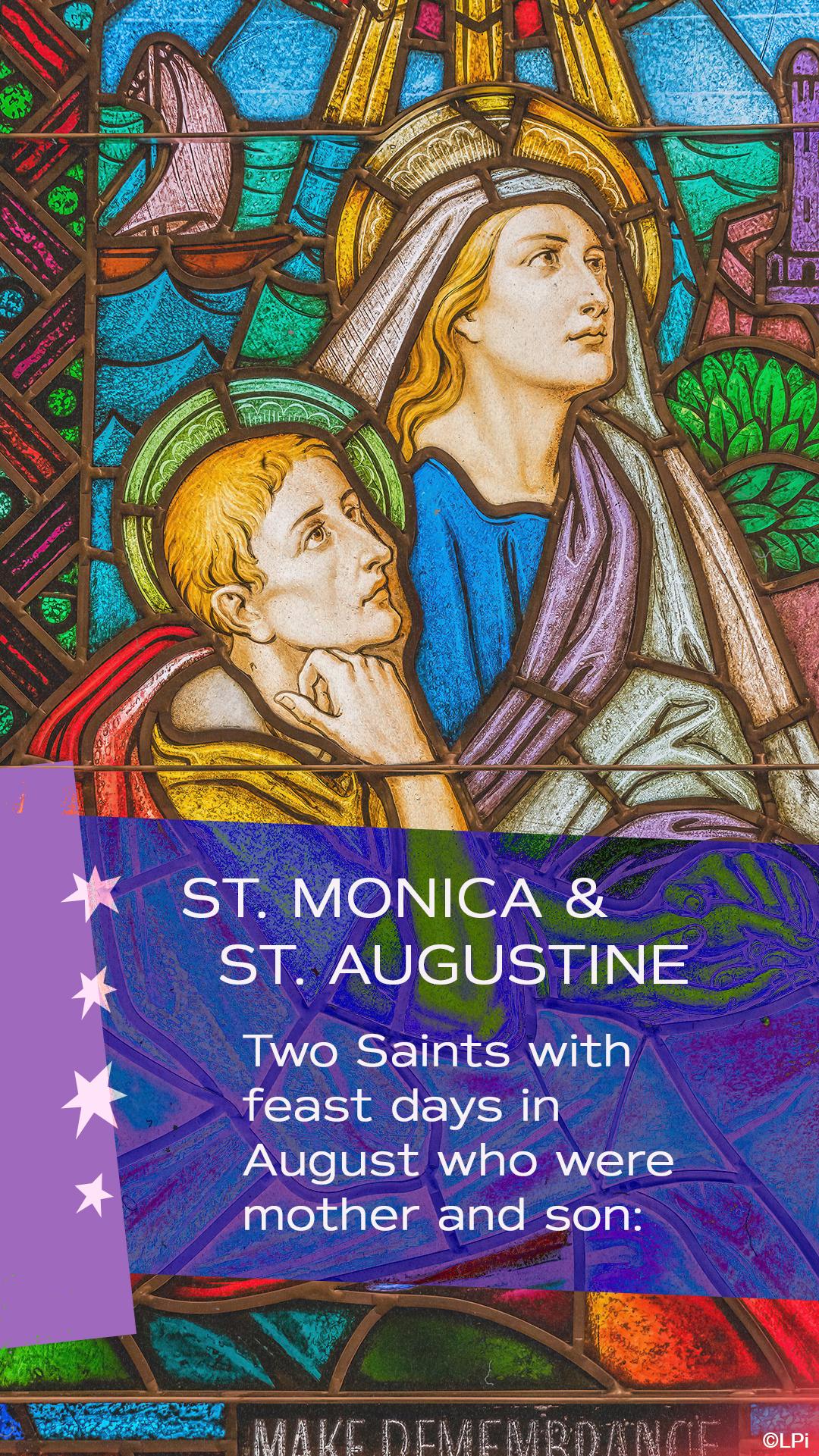
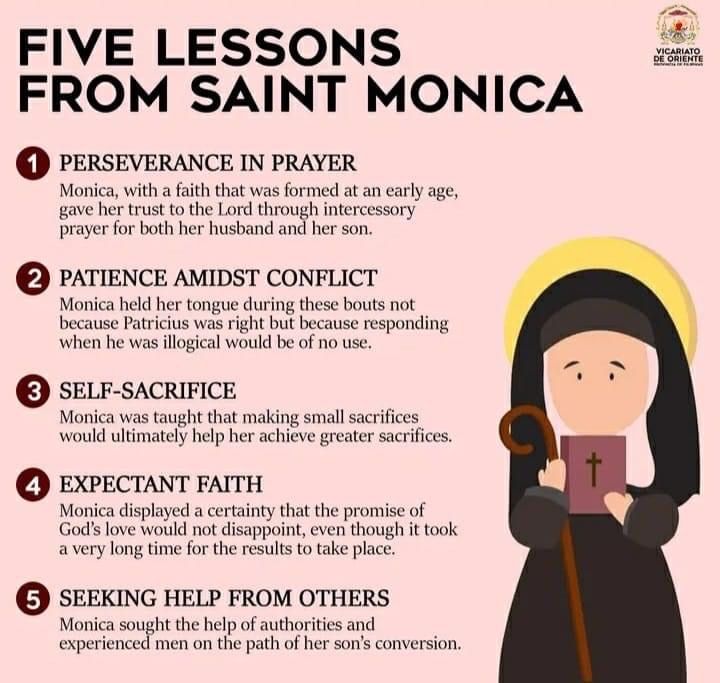
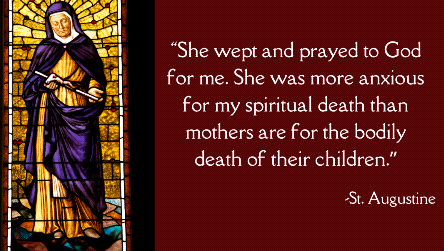
St. Monica and St. Augustine were mother and son, both revered as saints in the Catholic and Orthodox traditions. St. Monica, known for her unwavering faith and persistent prayers, played a crucial role in the conversion of her son, Augustine, who initially embraced heresy and lived a wayward life. Their story is one of a mother's love, perseverance, and the transformative power of prayer.


St. Monica’s feast day is August 27, followed on August 28 by her son St. Augustine.

The Greatest Gift of All


This children’s song is based on the words of St. Paul’s ode to love (1 Cor 13) It is performed here by Believers Fellowship KIDS

Bible Study on Apocalypse

in the Bible


Fr. Ron Bagley will teach a course on Apocalyptic Literature this fall. Come and explore the deeper meaning of the strange and puzzling form of writing in the Bible.


The course includes an exploration of the apocalyptic writing of the Old and New Testaments, its literary genre and the historical contexts of its use in God’s Word. After a brief overview of apocalyptic writing in general in the Bible, this course will focus primarily on the Book of Revelation, examining its meaning at the time it was written and its relevance today.


Venue: St. Patrick Parish Center Dates: Tuesdays – September 30, October 7, 14, 21, 28, & November 4

6:30-8:30 pm


Register by contacting the Diocesan Institute at 858-490-8212 or online at their website.

Online Giving Reminder


If you currently use Online Giving for your electronic giving, please make sure you login to the application frequently to make sure your payment method is current and your donations are being processed.


Click on the Online Giving icon below to create or access your account.

Catholic Trivia


"Catholic Trivia”... not because they are trivial but because these might be things that not everyone knows. Test your knowledge by reading the five questions, remember your answers (or jot them down), then click the link below to find the answers.


  1. What are the three theological virtues?
  2. What are the four cardinal virtues?
  3. Why are they called “cardinal” virtues?
  4. Which cardinal virtue is defined as "firmness of soul" in the general sense, but as a cardinal virtue, it is the virtue needed to endure the trials of life?
  5. What does St. Paul say is the greatest virtue of all?


Feel free to email Fr. Ron with ideas for future Catholic Trivia questions rmbagley@yahoo.com

Twenty-First Sunday in Ordinary Time – Year C


First Reading

Isaiah 66:18-21

Nations of every language shall come to see my glory.


Responsorial Psalm

Psalm 117:1-2

Praise the Lord, all you nations.


Second Reading

Hebrews 12:5-7,11-13

Whom the Lord loves, he disciplines.


Gospel Reading

Luke 13:22-30

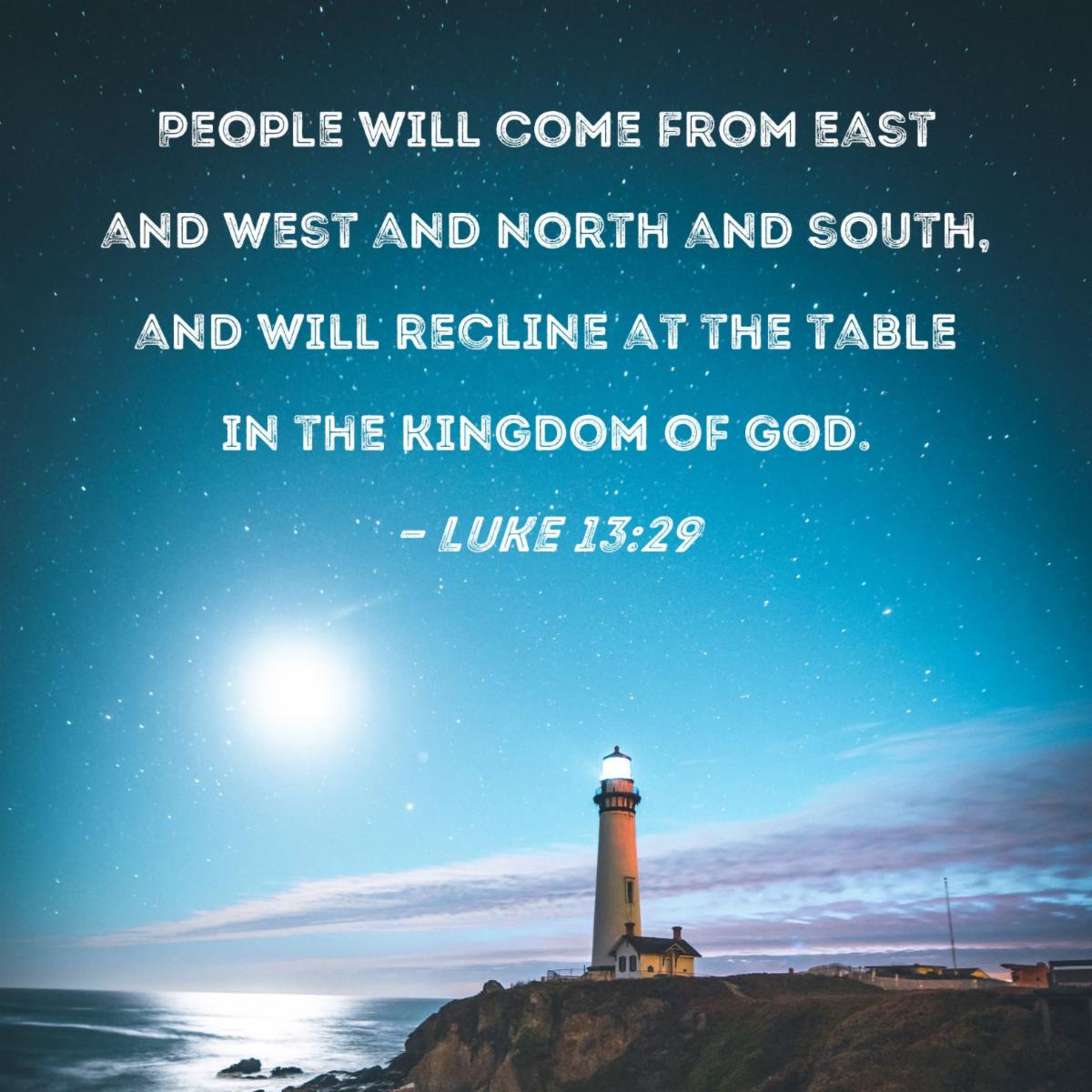
People will come from north and south, east and west, and take their place in the Kingdom of God.


Background on the Gospel Reading


Today's Gospel reading is the third of three parables in chapter 13 that deal with the theme of the unexpected reversals brought by the Kingdom of God. The other two parables are about the tiny mustard seed that grows into a large tree and the small amount of yeast that makes a large batch of dough rise. All three are about the few and the many and the Kingdom of God.


As this parable opens, Luke reminds us that Jesus is making his way to Jerusalem. This journey, this exodus as Luke refers to it, makes up the entire middle of the Gospel. He is teaching as he goes. A question from the crowd gives Jesus the chance to make a prophetic statement. Luke uses this question device a number of times in his Gospel. A few weeks ago, the question “What must I do to inherit eternal life?” led to the parable of the Good Samaritan. The question about will only a few be saved uses typical Christian language about salvation but also expresses the Jewish concern about whether everyone who calls himself a Jew is actually faithful to the covenant. This was a concern of the Pharisees.


Jesus answers that they must strive in the time remaining to enter through the narrow door because many will be trying to get in but won't be strong enough. He then moves to a parable about another door. (The translation says “gate” then “door,” but the same Greek word is used.) Once all those entering the master's house are in and he locks the door, there will be no way for others to get in. Those left outside may knock, but the master will say he doesn't know them. Unlike the Gospel reading from a few weeks ago where Jesus was teaching about prayer, and we were told to knock and the door would be opened, in this parable, the master will not open and say he does not know us. People from the north, south, east, and west will take our place inside. Abraham, Isaac, Jacob, and all the prophets will take our place in the Kingdom of God. Those who do not make it through the narrow door will be cast out to where there is wailing and grinding of teeth.


The image of the door is replaced in the final verses of the parable with the image of the heavenly banquet. Two passages from the Book of Isaiah influence the conclusion. Isaiah 43:5-6 speaks of God bringing Israel's descendants back from the east and from the west, the north and the south. And Isaiah 25:6 speaks of the Lord providing a feast of rich foods and choice wines for all peoples on his holy mountain. The answer to the question if only a few will be saved is no. In the end, many will be saved, but many who thought they would be saved will not be saved. The parable is a prophetic warning to repentance in order to enter the kingdom.

Goodness of God


This is a praise and worship song that invites you to sing of the goodness of God. The chorus repeats:

All my life You have been faithful, All my life You have been so, so good

With every breath that I am able I will sing of the goodness of God.

Religious Education Preschool to 8th Grade 

Registration Information for the 2025-2026 School Year


We are here to support parents in forming their children in the Catholic Faith and engage in our parish community where we worship and grow together in faith. We offer weekly classes for preschool through 8th grade and preparation for the sacraments for children in grades 1 through 8.


The online registration is open for all our classes from Preschool through 8th grade. 


Please visit our Religious Education Preschool to 8th grade website at www.stpatrickcarlsbad.com


Contact the Office for Religious Education at 760-729-8442, or mdornisch@stpatrickcarlsbad.com with questions about faith formation or sacramental preparation.  


Blessings, 

Margit Dornisch,

Religious Education & Family Ministry 

Programa de Catequesis Bilingüe y Ministerio Familiar

Ya estamos registrando para la Catequesis 2025-2026


El programa bilingüe de Catequesis de esta parroquia ofrece a los padres de familia el apoyo necesario para la formación religiosa de sus hijos/as integrando aspectos culturales dentro del plan de estudio.


Si desea registrar a sus hijos para la Catequesis en un programa donde los acompañamos a crecer en su fe incorporando el aprendizaje con la vida de la comunidad a través de la Misa dominical, entonces los invitamos a ser parte de este proceso.


Para obtener más información sobre el programa y registrar en línea haga clic en el siguiente enlace; Si desea comunicarse a la Oficina de Catequesis por favor marque 760-434-9099 o envíe un correo a lramirez@stpatrickcarlsbad.com


Sea bendecido!


Lorena Ramirez

Bilingual Coordinator of Catechesis

& Family Ministry

760-434-9099

lramirez@stpatrickcarlsbad.com

Un Saludo de

parte del Diacono Miguel,


“En aquel tiempo, Jesús iba enseñando por ciudades y pueblos, mientras se encaminaba a Jerusalén. Alguien le preguntó, “Señor, ¿es verdad que son pocos los que se salvan?” Esta es la gran pregunta de muchos, “¿quién será salvado al final de los tiempos?” Diferentes religiones han desarrollado diferentes ideas o teologías respondiendo a esta pregunta. En el evangelio de esta semana, la “gente que seguía” a Jesús le hace esta pregunta, ¿es verdad que son pocos los que se salvan? Ellos confiaban en su salvación porque sabían quién era Jesús, se arrimaban para escuchar sus enseñanzas, bebían y comían con él. Pero Jesús responde usando una parábola, les habla de “entrar por la puerta angosta, muchos tratarán y no podrán”. “Que cuando venga el dueño de la casa, cerrará la puerta y ustedes quedaran afuera”. Y me imagino la desesperación de la gente que se queda afuera, confundida, gritando de afuera, “¡Anduvimos contigo, ábrenos!” Luego Jesús les dice, que vendrán muchos del oriente y del poniente, del norte y del sur, y ellos participarán en el banquete del Señor. ¿Qué nos está diciendo Jesús en este texto? Que no es suficiente saber quién es Jesús. Que no es suficiente ir a los lugares en que se leen las historias de Jesús y hacer las oraciones. Lo que es lo más importante, es conocer quién es Jesús. Dejarlo ser encarnado nuestro ser para que nuestras acciones y actitudes reflejen el amor y la compasión de Jesús. ¿Quién es salvado? No nos toca a nosotros decidirlo. Sólo nos toca compartir la ternura de Jesús a todos, porque es de esta manera que otros conocerán a Jesús, ¡El Señor de Señores! 

3821 Adams Street

Carlsbad, California 92008

760.729.2866


  • Our parish offices are open, Monday through Friday, 8:30am to 12:30pm and 1:30 to 4:30pm


  • In case of emergency, you can always reach a priest. Call the parish number 760-729-2866 and press number 6 which will connect you directly to one of our priests.


  • If you know someone who does not receive our emails, please forward this to them, or have them reply to this message.


To email a priest at St. Patrick Church click the address below:

rmbagley@yahoo.com