|
|
St. Vincent de Paul is currently
gathering supplies for the upcoming
Back to School season!
St. Vincent de Paul of Alameda County is collecting new backpacks and school supplies for 700 children to be distributed at our Back to School Bash for Kids on July 26th from 10:00am-2:00pm
Backpacks and school supplies are needed by, July 12th at our Community Center, located at West Oakland Site at 2272 San Pablo Ave.
To donate supplies or $25 grocery gift cards and to schedule donation drop-offs, contact Brenda Addison baddison@svdp-alameda.org or Text (510) 593-5501
To donate online go to www.svdp-alameda.org/donate
or mail your check to St. Vincent de Paul-AlamedaCounty, 2272 San Pablo Avenue, Oakland, CA 94612.
Please designate your gift to Back-to-School 2025
| |
VOLUNTEERS NEEDED!
The back-to-school event happening July 26th. The shift will be from 8:30-2:30pm. We need 30 volunteers to make it a success
| |
|
Attention Vincentians, if you are helping a neighbor experiencing homelessness or some other crisis, START HERE:
Coordinated Entry System – Coordinated Entry is the front door to the crisis response system to help neighbors in need with temporary shelter, housing and other effective resources and interventions throughout Alameda County that will end their homelessness and help them with their other urgent needs.
The following links to the Coordinated Entry services and other links, including “Beloved Community – Resources for our Neighbors in Need and Those We Serve” are provided for you to assist neighbors in need and are featured in this newsletter on a recurring basis. I will do my best to keep them up to date. Please do not hesitate to let me know if any of this information is not current, if the links do not work, or if you know of other resources that I might include here, by replying to this email.
| |
Homelessness Solutions in Alameda County
Coordinated Entry – The Coordinated Entry process is an approach to coordination and management of the crisis response system’s resources that allows users to make equity consistent decisions from available information to connect people efficiently and effectively to interventions that will end their homelessness.
The Coordinated Entry System includes:
- Points of access to resources for people experiencing homelessness
- Housing Problem Solving
- Assessment
- Prioritization for available resources
- Referral/Matching to Housing/Homelessness Resources
- Grievance processes
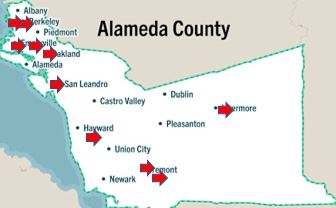
For more information about housing and resources for people experiencing homelessness, contact a Housing Resource Center in your area.
- North County (2)
- Oakland (4)
- East County (1)
- Mid County (2)
- South County (2)
- Transitional Age Youth (1)
Street Health Outreach Teams operate throughout Alameda County with the goal of reaching unsheltered homeless persons with high medical needs. Learn more at www.achch.org/street-health.html
Coordinated Entry Refresh
In 2020 Alameda County updated our Coordinated Entry System to:
-
Incorporate findings from recent racial equity and systemwide modeling analyses that will allow us to plan strategically for adequate housing resources and work towards ending homelessness
- Focus on problem solving, connecting people to available housing and flex funding resources
- Offer housing assessment for the housing queue
- Offer crisis assessment for those seeking shelter, transitional housing or safe parking
- Ensure clear, transparent, and timely communication
- Improve HMIS workflow
- Implement changes to regional coordination
Coordinated Entry Policies
|
If you are looking for housing or services, you can also call 2-1-1.
| | | | |
Please click "Directory" below for a comprehensive list of Resources for our neighbors in need and those we serve. This is a PDF with names and brief descriptions of resources. Click on the name of each resource in the Directory for a link to the websites of these service providers.
| | |
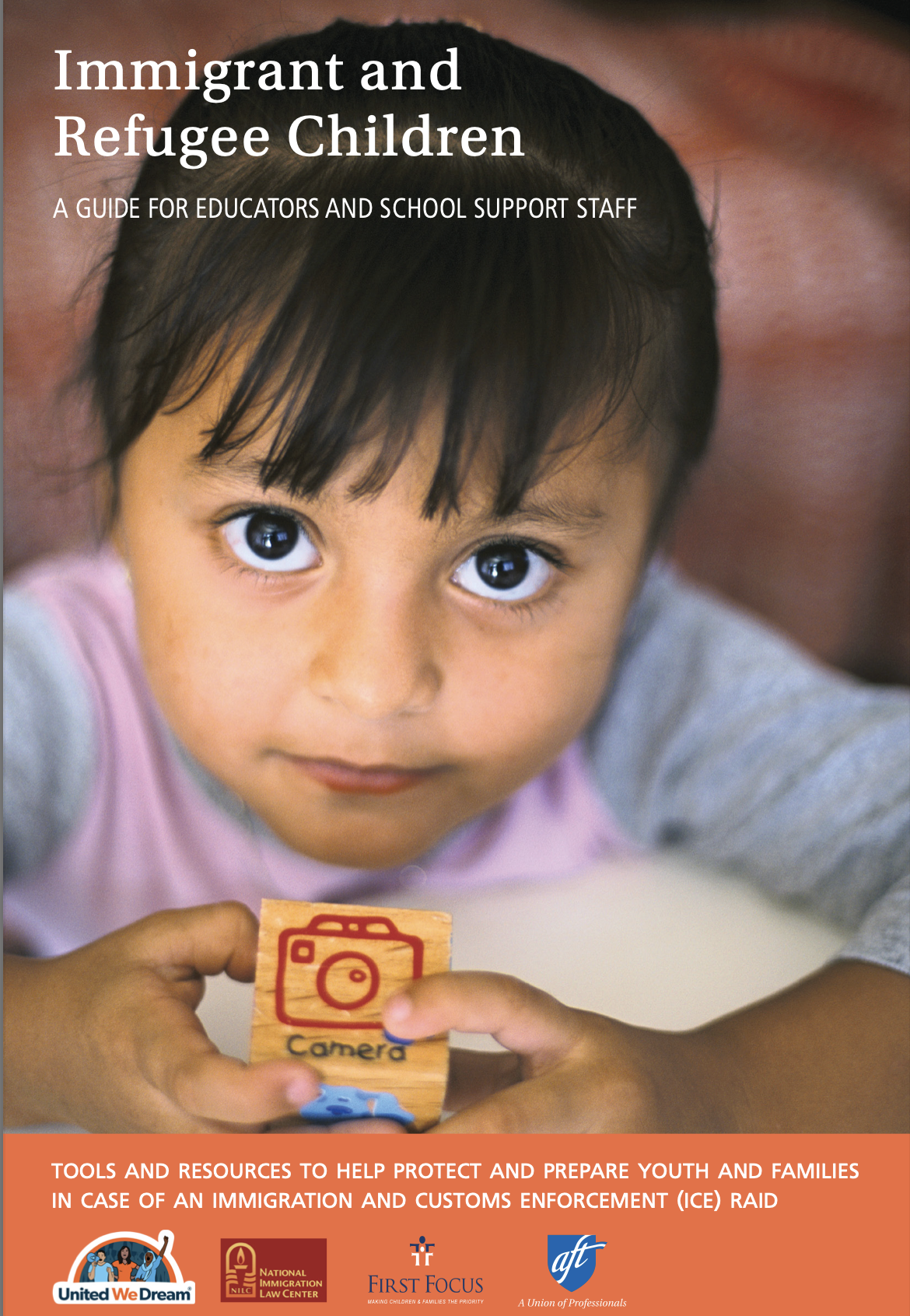
Events and Resources for Immigrants and Refugees
| |
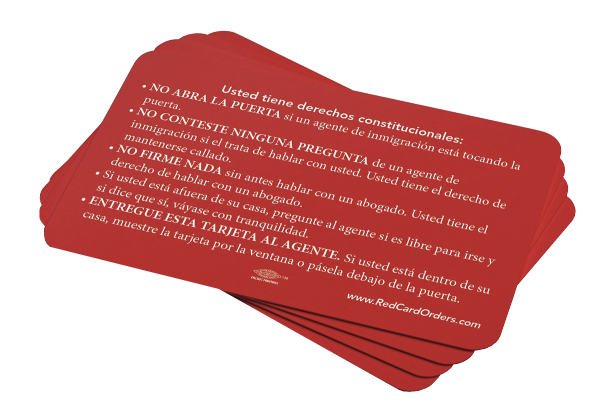
Red Cards / Tarjetas Rojas
All people in the United States, regardless of immigration status, have certain rights and protections under the U.S. Constitution. Immigrant Legal Resource Center "Red Cards" help people assert their rights and defend themselves in many situations, such as when ICE agents go to a home.
Click the button below for PDF's of the ILRC "Red Cards" in both English and Spanish. Please note, the text is black on white background.
(Thank you Ryan Uyehara!)
| | |
Immigrants' Rights
Centro Legal’s immigration practice is focused on serving the needs of our most vulnerable community members, including families living in poverty, long residing undocumented immigrants and families, youth, victims of violent crimes, asylum seekers, and detained individuals in removal proceedings.
Tenants' Rights
Stopping displacement, maintaining neighborhoods and stabilizing our communities are very important goals for the Tenants’ Rights Program.
Workers' Rights
The low-wage immigrant workers served by Centro Legal’s Workers’ Rights Program are employed in industries where wage theft and other serious workplace violations are commonplace.
Litigation
Through each of our legal programs, Centro Legal represents low-income and immigrant workers, tenants, and other clients and communities in affirmative and impact lawsuits to protect their rights and improve conditions more broadly.
| | |
You have rights! Regardless of your immigration status, you have protections from immigration raids at your home or place of work. Below please find a variety of videos, training slideshows, and info guides on your legal rights to help you and your friends, family, coworkers, and neighbors be safe.
California: A Sanctuary State
The California Values Act (SB 54), enacted January 1, 2018, ensures that the use of local or state resources to assist in federal immigration enforcement is prohibited and that our schools, hospitals, and courts are safe spaces for everyone in the community. Berkeley, Oakland, San Francisco, San Jose, Sacramento, Los Angeles, and Anaheim are all Sanctuary Cities with increased protections for immigrants.
This means the police cannot ask you about your immigration status or deport you solely on immigration charges. If you are arrested, the police cannot transfer you to ICE custody unless you have a felony or high level misdemeanor conviction (DUIs; sale, possession, or use of drugs; domestic violence; robbery; murder).
If you do come into contact with the police or ICE agents, you are entitled to fundamental legal rights.
| | |
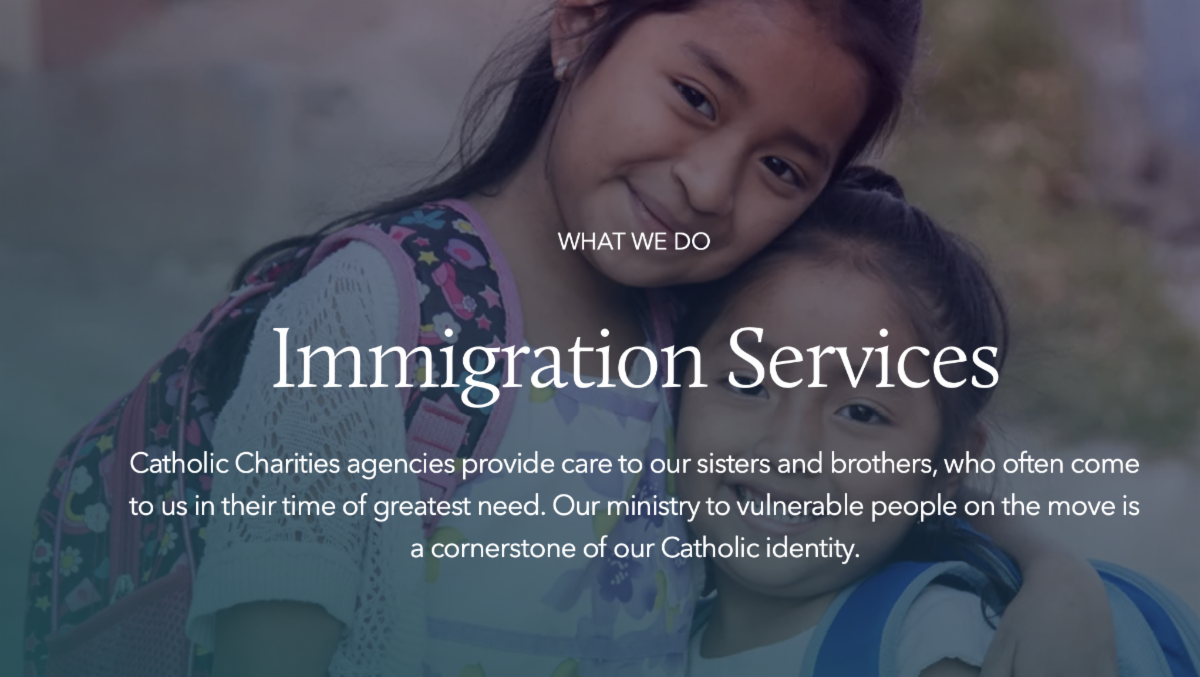
People migrating to the United States are often fleeing war, violence, persecution, economic and political upheaval, and devastating natural disasters. Catholic social teaching holds that humans have a right to move to protect their lives and families. Catholic Charities immigration services support the federal government’s right and duty to regulate our borders while also calling for bipartisan, effective, humane reforms to our country’s broken immigration system.
| | |
"Preach the Gospel at all times and if necessary, use words."
St. Francis of Assisi
|
| |
Vincentians, what's going on in your Conferences?
Reply to this email with photos and stories of Conference life so that we may share it in Praxis.
| | ...or email jproctor@svdp-alameda.org with your good news! | | |
SERVING IN HOPE
Vincentians "Serve in Hope" because we are called to bring the love of God, the compassion of Jesus, to those who are poor and suffering.
St. Vincent said, "God demands first the heart, then the work." It is only with our heart that we can bring compassion, respect and devotion to the destitute and marginalized.
It is only with a heart on fire with God's love that service can become mission. And it is only by "Serving in Hope" that our mission can root us in the faith that in the poor "Vincentians will see the face of Christ."
Serving in Hope is featured in Praxis as part of the Formation Plan for the Society of St. Vincent de Paul of Alameda County, as are other Spirituality and Formation resources in this newsletter. Conferences are encouraged to use Serving in Hope sessions as part of their Conference Spirituality, especially for Conferences that do not have a Spiritual Advisor.
The May 30 edition of Praxis featured Module VII of Serving in Hope, Session 7.5, "Praying With a Vincentian Heart."
This week we start at the beginning, with Module I of Serving in Hope, "Our Vincentian Vocation," Session 1.1, "What is a Vocation?"
| | |
THE VINCENTIAN VOCATION
A mission statement describes the unique purpose in the life of an organization.
It captures the values and the inspiration of the vision given to the members.
Our Mission Statement captures the grace of our Vincentian Vocation:
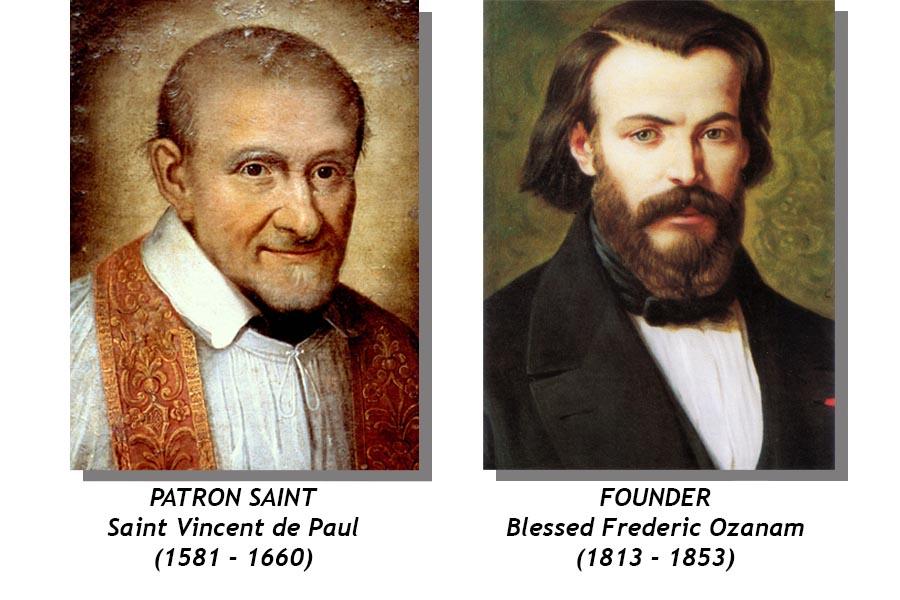
Inspired by Gospel values, the Society of St. Vincent de Paul, a Catholic lay organization, leads women and men to join together to grow spiritually by offering person-to-person service to those who are needy and suffering in the tradition of its founder, Blessed Frederic Ozanam, and patron, St. Vincent de Paul.
As a reflection of the whole family of God, members, who are known as Vincentians, are drawn from every ethnic and cultural background, age group and economic level.
Vincentians are united in an international society of charity by their spirit of poverty, humility and sharing, which is nourished by prayer and reflection, mutually supportive gatherings and adherence to a basic Rule.
Organized locally Vincentians witness God's love by embracing all works of charity and justice.
The Society collaborates with other people of good will in relieving need and addressing its causes, making no distinction in those served because, in them, VINCENTIANS SEE THE FACE OF CHRIST.
The word "vocation" comes from the Latin vocare; which means "to call." Vocation is a "call" a personal summons from God to a human being, inviting the person to embark upon a specially chosen work relative to God's plan of salvation. As members of the Society of St. Vincent de Paul, we have been "called" by God to a ministry of service to those who are poor, to bear witness to Jesus' compassionate love.
It's not for everyone. It's not for anyone. But being a member of the Society of St. Vincent de Paul - being a Vincentian - is for some. It is a special calling by God. Blessed Frederic Ozanam says: " ... what is proposed to us is the sublime vocation God has given us. Would that we were a little bit worthy of it and bent easily to its burden." (Letter #90)
St. Vincent de Paul said over and over again, "Put on the Lord Jesus Christ." The Church says: "The followers of Christ are called by God, not according to their accomplishments, but according to his own purpose and grace." (Lumen Gentium, #40)
| | |
A member of the Society puts their faith into action - this is the meaning of the word "Praxis." The Vincentian vocation is the intimate desire to participate personally and directly in helping the needy by person-to-person contact and by the gift of one's heart and friendship, doing so within a Conference, a community of faith, of lay persons each inspired by the same vocation.
The Vincentian vocation may be expressed in many ways and with different shades of meaning. Practical translation of faith into action, meditating upon it and adapting it to our changing world is the very life of every Vincentian, the very life of the Society.
Serving in Hope Books
The Serving in Hope books contain readings, discussion topics, prayers, divided into short sessions. These magazine-sized books are designed to be used in Conference Meetings or retreats, but are excellent for individual reading, as well. Each session takes about 20 minutes as a group reflection, or the entire Module may be used for a longer retreat. You will need one book for each participant. Module VI covers Our Vincentian Conference. Sessions include:
- Our Vincentian Vocation
- Vocation of the Laity
- The Vocation of Vincent and Frederic
- Essential Elements of the Society
- Core Values
- Mission
Module I: Our Vincentian Vocation
Module I: Our Vincentian Vocation introduces the opportunity for frequent stops to: "Pause to Reflect and Share," providing the important time for moments of silent personal reflection, to sharing in small groups as well as discussion together in the Conference. This allows for a focus on dialogue and reflection and so each Conference will likely move at a different pace as each Session will take many meetings to complete.
The facilitator is challenged to "hold the space" as the members of the Conference become more and more comfortable with these various forms of reflection and sharing. Periods of silence are actually expected. There will also likely be times of spirited dialogue as we embrace the diversity of relationships with the neighbor that challenge our status quo approaches.
The facilitator for the meeting will be focused on creating an environment for learning and sharing among Conference members as a priority, taking as many meetings as necessary to proceed through the sessions.
This variation is encouraged and based on the inclusion of a broad range of home visit strategies emerging in our focus on systemic change, and our need to have sufficient time for sharing and reflection. This Module can be used during Conference meetings or for a Retreat Day. As the session titles reflect, this Module is about the cultivation. of a Vincentian Heart in the context of our encounter with the neighbor, each other, and the communities we serve.
To view or download the videos that accompany Module I, follow the link below and use the password: “hope”
https://vimeo.com/showcase/9161681
| | |
Amelie and Frederic Ozanam
FREDERIC OZANAM'S VOCATION STORY
Frederic Ozanam was born in Milan, Italy on April 23, 1813, and at the age of three, his family moved to Lyon, France. When Frederic was 7 years, old he nearly died of typhus. His parents had already faced the death of 8 of their children, but with a deeply rooted faith in God they prayed that Frederic would be cured, and by a miracle of grace he lived. Frederic's father was a doctor, and he often saw his father and mother leave, sometimes in the middle of the night, to take care of the sick and the dying. Their example gave him the wisdom and compassion that only comes from the witness of people's lives.
At the age of 16, while in college, Frederic suffered a severe crisis of faith. He questioned why he believed and he faced despair, depression and scruples. When the temptations became stronger and sharper, Frederic felt surrounded by darkness and he felt utterly alone. He prayed to the Holy Spirit; he asked for the gift of faith, the grace to believe, and when the crisis ended, he promised to consecrate his life to the defense of the faith and the service of truth.
The Society of St. Vincent de Paul
At the age of 18, Frederic went to Paris to attend the University. The post-revolutionary Paris was not merely anti-Catholic, it bristled with open hostility against anything Catholic or Christian. The young college students would often meet with their friend and mentor, Monsieur Emmanuel Bailly, to discuss and debate issues. One evening, at a meeting, the revolutionaries issued a challenge by saying, "Christianity is now outworn and defunct. It may have been useful in the past, but what use is it today? What has Christianity to offer? Where are its works now? Show us your works!"
"Show us your works," this pierced Frederic's heart and sent him to the poor. By grace, Ozanam knew the secret that service must be motivated by love and that assistance given to the poor must be given personally with sympathy, humility, compassion and respect. The lives of his parents had taught him this wisdom.
Frederic and his companions came to know that they needed to organize their works for the poor- they needed to organize formally to help the poor on a regular basis, both in order to serve the poor and in order that others could see the witness of their lives. And so on Tuesday evening, April 23, 1833, Frederic Ozanam, together with Emmanuel Bailly, Auguste Le Taillandier, Francois Lallier, Paul Lamache, Felix Clave and Jules Devaux, began the Conference of Charity and the Society of St. Vincent de Paul was born.
Emmanuel Bailly sent Frederic and his companions to Sr. Rosalie Rendu, a Daughter of Charity. Sr. Rosalie gave them the names of families to visit in their homes. Pondering, she looked at Frederic and said, "Because you see Christ in His poor, I know you will approach each one you visit with humility as His servant. But, always remember that if we had been through the hardships they have had to meet, if our childhood had been one of constant want, perhaps, we too, would have given way to envy and hatred, as I must admit have many of the poor in this quarter. But, be kind and love, for love is your first gift to the poor. They will appreciate your kindness and your love more than all else you can bring them."
Frederic chose St. Vincent de Paul to be the patron saint of his new Society. He once said:
"Even the revolutionaries admired St. Vincent, they forgave him the crime of having loved God." Frederic wrote: "To choose a patron saint does not mean simply adopting a figurehead which will help us to cut a good figure in the religious world. A patron is a model whom we must try to imitate, as he strove himself to imitate the Divine Model, Jesus Christ. It means trying to carry on the work he has started endeavoring to acquire something of his warmth of heart, attempting to catch up the threads of the thoughts which were in his brain. A patron saint provides a model for us to copy on this earth and a protector who will watch over us in heaven."
Frederic and Amelie
Frederic was named a professor at the Sorbonne when he was only 27 years old. He was the youngest to be named to this post. Frederic's faith that had been tried by fire, proved strong as he continued to face the prejudice and the anger of those who hated him in hating the church.
After many years discerning his vocation, thinking first that God was calling him to the priest-hood, Frederic realized that marriage was his vocation and on June 23, 1841, when he was 28, he married Amelie Soulacroix who was 20. Then on July 7, 1845, they had a child whom they named Marie. Frederic had a deep conviction that marriage was indeed a sacrament and a vocation. The sacrament of marriage was a powerful means of holiness for Frederic and Amelie, as for countless Vincentians throughout the world. Frederic knew the poverty of poor health all his life, and his suffering led him further on the journey to a compassionate heart.
It was Amelie’s love and strength that supported Frederic during the painful years of suffering that he had to face. Amelie believed in Frederic's dream, in his vision of the Society, and when he became discouraged, she was always there to bring hope.
Legacy
The Rule of the Society evolved out of the life and faith of Frederic. Authentic Vincentian service assists the impoverished and the troubled but it is done in love and with love. As Vincent, Frederic knew that this is what our Lord asks of his followers, namely, that they seek and find Jesus in the poor. Vincentianism is Faith in Action: it is a reaching out in friendship and with helping hands to those who are poor or who are suffering. Vincentian helping is per-son-to-person, by a personal gift of the heart, in humility, simplicity and charity. Being a Vincentian is a vocation.
Frederic knew that service must promote human dignity and integrity, and that "No work of Charity would be foreign to the Society." The Society was to be concerned not only with relieving need but also with redressing the situations that cause it, and so he advocated the concepts of Christian social justice, the rights and dignity of every individual and the need for equality of opportunity in education and employment.
Frederic taught that Vincentians must seek through prayer, meditation on the scripture, the teaching of the Church, through their daily lives, and in their relationship with those in need, to always bear witness to the love of God. And Frederic also knew, as Vincent did, that we do not go to the Lord, as if we were alone. We need a Christian community where members mutually encourage one another in loving God and neighbor.
Frederic possessed a faith conviction that a PROVIDENT GOD was guiding history and guiding his own personal journey. He always had a true devotion to Mary, the Mother of God. Therefore, it seems fitting that on the feast of the Birthday of the Blessed Mother on September 8, 1853 Frederic Ozanam died at the age of forty, having attained an authentic holiness through his life and work, knowing that God had indeed called him to be a Vincentian.
From Serving in Hope 1.1, Our Vincentian Vocation
| | Society of St. Vincent de Paul of Alameda County Direct Services Campus | | |
For the Dining Room: 8:30 am to 1 pm Tuesday through Saturday
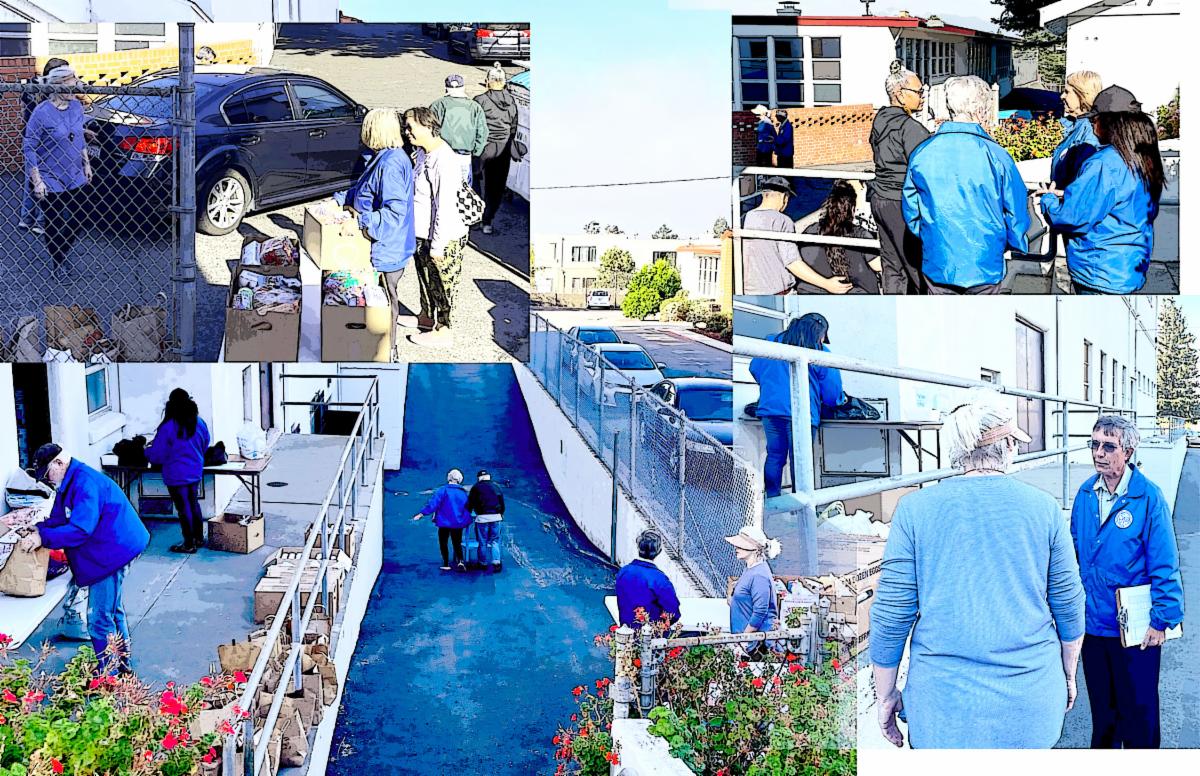
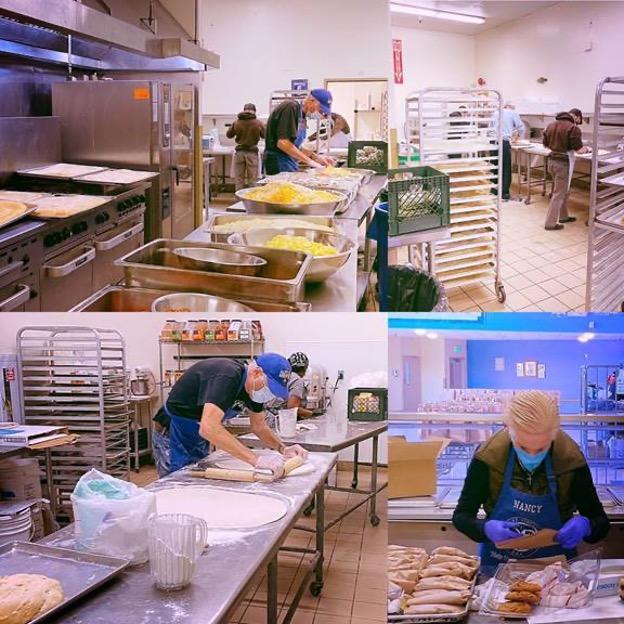
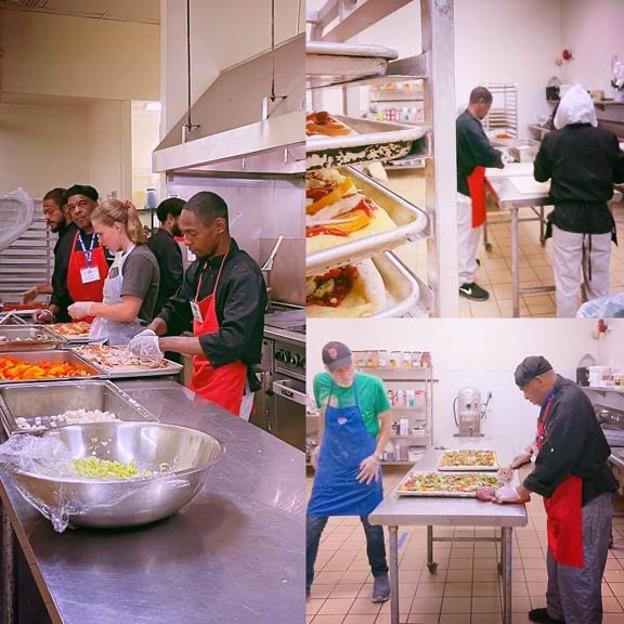
Volunteers in the dining room / kitchen prepare, and bag warm meals for our guests and serve them at the gated entrance to the courtyard. These excellent hot takeaway meals are being provided while the dining room remains open to the general public. The family dining room is open for elderly people, families with children and people with special needs.
We especially need Wednesday, Thursday and Friday volunteers.
Please contact Volunteer Coordinator Selena Lawson at slawson@svdp-alameda.org for more information.
| | |
"You are also asked to help the poor people to be able to earn their living in this season by supplying them with the implements to gather the harvest."
St. Vincent de Paul
| | Communications and Branding | | |
The Society of St. Vincent de Paul of Alameda County Online Conference Database
All conferences are strongly encouraged to use the SVdP Database for tracking and reporting assistance given to neighbors and conference finances. Doing so greatly simplifies generating the data for the Annual Report since the database tracks information in categories that are identical to those in the Annual Report. In addition, consulting the neighbor data when receiving requests for assistance enables rapid assessment of previous assistance by your conference and neighboring conferences to make the best possible decisions when providing help.
If your conference is not currently using the Database, and you are interested, please contact Mike Dresen at: m.dresen@comcast.net
| | |
Before considering help for “The Neighbor”
1. How much is the past due balance. Ask for that in writing in order to get a complete picture of the debt.
2. Sustainability- Is “The Neighbor” Working or on a fixed income? Can they afford to work out a plan, Keeping in mind that the monthly rent has to be paid in addition to payment plan amount.
3. Does the Lease Agreement include others in the H/H. All “Tenant’s “ listed have to agree on a repayment plan otherwise it is not legal and binding.
4. Any Agreement to pay amount past due once signed and dated by Owner, Landlord or Property Manager and Tenant or Tenant’s becomes a legal Document and if agreement isn’t kept may result in eviction.
5. How much can your Conference afford to pay? You can also use ATNCF Dollars ? Will this monetary support be enough to keep this “ Neighbor” or “Neighbor’s “ housed ? SVdp’s Goal is keep folks housed not merely send check’s to owners.
6. If you agree to help I would encourage Conferences to first speak directly with the Owners, Property Managers, and Landlords to confirm that they are on-board with this plan.
7. Consider the reason “The Neighbor” fell behind originally?
8. Consider Seniors and Disabled and Families with underage Children?
9. Some “Neighbor’s” who reach out for help are beyond the help we can afford them. Some decisions aren’t always easy to make but do your best. Offer support in other ways but that may not always be welcomed.
10. The linked document, "Amendment to Rental Agreement," is only a sample. Some Owners, Property Owners and Landlords may choose to use another form or another type of agreement.
| | Society of St. Vincent de Paul National Council of the United States | | |
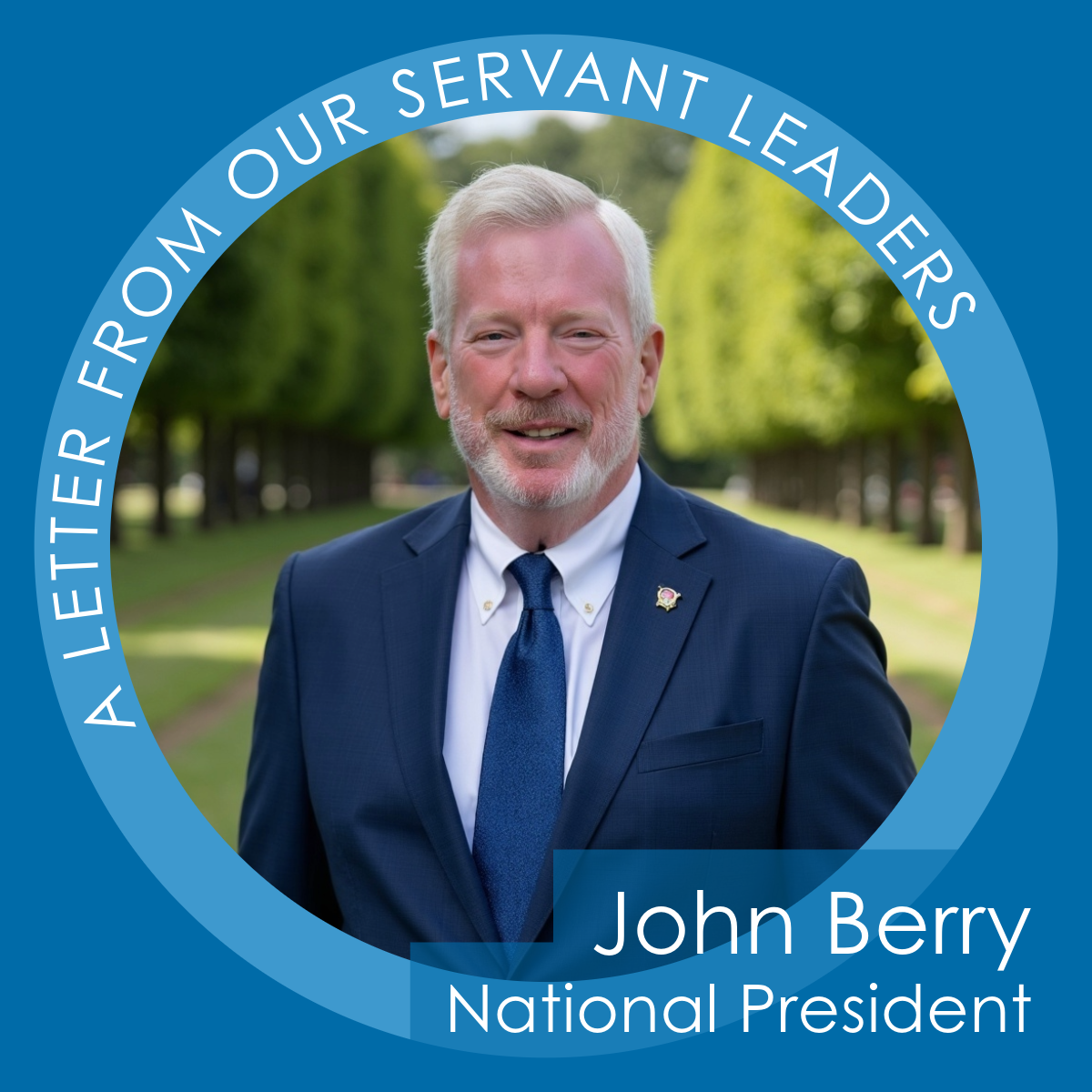
A Letter From Our Servant Leaders
| | |
“It is a ruse of the devil, by which he deceives good people, to induce them to do more than they are able, so that they end up not being able to do anything. The spirit of God urges one gently to do the good that can reasonably be done, so that it may be done perseveringly and for a long time.”
– St. Vincent de Paul
As I visit with Councils or Conferences, or attend SVdP meetings across the country, I hear about the impact that stress and burnout is having on our Vincentians. Too many cases…not enough money…not enough caseworkers. People are doing too many Encounters in a week. Encounters are becoming transactional instead of spiritual experiences. These are leading to burnout and frustration, and more importantly, they prevent us from growing spiritually in our service to people in need.
Burnout often begins with a holy desire: “I want to help. I want to sacrifice. I want to make a difference.” But the evil one twists this virtue into vice. He whispers, “If you rest, you’re selfish. If you say ‘no,’ you’re failing God.” Before long, we’re like Martha in Luke 10:40, “anxious and troubled about many things,” resentful of our own service.
How many of you have felt the subtle voice that whispers, “You could do more”? How many have looked at the endless line of need before you and thought, “If I just work a little harder, stay a little later, sacrifice a little more of myself, perhaps I can make the difference”? This voice masquerades as the call of conscience, as the voice of love itself. But Vincent warns us, this is deception dressed in the clothes of virtue.
St. Vincent called this “the devil’s ruse,” and it’s particularly insidious because it appeals to what is best in us. He takes our love for the poor, our genuine desire to serve Christ in the least of our brothers and sisters, and he whispers, “More, always more.” He convinces us that our worth is measured by our exhaustion, that true love demands we burn ourselves out completely. He makes us believe that to set any boundary, to acknowledge any limitation, is to fail in our calling.
The devil doesn’t need us to stop serving; he simply needs us to serve in a way that drains our souls. He knows that a burned-out volunteer, however well-intentioned, cannot reflect the love of Christ. When we push beyond our limits, we risk becoming like the lamp in the Parable of the Ten Virgins (Matthew 25:1-13), burning brightly for a time, but eventually sputtering out, with no oil left to sustain the flame.
Rooted in the Love of Christ.
The deepest spiritual truth Vincent reveals is this: God’s way preserves us for the long haul. The gentle spirit that allows us to do reasonable good ensures that we can do it “perseveringly and for a long time.” God is not interested in spectacular burnouts that flame bright and die quickly. God is interested in steady flames that burn consistently, giving light and warmth year after year, decade after decade.
The poor and marginalized we serve need us to be whole, not broken. They need us to serve from a place of strength, not depletion.
Why do we feel this relentless pressure to do more?
Some of it comes from the real needs around us. The poor are still hungry. The sick are still suffering. The injustices still cry out. But some of that pressure also comes from within, from pride, from perfectionism, from fear that we are not enough unless we are constantly producing, constantly giving, constantly saying “yes.”
But our identity is not rooted in our performance. It is rooted in the love of Christ.
We are not loved because we serve. We serve because we are loved.
The Lord does not ask us to save the world. That job is already taken. He asks only that you do your part, with love, and that you trust Him to fill in the rest.
Consider Jesus Himself. Did you ever notice how often Jesus rested? He withdrew to lonely places to pray. He got in a boat and went to the other side. He even slept through a storm. The Savior of the world, perfect love in the flesh, knew when to stop.
If even Jesus rested, how can we think ourselves holier for working ourselves to the bone?
St. Vincent gives us the answer: Do the good that can reasonably be done, so that it may be done perseveringly and for a long time.
A Different Type of Courage
This kind of goodness is not flashy. It doesn’t make headlines. But it is faithful. It is rooted in reality. It listens to the limitations of the body, the mind, and the heart. And it lasts. It reminds us that we are branches, not the vine. We cannot produce fruit unless we abide in the Vine, unless we rest in Christ.
So, I call you today to a different kind of courage, the courage to trust God’s gentle spirit rather than the harsh demands of false urgency. The courage to do reasonable good rather than impossible good. The courage to serve perseveringly rather than spectacularly.
It’s this courage that will allow you to trust that God’s work will continue even when you step back to breathe. Remember that the same God who calls you to serve also calls commands you to love yourself as you love your neighbor.
So, rest when you need to rest.
Say no when you need to say no.
Seek help when you need help.
If you are empty, be filled.
If you are questioning, bring your questions to the One who holds the answers.
Take time to pray, not out of duty, but out of hunger.
Take time to laugh, because joy is holy.
Take time to say no, because that too can be an act of faith.
In short, let yourself be human again.
And when you do serve, serve not as one who must fix everything, but as one who trusts God is already at work.
Remember what St. Vincent knew so well: it is better to do a little good with great love and do it for a long time, than to do too much and lose yourself (and lose the mission) in the process.
The poor will still be with us tomorrow. But so, thank God, will His mercies, new every morning.
May you be filled with that mercy today.
And may you serve from it.
Peace and God’s blessings,
John
| | |
2025 National Assembly in Louisville
Join fellow Vincentians across the country at the 2025 National Assembly in Louisville, KY, August 26 through August 30. Together we will learn about our Vincentian charism of spirituality, friendship, and service. As we prepare for this important event, the National Council is now accepting workshop submissions.
We invite you to share your expertise and insights by submitting a proposal for a workshop. Workshops are targeted at smaller audiences with high levels of interactivity and audience participation, and offer a unique opportunity to contribute to the enrichment and formation of our Vincentian community.
Workshops can cover a wide range of topics, including Membership, Governance, Formation, Spirituality, Technology, Finance, Advocacy, and more. Please submit your proposal by June 13, 2025. Learn more about submitting a high-quality proposal here, and submit your proposal here.
And Save The Date - National Assembly registration goes live on June 15, 2025! We look forward to a National Assembly with nationally-known keynote speakers, an amazing array of workshops, the Host City Event in downtown Louisville, and more.
| | |
Online Survey Coming to Your Email Inbox Soon
The National Council is conducting an online survey (available in English and Spanish) to collect updated contact information for all SVDP Conferences. This effort is intended to improve the accuracy of our internal membership records, improve future communication with Conference leadership, and create a public-facing Google map of all Conference locations to direct assistance requests to.
Regional leaders should be emailing the survey this week to all Conference Presidents, and submissions are due by July 15. Thank you in advance for helping the National Council to better serve you as our members and to serve our neighbors in need!
| | |
Guidance on Enforcement Agencies from the Society of St. Vincent de Paul USA
To: Vincentian Leaders
From: National Council of the Society of St. Vincent de Paul
Re: Guidance on Enforcement Agencies
Several members have reached out to the National Council recently requesting guidance on how to respond in the case of local or federal agents attempting to enter a Vincentian facility or access information on the people we serve. This memo addresses these questions.
The primary purpose of the Society of St. Vincent de Paul is for our members to grow in holiness through person-to-person service to people in need, “regardless” as our Rule says, “of race, creed, color, gender, sexual orientation, criminal justice status, disability, marital status, veteran status, national origin, age or physical handicap.” In the people we serve, we see the Face of Christ. This has been our charism for the past 180 years in the United States and it remains so today.
In light of our mission, we do not ask about immigration status, nor do we record that information if we happen to learn it. As our manual advises, “members should be careful to record only what is essential to serve [the neighbor].” This generally does not include immigration status. Because we do not collect this information, we cannot share it should anyone inquire as to someone’s status.
Recently, the Department of Homeland Security rescinded the 2021 Memorandum on “Guidelines for Enforcement Actions in or Near Protected Areas.” This memo had provided protections against enforcement agencies taking action in places such as schools, churches, medical facilities, and social service centers. While DHS has yet to provide new guidance that replace the 2021 Memorandum, the US Conference of Catholic Bishops has called the recission “contrary to the common good.” The Society joins with our bishops in expressing grave concern over the impact of DHS’ recission.
The Society of St. Vincent de Paul does not endorse political candidates or advocate for partisan views. We do, however, publicly address policies that concern poverty and the rights and needs of the people we serve. The Voice for the Poor raises awareness and advocates for policies that help to lift families and individuals out of poverty. Just this week, Vincentian leaders from around the country gathered in Washington to meet with our nation’s representatives. We urged them not to forget the poor and the vulnerable among us.
While we continue to advocate for the people we serve at all levels of government, it is important to develop guidelines for how the Society should respond if enforcement agencies attempt to enter our facilities. If a local or federal agent visits your Conference, Council, or Special Works facility, we recommend the following:
• Remain calm and professional. Our Vincentian charism encourages us to respect the human dignity of all.
• Know your rights and follow the law. Any agent needs a valid judicial warrant to enter non-public areas. Consider signage that designates “private area” to distinguish it from areas where any member of the public is welcome.
• Know your obligations. Comply with lawful warrants or subpoenas, and ensure you provide copies to your Council leadership.
• Protect confidential information. Maintain the confidentiality of the people we serve and do not volunteer information on their behalf. Again, comply with all warrants and subpoenas.
In our conference work, as always, information about someone served should remain confidential and details not shared via email. Remember, if a case is discussed during any meeting, the undocumented status of the person is not relevant.
• Record information on the visit. Note the name, badge number and agency of the visiting officer and ask for the purpose for the visit and their contact information.
• Alert local leadership. Inform your Conference or Council President/staff leader or Special Works Executive immediately. If you should have an encounter with an enforcement agency, it is critical that you contact your Conference or Council President or Executive Director/CEO so they can handle the matter directly or provide you guidance on how to respond.
• Alert the National Council. Contact Sherry Brown at the National Council at
sbrown@svdpusa.org or call (314) 576-3993, extension 200.
• Stay informed. Continue to follow the USCCB and your Diocesan guidelines as they relate to these issues.
Please continue to pray for all those the Society serves, especially those who may be experiencing
fear and uncertainty at this time. Our mission remains as essential as ever. We thank God for
blessing us with opportunities to put our faith in action every day.
For your reflection and contemplation, please find:
Pope St. John Paul II’s message on this issue given on World Migration Day, 1996
February 3, 2025
| | | | |
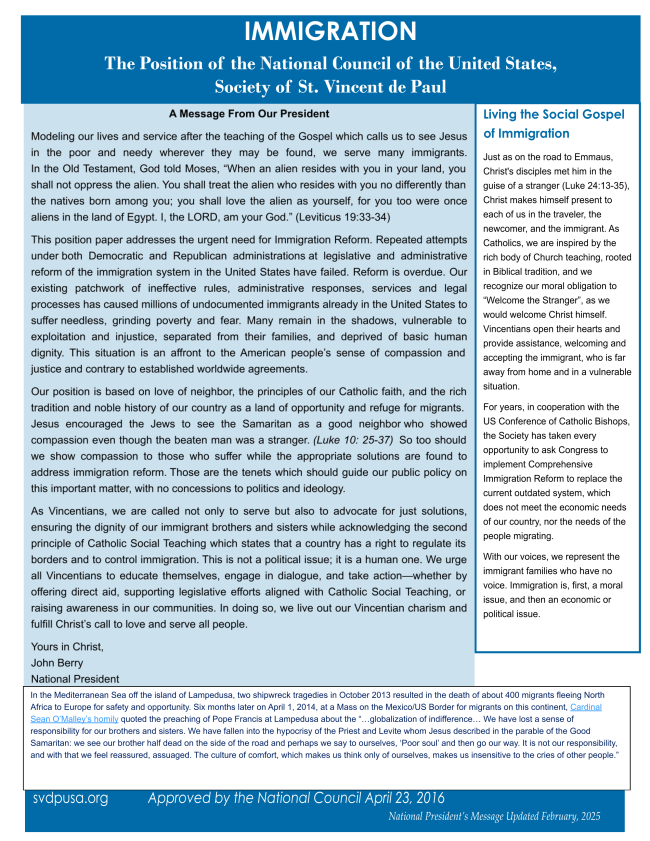
SVdP USA Supports Common Sense Immigration Reform
Modeling our lives and service after the teaching of the Gospel which calls us to see Jesus in the poor and needy wherever they may be found, we serve many immigrants. Approved by the National Council Members in 2016, our Immigration Position Paper addresses the urgent need for immigration reform. Our position is based on love of neighbor, the principles of our Catholic faith, and the rich tradition and noble history of our country as a land of opportunity and refuge for migrants.
Read the message from National President John Berry and the SVdP Immigration Position Paper here.
| | |
Contemplation: Not Our Help, but Our Hearts
It is easy to understand, in the practice of humility, that the credit for any of our good works does not go to us, but to God; as our Rule puts it, “we can achieve nothing of eternal value without His grace.” [Rule, Part I, 2.5.1] This echoes St. Augustine, who says “you do not boast of your good works as if they were your own, since it is God who works within you.” [On Grace and Free Will, 21] Whether worldly or eternal, all good comes from God.
St. Vincent, explaining how he knew that the Company of the Daughters of Charity was a holy institution, declared that there could “be no doubt whatever that it was God who established you. It wasn't [Louise de Marillac]; she didn't think of it. As for me, alas! it never occurred to me.” [CCD IX:358] Whatever good the world may credit to us is from the God who chooses to work through us. What good would boasting accomplish anyway? All worthwhile rewards come from God, not man, and after all, as Bl. Frédéric put it, “The greatest danger of all is worldly respect”. [Baunard, 297]
So, we do not boast of our achievements, but what about our failures? What about the neighbor who fell into deeper destitution despite all our efforts? What about the special works project that fell through for lack of donations, or lack of results? We do not boast of good outcomes, knowing they are the work of God, but accepting failures requires us to balance our humility with trust in Providence, which is not only trusting that He will provide what we need, but that He will know what is needed, even though it sometimes makes no sense to us.
“Without a doubt,” Frédéric once explained, “Providence does not need us to execute its merciful designs, but we, we need it”. [135, to Bailly, 1836] It is not for us to decide ourselves worthy, it is for the God who called us to decide. He doesn’t want our help, He wants our hearts, for “if He needed the help of men for the successful outcome of His plans,” St. Vincent counseled a discouraged missioner, “[He] would have put in your place a Doctor and a saint.” [CCD III:464]
We serve for love alone, not reward or credit, and so, as St. Vincent asks us, we “await the outcome patiently and hope that, if it is not as we wish, it will nevertheless be according to God's Will, which is all that we should be seeking…” [CCD VII:378] We always seek to do God’s will, and having done so, we wait, he said, “in a state of great indifference so that, whatever the outcome, it may find us well disposed to accept it.” [CCD IV:79]
Indifference in this context is not apathy, it is the purest trust, it is the hope in which we serve, and it is the unwavering faith that “The works of God are not accomplished when we wish them, but whenever it pleases Him.” [CCD III:613]
| | Formation and Spirituality | | |
New Copies of the Rule
Our newest reprint of the Rule and Regla includes all three parts in a small, pocket-sized format. It replaces both the old Pocket Rule, and the full Rule books, and is available now for purchase in English and Spanish.
Are there any changes to the text?
English: There are no changes to Part I or Part III of the Rule. There are some updates to Part II (the International Statutes).
Spanish: There is no longer an insert with previous updates. All three parts are completely updated, with a new and better translation.
Do I need to replace any copies of the Rule that I have now?
English: You should have one copy of this newest reprint for reference to Part II. However, since members primarily use Part I and III, there is no urgent need to replace old copies. Be sure you have the 2019 or newer version.
Spanish: We recommend that you begin replacing all old copies of the Rule as soon as possible.
| | |
Q: Are there any guidelines regarding reimbursement of Vincentians for attending national and regional meetings? Who is eligible, what is covered, what about spouses, and what about side events? (trips, golf, etc.)
A: If a member is designated as one who must attend a national or regional meeting, such as the National Council Member, then the Council to which the member belongs is expected to pay the expenses for the trip, hotel, normal meals, and meeting. This is only for the members (who are) expected to attend. It does not cover spouses, and it does not cover extraordinary expenses or side events unless the event is a necessary part of the gathering. If a Council or Conference chooses to sponsor anyone else to attend, or if someone wants to attend on their own, they may do so. The Council/Conference may set their own guidelines for what expenses are covered.
Q: If a Conference is going through some difficult times due to behaviors from an officer that are against the most basic and fundamental values of the Society, is it proper to involve the Spiritual Advisor? I believe we are obligated to involve our Spiritual Advisor, as I am concerned about the spiritual health of the members and the Conference. Is this proper?
A: One of the most important functions of a Spiritual Advisor is to help all of the members keep things in perspective (spiritually and in service). Yes, it would be important to include the Spiritual Advisor. Also, keep in mind that only the president is an elected position. All other officers are appointed by the president who may remove them from office if they are not fulfilling their roles properly and appoint someone else. The Rule, Part III, Statute 12 states: “All officers named by the president serve at the pleasure of the president.” This indicates the ability of the president to remove an officer and appoint someone in his/her place.
Submit your questions to Pam Hudson Johnson at phudson@svdpusa.org
| |
Contemplation: Jesus' Inclusive Table
Eucharistic Solidarity
Dr. Yolanda Pierce expresses her call to welcome those who come to the communion table:
There is no more sacred ritual I perform within the church context than serving communion. It is a duty I do not take lightly. I relish the opportunity to preside over the table and invite others into a moment of remembrance and reflection. Whether in the most modest of sanctuaries or in the grandest of buildings, standing before the people with unleavened bread and a cup of wine (or grape juice, as in my own tradition) is a humbling act….
When I stand behind the table, calling the gathered community to remembrance, I call forth all their sacred memories: those connected to the biblical text and those that emerge from their own lives. In that divine moment and in this one, I take seriously the exhortation in 2 Peter 1:13: “As long as I live in the tent of this body,” I will call the people to remembrance….
We do this in remembrance of the Holy One, who was and is and is to come…. In remembrance of the warriors for justice, the table turners, and the freedom riders. Those prophets who stood outside the gates of the city and declared the Word of the Lord. Those poets who penned indictments against inhumanity and degradation.
In remembrance of those who have experienced justice delayed and justice denied. Those whose sadness has yet to turn to joy, and those whose weeping has endured for more than one night…. We are all welcome at this table, whether with visible wounds or unblemished flesh, in the radical belief that only God’s justice quenches our thirst, heals our spirits, and renews our hearts.
Theologian M. Shawn Copeland describes how the Eucharist calls us to solidarity with those who suffer:
Eucharist is the heart of Christian community. We know in our bodies that eating the bread and drinking the wine involve something much deeper and far more extensive than consuming elements of the ritual meal…. We [all] strive to become what we have received and to do what we are being made….
Eucharistic solidarity orients us to the cross of the lynched Jesus of Nazareth, where we grasp the enormity of suffering, affliction, and oppression as well as apprehend our complicity in the suffering, affliction, and oppression of others.… Eucharistic solidarity teaches us to imagine, to hope for, and to create new possibilities. Because that solidarity enfolds us, rather than dismiss “others,” we act in love; rather than refuse “others,” we respond in acts of self-sacrifice—committing ourselves to the long labor of creation, to the enfleshment of freedom….
At the table that Jesus prepares, all may assemble: In his body we are made anew, a community of faith—the living and the dead. In our presence, the Son of Man gathers up the remnants of our memories, the broken fragments of our histories, [and] judges, blesses, and transforms them. His Eucharistic banquet re-orders us, re-members us, restores us, and makes us one.
Richard Rohr
Center for Action and Contemplation
Thursday, June 5, 2025
| | |
"God’s peculiar hope is reliable ground for not allowing the fears of the present to define or overpower us."
Walter Brueggemann
We have this hope, a sure and steadfast anchor of the soul, a hope that enters the inner shrine behind the curtain.
Hebrews 6:19
As we give thanks for the life and witness of Walter Brueggemann, anchor us—like he taught—in your peculiar and steadfast hope that enters beyond every fear.
| | | | |