|
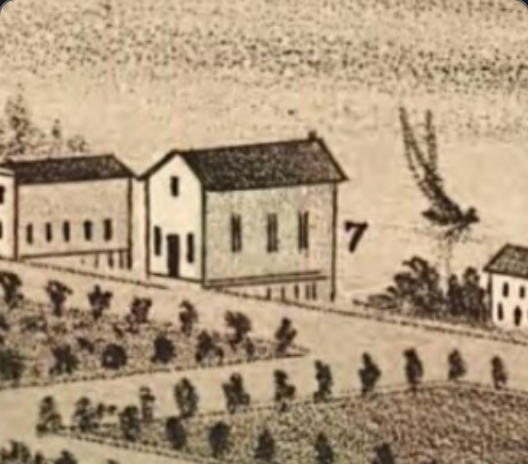
“With the establishment of the Town Square (Sylvester Park) by Edmund Sylvester, the social and religious center of town moved towards the streets adjacent to the square. The Unitarian Church was kitty-corner to the square along Main Street (Capitol Way), next door to the home of Thomas I. McKenny, a Civil War general who later became Indian agent for Washington Territory . . . . At the time, this part of Main Street ran along a rising bluff adjacent to the Deschutes Estuary, so that the back of the church and house were on the water.”
Reportedly costing just $3,000, it was described in various press articles on one hand as a “very neat, cosy little structure” (yes “cosy” was spelled this way) and a “substantial building” on the other, promising to “be the finest structure of the kind in Olympia.
Rev. Utter was debt averse. He did not want to dedicate the building until the debt was paid off. So, it was not dedicated until November 1877, the ceremony for which was reported in the Washington Standard.
“DEDICATION. – The dedication of the ‘Church of the Unity,’ occurred last Sunday, at 11 o’clock. The edifice was neatly decorated with evergreens and flowers, and with the tasty ornamentation observed in its construction, presented a truly elegant appearance. The dedication sermon was preached by the pastor, Mr. Utter, and the services consisted of an organ voluntary by Prof. Roberts, singing of hymns, (several of which were composed for the occasion), responsive reading, a song by the Sunday School, an address by Rev. Mr. Galvin and the benediction. The evening services were a continuation of the dedicatory work. Mr. Galvin led the services and Mr. Daniels read an interesting account of the formation and subsequent history of the First Unitarian Society of Washington Territory. The building is one of the finest religious edifices in the place, and the Society is free from debt.”
In a letter published in the Olympia Tribune in 1892, Rev. Utter recounted how the congregation came to the decision to build the structure. After noting that “our little Unitarian church was continually losing families and individuals of its best supporters during its early years,” “[n]evertheless we went forward, gathering in others to take the places of those who left, and undismayed we undertook to build a church.?” He continued:
“At a meeting to consider whether to proceed with the construction, the proposed resolution stated: “Resolved, that we will build a Unitarian hall if we can.” But Rev. Utter continued: “Our worthy and witty hostess seeing that a resolution with an ‘if’ in it was no resolution at all, instantly said: ‘I now move that we resolve that we can building a Unitarian hall if we will,’ and this, too, was carried with applause and laughter and we dispensed in good spirits, notwithstanding we had taken up a heavy burden. The church was built; the minister was the architect, drew the working plans and was general superintendent; obtained the subscriptions and collected them; was paymaster and sometimes carpenter, especially after the money gave out.”
But fewer than six years after the dedication of the building, tragedy hit. On September 13, 1883, around 1:30 a.m., a fire broke out in the office of the Surveyor General, on Main Street, next door to the church. Before water could be obtained to fight the blaze, the Survey General’s building was “wrapped in flames.” By 2:00 a.m., the fire had spread to the Unitarian Church, and it too was “consumed.” It was valued at about $5,000, and, unfortunately, the church had no fire insurance.
It would be almost ten years before the Olympia Unitarian Society would build another church.
Next, on December 10, Part V: Rev. Napolean Hoagland, Minister
|