|
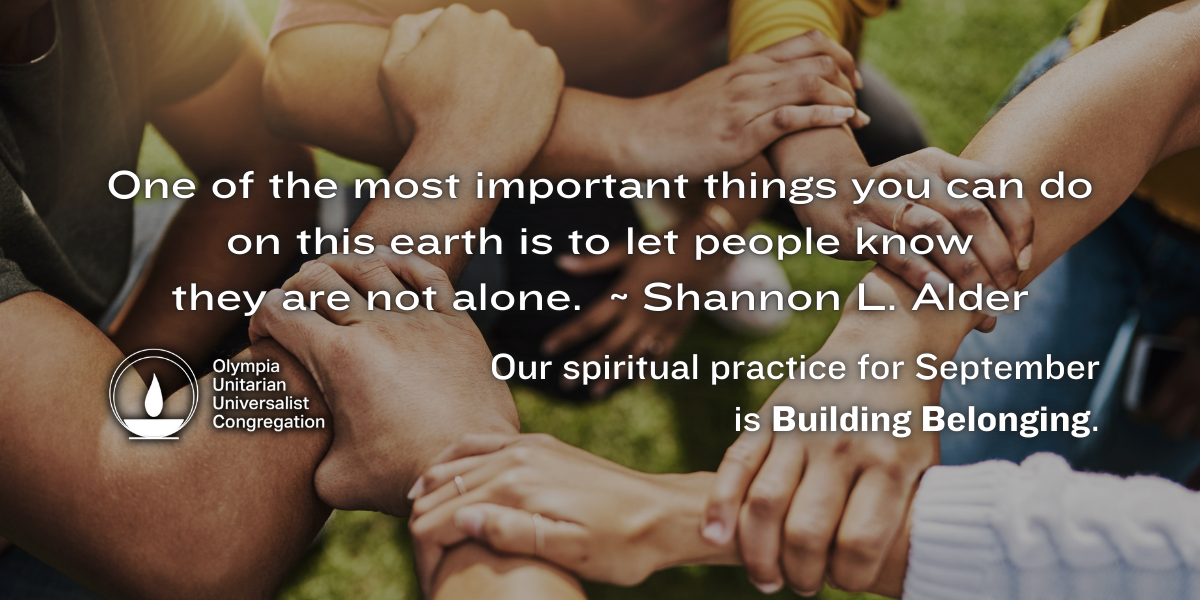
Our spiritual theme for the month of September has been Building Belonging, and we’ve explored this theme in worship, small group discussions, and children’s education programs. Another way we’ve practiced this month was with the Skillbuilder forum that I offered last Sunday, about how to create a covenant for a small group.
Covenants are central to our tradition as we are bound together not through common belief but through common values and practice. A covenant takes the agreed upon values and puts them into action form as agreements we can live into. We have layers of covenants at play. Article II is the covenant between congregations within the UUA bylaws. So all of us who are part of the congregations that form the UUA are part of that covenant and shared values. This describes how we belong together.
OUUC also has a covenant, created and voted upon by our members. And so all members of OUUC are part of this covenant, and this is another way to make explicit how we belong together.
And then small groups or even just two people can make a covenant between themselves. The OUUC staff as a whole have a covenant, and then Rev Mary and I also have a covenant we’ve made between the two of us. The children’s classes create a covenant, and many of our teams and small groups also make a covenant. These are all ways to build healthy belonging in these smaller relationship dynamics.
If you haven’t created a covenant for your group, or if you would like to take this practice into other intentional relationships of belonging in your life, you can watch the recording of the Skillbuilder here.
There are three pillars I recommend you begin with before you jump to making “rules” or “promises”:
- What are our shared values? What matters to this group or relationship? And I always through safety or health into that mix, just in case it gets left out. So Values and Safety are the first pillar to build.
- How does power and privilege show up in this group or relationship? What power imbalances are present and how would you like to address them in intentional ways?
- What needs are present in this group or relationship and how can more inclusion and access be created?
These questions may not be simple to answer, and creating a covenant isn’t a quick process if it is done right. But truly getting to your authentic and explicit answers to those three areas of relationship will do so much to build belonging and are well worth the time spent.
So please join in the practice of building belonging with us. Even if you aren’t creating an explicit covenant, talk to each other about our shared values. Talk about how power and privilege show up in our relationships with one another. Talk about how people have different needs and how we can work together to create inclusion and access and accommodation that works to meet those needs.
Let us build this deep belonging, together.
In faith,
Rev. Sara
|