Hey WRAP Community, The Pandemic Has Shown Us The System MUST Change Now
By WRAP and Molly Beckhardt Many will not remember this, but before the early 1980s, there weren't millions of homeless people in the United States. Far too many lived in poverty, but people were not forced to live in the streets. The advent of contemporary homelessness is well documented. It was created by a federal government response to what was, at the time, considered a short-term economic crisis: a recession exacerbated by federal affordable housing cuts. 
In 1983, the Reagan administration tasked the Federal Emergency Management Agency (FEMA) with directing a national solution to the rising number of people without homes. FEMA's response was to do what FEMA has always done in an emergency: create thousands of short-term, temporary shelters across the country. This approach not only failed to address the cause of homelessness but also pathologized homelessness as an individual shortcoming. It became increasingly apparent that the phenomenon of homelessness was not tied to market fluctuation but was predicated on massive, system-wide federal cuts to affordable housing programs at both The Department of Housing and Urban Development (HUD) and The United States Department of Agriculture (USDA). The federal government doubled down on hiding the structural cause of the crisis and in 1987 started funding what thirty-three years later we know today as "Homeless Programs." Homelessness quickly grew to epidemic proportions and was cemented into the American landscape. In 1987, the Reagan administration passed the McKinney-Vento Homeless Assistance Act, taking FEMA's crisis-based emergency response out of the equation and transferring authority over homelessness administration to HUD. With this handoff, HUD ironically became the dominant funding source for local communities to ostensibly address the homelessness created by HUD cuts in the first place. However, since HUD was originally gutted in 1980, the agency has not restored nearly enough funding to make even a dent in our nation’s housing crisis. As recently as a few months ago, Ben Carson reiterated his firm belief in homelessness as a local issue, devolving responsibility to cities and states, much like Trump's response to the COVID-19 crisis. 

Summary of WRAP Member Groups’ Responses to Covid-19 Pandemic
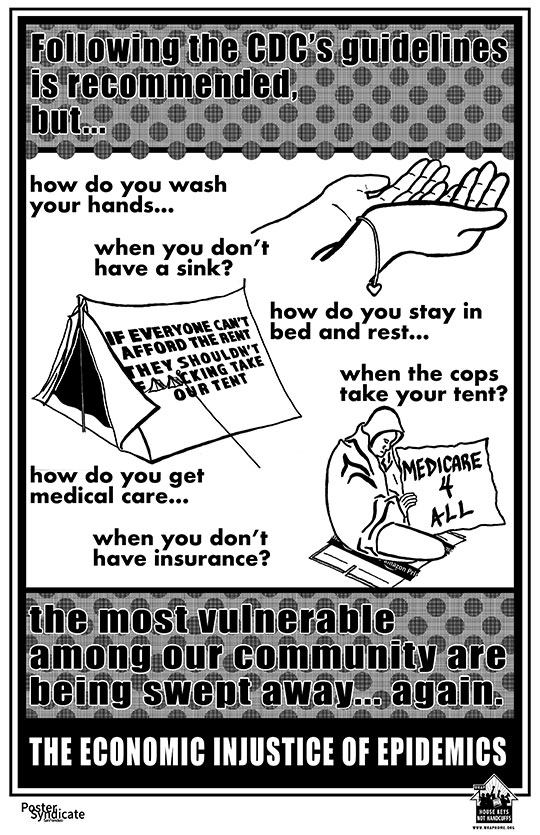
The neoliberal, profit-focused policies that have been the go-to in this country for 37 years are now deadlier than ever. The Covid-19 pandemic exposes for all to see the truths that WRAP and WRAP member groups have been working to expose for years: that housing, criminal justice, social safety net, healthcare, and other systems are fundamentally not set up to support poor and homeless people. Our demands, goals, and organizing work for Sleep Not Sweeps, House Keys Not Handcuffs leading up to this moment could not be more relevant.
WRAP and WRAP members are using this moment to push for an end to criminalization and housing for all. In the near-absence of charity and government support during Covid-19, our members have shifted to more of a mutual-aid-for-survival model than before. Providing mutual aid also serves as a crucial organizing tool, allowing our groups to keep a close pulse on the streets, share up-to-date information, utilize artwork in communications, and organize more and more people into our movement. Here is a summary of what is happening with WRAP member groups:
Motion Filed Today for Hearing in Case for Housing | Denver, CO.
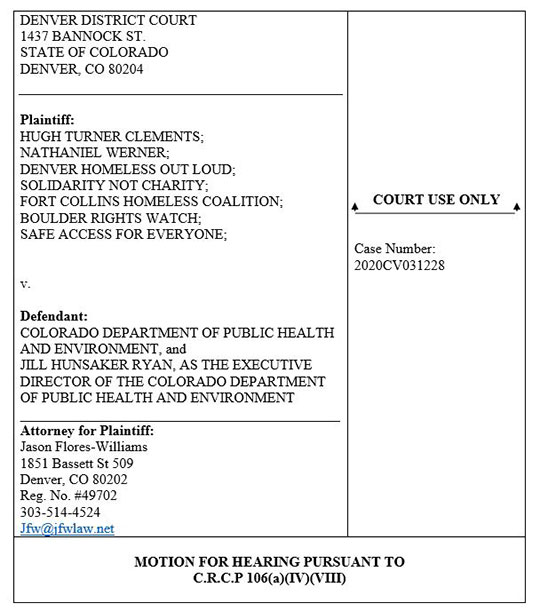 On April 1st 2020 we filed a Writ of Mandamus to mandate Colorado Dep’t of Public Health do their job and open housing for people who are houseless.
Some Colorado motel owners have offered housing for homeless people in response to this emergency, but local authorities have prevented them from making it available. At the same time, cities like Denver that are trying like mad to get hotel’s to take in houseless residents and hotels are refusing.
SF City Hall was ahead of the curve in its coronavirus response. So why is it now failing the homeless? 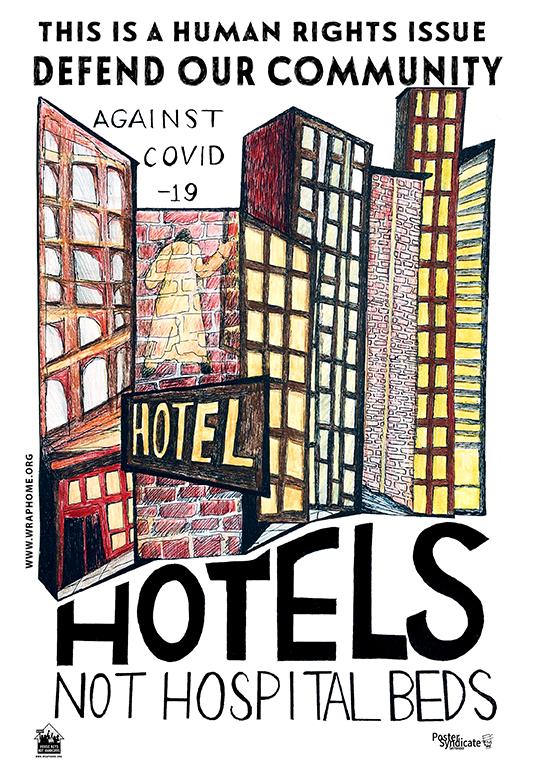
"Joseph Wilson is ticked off."
The executive director of Hospitality House, a homeless shelter in the Tenderloin, just wants City Hall to treat the 25 men who live there the same way it's treating the rest of San Francisco's residents during the scary COVID-19 pandemic.
He wants clear directions. Quick decisions. A real plan.
City Hall has come up with that for everybody else, likely saving lives and rightly earning acclaim around the country. But it’s not offering a coherent vision when it comes to homeless people.
"It's frustrating," Wilson said. "It's maddeningly slow, and ultimately it's putting more people at risk."
He said he asked the Department of Homelessness and Supportive Housing for digital thermometers for a month before getting them. City officials told him to keep his residents six feet apart, but also not kick anybody out - an impossibility in his tiny, packed shelter.

No Easy Fixes as Covid-19 Hits Homeless Shelters 
From the White House: a very different approach
Closing big shelters, however, is not the direction that federal authorities are pushing. The Federal Covid-19 Homelessness Workgroup, a White House task force assigned to coordinate the specific coronavirus response on homelessness, has given guidance to a network of faith-based shelters on how to resist evacuation orders — a memo that faith-based shelters are interpreting as assurance that they don’t have to comply with local orders to evacuate homeless people to hotel rooms. Robert Marbut Jr., who is the newly appointed White House czar on homelessness, heads up this group. As the director of the U.S. Interagency Council on Homelessness, he oversees initiatives for crisis housing across 19 different federal agencies. For the task force on coronavirus and homelessness, he has assembled a panel that includes the Citygate Network, a Christian ministry that links some 300 shelters across 45 states and the District of Columbia. Also on board the coronavirus task force: the Salvation Army and the American Red Cross. 
Ilhan Omar unveils bill to cancel rent and mortgage payments amid pandemic 
The Minnesota congresswoman Ilhan Omar has unveiled a bill that would cancel rent and mortgage payments for millions of Americans struggling amid the coronavirus pandemic.
Under the legislation announced on Friday, landlords and mortgage holders would be able to have losses covered by the federal government. The program would extend for a month beyond the end of the national emergency, which was declared on 13 March, and would be made retroactive to cover April payments. The proposal comes amid an unprecedented housing crisis: 31% of Americans in rental accommodation could not pay rent at the beginning of this month. Millions have lost their jobs since. 
City of Marysville, Yuba County to pay hundreds of thousands of dollars in compensation for destroying personal property belonging to homeless residents 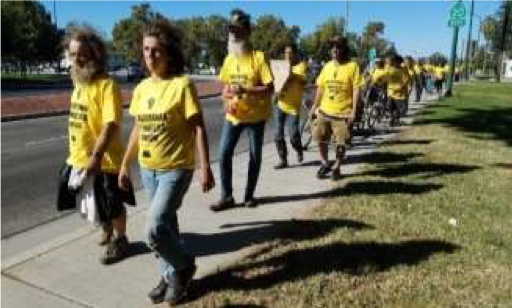
A federal class action lawsuit initiated by the California Homeless Union against the City of Marysville and Yuba County seeking damages for the destruction of thousands of items of personal property has been tentatively settled for $330,000.00.
Marysville Homeless March to City Hall. The lawsuit, Butcher et al. v. City of Marysville, Yuba County, et al., Case No. 2:18-cv-02765, was originally filed in October, 2018 on the initiative of the Marysville/Yuba County local of the California Homeless Union. Local union officers and named plaintiffs including Brigitte Raelynn Butcher, Stan Extein, Sue Extein, Michael Elliot and Crystal Motley, along with dozens of other homeless union members, led the unprecedented effort which included gathering scores of signed, sworn declarations of the homeless and a march by Homeless Union members to City Hall where officials were served with the original summons and complaint. 
REAGANS WET DREAM, COVID 19 Video 


|