Here’s a word you can work into the conversation at your next dinner party: taphonomy. That’s the study of how things decompose. After an organism dies, the remains undergo many changes that depend on things like temperature, moisture, insect and scavenger activity, and more. Forensic scientists have to understand how bodies change over time.
But first, they have to be able to find the bodies.
The Pinellas County Sheriff’s Office (PCSO) Forensic Sciences Division has created its own version of a body farm in an empty lot near its headquarters. An actual body farm uses donated human bodies exposed to varying conditions so scientists can understand the process of decomposition. Here, they use plastic, anatomically correct skeletons buried deep to give Forensic Specialists a chance to practice the delicate, painstaking process of recovering and processing human remains from a crime scene.
Oh yeah, and there’s a pig too. More on that later.
A grassy field off of 49th Street holds a grisly secret. That’s where Dr. Meredith Tise hides her bodies. She’s not a serial killer, but rather the PCSO Forensic Quality Assurance Coordinator. She has a background in forensic anthropology, making her the perfect instructor for the PCSO’s Recovery of Human Remains class.
This comprehensive three-day class teaches students about human osteology (the study of the skeleton), how to distinguish between human and non-human remains, how to recover human remains in both burials and surface scatters, and mapping techniques.
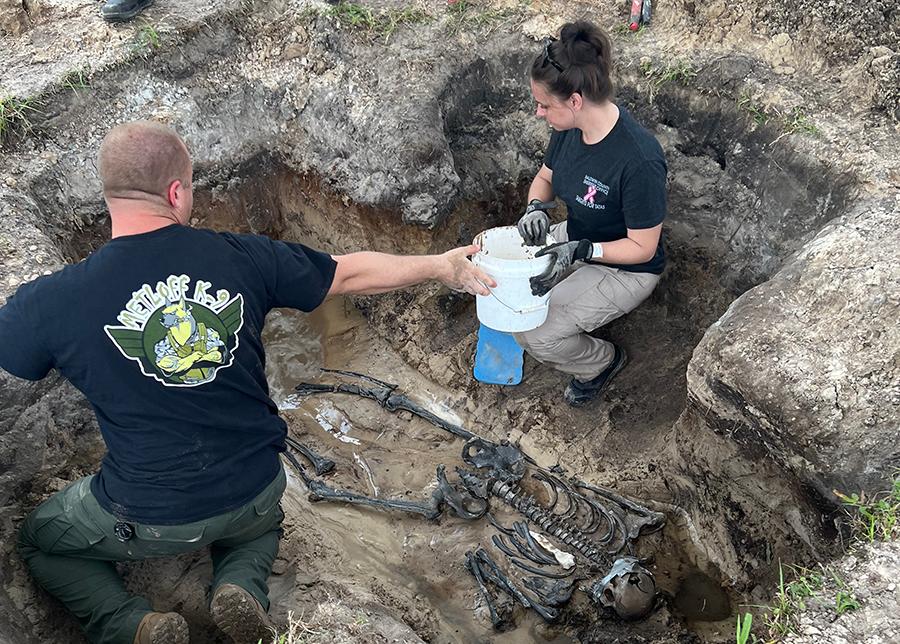
A few years ago Dr. Tise buried two accurate human skeleton reproductions, along with the sort of evidence that forensic scientists might find at a crime scene: duct tape, zip ties, bullet casings, or weapons. Now, when Forensic Specialists at the PCSO and other agencies need to know how to recover a buried body, they can get plenty of practice.
The first step is locating the body, which may be in a shallow grave or six feet under. Surface clues like depressions in the soil or different color vegetation might give a hint, and cadaver dogs can sometimes find a corpse. Most of the time, though, investigators need more to pinpoint the body’s location. That may come from a confession or a tip – maybe they get information that a body is buried in a certain field. Rather than dig up the whole area, they can use ground penetrating radar (GPR) to pinpoint the human remains.
GPR is a device that rolls across the surface and sends radio waves into the soil. It can detect objects underground, as well as hollow spaces and changes in the substrate.
Once the GPR indicates there may be something buried underground, Forensic Specialists have to use old fashioned muscle and sweat to dig down to the object. Sometimes excavation equipment can be used, but working by hand makes it less likely that evidence will be lost or damaged.
At the last class, students from the PCSO as well as the Sarasota, Osceola, and Baldwin County (Alabama) sheriff’s offices got down and very dirty to dig up two training skeletons. They even faced a common problem in Florida – they hit water, complicating the recovery. Remains had to be respectfully removed from the grave, with every bone accounted for. Students used mesh screens to sift through all the dirt surrounding the body. They can’t leave a single tiny toe or finger bone behind… or even an artificial fingernail that might have evidence underneath.
After the Forensic Specialists remove everything they can find, they use a metal detector to look for metallic evidence like weapons and ammunition, or personal effects such as coins. They’ll dig beneath the body until they reach undisturbed soil, which they can identify by its different color or composition.
Every location has to be properly mapped, and every piece of evidence has to be accounted for. It is a meticulous process, because the entire case could depend on one tiny clue hiding in the dirt.
“This class provides realistic training to forensic professionals to be prepared for the recovery of human remains, whether buried, burned, or scattered on the surface,” Dr. Tise says. “We start out in the classroom, but there is no replacement for actually getting dirty and completing a recovery one step at a time.”
The Forensic Specialists in the class were muddy and sweaty, but they never lost focus. “It is imperative to complete the recovery of human remains diligently and sequentially so as to maintain the integrity of all evidence recovered, including the body,” Dr. Tise said.
Now, back to that pig.
Pigs are often used as human analogues in training about decomposition and recovery of evidence. Their body mass and organs are similar to ours, and they present fewer logistical and ethical considerations than human cadavers.
Earlier this year, Dr. Tise buried a pig in a shallow grave. Right now you can see the depression in the ground as well as different vegetation over the area where the remains lie. In the fall a group of Forensic Specialists will search for and dig up the pig remains, processing the evidence as if it was human.
Stay tuned to Inside the Star later this year to find out what they will uncover!