|
The Price Increases You're Afraid to Make
Every owner I work with has a number in their head. It's the price they know they should be charging — and the price they are actually charging. The gap between those two numbers is rarely small, and it is almost never talked about out loud.
I once met with the leadership team of a $40 million manufacturer that was certain its core product line was underpriced by 8–10%. They knew it not because a consultant told them, but because competitors were quoting higher and still winning the work. Customers had even said, unprompted, that they expected to pay more. Yet the company had not raised the price in three years.
That's not a pricing problem. That's a fear problem. And it's one of the most expensive kinds of fear an owner can have.
Why Smart Owners Freeze on Price
If underpricing is this common and this costly, why doesn't everyone just fix it? Raising prices triggers a very specific kind of anxiety that has nothing to do with spreadsheets and everything to do with identity and risk.
The math is simple. The nerve is not.
Three fears show up over and over, and they're worth naming because naming them is the first step to getting past them.
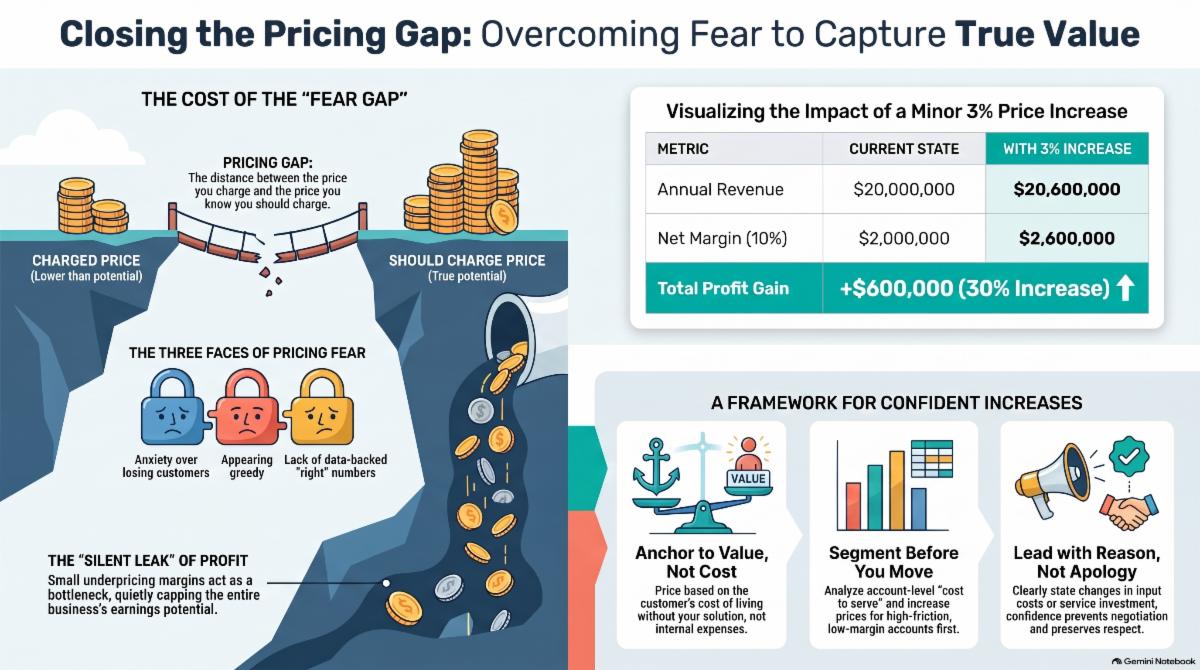
The first is the fear of losing the customer. It is the loudest fear and the least examined. Owners imagine the phone call where the customer says "we're moving on" — and they stop the thought experiment right there, before asking what actually happens next. They don't run the math on what that customer is worth after the increase versus before it. They don't ask whether losing a low-margin, high-friction account might be a net win. They just flinch and hold the price.
The second is the fear of being seen as greedy. It is more personal. Many owners built their business on a reputation for being fair, for taking care of people, for not being "that guy." Raising prices feels like betraying that identity, even when costs have gone up 15% and the price hasn't moved at all. Fair and cheap are not the same thing, but it can feel that way when you're the one who has to make the call.
The third is the fear of not knowing what "right" actually is. It is the quietest fear but often the most paralyzing. Most owners have never done a rigorous value-versus-cost-to-serve analysis. They're pricing off of gut feel, last year's number plus a little, or "what we've always charged." Without a real anchor, any price increase feels arbitrary — and arbitrary is scary to defend, even to yourself.
Notice what's missing from all three fears - data. These are emotional reactions to a decision that should be evidence-based.
The Real Cost of Standing Still
Here's the part that doesn't get enough airtime: not raising the price is also a decision, and it has a cost. It just doesn't show up as a single dramatic event. It shows up as a slow leak.
Take a $20 million company running a 10% net margin. That's $2 million in profit. If that company is underpriced by just 3% across the board — a number well inside what most companies actually leave on the table — that's $600,000 in gross revenue quietly walking out the door every single year. On a fixed cost base, nearly all of that drops straight to the bottom line. That's not a rounding error. That's the difference between a mediocre year and a great one, year after year, compounding as the business grows.
The owner who avoids the uncomfortable conversation with a customer is choosing, by default, a much larger and more permanent loss. The irony is that the imagined pain — the one phone call, the one hard conversation — is tiny compared to the real pain, which is invisible, ongoing, and silent.
This is the same logic that applies to identifying a bottleneck in a production line. The constraint you don't see clearly is the one quietly capping everything downstream of it. Underpricing is a profit constraint. It caps what the rest of the business can produce in earnings, no matter how well everything else runs.
A Framework for Making the Call with Confidence
The fix isn't "charge more and hope." Fear shrinks when you replace gut feel with a process. Here's the sequence I walk owners through.
Start with value delivered, not cost incurred. Most pricing conversations start in the wrong place — with internal costs. Flip it. What does this product or service actually do for the customer? What would it cost them to solve the problem another way, or to live without solving it at all? Price anchored to value gives you a real ceiling to work toward, not just a floor to defend.
Then calculate true cost to serve, by account, not by product line average. This is where the fear problem often turns out to be a data problem. When you actually break down service cost — order handling, customization, expedites, returns, support load — by specific customer, a clear pattern emerges. Some accounts are comfortably profitable at current pricing. Others are being served at a loss and have been for years. You cannot make a smart pricing decision on an average. You need the account-level truth.
Segment before you raise. Not every customer gets the same conversation or the same increase. Your highest-value, lowest-cost-to-serve accounts may not need a large increase at all — protecting that relationship matters more than squeezing a percentage point. Your highest-cost, most-demanding accounts may need a much larger increase, or a service model change, or in some ca
ses, a respectful exit. Applying the same approach to every customer is a pricing mistake. It also makes increases feel more frightening than they are, because you start imagining the toughest conversation happening with every account, when only a few actually warrant that level of difficulty.
Lead with the reason, not the apology. When the increase is communicated, the tone matters as much as the number. Owners who apologize their way into a price increase invite pushback, because they've signaled the number is negotiable and maybe unfair. Owners who state plainly what's changed — input costs, service investment, market repositioning — and hold the line tend to keep the account and the respect that comes with confidence. Customers can smell uncertainty, and they will push exactly as hard as they sense they can.
Test before you roll out company-wide. You don't need to solve this in one bold move across the entire customer base. Pick a segment — new customers, a product line up for renewal, a group of accounts you've already identified as underpriced — and test the increase there first. Watch what actually happens to retention and margin, not what you feared would happen. Real data from your own customer base is the fastest way to dissolve the fear, because it replaces imagination with fact.
The Question Worth Asking This Week
If you have a number in your head — the price you know you should be charging, versus the one you're actually charging — that gap is not a mystery to be avoided. It's a diagnostic to be run.
Pull the cost-to-serve data on your five largest accounts. Look at what each one actually costs you to keep happy versus what they pay you. You may find the fear was protecting a handful of relationships that were never as fragile, or as profitable, as you assumed.
The increase you're afraid to make is very often smaller, safer, and more overdue than it feels. The only way to know for certain is to stop guessing and start measuring.
Question for You to Ponder
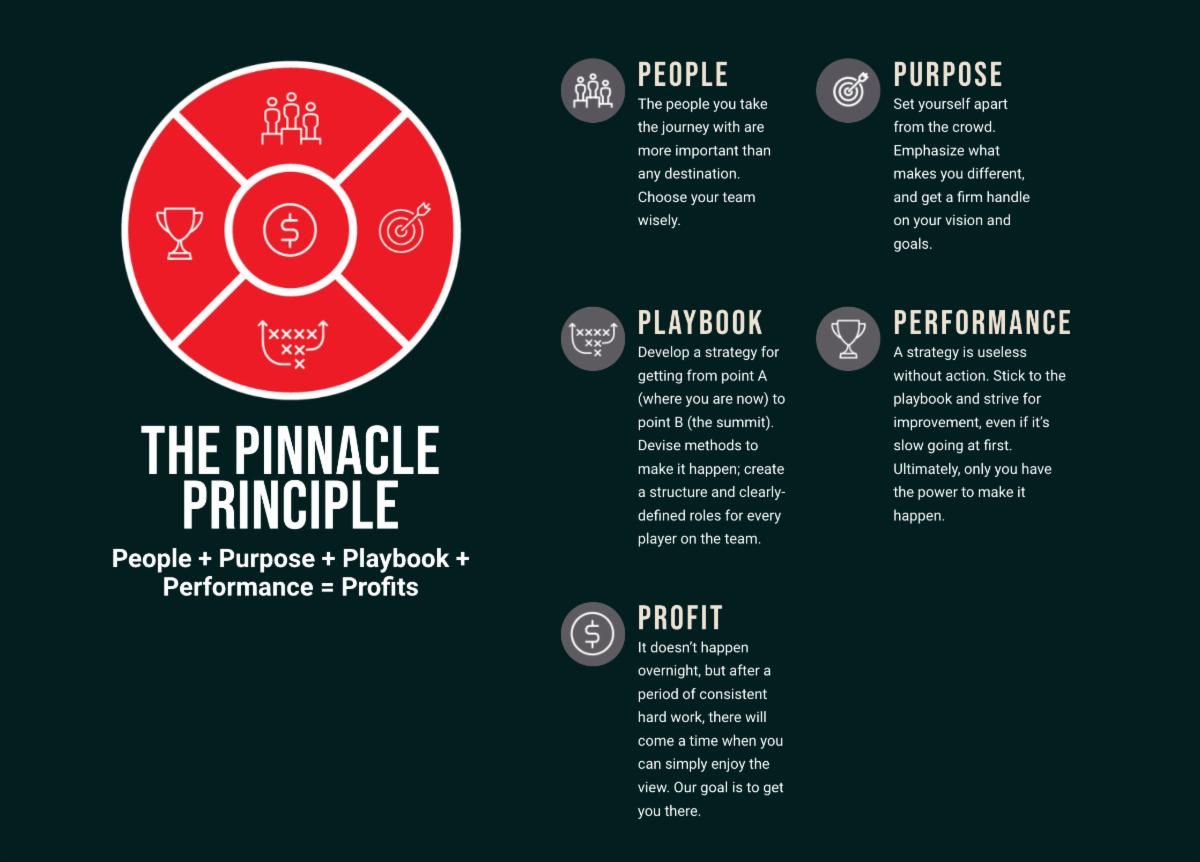
Are you ready to lead your business to its Pinnacle?
Outcome (if you act)
More valuable company, higher profit, and a better quality of life.
Call to Action
-
Ask me for a copy of the Path to Pinnacle
- Schedule a Meeting with Me
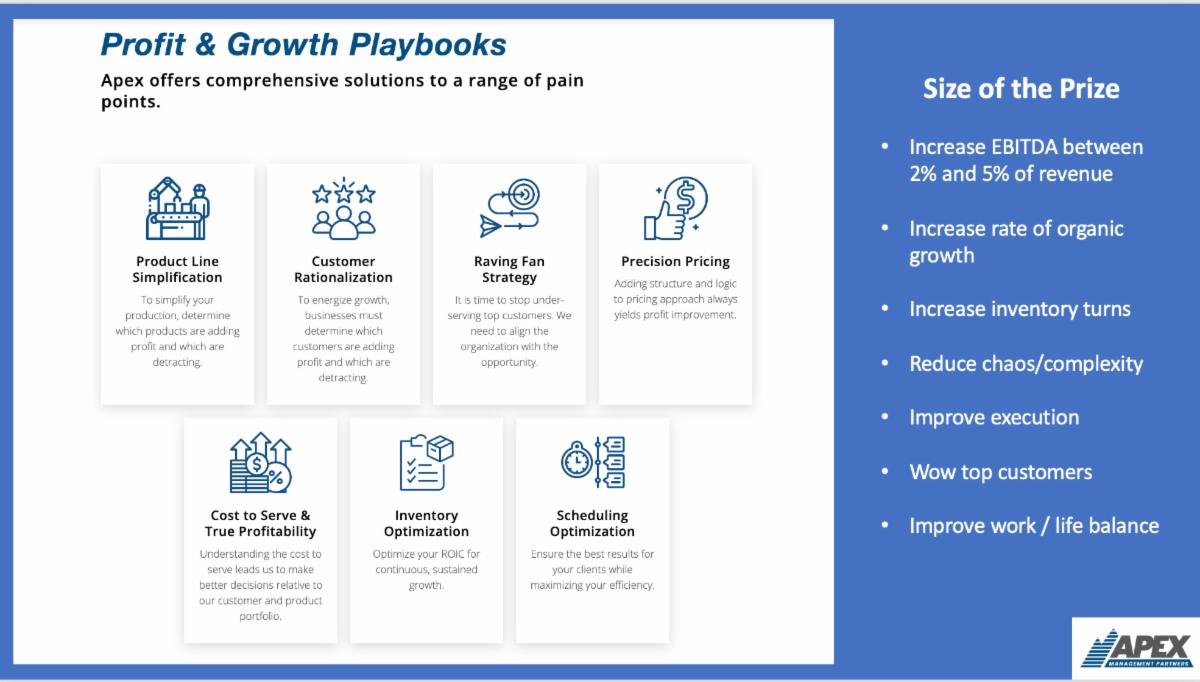
Our Mission: Accelerate Profitable Growth and Improve Execution
|