You are receiving this newsletter because you are enrolled in the WECA Food Program. | |
August 2025
Stay connected: Check out our current staff directory here.
| | Your Monthly News & Updates | | |
Food Program Anniversaries in August
5 years: Amanda Engstrom
10 years: Kari McCorkle
15 years: Michelle Koconis-Hinrichs
30 Years: Bonnie Wing
We applaud your commitment to serving nutritious meals and snacks to the children in your care!
| | |
Welcome to Our New Providers!
Toni, Alexandria, Santana, Sade, Devlin, Randy, Uniquia, and Alvernea in Milwaukee
Jordan in Iron River
We welcome you and applaud this mark of professionalism!
| | |
Child Care Bridge Payments
The Child Care Bridge Payments (CCBP) are direct, monthly provider payments. The program is similar to Child Care Counts, with the same application, eligibility, and overall structure. Providers must continue to update their staff and child care records on a monthly basis by logging into the Child Care Provider Portal and uploading required documents. Once approved for payments, eligible providers may continue to receive ongoing monthly payments through June 2026.
Note important dates below for the upcoming counts period:
- Count Weeks: July 13–July 26, 2025
- Application Period: July 26–Aug. 3, 2025; All providers must submit a new initial application and upload verification documents (child and staff records)
- Payment Letter Date: Aug. 15, 2025
- Spending Deadline: Dec. 13, 2025
| | |
Ask the Food Program
Question:
I keep getting “199 Over capacity” statements on my Claim Summaries. What does this mean?
Answer:
Congratulations on reviewing your Claim Summary information!
This is an important step to take to:
- Understand how your Food Program claim was processed
- Double check your claim was paid properly and if the Food Program made an error in processing, to request an adjustment
- Minimize future deductions
There are several reasons a provider could receive deductions related to capacity:
-
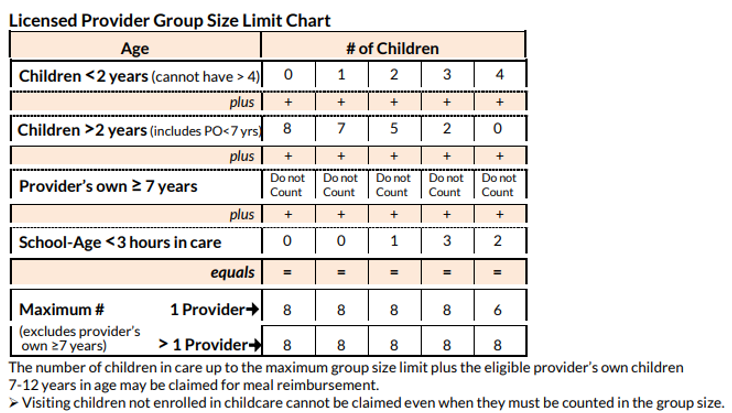
The provider may be over their capacity or their age ratios. Consult the Licensed and Certified Group Size Limit Charts below. Providers may not exceed either their overall group size OR violate the age ratios for their regulation type. Some providers may have legitimate confusion about age ratios, believing that if they are licensed, they can care for 8 children regardless of their age. If you are unsure whether you fully understand your capacity and age regulations, reach out to your regulator for help.
| |
-
A licensed provider may be working with a helper to meet capacity or age ratios, but without informing the Food Program that a second provider was on site. If you are such a provider, notify the Food Program using this form.
- Example: A licensed provider working alone can provide care for 4 children under the age of 2. With a properly qualified helper, the providers working together can care for a total of 8 children under 2.
-
A licensed provider may have a 5-year-old child in care, who is enrolled in full-day school and in care for 3 or less hours per day. Is that true for you? Use this form to let the Food Program know.
| |
- Either a certified or licensed provider may have a group of children present during the school day, who leave care in the afternoon and are replaced by after school or evening care children.
-
Example: It may be that the provider never exceeds either capacity or age ratios, but when entering the claim information, the number of children claimed appears to exceed the total group size. The Food Program must disallow the meals/snacks in that claim month for the children who exceed the overall group size or age ratios for the type of regulation on file for that provider. This is seen quite frequently at P.M. snack time.
Sometimes this can be remedied if providers claim Breakfast, A.M. snack and Lunch for the daytime group of children, and P.M. snack, Dinner and Evening snack for the later-attending children – if children are present during that meal/snack service and offered each of those meals and snacks.
| |
|
Food Program Open Office Hours
Have Food Program questions? We’re ready with answers! We recently launched office hours to help you with your CACFP-focused questions! Each virtual session has a topic for discussion, which is followed by an open forum for any questions you have. Held the first and second Wednesday of the month from 1-2 p.m. on Microsoft Teams, which is a platform similar to Zoom. Virtual meeting details are below!
Office Hours Offered in English
Second Wednesday of every month | 1-2 p.m.
Meeting ID: 266 968 289 946 6
Passcode: Kg3x4MJ6
Dial in by phone
+1 715-598-9883,,702555838# United States, Eau Claire
Phone conference ID: 702 555 838#
| |
Office Hours with Spanish Interpretation
First Wednesday of every month | 1-2 p.m.
Registration is not required, and this link will stay the same every month.
Meeting ID: 234 627 533 377 6
Passcode: wJ75Di2D
Dial in by phone
+1 715-598-9883,,592087910# United States, Eau Claire
Phone conference ID: 592 087 910#
| | | | |
Recipes to Try!
-
Instead of commercial pizza with a CN label or Product Formulation Statement, try this recipe for Anytime Pizza from MyPlate.
-
Looking for a savory dip for those fresh, seasonal vegetables? Try this Bean Dip from MyPlate.
| | |
Nut Butter
Only peanut butter and other nut/seed butters are creditable on the Food Program. Products labeled spread, such as peanut butter spread, Nutella spread, etc., are not creditable. Always read product labels carefully to ensure you serve nut butter.
| |
Documenting a Child’s Special Diet
A Special Diet Form is required whenever a child in your care can’t be fed according to CACFP guidelines.
Documents to Complete for Disability Related Special Dietary Needs Requests: “A physical or mental impairment that substantially limits one or more ‘major life activities’ including caring for oneself, performing manual tasks, eating, breathing, digestive, bowel and bladder, neurological, respiratory, circulatory, and endocrine functions.”
-
Special Dietary Needs Tracking Form Section 1: Disability (for Providers to Complete)
-
Medical Statement (For Licensed Health Care Professionals to Complete: Physician, Physician Assistant, Nurse Practitioner (APNP), Dentist, Registered Dietician, Optometrist, or Podiatrist)
Documents to Complete for Non-Disability Special Dietary Needs Requests: i.e., for preference, including religious or ethnic preferences, or lifestyle reasons.
-
Special Dietary Needs Tracking Form Section II: Non-disability Special Dietary Need (SDN) Request (For Providers to Complete)
-
SPECIAL DIET FORM (For Providers to Complete)
YOU MUST REPORT EVERY SPECIAL DIET required for a child, whether it’s due to a disability or preference. It does not matter whether the meals are reimbursable or not.
Work with parents/guardians to obtain the required documentation so appropriate and safe meals can be served to the child.
NOTE: Meal and snacks served to a child with a Special Diet between the dates the Special Diet is discovered by the Food Program until it is approved by the Food Program (if it can be*) may be disallowed. Remember: NOT EVERY SPECIAL DIET CAN BE REIMBURSED.
| |
Home Canned Foods
Home canned foods are not allowed for service in CACFP for health and safety reasons. Fresh, commercially canned, dehydrated, commercially frozen, or home-frozen produce is allowed.
| |
Foods On-Hand and Manufacturer’s Packaging
- During Home Visits, Area Coordinators verify food served to children in care meets CACFP requirements. Coordinators look in the refrigerator, in the freezer, and in the pantry to check for foods on hand, including whole grain-rich sources, iron-fortified infant formula and infant foods, proper fat content of dairy milk, and sugar content of yogurt and cereal.
- To do that, the foods offered must be kept in the original manufacturer’s packaging and cannot be decanted from that packaging to alternative storage such as plastic storage bags, storage bins, or glass bottles. This includes foods or beverages provided by parents, such as iron-fortified infant formula per a Parent Provider Formula Agreement (but does not include breast milk).
- Per guidance from DPI, when providers are found not to have foods on-hand from their reviewed menus during Home Visits, and there are repeated occurrences of that issue on subsequent Home Visits, the consequences for each occurrence will escalate. If unaddressed by the provider, this will result in disallowance of meals and snacks, either back to the first of the prior month or to the date of the previous Home Visit. This eventually can result in the provider being made Seriously Deficient.
| | |
Claim Summaries: Tier Expiration and Update
Every income eligibility determination expired on June 30, 2025.
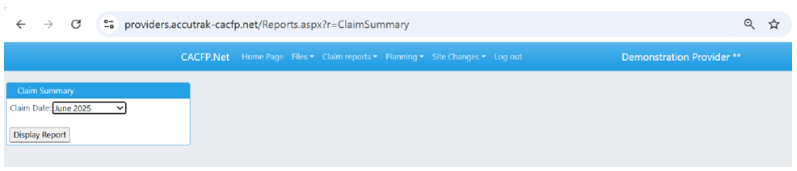
Review your July and subsequent Claim Summaries for the current information about how your claim was paid. How? In CACFP.Net, select Claim Report and find the Claim Summary for the month you wish to review in the dropdown menu:
| | |
Tier 1 Eligibility for Children Enrolled in Head Start
Children in Head Start who also are enrolled in a Tier 2 family child care home are eligible for higher Tier 1 reimbursement when served eligible meals in child care.
- A copy of the current approved Head Start application from the child’s family or a statement of enrollment in Head Start must be on file at the Food Program office.
- Current documentation must be received for each fiscal year. The provider may assist in providing this documentation to WECA.
- Siblings or other children in the child’s household are not automatically eligible for Tier 1 rates.
- A provider is not automatically eligible for Tier 1 reimbursement because the provider’s own child is enrolled in Head Start.
- Children who are officially categorized as Homeless, Runaway or Migrant children may also qualify for Tier 1 reimbursement.
| |
Offer Water Throughout the Day
You are required to offer water to children throughout the day. Water can be self-serve, or you can make water available in a variety of ways including:
- Providing cups beside your sink
- Setting out pitchers of water and cups
- Giving water upon request
- Serving water at snack when no other beverage is served
- Offering water in a training cut or bottle for toddlers and infants
Water must be available during a meal or snack, but remember:
- Water does not replace milk
- Water is not part of a reimbursable meal
- Water is not listed on the drop-down menu in CACFP.Net and is not recorded on daily menus
Take care not to serve too much water before and during mealtimes, so kids have an appetite for the required foods and beverages.
| | |
This institution is an equal opportunity provider.
The Provider Connection is published by the WECA Food Program.
Any Questions: Call 608-240-9880 or visit our website.
| | | | |