You are receiving this newsletter because you are enrolled in the WECA Food Program. | |
March 2026
Stay connected: Check out our current staff directory here.
| | Your Monthly News & Updates | | |
Food Program Anniversaries in March
5 years: Laura Konetchy, Aundriell Dodd
10 years: Michelle Davies, Maria Vidal, Shawn Peckham, Heidi Duran
15 years: Gayle Willms
20 Years: Diane Nemec
We applaud your commitment to serving nutritious meals and snacks to the children in your care!
| | |
Ask the Food Program
Question:
I am getting capacity errors on my claim. I am a licensed provider with an assistant. Why is this occurring?
Answer:
Thank you for that question!
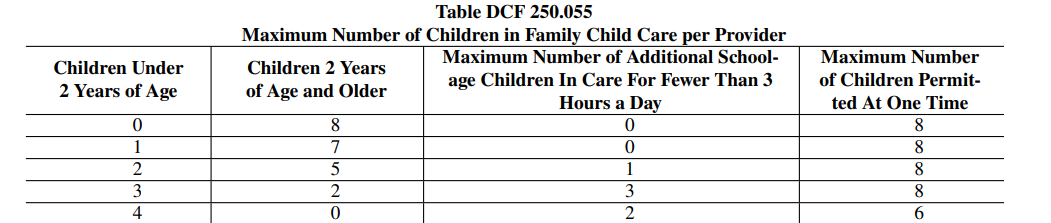
Below is the Capacity Table for Licensed family child care providers.
| | |
(Source: https://docs.legis.wisconsin.gov/code/admin_code/dcf/201_252/250.pdf )
Your question stated you have a Statement for Providers with Assistants on file. Note that this form is only for Licensed providers.
Near the end of the fiscal year last year on Sept. 10, 2025, the Food Program purged the database of Helper information, emailed all providers who had been listed as having a Helper statement, and requested that a new document be submitted. If you have not responded to that email, you may mistakenly believe that information still is in the database for you.
Note that having an assistant does not increase the overall capacity of the child care home. Use of an assistant affects the age ratios that would normally be in effect but does not increase the total group size. Total group size for a licensed child care home is eight children.
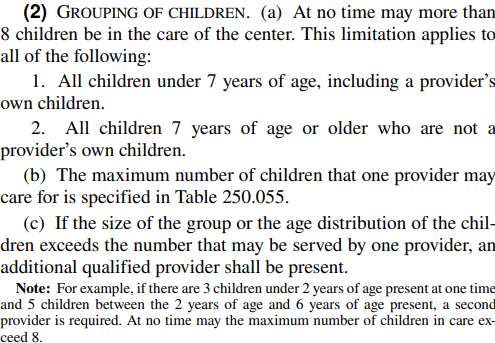
As shown below, a provider’s own children aged 7 or older do not count in the total group size.
| |
If you have already verified that you have a current Statement for Providers with Assistants on file, and have verified you are within the total capacity of eight, not including your own children who may be present and eating with the other children in care (and whose meals or snacks may be reimbursed if your household meets the Income Eligibility requirements), you may have “shifts” of children that you are trying to record at a meal or snack time that make it appear during claims processing that you are over capacity. For example, if day “shift” children are served and recorded at p.m. snack, leave the center and are replaced by after school children, who also are served and recorded for p.m. snack, you may be trying to claim and be paid for more than eight children’s snacks. The Food Program must disallow the snacks served that exceed the total capacity of eight.
From time to time, people may either misunderstand their capacity/age ratios or flout the regulations. For providers that do not take their capacity and age ratios with appropriate seriousness, note that the Monitoring Guide for Wisconsin’s Licensed Child Care Programs lists capacity violations as Serious Violations. If you need assistance understanding licensed capacity or age ratios, contact your Licensor.
| (Source: Monitoring Guide for Wisconsin’s Licensed Child Care Programs https://dcf.wisconsin.gov/files/publications/pdf/5279.pdf) | | |
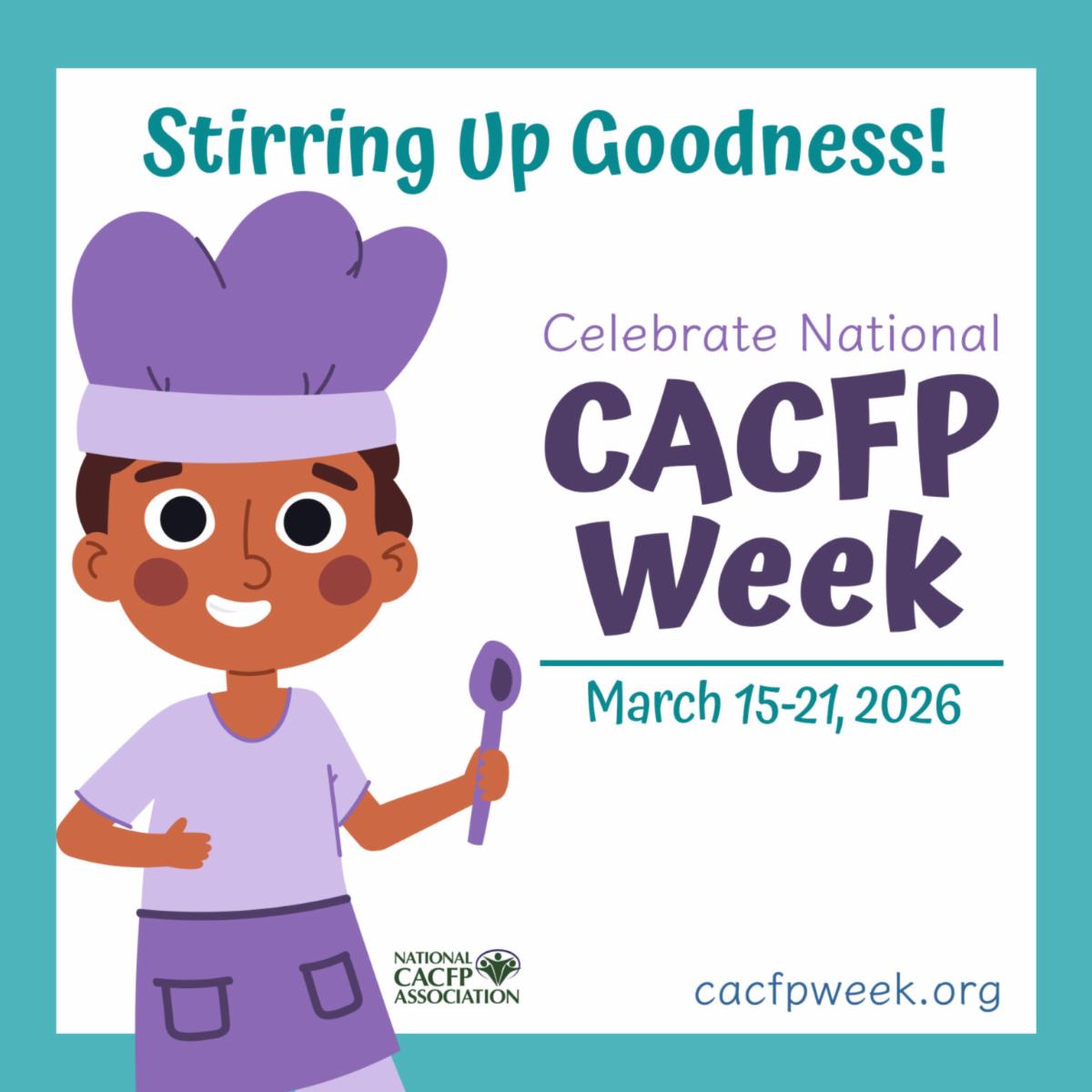
National CACFP Week March 15-21: Stirring Up Goodness
Get ready to celebrate National CACFP Week with us! It’s a national education and information campaign sponsored annually the third week of March by the National CACFP Sponsors Association. The campaign is designed to raise awareness of how the USDA’s CACFP works to combat hunger. CACFP brings healthy foods to tables across the country for children in child care centers, homes, and afterschool programs, as well as adults in day care.
Submit your images to foodprogram@wisconsinearlychildhood.org on or before March 10 to be entered in a drawing! Complete waivers if your pictures contain images of children in child care and submit the completed waivers with your photo.
Note: Enter only once. Your input may be featured on social media and in other WECA electronic or print media.
| |
Celebrating the Impact of WECA’s REWARD Program
As WECA approaches the 25th anniversary of the REWARD Wisconsin Stipend Program later this year, we want to hear from you: How has the program, which provides direct payments to child care professionals to boost wages, helped you in your work and personal life? REWARD recipients, we want to work alongside you to share the impact of this important program and the role it has played in early educator compensation in Wisconsin. Haven’t heard about REWARD? Discover why thousands of early childhood educators count on the program at the link for more information!
| | |
Compensation for child care providers has been a longstanding challenge in Wisconsin and across the nation, but it is one that programs like REWARD help address – because early educators need and deserve wages that match the importance of their work.
“We cannot expect teachers to go into this work with enthusiasm when they are not receiving the right amount of salary.”
That might sound like a quote from 2026, but it actually was shared more than 100 years ago by an association of child cares in New York state. This kind of historical context is part of the research and resources shared by the Center for the Study of Child Care Employment, a California-based organization dedicated to national-level study of challenges affecting the early care and education workforce. Partners like CSCCE are important as we all work to lift up the importance of compensation – because when providers are supported, children, families, and entire communities benefit.
| |
Recipe(s) to Try!
The 2025 Student Chef Competition, a contest for teams of middle and high school students in Wisconsin, is the source for this recipe. Find the recipe on page 24 of the Whipping Up Wellness 2025 Cookbook.
CACFP crediting information for this recipe is not available.
| |
Juice Reminder
Only 100% fruit or vegetable juice is creditable on the Food Program. Choose your juice from the list of foods in the drop-down menu in CACFP.Net so the program can track how many times you serve juice each day. Juice may be served once per calendar day to children 1 year and older.
A creditable juice product will state Juice: Full-strength juice; single-strength juice; 100% juice; and reconstituted juice; juice from concentrate; or juice concentrate. Items named cocktail, beverage, or drink are not 100% juice and are not creditable.
Juice is not creditable for infants.
| |
Homemade Combination Foods
Whenever you serve one of your own recipes that combines two or more foods, be sure to enter each component on your menus. We don’t know your recipes! Be sure the appropriate serving size (by age) for each component is being served to each child.
Keep copies of your recipes for homemade combination foods in your Food Program binder for review by your Area Coordinator during Home Visits.
| |
Milk on the CACFP
Dairy milk of the proper fat content per age of child is the required beverage at mealtimes for children aged 1-12 on CACFP.
| | |
(Source: CACFP Meal Pattern https://dpi.wi.gov/sites/default/files/imce/community-nutrition/pdf/cacfp_child_meal_pattern.pdf )
Documents for a Special Diet – either Disability Related or Non Disability-Related – must be submitted to the Food Program and approved to allow reimbursement of meals or snacks that substitute another “milk,” such as a plant-derived milk like soymilk, for dairy milk.
Documents:
Medical Statement – used to document a Disability Related Special Dietary Need. This form must be completed by a licensed health care professional. See the listed healthcare workers whose credentials are recognized by Wisconsin DPI as having the authority to sign this document on the Food Program website under Forms and Resources:
Special Diet Form – used to document a Non Disability-Related Special Diet, such as for a family’s vegetarian diet adherence.
The types of non-dairy milk that can be approved using the Special Diet Form must be nutritionally equivalent to dairy milk. All currently approved non-dairy beverages can be found here:
NOTE: “Beverages that do not meet nutritional standards include almond, cashew, coconut, hemp, oat, and rice milk, water, juice, sports and electrolyte drinks, and nutritional supplement drinks, etc.” The use of those beverages in replacement for dairy milk of the proper fat content per age can ONLY be authorized by a valid Medical Statement for a Disability Related Special Dietary Need, submitted to the Food Program and approved. Without approved documentation, meals – and snacks when the non-creditable beverage is one of the two required snack components – served to children receiving any of those beverages must be disallowed.
(Source: Creditable Non-Dairy Beverages: Fluid Milk Substitute)
| | |
When Child Enrollments are Incomplete or Inaccurate
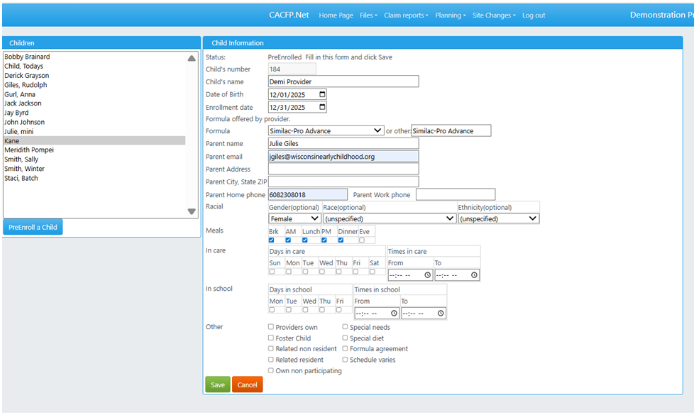
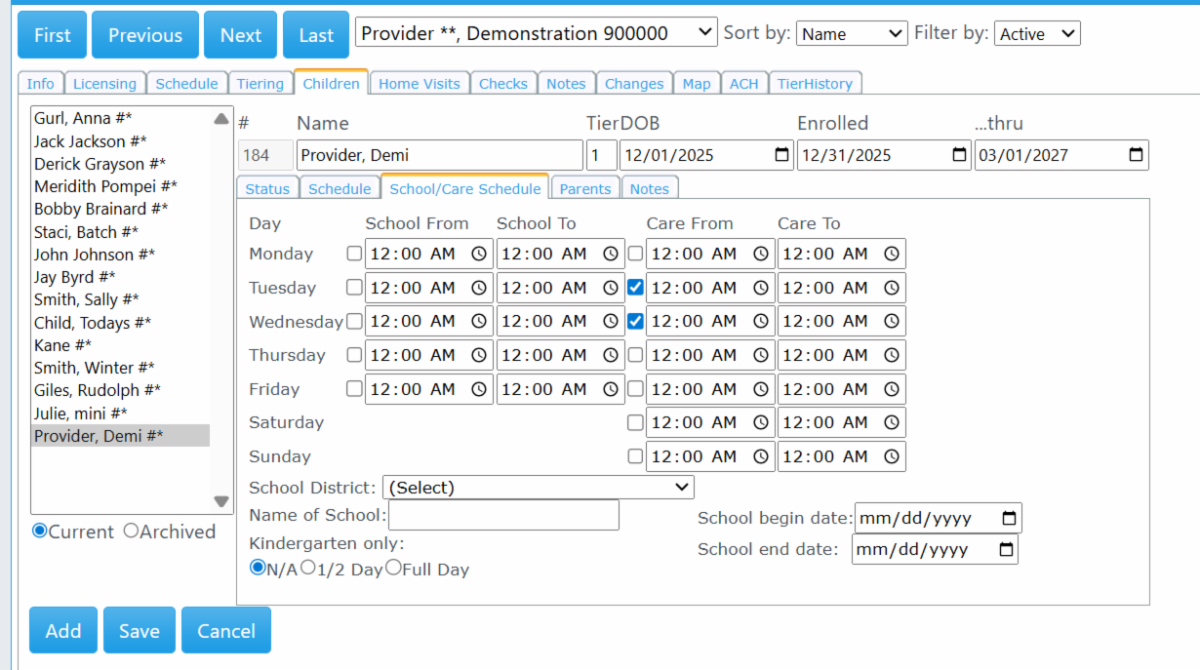
When providers or parents fail to complete Child Enrollment Forms accurately, a variety of issues may occur. Here is a recent pre-enrollment for a child added in CACFP.Net in the Demonstration Provider account. If the provider fails to fill in the basic information for the child, as shown below, what comes over to the parent to complete requires them to fill in any information that was made required when the form was engineered.
| |
Parents do not know how to accurately complete the form.
- They may not know what Special Information should be selected, such as Formula Agreement, which would apply to this child.
- They would not know what meals or snacks will be offered and served to their child.
Food Program recommends all meals and snacks for which the provider was approved are selected at enrollment.
- They may not know to select Schedule May Vary, which the Food Program recommends be checked.
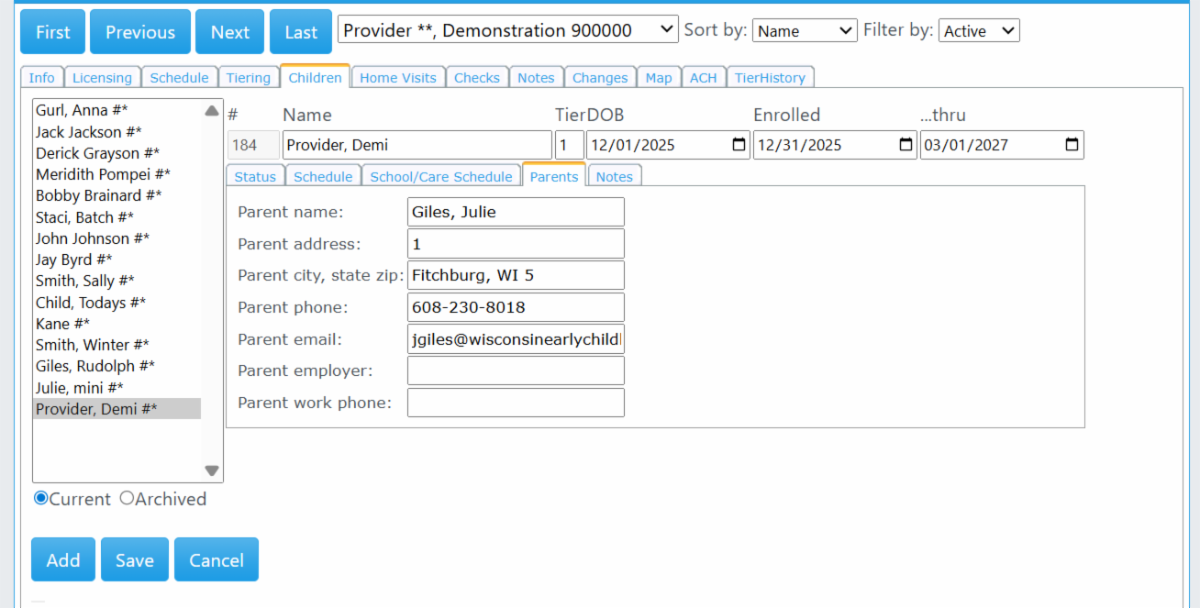
Providers failing to complete the Pre-enrollment for new children accurately greatly increase the likelihood that poor quality information will pull into the database from the Child Enrollment Form, which may result in issues or disallowances during claims processing. The Pre-enrollment for this sample child pulled in as shown:
| |
- Be complete and accurate when you are Pre-enrolling a child. Fill in each of the forms’ fields and double check your work.
-
Verify that the information the parent provides is complete and accurate. If it isn’t, mark the change on your copy of the Child Enrollment Form, have the parent sign and date the change, and submit the updates to foodprogram@wisconsinearlychildhood.org
| |
|
Food Program Open Office Hours
Have Food Program questions? We’re ready with answers! We recently launched office hours to help you with your CACFP-focused questions! Each virtual session has a topic for discussion, which is followed by an open forum for any questions you have. Held the first and second Wednesday of the month from 1-2 p.m. on Microsoft Teams, which is a platform similar to Zoom. Virtual meeting details are below!
Office Hours Offered in English
Second Wednesday of every month | 1-2 p.m.
Meeting ID: 266 968 289 946 6
Passcode: Kg3x4MJ6
Dial in by phone
+1 715-598-9883,,702555838# United States, Eau Claire
Phone conference ID: 702 555 838#
| |
Office Hours with Spanish Interpretation
First Wednesday of every month | 1-2 p.m.
Registration is not required, and this link will stay the same every month.
Meeting ID: 234 627 533 377 6
Passcode: wJ75Di2D
Dial in by phone
+1 715-598-9883,,592087910# United States, Eau Claire
Phone conference ID: 592 087 910#
| | | | |
Integrity on the CACFP: Are You at Risk?
The Food Program’s Area Coordinators are tasked with monitoring providers’ adherence to the rules of CACFP during Home Visits. Home Visits require a variety of verification to determine whether a provider is upholding the rules of participation and whether meals and snacks served and foods on hand meet requirements.
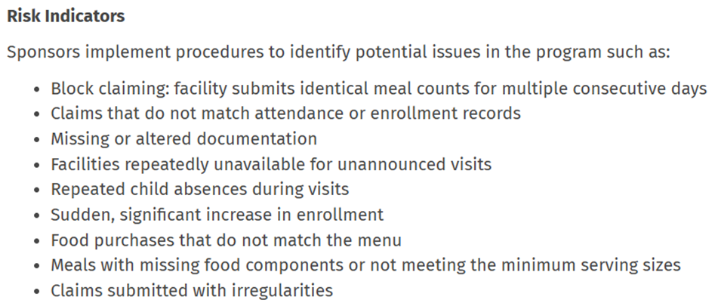
Below is a summary of Risk Indicators from National CACFP that identify integrity issues that Food Program sponsors must be watching for:
| |
Source: Program Integrity in the CACFP: Role of Sponsoring Organizations from the National CACFP Association
The success of the CACFP depends on the careful work of the Food Program, and it depends on the intentional participation of providers to meet the standards and uphold the responsibilities of participation. Your conscientious participation helps ensure your success – and that of the CACFP.
| |
Is Your Contact Information Correct?
To keep you informed, the Food Program needs your correct contact information.
Changed your email? Notify us here.
Name, address or phone number changes? Notify us here.
If your name or address has changed, you MUST submit a copy of your new Certification of License. Email it to foodprogram@wisconsinearlychildhood.org.
WECA may send you updates about the Food Program through email and/or text message or voicemail – another reason to ensure your contact information is always up to date.
| | |
This institution is an equal opportunity provider.
The Provider Connection is published by the WECA Food Program.
Any Questions: Call 608-240-9880 or visit our website.
| | | | |