|
Making an appearance that evening as a “guest shark” was comic actor and entrepreneur Kevin Hart, who coincidentally is one of three people Manuel Godoy has said he most admires for their savvy in marketing, managing, and continuing to own their intellectual property (IP)—the others being filmmakers Tyler Perry and George Lucas. As Godoy had anticipated since learning only two weeks prior of Hart’s appearance, the comic was very interested in what he had to pitch.
Offers and counteroffers ensued; the Godoys walked away with a tentative deal in which Hart and fellow shark Mark Cuban would receive an equity stake in Black Sands Entertainment. In return, Hart’s Hartbeat media company would offer its considerable resources to help Black Sands expand its portfolio of offerings, grow their distribution, and possibly move into film, television, and video game production.
Parting Partners
But the partnership was not to be. Negotiations ultimately ended with Manuel Godoy recently telling Birmingham Christian Family Magazine, “It just wasn’t for us. There’s a lot of red tape with celebrities. . . It had to be either-or, and we had to go with what we already knew.”
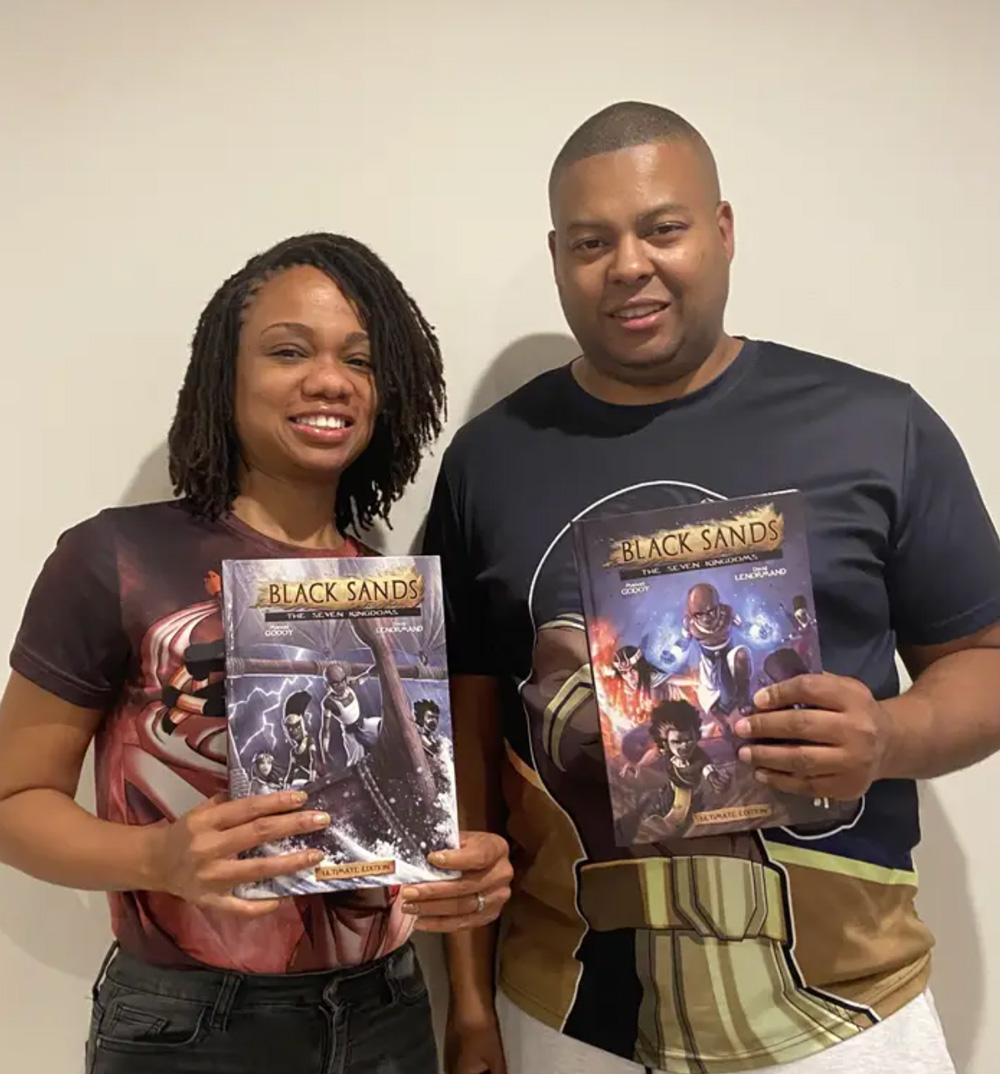
What Manuel Godoy knew was that there was an audience for what they he had to offer, an audience he had been cultivating since 2017 when he began selling his original comic book, “Black Sands,” from a kiosk at a shopping mall in Alabama. It’s an audience Manuel and Geiszel considered themselves to be part of: African Americans looking for works of historic fiction that feature Black characters but don’t involve slavery or the civil rights movement. Works that parents of pre-teens, like the Godoys, would be happy to have their children read.
“Black Sands” is set in ancient Egypt, which according to history buff Manuel’s research, was populated by far more Black people than has been depicted in the Eurocentric creations experienced by generations of moviegoers. The comic follows the adventures of a young Black boy, Ausur, who wants to prove to his grandfather that he has what it takes to become pharaoh.
In a February 2022 appearance on “The Breakfast Club” radio show (105.1 FM in NYC) and podcast, the Godoys explained how Manuel’s original ambition was to create a “Black Sands” video game. “We had burned through $20K when I came to the conclusion that the final production would cost so much more,” said Manuel. “So, I was like, ’Let’s pivot. Let’s make a comic book off of the same series.’ Then we went to Kickstarter and raised $20,000 off of a $4,000 Kickstarter. The rest was history after that.”
In 2017 Manuel opened a kiosk in a mall in Hoover, Alabama, to sell the original “Black Sands” comic book. He sold $6,000 worth there; during the same period, he sold $45,000 online at Shopify. Clearly, online merchandizing was the way to go. It was also where Manuel could leverage his social media savvy to build a fan base.
Online Options
As he told “The Breakfast Club,“ “I’m a monster when it comes to social media platforms and advertising. If you see my stuff once and hit the Like button, the Facebook gods are going to hunt you down for the rest of your life until you follow me. . . Online is like everything I do. Online you know who your audience is and you can start laser focusing on them with your marketing strategy.”
As CEO of a company he created, Manuel Godoy is plainly proud of the independence he continues to enjoy. (Geiszel is CFO.) He has used online platforms, principally Patreon, to raise capital from small investors to sustain and grow Black Sands Entertainment. As of June 2023, the website wefunder.com reported Black Sands Entertainment had raised $2,159,771 from 5,126 investors. In 2021, the company did more than $2 million in sales continuing to issue titles under the Black Sands brand, featuring Black characters in historical settings before the advent of European colonialism. A departure from that formula are titles written by Geiszel called “Mori’s Family Adventures“ and “Ineola.”
Milestone Missteps
As Manuel explained to “The Breakfast Club” audience, he hoped to avoid the pitfalls experienced by Milestone, an earlier Black-owned publisher of comics with Black superhero figures. “Milestone did some things that were great,” said Manuel, “but they didn’t have the tools that are available to us today. They didn’t have the social media platforms to literally build their own audience, because if they did, they probably would have made different choices.”
One choice, he explained, to broaden their audience by becoming part of powerhouse DC Comics, ultimately led to Milestone’s demise: DC killed the brand for failing to meet anticipated sales figures. “Milestone had no choice in the matter, and they disappeared 30 years ago,” declared Manuel.
That historic failure may have contributed to the decision to walk away from the “Shark Tank” deal. “The main thing was just simply control,” Manuel explained in a recent phone interview from his home in Delaware. “At the end of the day, you give up a lot of control with these ‘Shark Tank’ deals. Of all the major causes that were a deal-breaker for us was that I couldn’t raise capital through my fans anymore. Major investors, VCs [venture capitalists], that’s fine, but they didn’t want to have unaccredited investors in the investment pool. And I was like, ‘Well, that’s how I’ve been doing it for years.’’’
“Now the ‘experts’ [referring to ‘Shark Tank’] are telling me what my value is. I can’t deal with that. I want the fans to decide what my value is. . . . I’m not trading in my freedom for the chance of success.”
By his standards, Manuel Godoy already is a success, ticking off the capital he’s been able to raise through investments and sales and projects he has in the pipeline, which include an anime deal with Carl Reed and Composition Media and production of the video game he’s always wanted to create: “We’re developing a video game, because I can afford it now. And I might be able to get an Xbox distribution deal to go with it. . . I’m pretty comfortable.”
Manuel also feels a strong sense of loyalty to those who helped get Black Sands Entertainment to where it is today. In addition to the small investors, he said: “Our Patreon community has always been one for creators . . . You have the people who are voice actors, writers. Some of the titles that we have published now, they were Patreon titles. These are books that were [determined by] competitions on Patreon: Those creators had the best submissions and then we funded an entire comic book series with them as a writer.”
The titles “Lions Game,” “Granada’s Shadow,” and “Madagascar” are Patreon series made by the Patreon community. The creators weren’t necessarily career comic book writers, but Manuel guided them through the process of bringing their creations to life, including putting them in touch with a proper art team.
Scaling Success
Still, he freely concedes the value of the exposure he received by being on “Shark Tank,” noting the importance of having millionaire investors stating before a television audience that his business was worth millions—not that it had the potential to be worth millions, but that it was worth millions at that moment. “That’s a big take to say that you are a hundred percent legitimate company and you can do products to scale.”
Manuel, who grew up in Kew Gardens and Flushing, attributes his success in large part to his education at Queens College, where he earned a BA in Economics. “My years of studying economics have brought me to think of everything as supply versus demand. I believe that’s what has separated me from the competition. While other [comic book] writers were thinking about what’s a good story, I was looking at my customers and thinking what’s the story they want. What’s the market for that story? How do I avoid as much competition as possible. . . These are things most writers don’t think of. . . I feel that a lot of that came from my economics education. I didn’t have any other place to learn it. I didn’t have an internship or anything. I learned most of what I know about finance and business administration through college.”
Education, specifically the education of middle schoolers, is an area where the Godoys have been making inroads, with a recent deal to sell their publications to Birmingham public schools. Originally intending to buy a couple of hundred books, the school system ordered 3,500. Manuel also mentioned a conversation with a librarian who was ordering books for public libraries in Manhattan, Brooklyn, and the Bronx; the librarian is considering an order in the thousands.
Parents, Manuel told “The Breakfast Club,” complain that their children aren’t reading enough, which he believes is attributable to what they are expected to read. According to research, he said, “It’s not that the kids aren’t reading educational content, it’s that they’re not reading.” With his publications, he says, “You can get them interested in reading first, and then you give them Charlotte’s Web.”
|