|
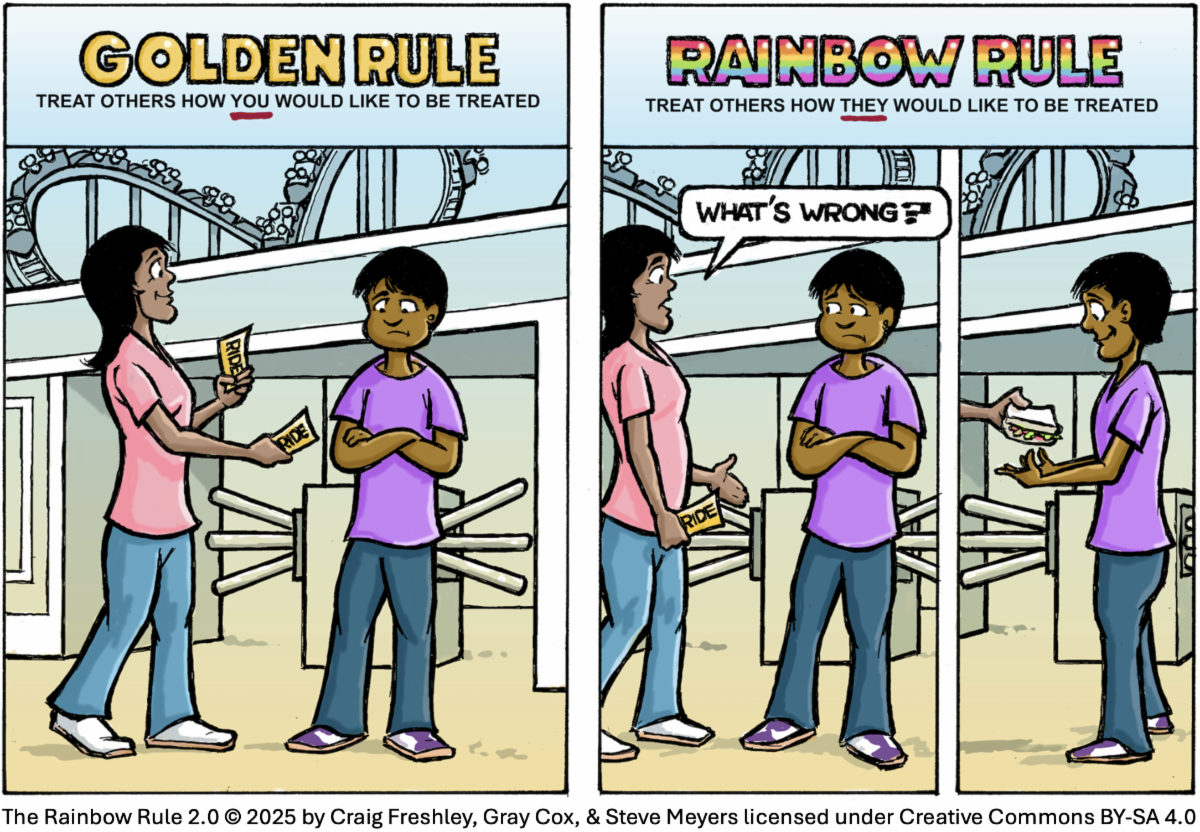
Two strangers – let’s call them Rose and Purple – are outside a rollercoaster ride. Rose sees a sad person and assumes, “If I was that person, I would want a ticket to the rollercoaster.” Without checking her assumption, Rose provides what she would want.
Yet Purple is in another world. They don’t care about the rollercoaster. They’re hungry. Maybe starving. And they get handed a ticket for a ride.
The Golden Rule is often considered the highest standard for moral behavior. It’s logical. It’s beautifully symmetrical. I should treat you how I would like to be treated. It makes sense. Yet it doesn’t work well in all situations.
While the Golden rule appears generous, it can be self-centered. It encourages me to think of me first. What would I want? Under the Golden Rule, I set the standard for your treatment. However I want to be treated, that’s how you should be treated; says the Golden Rule.
It can also be self-righteous. I don’t even have to ask you what you want. I know what’s best for you. And without any communication between us, I can feel as though I’m being helpful.
More than that, the Golden Rule can be used to justify pushing one’s beliefs on another. It’s very useful for empire building. It’s very convenient for oppression. “If I was a native savage in the woods,” believes the missionary, “I would want to be civilized and shown a better way of living.”
The Golden Rule is relatively easy. I do the little test in my own head (how I would want to be treated) and then I act. And it’s one-size-fits-all. I decide the standard and then apply it everywhere the same. It’s kind of black and white.
The Rainbow Rule is harder. Notice in the drawing how the Rainbow Rule requires two frames whereas the Golden Rule is in a single frame. With the Rainbow Rule I don’t assume that people want the same things I want. I have to ask first. Then act. It’s a two-step process: Ask, then act.
The Rainbow Rule starts with a question, not an answer.
Click here for more analysis & comments
|