| | |
The
Raven's
Nest
September
2025
| | |
Birding Events
Join us for birding on these Saturdays. Free and open to all.
September 13, 8 am
Jackson Park
September 20, 8 am
Weaverville Mainstreet Nature Park
September 27, 8 am
Lake Julian Park
October 4, 9 am
Beaver Lake
Please note that our Saturday Bird outings begin at 9 am starting in October!
More about our monthly bird outings
| |  | |
Programs/Events
Beaver Lake Workdays
Saturday, September 13
9 am - 12 pm
Tuesdays: Sept 16, 23, 30
October 7, 14, 21, 28
10 am - 12 pm
Beaver Lake Bird Sanctuary
Swift Night Out
Thursday, September 25
6:45 pm
Civic Center (Rankin) garage
Plants for Birds
Saturday, September 27
1 -2 pm
Beaver Lake Bird Sanctuary
| | | |
Friends,
Fall migration is in full swing. It’s hard not to notice. You can feel it in the air, in the trees. The birds’ habit patterns are changing, as suddenly our resident chickadees and titmice are more active—and suddenly are accompanied by a host of migrating warblers in the canopy. Nighthawks are flying overhead at dusk. Southbound flycatchers are coming through and defying easy identification. It’s hard not to notice.
Even the New York Times makes mention of it. One of my favorite columnists (and a gifted author), Margaret Renkl, recently devoted a column centering on the gathering of purple martins in downtown Nashville, TN, every September. They gather by the thousands, conglomerating and swirling overhead in the last light of day before descending en masse to a copse of trees to roost overnight. Renkl’s lyrical descriptions always captivate and inspire me as she has such a simple way of framing natural phenomena.
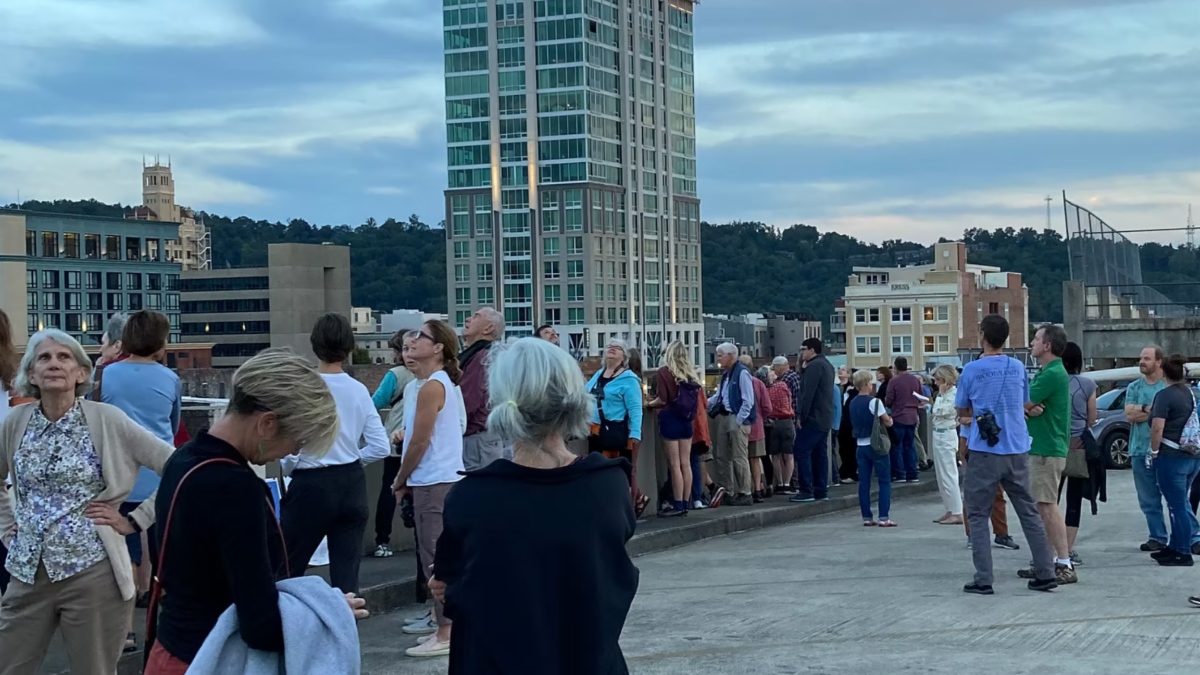
Here in Asheville we do not really see huge purple martin gatherings, but we do so with Chimney Swifts, and we will celebrate this at September 25’s Swift Night Out in downtown Asheville (details below). This annual event is truly a sight to behold—in recent years we have had 5000 or more swifts swirling in the sky before funneling into a single chimney at dusk, so I hope you can join us that evening.
Our migrating birds face a torrent of obstacles as they make their way south. Millions of birds die every year from collisions with buildings during their migration, but there are things we can do to help them out. Turn your lights off at night, especially during migration. If you have large windows, adding window treatments can help prevent collisions too. Blue Ridge Audubon is committed to addressing these and other hazards that birds face in migration. If you are interested in helping out, please read further here. We can always use the help!
The fact that these little feathered friends can make these long, intense journeys across continents is truly an impressive feat. I hope that you can take a little time this month to step out and enjoy the spectacle.
John Koon
| | |
Beaver Lake Workday
Saturday, September 13
| | |
We will have a workday at the Beaver Lake Bird Sanctuary on Saturday, September 13 from 9:00 am until noon. Of course, volunteers can leave whenever. The focus will be on pulling Japanese stiltgrass, an invasive plant, before it goes to seed. As an annual, it is very easy to pull. No experience or tools are necessary but best to wear long pants and a long-sleeved shirt. We'll have gloves available but bring them if you have them. Please join us if you can!
| | |
Swift Night Out
Thursday, September 25
| | |
Fall is the season for Chimney Swift migration! During migration, these birds gather in large flocks in the evenings to roost communally in chimneys, smokestacks or hollow trees--and it is quite a sight to see them swirl into their roost at dusk!
Blue Ridge Audubon's annual Swift Night Out (free) will be held on Thursday, September 26, on the roof of the Civic Center Garage. We'll gather at 6:45pm and watch as the swifts will gather overhead before swirling into a nearby chimney after sunset. We've had as many as 3-4000 swifts in recent years!
Hope you can join us!
Sep 25, 2025, 6:45 PM – 8:00 PM
Civic Center (Harrah's) garage, 68 Rankin Ave, Asheville, NC 28801, USA
Note that there are two garages on Rankin Ave, and the garage we will be at is the most northerly of the two - the Harrah's garage on this City of Asheville map: https://www.ashevillenc.gov/service/park-in-a-parking-garage/
| |
Plants for Birds - Wingstem
by Florrie Funk
Saturday, September 27
|
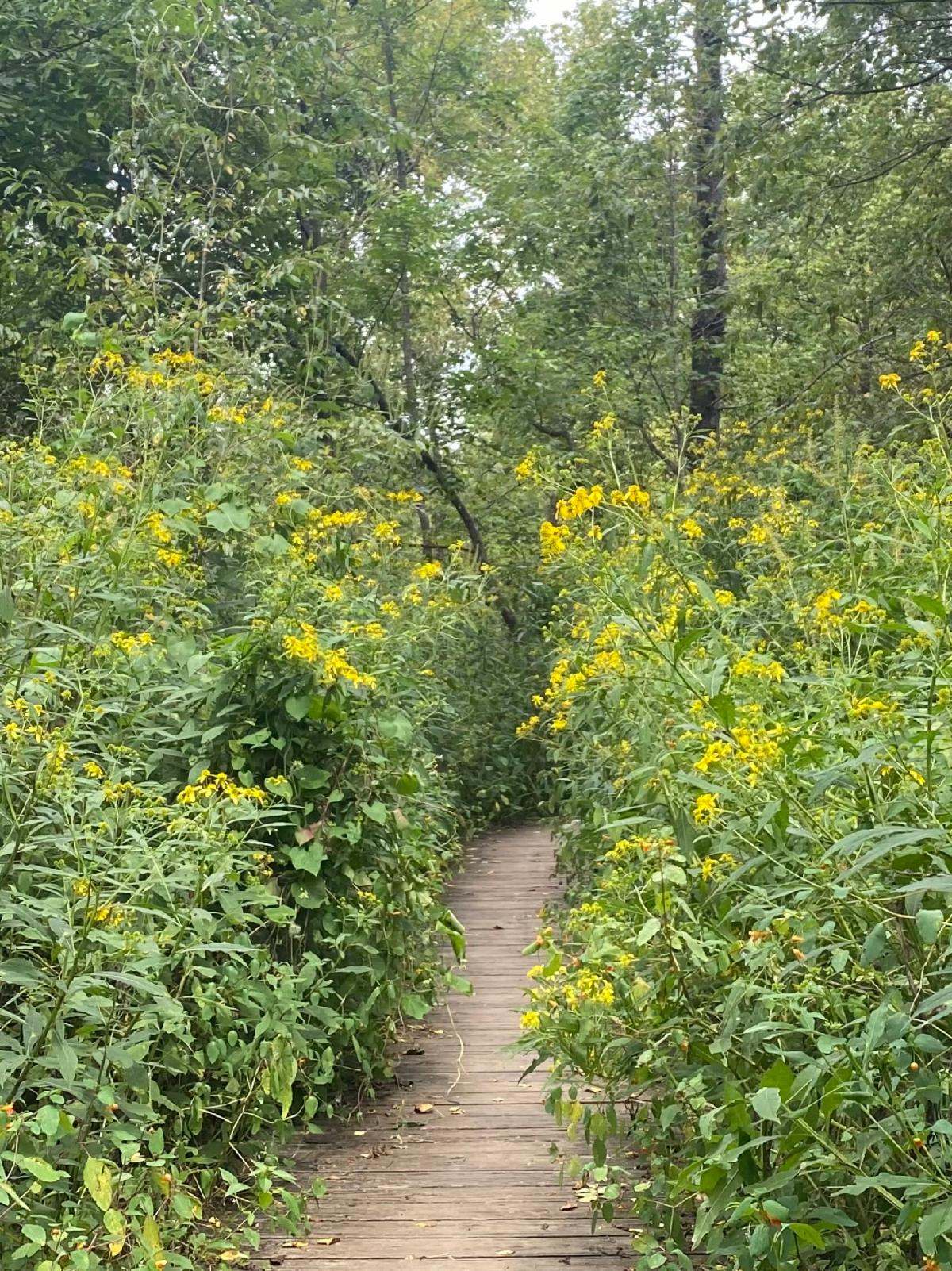
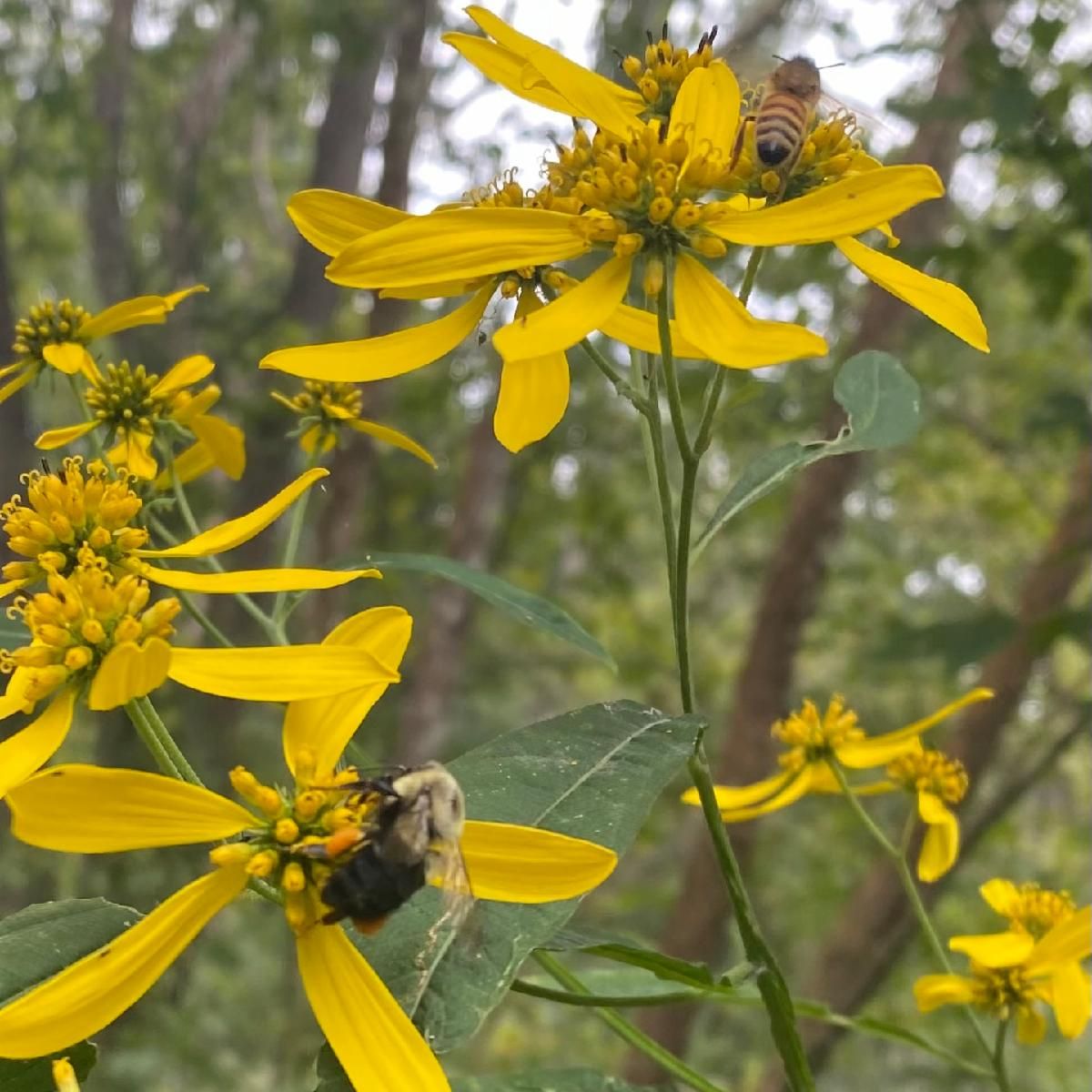
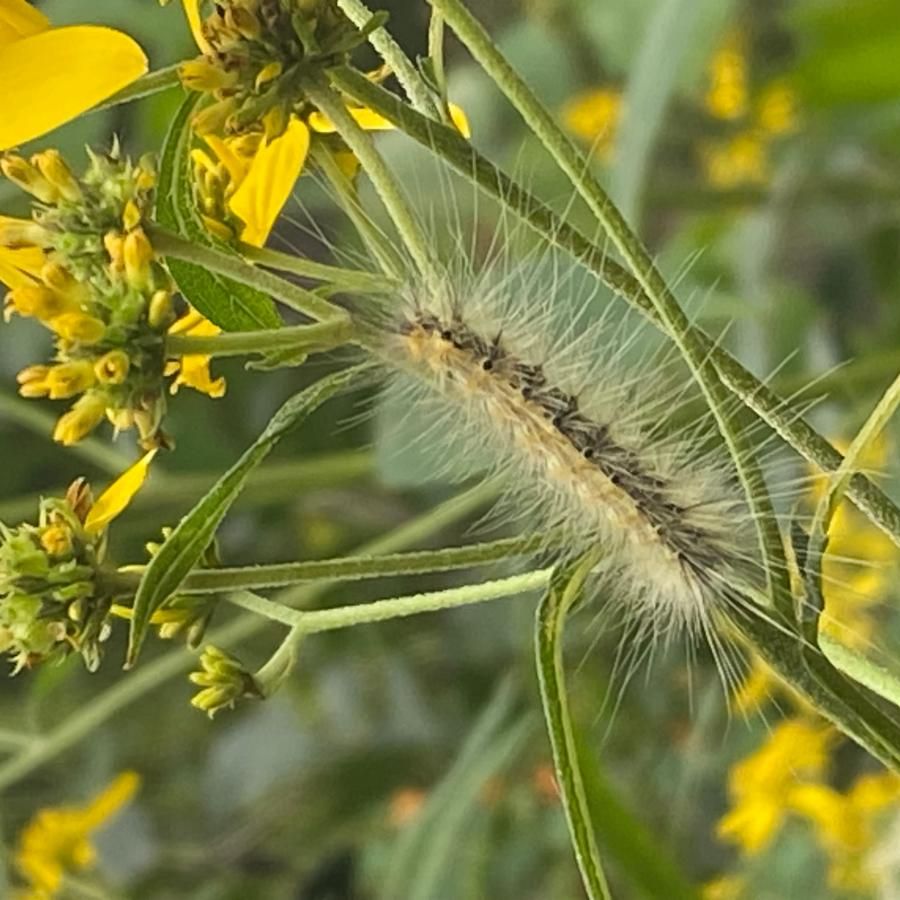
 | | As the summer comes to a close, we see along trails and roadsides a number of tall colorful plants in bloom: Joe Pye, Ironweed, Goldenrod and Wingstem. Along the boardwalk at the Beaver Lake Bird Sanctuary, there is now a lot of Wingstem (Verbesina alternifolia) with its clusters of spiky composite yellow flowers on stems up to eight feet tall. The leaves are long and narrow and the stems are noticeably “winged”. After last year’s flooding storm and this summer’s abundant rain, these plants seem denser and taller than in past years. For the birds, they bring a bounty. Not only are the seeds an important food source that last into the winter, but the flowers attract numerous pollinators including bees, butterflies and beetles that are a protein-rich food source for fall migrating birds. Wingstem is also a host plant for Silvery Checkerspot and Pearl Crescent Butterflies as well as for several moth species, and we know how important caterpillars are as “baby food” for almost all of nestling birds.
| | |
Join Florrie on our next Plants for Birds outing at Beaver Lake on Saturday, September 27 at 1 pm. We will focus on the native plants, trees, and shrubs that sustain the birds that visit our sanctuary. No special equipment is needed, just bring your curiosity!
Photos of Wingstem and insects it supports by Florrie Funk
| | Research & Conservation Grants | | |
New in 2025, Blue Ridge Audubon Chapter (BRAC) is providing grants to support research and conservation of birds in the Blue Ridge region and their habitats. Grant applications are accepted twice annually: 2nd Friday of April and 2nd Friday of October (October 10, 2025).
Applicants should be:
- interested in the conservation of birds
- a degree-seeking undergraduate or graduate student in Buncombe (or surrounding) County OR a group of students who are active members of a campus environmental club.
Preference will be given to students in the region served by Blue Ridge Audubon Chapter. Applications should be made through an educational institution.
|
| |
Birds & Bagels
by Tom Tribble
| | Well, we had bagels. The parkway was socked in and still socked when I drove off at around 10 am. About 50 people showed up and everyone enjoyed the bagels and coffee and conversation. Birds, not so much. The count was 4 species - a robin flyover and a junco were seen; a Carolina chickadee and hooded warbler were heard. Everybody was happy and enjoyed the camaraderie. I promised everyone that we will see more birds next year at Ridge Junction. |
| |
2025 Birdathon
by John Koon
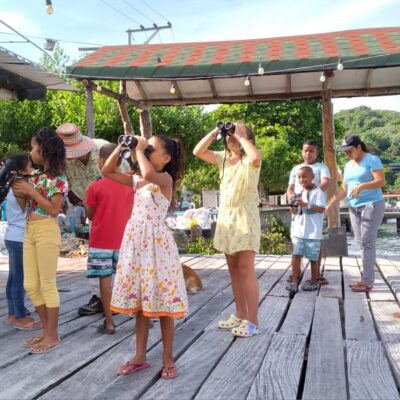
| Blue Ridge Audubon’s 2025 Birdathon was a spectacular success! We raised $12,867 for Bird Conservation and Environmental Education in a crucial wintering ground for many of our beloved summer migrants like the Cerulean Warbler and Acadian Flycatcher, in Santa Maria, Boyaca Province, Colombia. | |
Our conservation partner in this endeavor, SELVA Colombia, has given us an update on details of what your generous donations are going to provide:
Environmental education & guide training.
- Funding for monthly outings with a group of 9 children led by Diana Catherine.
- Four workshops with up to 50 students focused on themes including biodiversity, bird identification, protected areas and conservation.
- Guide training for 10 local individuals in a 6-month, 12-session program.
Ecological Restoration
- Establishment of a tree nursery in the "ecological park" at the secondary school in Santa Maria.
- Ecological restoration workshop carried out with students from school and the environment group.
- At least 500 trees planted on students' farms and areas close to or bordering key conservation areas, focusing on species that provide resources to migratory birds.
Development of ecotourism value chain & links to protected areas
- Educational campaign and development of ecotourism value chain (sales of bird-friendly coffee and chocolate)for families living close to birdwatching sites.
- Painting murals depicting emblematic species at strategic locations close to birdwatching trails.
- Development of manakin lek for observation and photography, ensuring benefits for local landowners.
Our fundraising totals were up 80% over last year’s effort, and the number of donors was up almost 100%. We thank everyone who contributed this year and are gratified that many people agreed with the worthy cause we have chosen to support. Blue Ridge Audubon’s is hopeful that this year’s Birdathon marks the beginning of a great relationship with Selva to support our common goal of Hemispheric Conservation. We are researching other ways to interact with this community and organization including coffee and cocoa sales and a birdwatching field trip to Colombia! Stay tuned for more details in coming months.
| Photo: SELVA promotes communication of science, collective learning and the empowerment of future researchers through education curriculums, didactic games, training courses and scientific research and writing grants. https://www.selva.org.co |
| |
Meet our new Volunteer Coordinator
by Erika Wagner
| | |
My name is Erika Wagner. Many of you may be hearing from me soon, if you haven’t already.
After moving to Asheville for a job in 2017, I found myself looking for ways to connect to the community and get outdoors to enjoy the area. One of the ways I found was through my burgeoning interest in birding. Having been a backyard birder for many years, it seemed natural to explore that interest a bit more. That fall, I went on my first official birding adventure at Beaver Lake Bird Sanctuary through one of the monthly Saturday morning Blue Ridge Audubon Chapter (BRAC) outings, and found myself hooked on birding as an official hobby.
Having done a fair bit of solo birding in the following years, staying “on the outskirts” of BRAC (“too busy,” I said), I’m excited to now get more involved in the birding community here. As an At-Large Board Member, I’m hoping to share the joys of birding and encourage others to get involved as well. As such, I’ve taken up the mantle of Volunteer Coordinator, which Art has worn until now (thanks for all your work, Art!) so if you see an email from me in your inbox, you’ll know why. Needless to say, I’m thrilled to be here, and am excited to partner with you all in what BRAC is doing here in Asheville.
That said, we’re always looking for folks who are interested in working with us. If you’ve been “on the outskirts” for a while too, maybe now’s the time for you to jump in, as well. Many of our opportunities can be found on the BRAC website, but if you’re interested in contacting me directly regarding volunteer opportunities (whether by just getting on the volunteer mailing list, or asking about a particular opportunity, feel free to message me at: erikawagnerbrac@gmail.com .
I look forward to working (and birding!) alongside you all.
Erika Wagner
| | |
Artificial lights at night can disorient birds, leading to fatal building collisions.
by Audubon NC
| | |
DURHAM, NC— Migrating birds face a myriad of threats during their long journeys south, from habitat loss to declining food resources, but there is a lot we can do to help them get to their wintering grounds safely. It starts as early as tonight in your own home or place of work and is as simple as turning off unnecessary lights from 11pm to 6am.
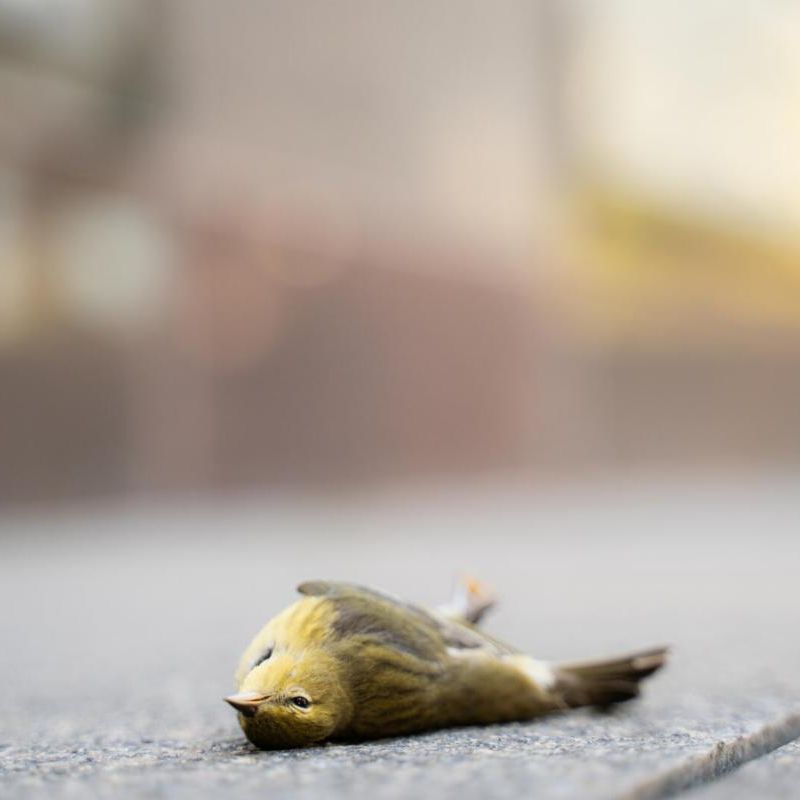
Most birds migrate at night, using the moon and stars to navigate their way and often fly over urban centers. Unfortunately, bright lights can distract birds, causing them to become disoriented and collide with buildings or collapse from exhaustion. A study released last year estimates that more than 1 billion birds die per year in the United States as a result of building collisions.
“Many people think that skyscrapers in densely populated areas are the primary issue for night-migrating birds,” said Executive Director Curtis Smalling. “But a greater number of bird-building collisions take place at much smaller structures.”
This is largely due to the fact that there is a larger number of homes and small buildings in the United States than there are skyscrapers, making them more likely for birds to encounter on their southward journeys.
The good news is that there are easy actions people can take to decrease bird mortality during migration. Start by turning off your own lights at night, then lobby your local government to do the same. In fact, North Carolina has been a leader in the Lights Out movement for more than a decade. Nine municipalities and counties across the state have started Lights Out programs, including Winston-Salem, Asheville, Greensboro, Matthews, Raleigh, Chapel Hill, Cary, Durham, and Cumberland County.
As fall migration brings greater bird traffic to our area, join the growing Lights Out movement. Here is what you can do to help no matter where you live or work:
- Turn off exterior decorative lighting
- Extinguish pot and flood-lights
- Substitute strobe lighting wherever possible
- Reduce atrium lighting wherever possible
- Reduce interior lighting especially on higher stories
- Close blinds and curtains
- Down-shield exterior lighting to eliminate horizontal glare and all light directed upward
- Install automatic motion sensors and controls wherever possible
- When converting to new lighting assess quality and quantity of light needed, avoiding over-lighting with newer, brighter technology
Photo: A dead Blackpoll Warbler, victim of a glass collision. Photo: Sydney Walsh/Audubon
| |
Beaver Bits
by Jay Wherley
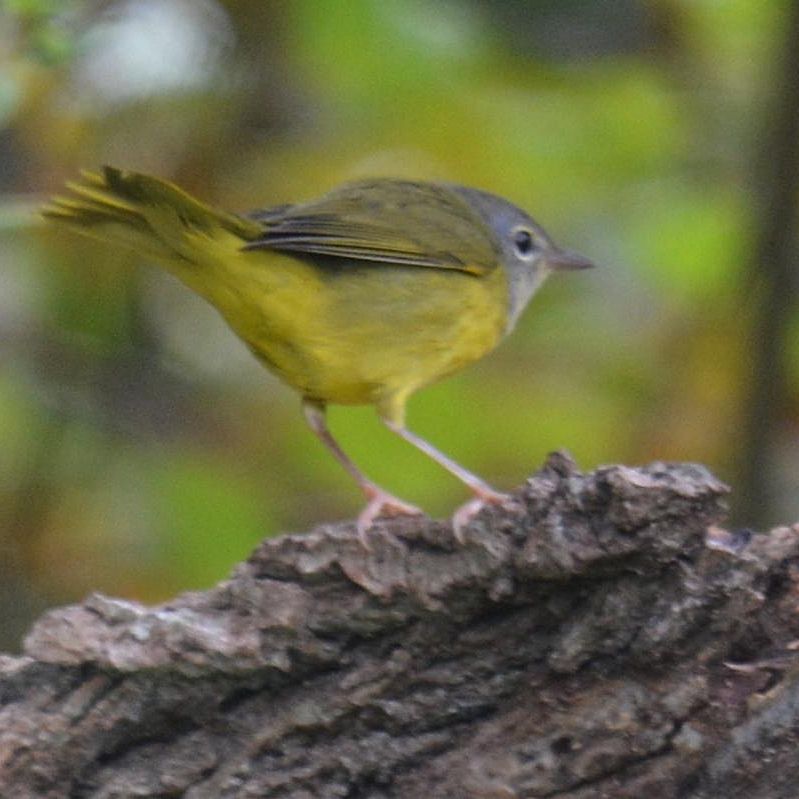
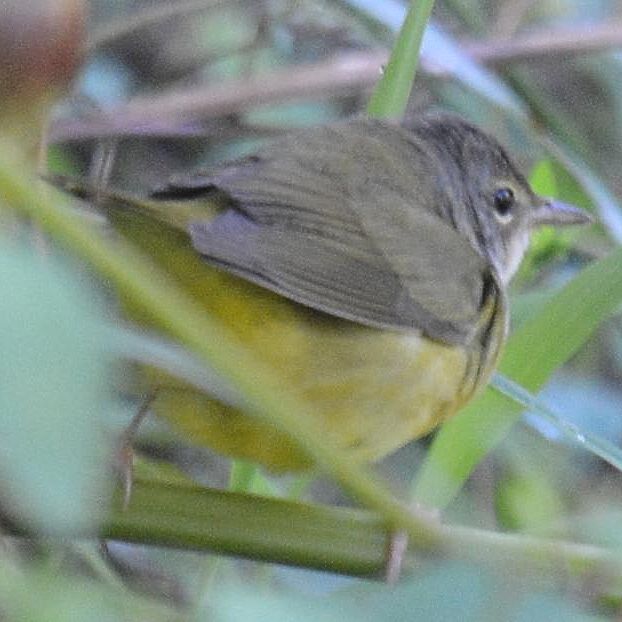
| | One of the more difficult bird species to observe in the Eastern United States is the Mourning Warbler (Geothlypis Philadelphia). It might be surprising to learn that their population has remained fairly steady; they are considered a species of ‘Least Concern” with regard to conservation efforts. (They prefer early succession habitats that occur as part of human projects). The chances we get for observation in Western North Carolina (WNC) are during Spring and Fall migration as this species breeds north of us, and winters in the tropics. | | Sept 2023 first year male. Note bright yellow belly and short undertail, broken eye ring, pink legs and feet. This bird also showed the start of a black bib indicating a male. | | Sept. 2017 first year bird. Note the broken eye ring, yellow bellow, yellow undertail, pink legs and feet. | | |
While most observations in North Carolina are single reports at a location, Beaver Lake boasts eight observed individual birds – including one as I write this. (The other NC location with at least that quantity of sightings is Jackson Park).
Date of BLBS Mourning Warblers Duration
Sept. 2025 3 days+, 1st year bird
Sept. 2023 6 days, 1st year male
Sept. 2022 1 day, 1st year bird
Sept. 2021 2 days, adult male
Sept. 2020 1 day, 1st year bird
Sept. 2019 2 days, 1st year bird
May 2018 1 day, adult male, singing
Sept. 2017 1 day, 1st year bird
Seven of these birds I initially found solo or with one other person (Tom B., Blake C.). Knowing their habitat and calls are key to this detection. The fall birds are always low and in cover, usually amidst tight stalks of plants. The call is a “pwich” with a bit of sibilance to it. It is a different sound than the “tschat” rougher call of Common Yellowthroat – which can appear in the same habitat with a similar appearance to the 1st year birds we tend to get. Look for the clear lateral delineation of yellow border on the Common Yellowthroat vs a diffuse white/yellow on the Mourning Warbler. The Mourning also has bright yellow belly vs. pale colors on the Common Yellowthroat.
The birds can remain silent and in cover for hours at a time – patience is required. They rarely appear in the clear for photography as my attempts included here show. Put in the work and they can be one of the most rewarding warbler observations you will have.
| | UNCA Environmental Science BRAC Scholarship. | Blue Ridge Audubon Chapter annually awards a $1500 scholarship to a University of North Carolina Asheville student who is majoring in a science field that helps protect birds and the places they need. This year’s recipient is Robert Watkins. | |
Hello there! My name is Robert Watkins, and I’m a Junior at UNC Asheville, majoring in Ecology. Birds are some of my favorite creatures, and one of my favorite subjects to learn about. No matter where I am or what I am doing, birds steal my attention more than anything else, and I often find myself telling others fun facts about birds (Did you know that in mating season, the legs of Lava Herons turn a lava-orange color?), or about difficulties or progress in bird conservation. My main passion lies in photography, and birds are by far the ones I enjoy photographing the most.
| | About the Blue Ridge Audubon Chapter | | |
Blue Ridge Audubon is a chapter of the National Audubon Society, serving Buncombe, Henderson, and surrounding counties in western North Carolina.
We are a 501(c)(3) nonprofit organization. Donations are
tax-deductible to the extent
allowed by law.
Raven's Nest Editor:
Jennie Burke
jennifer_bradbury85@yahoo.com
| | |
Blue Ridge Audubon Chapter
PO Box 18711
Asheville, NC 28814
Blue Ridge Audubon's mission is to protect birds and the places they depend on. We believe that a world in which birds thrive is a world that benefits all living things.
Our vision is a vibrant and just community where the protection of birds and our natural world is valued by everyone.
| | | | |