October 2025- Food Scarcity & Eating Disorders | | Welcome to The Reasons Thread. This monthly resource explores one key topic in eating disorders, weaving together evidence, clinical wisdom, and personal perspective. Expect diverse viewpoints—because progress comes from curiosity, not consensus. | | Food Insecurity and Eating Disorders: Understanding the Impact | | |
Food insecurity is one of the most overlooked social factors impacting eating disorder recovery. When access to food becomes uncertain, the body and mind adapt in ways that can intensify restriction, bingeing, or shame. Research shows that individuals facing food insecurity are up to three times more likely to experience disordered eating behaviors—yet these patterns often go unnoticed or untreated.
Our latest blog explores:
- The research linking food scarcity and eating disorders
- How chronic stress, limited access, and stigma shape eating patterns
- Why responsive, compassion-focused, evidence-based care is essential for healing
Click here to read the full blog ›
This moment calls for more than awareness—it calls for action. Addressing food insecurity within eating disorder care is not optional; it’s essential to lasting recovery.
| | |
“At Reasons, we’re seeing how food insecurity can quietly shape a person’s relationship with nourishment long before treatment begins and in some cases, long after food insecurity has been resolved. This reality challenges us to widen our lens—to recognize that recovery isn’t only about food choices, but about access, safety, and trust. Our role is to provide care that is compassionate, adaptive, and grounded in both clinical understanding and social awareness.”
-Claire St John, MPH, RD, CEDS-C Director of Research & Operations
| | |
It can exist in communities of abundance, within treatment settings, and even in recovery itself. It can coexist with privilege, with resilience, and with ongoing healing.
As the conversation around food insecurity grows, we’re curious how it’s showing up in your work. What does it bring up for you as a clinician, and how might it reshape the way we talk about nourishment and recovery?
We’d love to hear your perspective.
Click below to share how food insecurity surfaces in your clinical work or the systems that surround your clients.
| | | |
Food insecurity predicts restrictive and compensatory eating behaviors
Kosmas et al. (2025), International Journal of Eating Disorders
A recent study examined how food insecurity influences a range of eating disorder symptoms beyond binge eating. While most existing research has focused on binge-related patterns, this study expands the conversation—finding that, over a three-month period, individuals facing food scarcity were significantly more likely to develop or intensify dietary restriction, excessive exercise, and purging behaviors. The findings highlight how instability in food access can drive both physical and psychological distress, underscoring the need to view food insecurity as a risk factor across the entire spectrum of eating disorders.
Takeaway for Providers: Food insecurity can manifest in diverse and often restrictive ways. Recognizing this complexity helps us better understand and respond to the full spectrum of eating disorder behaviors connected to scarcity. Read the full article ›
| |
Centering Equity in the Conversation
We can’t talk about food insecurity and eating disorders without talking about the BIPOC community. Structural racism, anti-Blackness, and fatphobia shape who experiences food scarcity, how it’s perceived, and whose struggles are believed.
To deepen this understanding, we’re highlighting the work of Patrilie Hernandez (they/she)—nutrition equity advocate and founder of Embody Lib—whose writing challenges traditional narratives of hunger and healing. In “Food Insecurity, Anti-Blackness, & Fatphobia: What Food Access Advocates Need to Understand,” Patrilie invites readers to confront how power, bias, and access intersect with nourishment and recovery.
Read the full piece ›
| |
Eating Disorders & Food Insecurity – A Panel Discussion
Food insecurity doesn’t just shape what’s on a person’s plate—it influences how they relate to food, body, and self. In this powerful discussion, experts and lived-experience voices explore the intersection of hunger, trauma, and eating disorders. Together, they unpack how limited access, chronic stress, and systemic inequities contribute to disordered eating patterns—and what providers can do to respond with compassion and context.
Why watch:
- Understand how food insecurity drives both restrictive and binge-related behaviors
- Hear firsthand stories that bring the data to life
- Gain insight into building treatment approaches that honor access, equity, and safety
This conversation is an essential listen for clinicians, advocates, and anyone committed to healing beyond privilege and assumption.
Watch the discussion here ›
| |
Watch This Space: Voices Shifting the Conversation on Food Scarcity & Eating Disorders
Carolyn Black Becker, PhD — Trinity University
A pioneer connecting food insecurity with eating-disorder pathology among marginalized populations. Her multi-site collaborations continue to examine how structural scarcity influences eating-disorder risk and treatment outcomes.
> DigitalCommons Trinity – Recent publications
Vivienne M. Hazzard, PhD — Michigan State University
Lead author of the landmark review “Food Insecurity and Eating Disorders: A Review of Emerging Evidence.” Her current research expands into longitudinal data exploring how economic stressors and food access shape binge-eating trajectories. > Hazzard et al., 2020 Review (PubMed)
Lisa Smith Kilpela, PhD — UT Health San Antonio
Co-principal investigator for the NIH-funded PROSPERA Study, which examines binge-eating disorder and food insecurity among older Hispanic women. Findings expected in 2026. > UT Health San Antonio announcement on PROSPERA
Keesha M. Middlemass, PhD — Howard University
Currently leading new research on food insecurity in returning-prison populations, broadening how the field understands eating-disordered behavior within systems of incarceration and re-entry. > Howard University faculty profile
Christine C. Call, PhD — University of Pittsburgh
Researcher examining the link between food insecurity and disordered eating during pregnancy. Her recent study of WIC participants found that nearly one in four experienced disordered eating behaviors, with the highest rates among those facing food insecurity—highlighting the need for integrated nutrition and mental-health support during pregnancy. > Call et al., 2023 — Disordered Eating During Pregnancy (WIC Study) (PubMed)
Patrilie Hernández, MS (they/she) — Embody Lib
Anti-hunger advocate and body-liberation educator centering lived experience in conversations about access and disordered eating. Their current projects focus on connecting the hunger-relief and eating-disorder fields through equity-driven education and storytelling.> Embody Lib
| | |
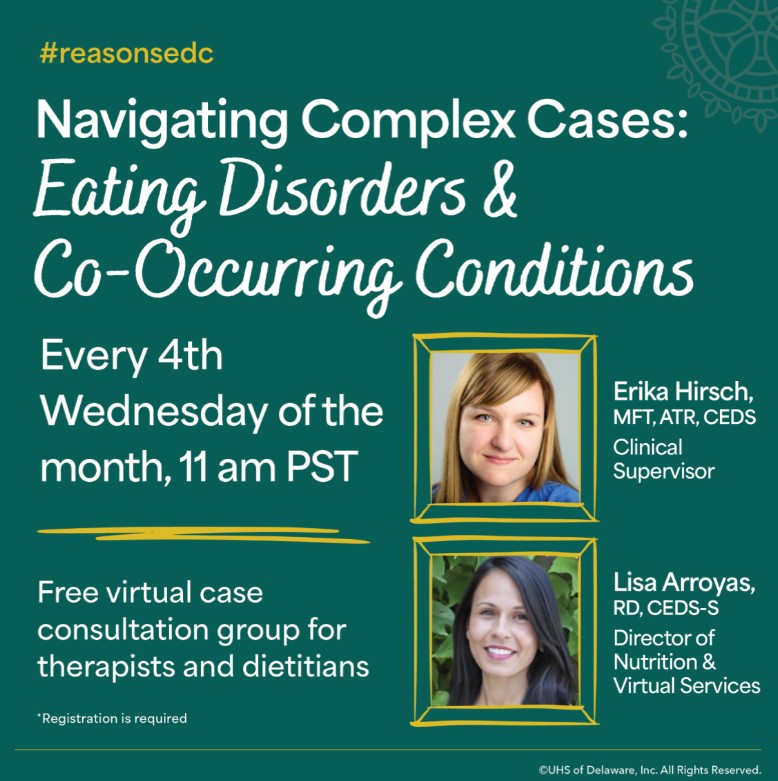
Navigating Complex Cases: Eating Disorders & Co-Occurring Conditions
Join Reasons Eating Disorder Center’s Erika Hirsch, MFT, ATR, CEDS, and Lisa Arroyas, RD, CEDS-S for a free monthly virtual case consultation group for therapists and dietitians. This collaborative space invites discussion of challenging cases and real-world themes that may arise in practice—such as food insecurity—and how they intersect with recovery.
Held every 4th Wednesday at
11 a.m. PST. Free, registration required.
Register here ›
| | |
WithAll Recovery Support Program
WithAll, a national nonprofit, offers financial assistance to individuals in eating disorder treatment through its Recovery Support Program. Grants can be used for essential needs like groceries or rent while in PHP, IOP, or residential care. Applications open the first of each month, helping make recovery more accessible for those facing financial barriers.
Learn more ›
| |
Progress comes from collaboration. If you have research, practice wisdom, or lived experience that could enrich this dialogue, or if you would like to suggest a topic that you would like to see featured, let us know by emailing Shannon.Braasch@uhsinc.com—we may feature it in a future edition! | |
|
Know Someone Needing Support?
Want to learn more about Reasons EDC or connect someone with treatment? Our admissions team is here to help—reach out by phone at
844-573-2766 or through our secure web form here to
explore care options.
| | | | |