The Rebirth of American Islamic College in Chicago

Bill Chambers is a recent MA in Islamic Studies graduate of AIC

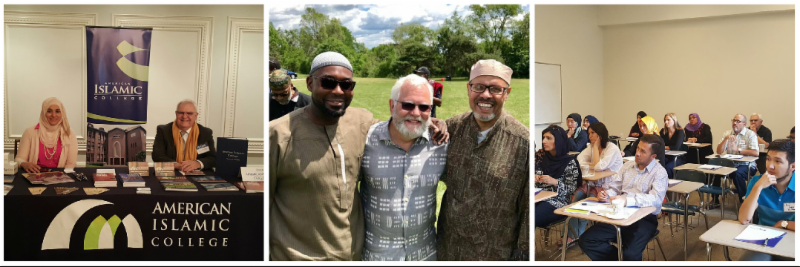
The American Islamic College (AIC) was originally founded in 1981 in a landmark building near Lake Michigan in Chicago. Its mission from the beginning, carried on by the founders and subsequent presidents, faculty, and staff was to engage students in a sound, academically rigorous curriculum that valued service to the community as highly as scholarship. One of the earliest themes for the College was “service through Islamic learning” as its theme.

AIC began its first academic semester in September 1983 as the first Islamic institution of higher education in the United States, but this proved to be an idea ahead of its time, as efforts to offer degree programs were suspended in the 1990s.

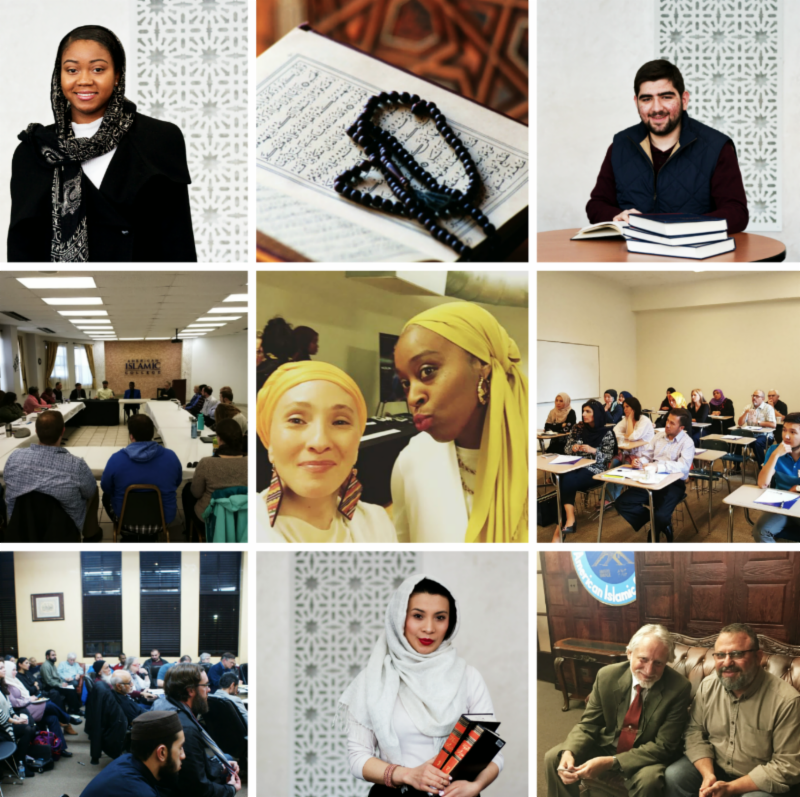
In 2010, AIC reopened with a new administration, a new Board, and new operating authority from the State of Illinois, and this year graduated its first Masters of Islamic Studies students with some undergraduates planning to complete their degree in the Spring. The College has Degree Granting Authority for all three of its degree programs — the BA and MA in Islamic Studies and the Master of Divinity in Islamic Studies (MDIS). AIC does not have regional accreditation, and so students may not currently gain some benefits of accreditation, such as transferring credits and FAFSA. Multiple undergraduates and graduate students now use the renovated classrooms, dormitory, conference rooms, library, and masjid.

Muhammad Al-Ahari, a graduate student at AIC, also attended the school in the 1980s as an undergraduate, describes the major changes transforming the College.

“The college in the 80s was not run as professionally as it is now. The facilities then were not as well kept as they are now and the library was rarely used. Today the school looks inviting, and has a growing library. The professors and staff come to work each day at a promising educational institution leading the way in developing an American Islamic scholarly class.”
One of the most important changes beyond the facilities is the revision of the mission so it focuses on providing students of every background with a solid liberal arts and sciences education including a rigorous academic foundation in Islamic Studies.

Ozlen Keskin, the Dean of Students, describes the atmosphere at AIC.

“I started working at AIC in 2011, when everything was very new. Working at a new college comes with difficulties, but also gives you the chance to be the part of this new structure that needs to be rebuilt…The idea of having a liberal arts college with an Islamic orientation in the Heart of Chicago which serves not only Muslims or any ethnicity but to all religious and ethnic backgrounds really got me excited.”

She continues by describing the changes, “AIC has continuously improved since its reopening. In the beginning, we couldn't offer any degrees or classes for credit. Now we offer three-degree programs and students enrolled in each of them. I used to vision AIC with students walking in the hallways and reaching out to us with all kinds of questions. Alhamdulillah we got it all for real now in a very intimate, family like environment where everybody knows, everybody.”

The College takes its mission seriously in providing students with a broad understanding of the historical and global forces shaping the political and social structures of diverse Muslim societies. But the College also stresses teaching the history of the Muslim American community and how to use that knowledge in your own community.

Rabbani Mubashshir, AIC undergraduate and Imam at the Masjid Al-Taqwa in Chicago, describes what brought him to study at AIC.

“I’ve had an interest in the academic study of Islam for many years. My first Arabic class was under the leadership of Hon. Elijah Muhammad. Imam W. Deen Mohammed (RA) strongly emphasized importance for Imams to increase their formal knowledge of Al-Islam. For me, AIC is an opportunity to receive in-depth study of important Islamic sciences.”

Being a teacher at his masjid, Rabbani reflects on the College’s impact on his work.

“As a Muslim American, I believe correct knowledge of the religion is crucial to representing the proper perspective of Islam. Every Imam is obligated to learn the religion from the most authentic sources and hopefully influence others to appreciate Islam’s universal relevance. AIC has afforded me to the opportunity to engage foundational knowledge sources and share them with students at the masjid.”
Tauseef Chaudhry, AIC graduate student and staff member at CAIR-Chicago and the Burma Task Force (BTF), also has seen the impact of his education on his activism.

“As a researcher and writer at CAIR-Chicago and BTF, the work has helped me to understand the theological histories of the communities I serve, their similarities and differences. Most importantly it has informed my understanding of social justice and our role as actors who have a socio-spiritual ethic that seeks to transform the ills in society and contribute to its betterment.”

The College is also committed to the entire Chicago community by offering lectures, programs, and interfaith events.

As Rabbani describes it,“Over the past four years that I have been a student at AIC I’ve seen the school grow to become a cultural as well as an educational center. We have frequent scholarly lectures that are regularly attended many Muslims and non-Muslims in Chicago.”

The College has a commitment to offer financial assistance to its students that meet the requirements. Work-study positions are available as well as internships to help prepare students for their chosen career.

The internship programs, lecture series with the community, and participating in interfaith events are all methods used to encourage leadership and policy roles for students after graduation.

A key element in AIC’s mission is to be a “Institution of higher learning grounded in Islamic values, embracing students of all backgrounds.” The Muslim American community as a mirror of American society is made up of people from all ethnic backgrounds and belief systems. The emphasis of the College on demonstrating understanding and respect for all people from all backgrounds and faiths helps prepare students to continue to be those leaders who continue to show this respect for diversity in their future jobs.

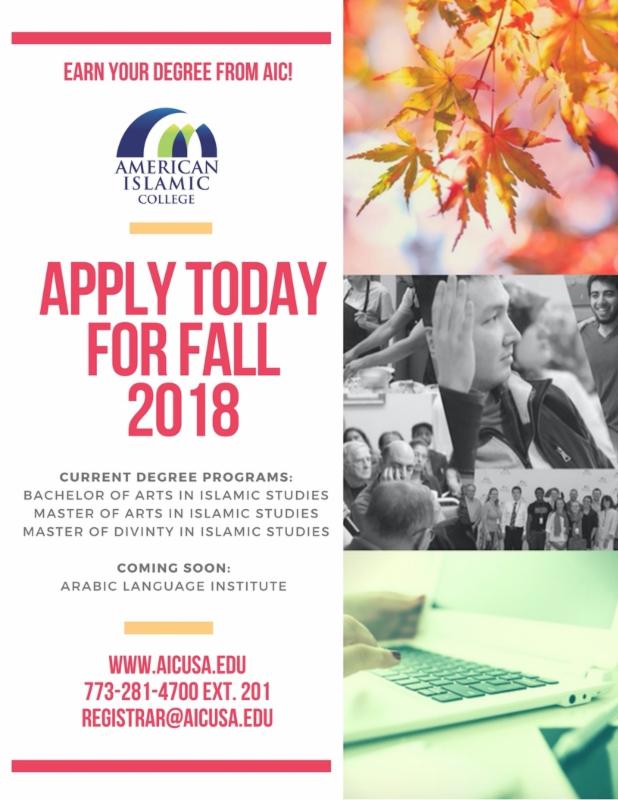
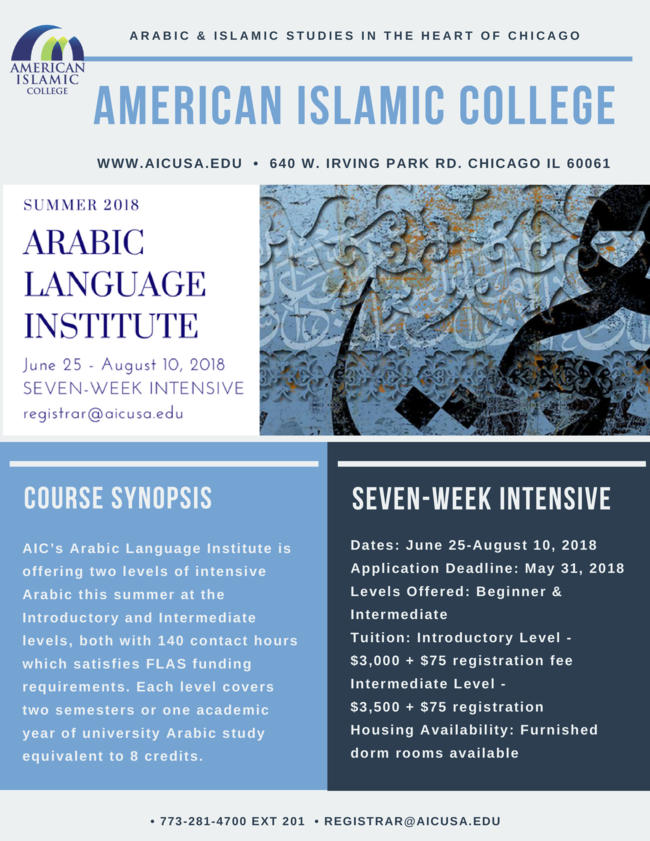
AIC is still accepting applications for undergraduate and graduate students for the Fall Semester that begins August 28, 2018 . Review the AIC website for further information. www.aicusa.edu

Bill Chambers is a recent MA in Islamic Studies graduate of AIC and a member of Masjid Al-Taqwa in Chicago.
American Islamic College is an institution of higher learning grounded in Islamic values, embracing students of all backgrounds. AIC promotes appreciation for the scope and richness of Islamic history and civilization both in the classroom and by means of public events highlighting Islam’s intellectual, artistic and cultural expressions. Through rigorous scholarship, civic engagement and interfaith/ intercultural activities, AIC prepares our students to become global citizens and visionary leaders.

Investing in education is investing in our collective future!
American Islamic College is a 501(c)(3) nonprofit higher education institute. 
Contributions are tax deductible to the fullest extent permitted by law.