The Reliant Review
1st Quarter 2021
|
|
|
Welcome to the Reliant Review, our quarterly newsletter. We hope this will provide additional insight into our investment philosophy and thought process when it comes to managing money and advising you on your financial position. Our goal is to provide concise, yet comprehensive commentary on the state of the financial markets, some of the moves we have made within the portfolios, and a few wealth management considerations for the near future. |
|
Looking back at the first quarter of 2021, we saw it defined by three Rs: Robinhood, Rates, and Reopening. |
|
Robinhood is an investing platform with zero trading commissions and no account minimums. While the company has been operating since 2013, it was early this year when the trading activity of their users made daily headlines. Activity on Robinhood’s app more than doubled in late January thanks to the hysteria surrounding stocks such as GameStop, AMC, and BlackBerry. Trading volume, the amount a security changes hands over the course of a day, was so elevated back in January that many brokerage firms had trouble keeping their online platforms operating efficiently. The activity has slowed in recent weeks, as indicated by the chart on the right. Individual purchases of stocks are down 60% from the highs back in January and traffic to Robinhood’s website is down 63%. While the investment landscape has certainly been altered by this new form of retail trading, studies show that these zero-commission investors in aggregate behave as noise traders, investors who make decisions to buy or sell based on factors they believe to be helpful but in reality give them no better results than random choices. The broader market has remained focused on core fundamental factors such as company earnings, economic stimulus, monetary support, and vaccine distribution. Likewise, we remain focused on these things as well and seek timely investment opportunities where we believe particular industries, sectors of the market, and individual companies will outperform in the long run. |
|
Longer-term interest rates have risen significantly throughout the first quarter, pointing to brighter days ahead for an economy that less than 12 months ago was more restricted than at any time since the Great Depression. The Federal Reserve lowered rates in the first half of 2020 to stabilize markets during the massive rise in unemployment through the height of the pandemic’s shutdown. Lower rates can encourage borrowing and investing, two major stimulants of economic growth, and the Federal Reserve used this as their primary tool to contain the effects of the shutdown on the economy’s long-term growth rate. The risks of leaving rates too low for too long are excessive growth and inflation, two topics we provide additional commentary on below. |
|
As of this writing, about 15% of the US is fully vaccinated against COVID-19, while almost 30% of the country has received at least one dose. At the current pace, the US is on track to have a large majority of its population vaccinated by the start of fall. Projections can change of course, but we feel that the economy fully reopening on the back of continued vaccine rollout provides an opportunity for a broader number of companies and economic sectors to participate in the recovery. This has been the basis for many of our additions to the portfolio during the quarter. When you add to that the additional stimulus from Congress and continued support from the Federal Reserve for business, it is simply hard to think that the economy will not improve from here. We do believe, however, that while the additional stimulus is a net positive, the impact on interest rates, inflation, and tax policy adds uncertainty. |
|
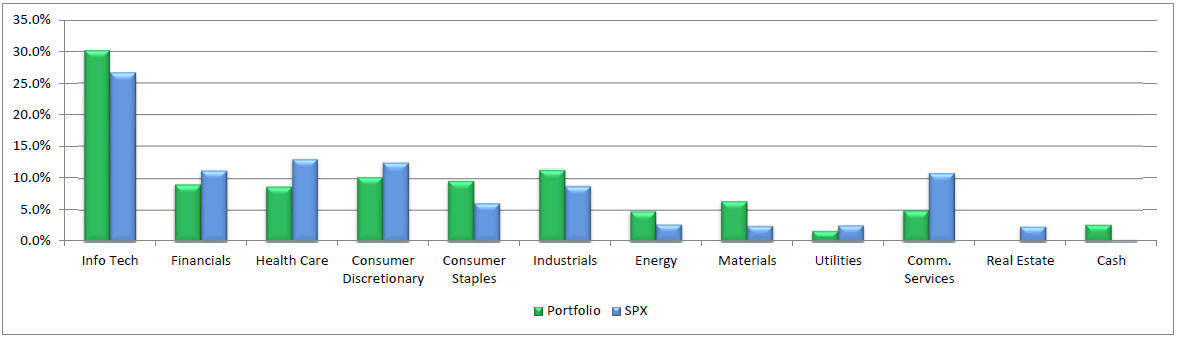
Reliant Strategic Sector Weightings vs S&P 500 Sector Weightings |
|
We sold two of our top 2020 performers during the quarter, Domino’s and Dollar General. Both companies saw record levels of sales throughout the pandemic as more customers sought food delivery and one-stop shopping options. While both companies still have strong business models and robust long-term earnings growth potential, we believe that the financial results booked in 2020 will provide a tough comparison in 2021 and that the stocks’ performance will “cool off.” As such, we decided the prudent move was to protect the gain in your portfolio and reallocate this capital into more “reopening related” ideas.
We added BP and Schlumberger, two energy companies, to the portfolio mid-quarter. We expect both business and leisure travel to increase as the year progresses alongside growth in manufacturing and production levels, all of which should positively impact the demand for oil. Sysco, the world’s largest broadline food distributor, was another addition during the quarter based on the theme of reopening. Aside from restaurant restrictions being lifted, Sysco should also benefit from a rise in hotel occupancy, cruise ship sailings, and in-person gatherings such as concerts and sporting events. Comcast and Corteva rounded out our effort to broaden our sector diversification.
|
|
About Those Interest Rates... |
|
You may be wondering whether rates will keep rising and how it could affect both bond and equity values. While the aforementioned catalysts of the move to higher yields is not to be discounted, the Federal Reserve has been quick to remind investors that for true long-term inflation to take root (which could cause interest rates to continue to move higher), much of the slack in the economy via unemployment must first be soaked up. If history is any guide, we know that will take some time. A plausible scenario would be that interest rates continue to move modestly higher on inflation concerns over the coming quarters. However, after the effects of the initial economic reopening and stimulus wear off, we could see inflation and rates stabilize until the economy begins running at full capacity again. A stabilization in rates would help prevent losses in bonds and equities with higher valuations.
|
|
The Federal Tax Filing Deadline has been extended to May 17, 2021. Additionally, the filing deadlines have been extended until June 15, 2021 for residents of Oklahoma, Louisiana, and Texas as a result of the winter storms in February. Many states have extended their filing deadlines to match the May 17 federal deadline, but this varies, so we recommend contacting your CPA to confirm. Estimated tax payments for the first quarter of 2021 are still due by April 15.
The IRA contribution deadline has also been extended until May 17, 2021. If you have earned income, you still have time to add $6,000 to your IRA if you did not do so in 2020, and IRA owners over age 50 can add an additional $1,000 as a catch-up contribution.
Stimulus payments are non-taxable to you. If you were entitled to receive any stimulus payments in 2020 but did not, then those payments will be accounted for as refundable credits on your 2020 tax return.
Required Minimum Distributions (RMDs) must be taken by the end of 2021. The government holiday for no required minimum distributions from retirement accounts only applies to the 2020 tax year. Let us know if you would like to set up a regular draw on your account or establish a plan for your distribution.
Qualified Charitable Distributions (QCDs) are available to retirement account holders over age 70 ½. A QCD is a direct transfer of funds from your retirement account to a qualified charity. QCDs can be counted toward satisfying your required minimum distribution for the year, so it can be a particularly effective tool to mitigate tax bills for those who do not need their RMD to live on during the year.
|
|
|
|
As always, please do not hesitate to contact us with any questions, ideas, or concerns. We are happy to meet with you in person or via video conference. |
|
|
1715 Aaron Brenner Drive Suite 504 | Memphis, TN 38120 | 901-843-0600
|
|
|
|
|
|
|
|